
You've got a launch coming up, the checkout flow is almost ready, and the payment processor comparison tabs are still open. Stripe looks easiest to build around, Square seems practical if you sell in person, and PayPal is the familiar button customers already know. The fee table makes the choice look simple. It isn't.
A processor shapes more than the amount deducted from each payment. It affects how you handle subscriptions, disputes, payout records, customer identity, and proof that your project has real traction. For most online-first founders, Stripe is the right primary processor. Square is the stronger choice for businesses that depend on physical sales, while PayPal often makes sense as an additional wallet option rather than the core system.
| Processor | Best structural fit | Main advantage | Main trade-off |
|---|---|---|---|
| Stripe | SaaS, online platforms, recurring support | Programmable payments and subscription tooling | Requires more deliberate technical setup |
| Square | Retail, pop-ups, service businesses | Payments integrated with seller operations and point-of-sale | Less compelling as the foundation for a custom online product |
| PayPal | Checkout for customers who prefer a familiar wallet | Consumer account and wallet reach | More integration complexity and a higher fixed fee in common checkout pricing |
The decision in Stripe vs Square vs PayPal isn't just about finding the smallest fee. It's about choosing a payment architecture you can defend when recurring revenue, disputes, and verified traction start to matter.
Table of Contents
- Why This Decision Matters More Than the Fee Table
- Where Stripe, Square, and PayPal Actually Came From
- Fees, Disputes, and the Real Cost of a Transaction
- Developer Experience and API Maturity
- Recurring Billing, Payouts, and Global Reach
- Matching the Processor to Your Business Model
- Decision Framework, Lock-In Risks, and Common Questions
Why This Decision Matters More Than the Fee Table
The founder's first payment decision often happens under pressure. A creator platform is about to launch, an indie SaaS product needs its first paid plan, or an open-source project is preparing to ask its community for support. The team compares checkout rates, picks the option that looks familiar, and moves on.
That shortcut can create expensive cleanup later. A processor that works for one-time card charges may not fit recurring billing, creator payouts, or a system that needs to verify successful payments before publishing contributions. Switching later can also mean reconciling customer identities, subscriptions, refunds, tax records, and dispute evidence across systems.
Choose for the business you're building
A $20 contribution may make the fixed fee look decisive, but the payment itself is only one part of the cost. If customers don't trust checkout, if recurring payments need awkward workarounds, or if your team can't reliably distinguish a completed payment from an abandoned attempt, a slightly lower advertised rate won't rescue the business.
The same applies to traction. A dashboard full of payment totals isn't proof that customers are retained, that a product is shipping, or that supporters can see what their contribution funds. Founders should choose a setup that gives them usable records and a credible way to verify what happened.
For a broader view of how businesses compare gateways, this guide to payment gateway options for small business is a useful starting point. But a general small-business comparison won't make the decision for an online platform, SaaS product, or community-funded project. Those businesses need to weigh how payments connect to their product and evidence of demand.
Practical rule: Choose the processor that fits your operating model first. Then compare fees among the options that can support it.
This is an opinionated guide, not a feature catalog. The short version is clear: start with Stripe for online-first products and recurring support, use Square when physical commerce is central, and add PayPal when customer preference for its wallet justifies another checkout path. The details below show where that advice holds and where it changes.
Where Stripe, Square, and PayPal Actually Came From
The shape of each product makes more sense when you look at what its company set out to solve. PayPal began as a consumer wallet and online checkout network, Square started with card acceptance for small merchants, and Stripe built programmable payment infrastructure for internet businesses. Those origins still influence what each platform does well.
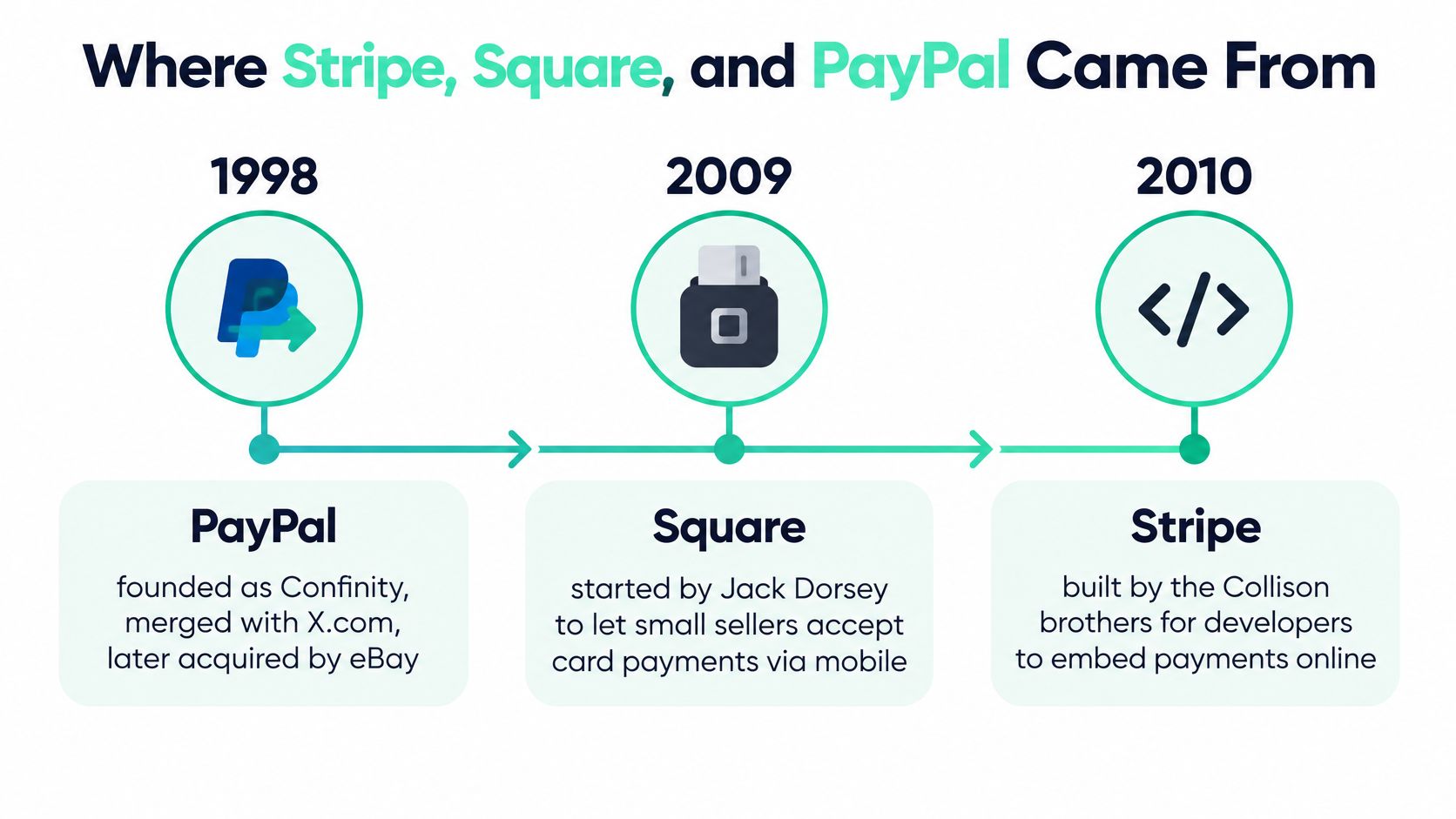
PayPal was founded in December 1998 and became a public company before eBay acquired it in 2002. It later became independent again in 2015. Its early importance came from making online wallets and checkout recognizable before smartphones and app-based commerce became dominant. That history explains why PayPal still makes sense when a buyer wants to use an account and wallet they already know.
Square, founded in 2009 by Jack Dorsey and Jim McKelvey, began with a compact mobile card reader aimed at small sellers. It expanded from taking card payments into point-of-sale software, lending, payroll, and other seller services. Square's core strength remains the connection between accepting money and running a merchant operation.
Stripe arrived in 2010, founded by Patrick and John Collison. Its focus was developer-friendly infrastructure, including APIs, hosted checkout, billing, fraud tools, and marketplace payments. Stripe's advantage isn't just that it processes online payments. It gives a product team more control over how payments fit into a software experience.
Scale is real, but it isn't a recommendation
PayPal's public reporting makes its payment volume visible in regulatory filings. In fiscal 2025, PayPal processed $1.793979 trillion in total payment volume, up 7% from $1.681150 trillion in fiscal 2024, and handled approximately 25.4 billion transactions (PayPal's fiscal 2025 earnings release).
Stripe is privately held and doesn't publish the same standardized public-company reporting package. Its reported platform volume therefore isn't directly equivalent to PayPal's SEC-filed total payment volume. Square is part of Block, whose reporting commonly uses gross payment volume, with a business mix especially tied to seller transactions and point-of-sale commerce (comparison of Stripe, Square, and PayPal scale and reporting).
Don't select a processor by comparing large volume totals. Volume doesn't tell you whether a system fits your subscriptions, keeps customer records portable, or gives your product team the control it needs. The useful distinction is structural: PayPal brings a consumer wallet network, Square bundles seller operations, and Stripe provides programmable payment rails.
Fees, Disputes, and the Real Cost of a Transaction
Headline processing rates leave out the details that often matter most to a small business. The fixed fee takes a larger share of a low-ticket payment, and dispute costs can turn an apparently small pricing difference into a poor operational choice.
For a US-based online creator platform, the common published card rate for Stripe and Square is 2.9% + $0.30 per successful transaction. PayPal checkout is commonly listed at 2.99% + $0.49, though some schedules show 3.49% + $0.49 (small-business payment-processing comparison).
| Processor | Online card rate | Dispute fee | ACH support |
|---|---|---|---|
| Stripe | 2.9% + $0.30 | Commonly $15 | 0.8%, capped at $5 |
| Square | 2.9% + $0.30 | Often described as no separate dispute fee | Comparable standard pricing isn't consistently available in the comparison |
| PayPal | Commonly 2.99% + $0.49, with some schedules at 3.49% + $0.49 | Depends on transaction type and account status | Comparable standard pricing isn't consistently available in the comparison |
At a $20 pledge, Stripe or Square costs about $0.88 at the standard online rate, compared with approximately $1.09 for PayPal at 2.99% + $0.49. On a $100 payment, that difference is about $0.20. The fixed portion is why a seemingly small gap can be more noticeable when supporters make modest contributions.
Model the dispute, not just the checkout
A dispute can involve more than a fee. A founder may lose the payment, pay for already delivered goods or services, spend time assembling evidence, and still face nonrefundable processing costs. Stripe commonly charges a $15 dispute fee; PayPal's fee depends on transaction type and account status, while Square is often described as charging no separate dispute fee (comparison of processor dispute costs).
Don't assume the same rules apply to card-network chargebacks and PayPal-native claims. Check whether a fee is returned after a successful defense, and keep records of customer communication, delivery, and fulfillment. For a useful overview of how payment-processing fees are structured, Samba's guide to payment fee solutions can help frame the questions to ask before choosing.
Stripe's ACH option, 0.8% capped at $5, can also matter when customers are paying larger amounts or supporting a subscription. It isn't an automatic win: compare the payment method your customers will use, then include disputes, refunds, and fulfillment in the model. The lowest headline rate isn't necessarily the lowest total cost.
Developer Experience and API Maturity
For an online product, integration quality shows up in ordinary production problems. Payments arrive asynchronously, customers retry, and network or page errors can leave the buyer unsure whether a contribution went through. The processor has to support a system that handles those cases without posting duplicate records or counting an unverified payment as completed.
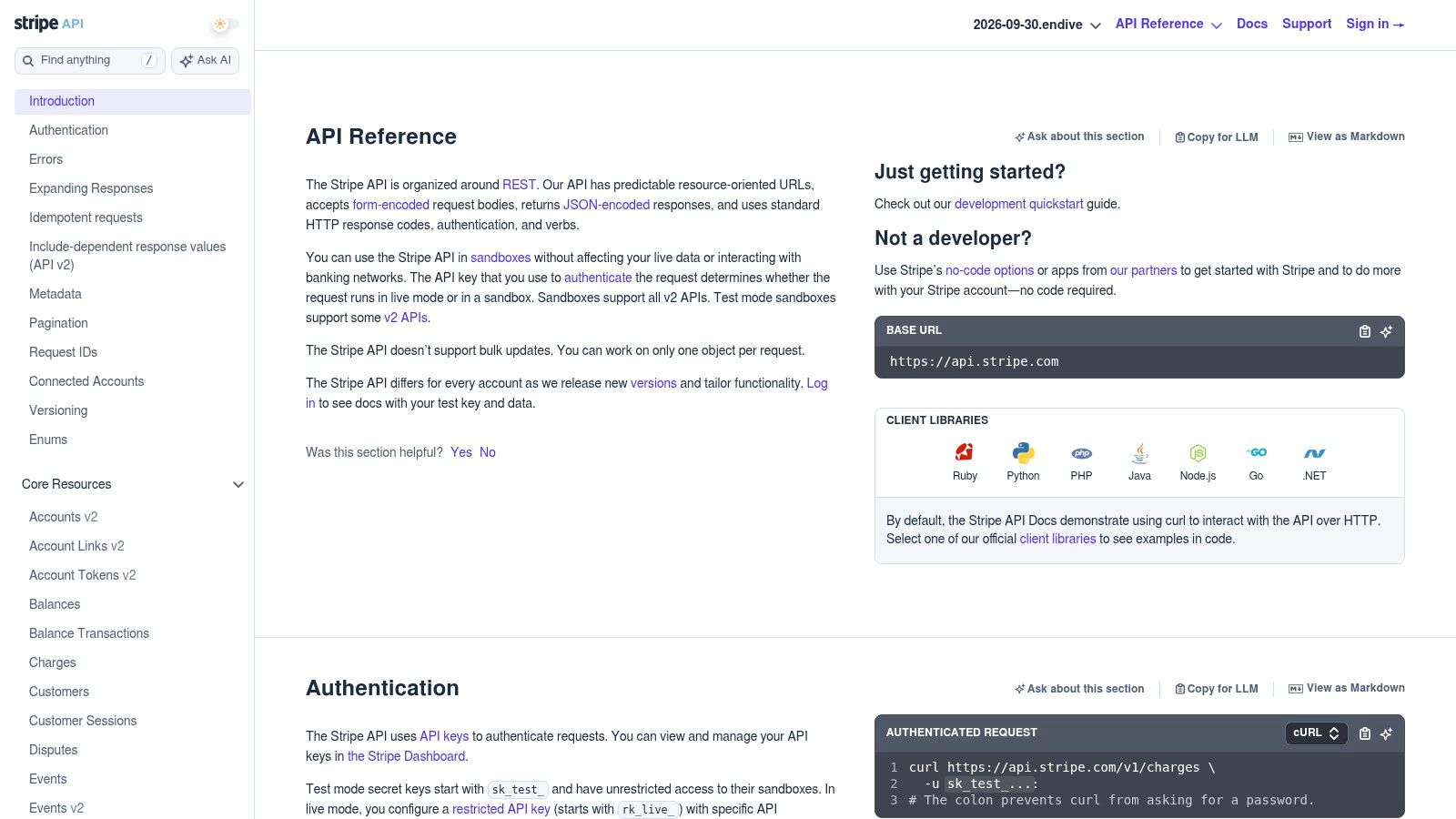
Stripe is the clearest fit for an engineering-led product. Its REST APIs, SDKs, test mode, webhooks, and subscription tooling give teams a strong foundation for custom flows. Square has capable payment APIs, but its online developer ecosystem is less extensive. PayPal has strong wallet familiarity, though supporting multiple checkout flows, OAuth token handling, and region-specific behavior adds integration surface area.
Build around verified payment events
A sound payment flow doesn't treat a successful browser redirect as proof that money arrived. Create or confirm the payment server-side, listen for signed webhooks, and make a contribution visible only after your backend verifies the relevant success event. Add idempotency keys so retries don't create duplicate payment or contribution records.
That architecture is particularly useful when a creator's page displays support publicly. A payment can be pending, fail, or be retried; the page should reflect the verified state rather than the user's last click. The basics of Stripe payment processing are useful context if you're mapping that flow for the first time.
Independent performance comparisons put Stripe's average API response time at roughly 150 to 200 milliseconds, Square's at 160 to 220 milliseconds, and PayPal's at 200 to 300 milliseconds. Treat those figures as directional, not standardized benchmarks, and don't use them as a substitute for measuring your own production requests (independent processor API comparison).
For a recurring product or live traction page, Stripe's webhook and subscription tooling make it the strongest technical choice. Square earns a closer look when a creator also sells in person. PayPal is most useful as an optional wallet method when buyer preference is worth the extra integration work.
Recurring Billing, Payouts, and Global Reach
A payment processor has to keep working after the first charge. Subscriptions need reliable payment-state updates, refunds need to map back to customer records, and creators need to know which sales belong to them. If a platform sits between the creator and those records, changes to payment providers can become a painful data migration.
Stripe is a strong option for recurring support because its billing and webhook-oriented API model can synchronize subscription events with a product. For a creator platform, a useful arrangement is to keep each creator's Stripe account as the merchant of record while the platform displays verified payment and recurring events. That keeps the payment relationship connected to the creator rather than burying it inside a single platform account.
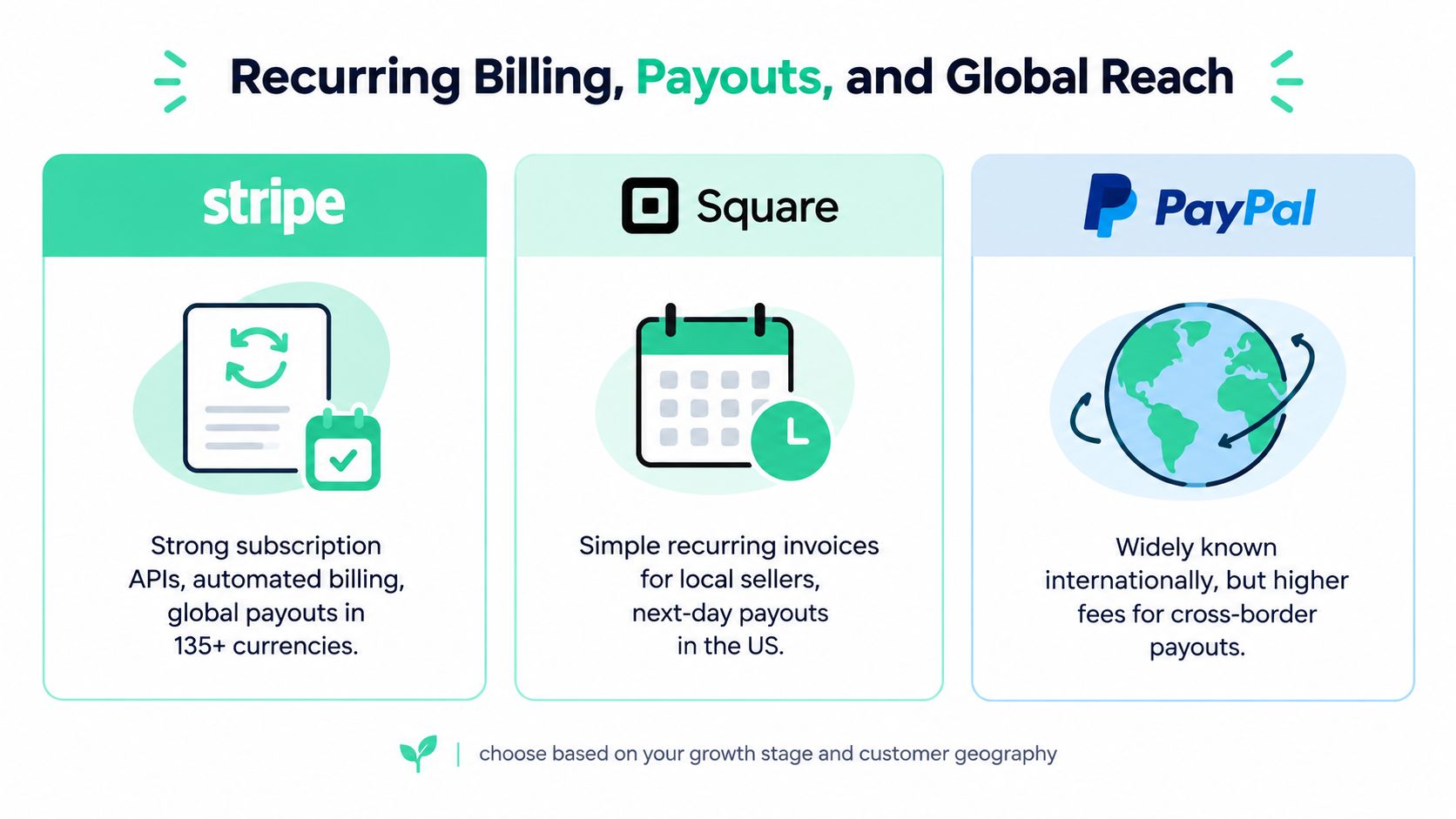
Stripe supports more than 135 currencies, which can be valuable for a platform serving customers across borders. Currency support alone doesn't settle the international decision: founders still need to understand their own payment methods, currency conversion, payout access, and fees. Don't promise a global checkout experience until you've tested the countries and payment flows your customers need.
Square's edge is operational coherence for sellers who accept payments online and face to face. A creator who sells workshops online and at physical events may prefer a system built around merchant operations and point-of-sale commerce. PayPal, by contrast, can reduce friction for customers who already prefer paying from a familiar wallet, but that benefit should be weighed against the additional integration and fee structure.
Here's the video for a visual walkthrough of the payment-provider comparison:
Keep the records portable: Customer identity, subscription status, refunds, and payment evidence should remain useful even if you change processors. A system that can export those records is easier to trust than one that makes its dashboard the only source of truth.
For current operational context, Fundl's guide to Stripe payout time can help creators understand the payout side of a Stripe-based setup. Payout expectations, currency reach, and who owns the customer relationship all affect whether your traction page reflects a real business or only a number of collected payments.
Matching the Processor to Your Business Model
Choose the processor that fits the work your business does. A developer-led SaaS product shouldn't inherit the workflow of a shop just because the point-of-sale bundle looks convenient. A local seller shouldn't build a custom payment stack when an integrated register and seller system solve the core problem.
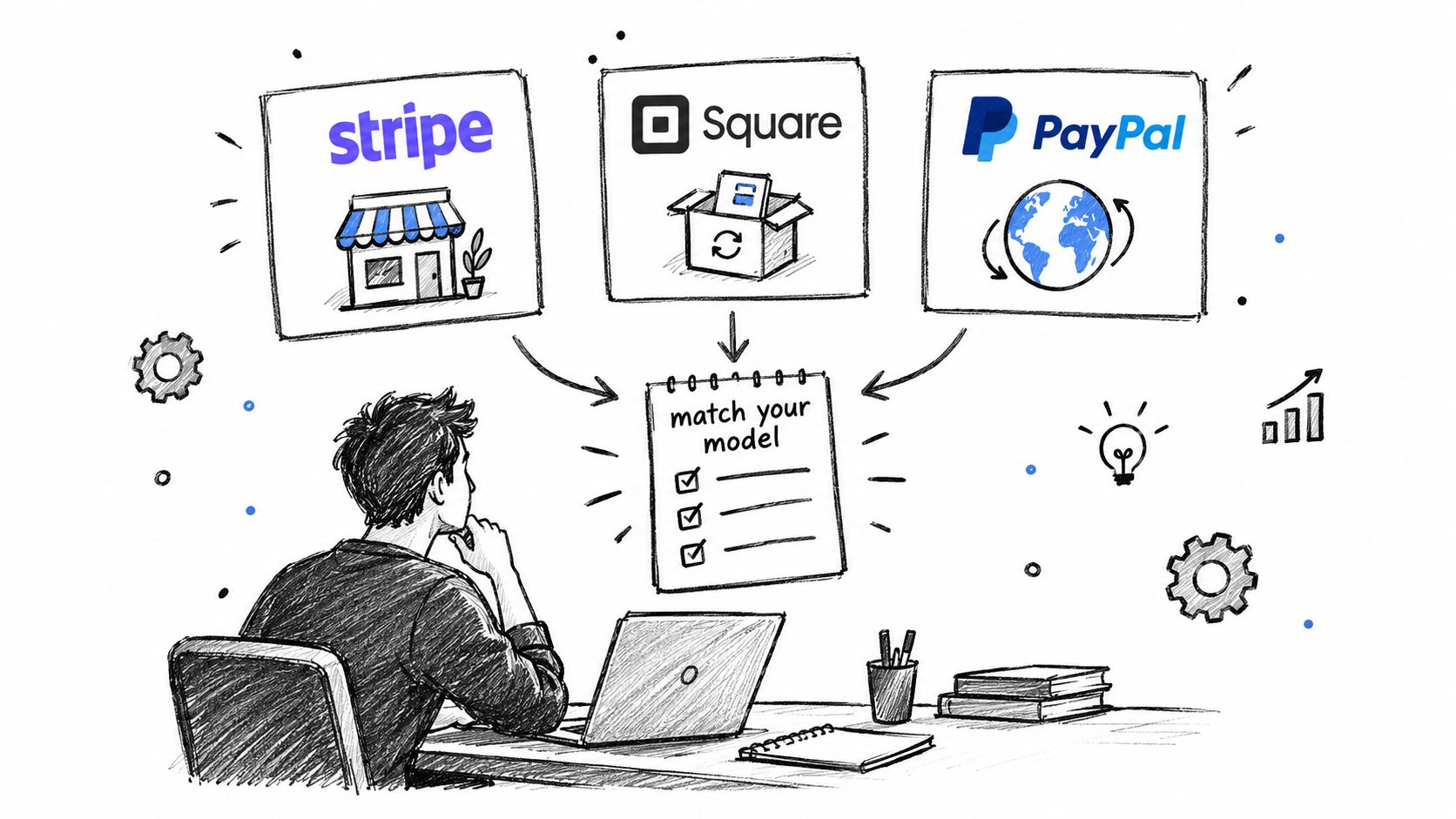
For indie SaaS founders, use Stripe as the primary processor. Recurring billing, programmable APIs, and webhook-driven payment updates fit the product. Don't build your core subscription workflow around PayPal just because some customers recognize its wallet. Add it as an alternative if customers need it.
For creators who sell online and at events, use Square when in-person operations are central. A point-of-sale system that serves both channels can be more useful than a custom online-first integration. Keep the online checkout experience simple, and don't choose Square for an API ecosystem you expect to use like Stripe's.
For open-source projects and community-funded software, start with Stripe and consider PayPal as a wallet option. You need to connect contributions to a real creator or organization and show which payments have been verified. A guide to crowdfunding payment processing can help frame the payment flow alongside how supporters experience the campaign.
Don't confuse invoice collection with traction proof
For productized services and no-code businesses validating demand, keep the initial setup lean. Pick a processor that can handle the payment method and customer record you need, then make a deliberate plan for disputes. If you also manage contractor billing, a practical overview of invoice software for contractors can help you compare the invoice workflow separately from your payment processing choice.
One processor can be enough. Two can be smarter when each has a clear job, such as Stripe for subscriptions and PayPal for customers who prefer a wallet. But each added provider creates more work to reconcile refunds, customer identity, tax records, and dispute evidence. Don't add a second checkout button without deciding where the resulting records will live.
For projects that need to show supporters what is happening beyond payment totals, Fundl connects a creator's Stripe account with project activity and analytics to publish a traction page with source-verified metrics. It processes contributions through the creator's own Stripe account rather than holding funds in platform escrow. That makes it an option for founders who want payments and evidence of traction connected without treating collected volume as proof of customer retention or product progress.
Decision Framework, Lock-In Risks, and Common Questions
Make the decision in this order: merchant-of-record portability, webhook reliability, dispute handling, then checkout reach. Put physical point-of-sale needs near the top if your business depends on them. Compare rates only after you've ruled out processors that don't fit your operating model.
Keep a portable record of customer identity, subscriptions, refunds, tax details, and dispute evidence. If those records only make sense inside one provider's dashboard, switching later will be harder than changing a payment button.
Can I use more than one processor? Yes, if each one has a clear purpose. Keep one system responsible for core customer and subscription records, and plan how you'll reconcile payments across providers.
When should I switch? Switch when the current processor is creating real operational friction, not because another provider has a more attractive headline rate. Map how active subscriptions, refunds, and customer records will move before you change checkout.
How do I reduce dispute pain? Keep clear delivery records, customer communications, and evidence that matches the transaction. Check the provider's rules for the dispute type you're handling, including whether a fee is returned after a successful defense.
Is ACH worth prioritizing? It can be, especially for recurring or higher-value payments. Compare the available terms with customer preference and the operational effort of supporting another payment method.
Fundl lets creators raise reward-based support through their own Stripe accounts and publish live, source-verified traction alongside their project. If you're choosing a payment stack for a SaaS launch, open-source project, or creator campaign, visit Fundl to see how verified metrics can make your progress clearer to backers.