
You launch your campaign, post the link, and watch the first pledges come in. The dashboard says people backed you. Your phone lights up. Then the confusing part hits: the money isn't sitting in your bank account, some backers' cards still look “pending,” and you realize you're not sure who is holding the funds, when they settle, or what happens if a payment fails later.
That confusion is normal. Crowdfunding payment processing sits in the middle of trust, conversion, and cash flow, but most creators only notice it when something breaks. Backers experience it as a checkout. You experience it as a payout. Underneath, it's a chain of decisions about when cards are charged, where money is held, who handles compliance, and how reliable your payment events are once the campaign is live.
If you're still shaping your launch, it helps to think about payments before you publish your page. A campaign with a strong story but a shaky checkout can lose support fast. A cleaner starting point is to map the funding flow as early as you map rewards, pricing, and your audience, which is also why it's worth reviewing a practical launch checklist like how to start a crowdfunding campaign.
Table of Contents
- Introduction to Crowdfunding Payment Processing Without the Jargon
- How Crowdfunding Payment Flows Actually Work
- Fees Payout Timing and What You Actually Keep
- Integration Patterns That Scale From Stripe Connect to Webhooks
- UX Fraud Prevention and Keeping More Pledges Alive
- International Payments Taxes and Reporting in the Real World
- Your Quick and Safe Setup Plan for Crowdfunding Payments
Introduction to Crowdfunding Payment Processing Without the Jargon
A simple way to understand crowdfunding payments is to stop thinking about them as “merchant account stuff” and start thinking about them as the part of your campaign that answers one question for both sides: Can I trust what happens next?
For a backer, trust means the checkout feels familiar, the charge timing is clear, and they know what happens if the campaign misses its goal. For a creator, trust means funds move predictably, fees don't surprise you, and payout rules won't freeze progress right when you need to pay for fulfillment.
Why this feels opaque on launch day
Most indie makers focus on the visible parts first:
- Campaign page: headline, rewards, screenshots, demo
- Traffic: email list, social posts, communities
- Offer: early bird tiers, bonuses, stretch ideas
The invisible part is the payment path after someone clicks “Back this.” That path decides whether a pledge is just an intent, an immediate charge, or a routed payment into your own processor account.
Crowdfunding checkout is not just a billing function. It's where your campaign proves it can turn interest into reliable money movement.
That's why two campaigns with similar traction can feel very different to backers. One says, “You'll only be charged if the campaign succeeds.” Another says, “You're charged now.” A third routes contributions directly to the creator's Stripe account instead of placing them in platform-held escrow. Those are not minor implementation details. They shape conversion behavior and your operating reality after launch.
What creators usually underestimate
The payment model touches three things at once:
Conversion
A confusing charge policy causes hesitation.Cash flow
The timing of capture and payout affects when you can spend.Risk
Refunds, disputes, failed cards, and compliance checks don't disappear after a campaign is funded.
Creators often ask, “What are the fees?” That matters, but it's only one layer. The bigger question is whether your setup makes backers comfortable enough to complete checkout and makes your operations stable enough to survive success.
How Crowdfunding Payment Flows Actually Work
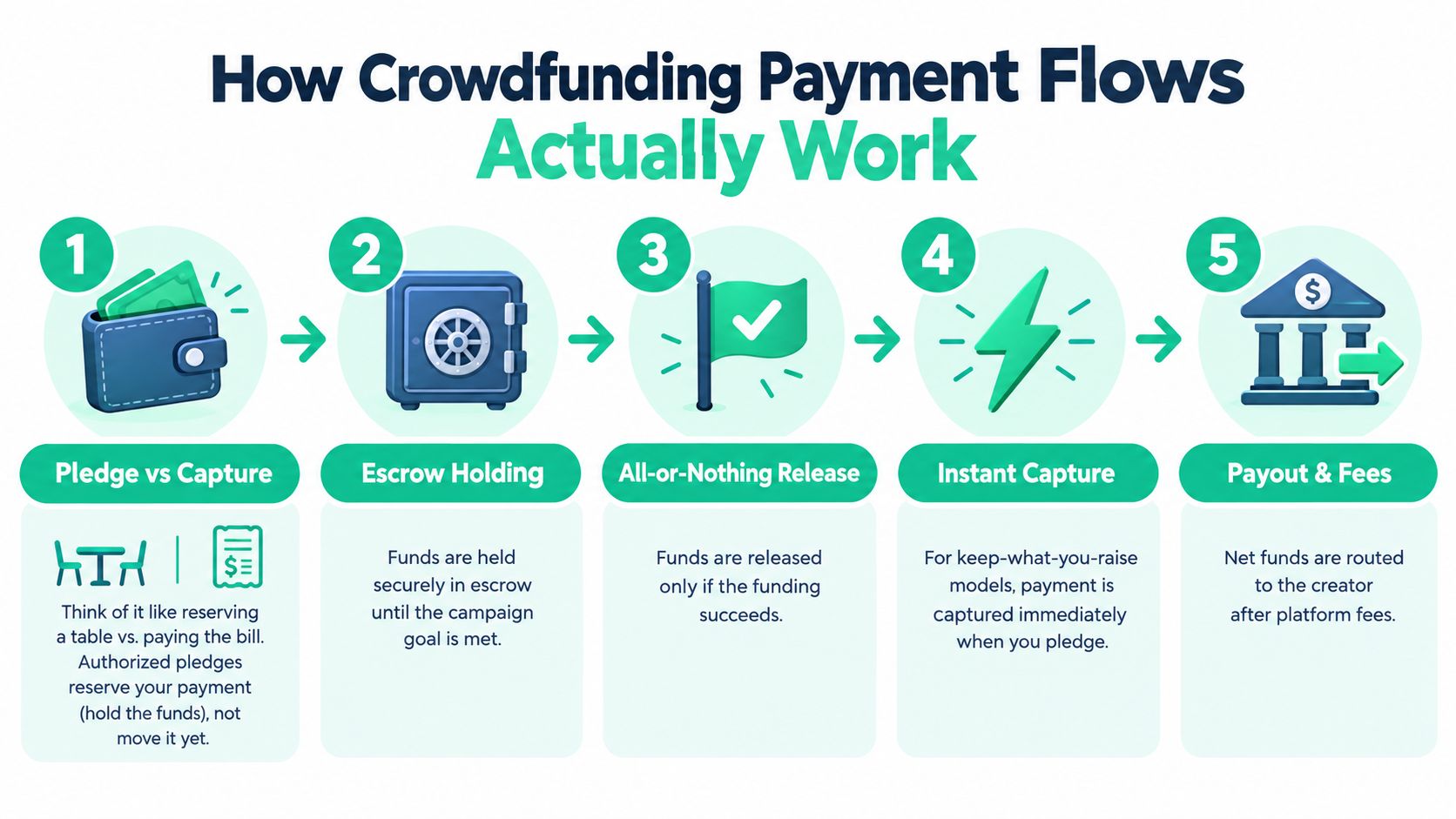
The easiest analogy is this: a pledge can work like reserving a table, or it can work like paying the bill.
If a platform uses a pledge-first model, the backer signals intent and the actual charge may happen later, often after the campaign succeeds. If a platform uses instant capture, the money is taken at checkout.
Pledge versus capture
Think of an all-or-nothing campaign. A backer supports your project today, but the platform may wait to charge until the campaign ends successfully. That gives backers confidence that they won't be charged for a project that didn't reach its target, but it also means some payments can fail later when cards expire, limits change, or banks decline the final charge.
By contrast, instant capture means the card is charged when the backer checks out. This can simplify your ledger, but it changes the trust model. Backers want to know where that money sits, what refund rules apply, and whether the platform or creator is holding funds.
Practical rule: If your campaign messaging says “you're only charged if we succeed,” your payment architecture needs to match that promise exactly.
Escrow versus direct routing
Here's the second distinction that trips people up.
Some platforms act more like a central money layer. They collect funds, hold them within their system, then release payouts according to platform rules. That feels escrow-like from the creator's perspective, even when the exact legal structure is more nuanced.
Other models route money directly through the creator's own payment account. For example, some newer setups connect your Stripe account so contributions process through your account rather than a platform-held balance. That gives you clearer visibility into processing, fees, and payout behavior, but it also pushes more responsibility onto your side for reconciliations and account readiness.
A useful comparison of how payment systems shape user confidence appears in Alignmint's payment processing guide, even though it focuses on nonprofit payments. The same trust logic applies in crowdfunding: people complete checkout more readily when the payment path is familiar and the flow after payment is easy to understand.
Why dedicated processors changed crowdfunding
The move from fragmented processors to a dedicated payments partner was a turning point. In January 2015, Kickstarter said it was replacing Amazon Payments with Stripe across all projects, after the platform had already processed about $1.2 billion in funding since launch, and coverage noted that the change reduced payment setup from days to minutes while making global card handling easier across countries and currencies, according to Wired's reporting on Kickstarter's Stripe switch.
That mattered because payment infrastructure stopped being a back-office detail. It became part of product design. Faster setup means fewer creator-side delays. Better cross-border support means more backers can complete checkout. Cleaner payout routing means less confusion when it's time to ship.
Later in the flow, event handling matters too.
A payment flow isn't finished when the card is charged. Your system needs to know whether a pledge succeeded, failed, got refunded, or turned into a dispute. That's where webhook reliability starts affecting real trust. If your app marks a reward as paid before the processor confirms it, you'll create support headaches fast.
Fees Payout Timing and What You Actually Keep
Creators usually quote gross pledges because that's the number the campaign page celebrates. Your supplier, fulfillment partner, and bank account care about the net number instead.
Kickstarter's help material says creators should expect both a platform fee and payment-processing deductions, and it notes that the payout funding summary becomes available about 48 hours after the bank has successfully processed the payout, as described in Kickstarter's payout and fee help article.
The fee stack is layered
Independent summaries of major crowdfunding platforms commonly put the payment-processing portion at roughly 3% to 5%, often on top of a 5% platform fee. That means your gross raised amount is not your operating budget.
Some deductions happen per successful pledge. Others show up after the campaign in the form of refunds, dispute costs, or reserves. And in some crowdfunding models, the fee burden isn't entirely on the creator. Some platforms add backer-side system fees on top of the pledge amount, which makes the true take rate less obvious upfront.
Crowdfunding Fee and Payout Components at a Glance
| Component | Typical Impact | When It Hits |
|---|---|---|
| Platform fee | Often separate from processing deductions | After successful funding or as funds are settled |
| Payment processing fee | Roughly 3% to 5% on many major platforms | Usually deducted from each successful pledge |
| Refunds | Lowers net proceeds | After creator action or platform-required reversal |
| Disputes and chargebacks | Can create extra losses and operational friction | After the original payment, sometimes well after campaign close |
| Payout timing | Funds are not instantly available | Funding summary may appear about 48 hours after bank processing of payout |
A better way to budget
Use gross pledges for marketing screenshots. Use net proceeds for planning.
If you raise money through a platform that takes a platform fee plus payment processing, your real fulfillment budget shrinks before you buy inventory, packaging, support time, or shipping. Then add the possibility of failed final charges, refunds, and post-campaign disputes.
Budget your rewards, manufacturing, and buffer from net expected receipts, not from the campaign total your public page displays.
A lot of creators discover this too late. They celebrate a campaign milestone, start allocating spend mentally, and only afterward see how deductions stack. If you're comparing options, a market overview like crowdfunding best websites can help you evaluate how platform structure affects what you receive, not just where you can list a campaign.
Timing matters as much as fees
Even after a campaign succeeds, payout timing still affects decisions. You may need to pay a contractor, lock in production, or place a supplier order before funds are fully available. That's where “successful campaign” and “usable cash” stop being the same thing.
That gap is manageable if you expect it. It's painful if you don't.
Integration Patterns That Scale From Stripe Connect to Webhooks
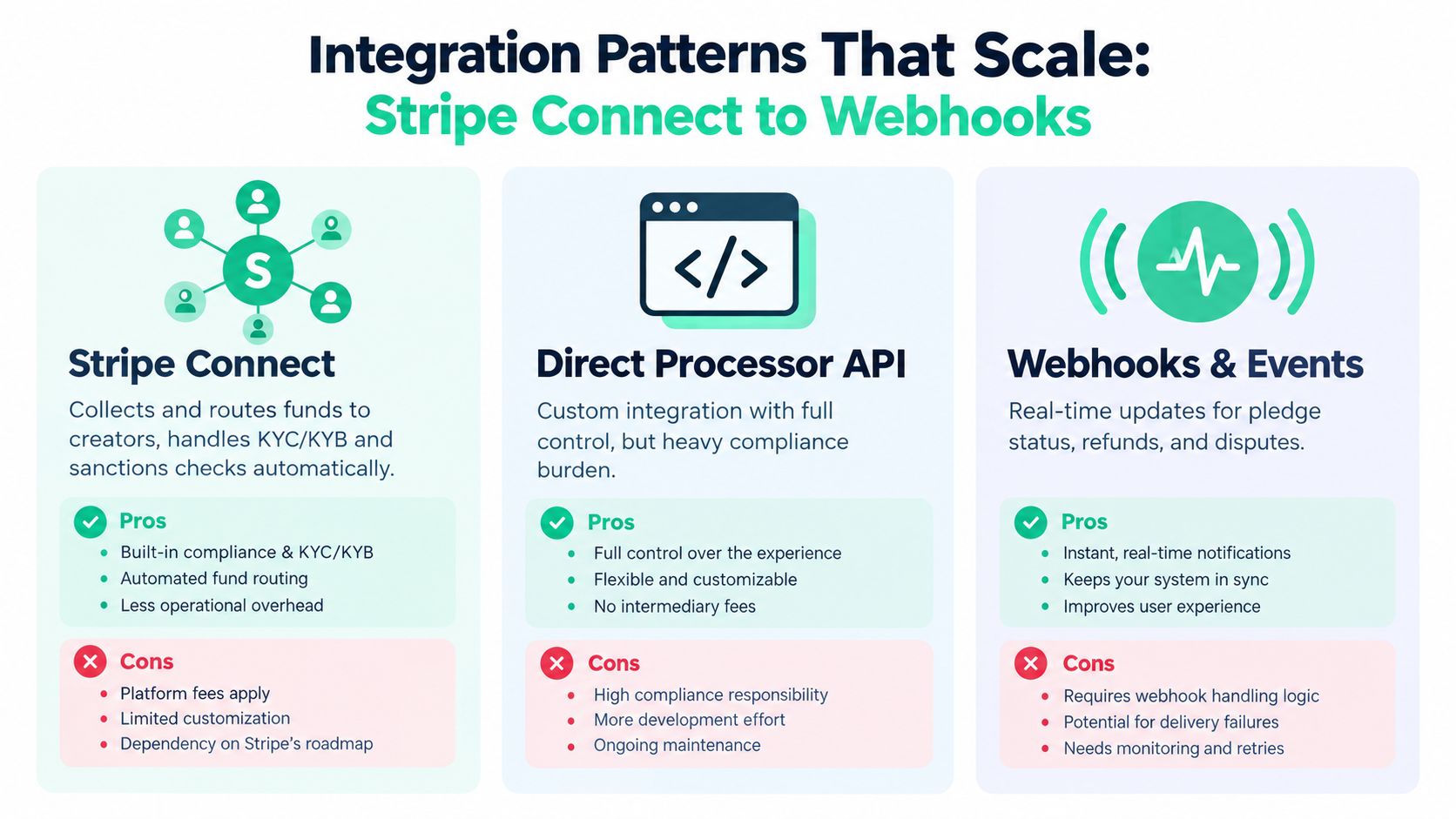
Once you stop looking at payments as a button and start treating them as infrastructure, you get three main implementation patterns: a platform account model, a direct processor integration, and an event layer that keeps your system in sync after checkout.
Stripe Connect for multi-party flows
For crowdfunding-style platforms, Stripe Connect fits the shape of the problem well because it lets a platform collect payments and route funds to creators while also handling onboarding data needed for KYC, KYB, sanctions screening, and compliance checks, according to Stripe Connect's feature overview.
That matters when your platform isn't just taking money for itself. It's moving money between backers, the platform, and creators.
For connected accounts in Europe, updated verification rules require identity, legal entity, UBO, and director verification for relevant accounts, and existing accounts need to meet those requirements to keep receiving payouts. Many indie teams get surprised. International scale doesn't usually break at checkout first. It breaks in onboarding and verification.
Direct processor API and who should own complexity
A simpler direct processor integration can make sense if you're not building a marketplace or multi-creator platform. You get more control over checkout and data design, but you also own more operational detail.
In practice, the trade-off looks like this:
Small single-creator campaign
Direct processing can be clean if funds only belong to one business.Multi-creator platform
Connect-style routing usually maps better to reality.International expansion
Built-in onboarding and verification support becomes more valuable.
One current example of the direct-to-creator pattern is Fundl, where reward-based contributions process through each creator's connected Stripe account rather than through platform-held escrow. That setup can improve money-flow clarity, but it also means creators need their Stripe account, payout settings, and verification status in good order before they drive traffic.
Webhooks are the nervous system
A lot of founders think the hard part is accepting payment. It isn't. The hard part is staying correct after payment.
Your app needs dependable event handling for:
- Successful payments so rewards are released at the right moment
- Failed charges so you can prompt retries without manual cleanup
- Refunds and disputes so records stay accurate
- Payout events so finance and support don't tell different stories
If your webhook handling is brittle, your campaign can look healthy on the front end while your operations quietly drift out of sync in the background.
That drift is expensive. You email a backer saying “thanks for your support” after their card failed. You trigger fulfillment before a payment settles. You miss a dispute window because the event never updated your internal queue.
For teams that want more warning before disputes escalate, tools built around chargeback alerts can help reduce reaction time. A practical example is disable Stripe disputes with alerts, which is relevant once your campaign starts handling enough volume that manual monitoring becomes risky.
UX Fraud Prevention and Keeping More Pledges Alive
A surprising amount of payment loss happens before fraud teams or chargebacks enter the story. It starts with a checkout that feels uncertain.
Backers hesitate when they don't know whether they're authorizing a pledge or making an immediate purchase. They also drop when mobile forms are clunky, card errors are vague, or the campaign doesn't explain what happens after submission.
The checkout side of trust
Treat checkout copy as part of conversion, not legal decoration.
A better flow usually includes:
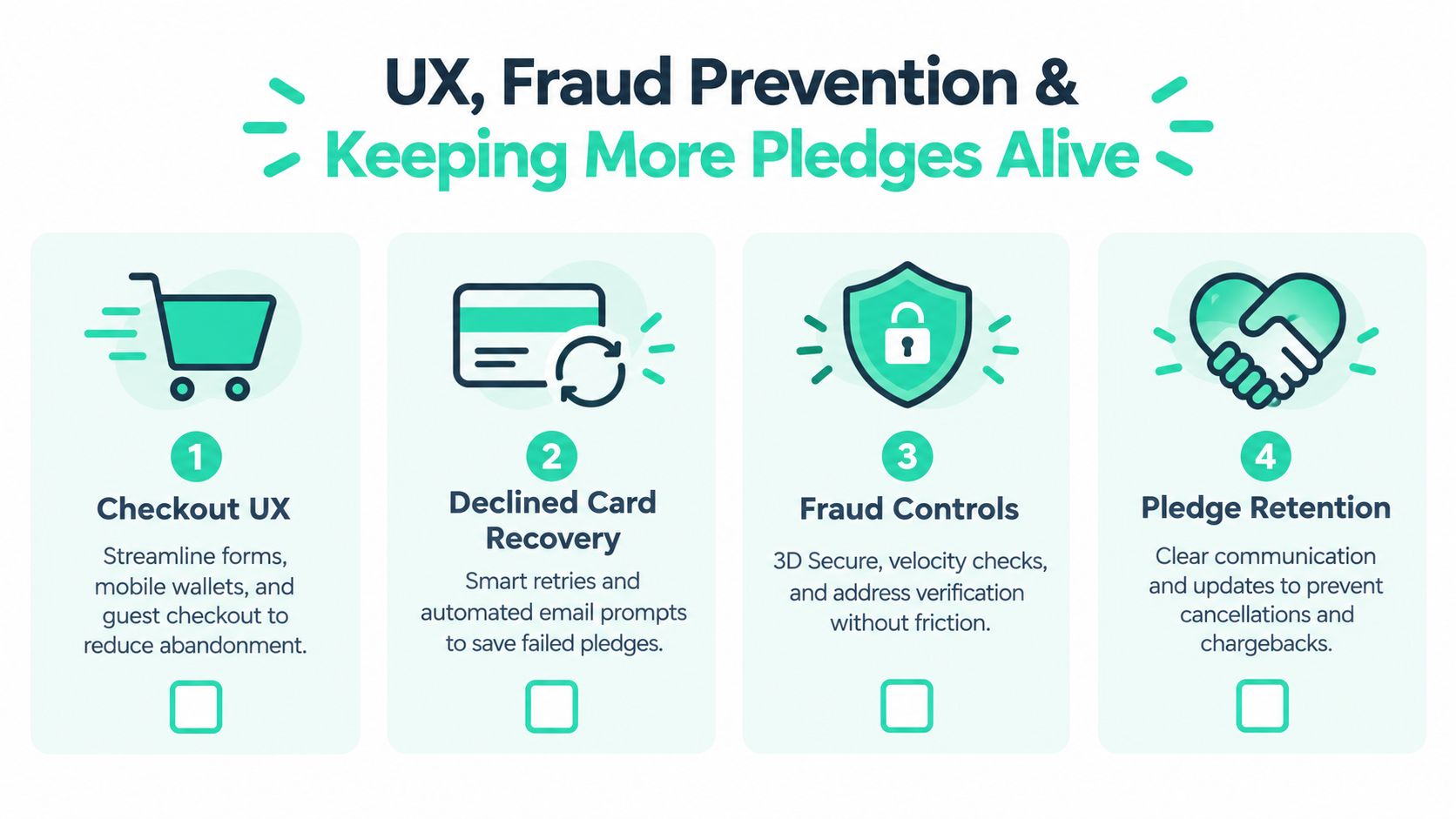
- Clear charge timing: state whether the card is charged now or only after campaign success
- Simple form design: remove anything that isn't needed to complete payment
- Mobile readiness: many backers will pledge from a phone
- Immediate confirmation: tell people what happened, what they'll receive, and what changes later
Short, plain copy beats clever copy here. “You'll be charged only if the campaign succeeds” is stronger than jargon about authorization or settlement.
Declines and disputes need a plan before launch
Failed cards aren't always fraud. Sometimes the bank blocks an unfamiliar international transaction. Sometimes the card expired. Sometimes the backer's balance changed by the time final capture happens.
That's why recovery matters:
Retry logic
Give failed payments a controlled path to succeed.Backer communication
Send a clear prompt to update the card or payment method.Support visibility
Make it easy to see who pledged but didn't complete payment.
Fraud control is a different layer. Stripe's risk documentation notes that refunds and chargebacks can create negative balances at either the connected account or platform level depending on charge type, and that platforms need to decide balance liability carefully, as covered in Stripe's Connect risk management docs.
That's the part many creators miss. A funded campaign can still create losses later if disputes hit after payouts have already moved.
Strong crowdfunding payment processing doesn't just accept good payments. It contains the damage from bad ones.
A pre-launch risk checklist
Before you open the campaign publicly, confirm these basics:
- Charge message matches reality: your page, checkout, and confirmation email should agree
- Dispute owner is defined: know whether the creator, platform, or connected account carries the risk
- Reserve thinking exists: leave room for reversals instead of assuming all payouts are final
- Refund workflow is documented: don't improvise policy in support inboxes
- Webhook retries are tested: event failures should not break your records
International Payments Taxes and Reporting in the Real World
Cross-border crowdfunding looks simple from the outside. A backer in another country sees your project, enters a card, and supports it. Under the hood, that payment can involve currency conversion, different card behavior, additional verification, and more expensive dispute risk.
That's why international crowdfunding payment processing is as much an operations question as a growth question.

Where global campaigns get messy
Backers often assume the amount they see and the amount you receive are close enough to treat as the same. They usually aren't.
Independent coverage of crowdfunding money flow points out that fee responsibility can be split across the creator, the backer, and the payment processor, and that some platforms add backer-side system fees on top of pledge amounts, making the take rate harder to estimate in advance, as discussed in this crowdfunding money flow analysis.
That creates two reporting problems for creators:
- You need to know what the backer paid.
- You need to know what landed, after processing and any other deductions.
For tax and bookkeeping, those are not interchangeable records.
What to track from day one
Creators who receive funds directly through their own processor account usually get more transparent reporting, but they also need to stay organized. Save records for each pledge, refund, fee deduction, and payout. Match campaign rewards to payment records instead of relying only on a public campaign total.
If you're running a nonprofit-style or mission-driven campaign across borders, the surrounding record-keeping gets more important because donor expectations and internal accounting often diverge. A useful angle on that planning appears in crowdfunding for nonprofits, especially if supporters expect clearer documentation around what was given and what was deducted.
Disputes don't stop at the border
Another under-discussed issue is what happens after campaign close. Transfer-focused guidance notes that processors commonly charge flat dispute fees and that platforms may hold reserves to cover chargebacks or late disputes, especially where international cards and currency conversion push costs higher, as summarized in this Stripe fee and dispute explainer.
The practical takeaway is simple. If you accept global backers, keep a buffer. Don't spend every payout as if it's irrevocable the moment it arrives.
Your Quick and Safe Setup Plan for Crowdfunding Payments
The fastest safe setup is the one that makes a few hard decisions early and avoids custom complexity you don't need.
A lean order of operations
Start with the flow, not the tools.
Pick whether your campaign should use a pledge-later model or instant capture. Then decide where money lives during the campaign. If your backers expect all-or-nothing behavior, your charge timing must support it cleanly. If your campaign is reward-based and routes directly to your own payment account, make sure that directness is obvious in the way you explain checkout and refunds.
After that, model the economics. Don't launch with only a gross goal in mind. Build your reward pricing around expected net proceeds, possible failed payments, and a buffer for reversals.
What to test before you share the link
Run a short private checklist:
- Verify account readiness: complete processor onboarding and confirm payout settings
- Make a test contribution: check what the backer sees before and after payment
- Inspect event handling: confirm your webhook-driven updates fire correctly
- Review confirmations: make sure emails and dashboard states match real payment outcomes
- Rehearse edge cases: failed card, refund request, and delayed payout should all have an answer
Launch speed matters. Payment clarity matters more. A campaign with traffic and weak payment handling burns trust faster than a campaign that launches a day later with the basics tested.
If you're an indie founder, keep the system boring. Familiar checkout. Explicit charge timing. Minimal fee surprises. Clean records. Reliable events. Those don't sound exciting, but they're what let a campaign survive real attention.
When crowdfunding payment processing works, backers don't think about it much. They feel confident enough to pledge. You feel confident enough to build.
If you want a direct-to-creator setup instead of a platform-held money flow, Fundl lets creators publish traction-based crowdfunding pages and process reward-based contributions through their own connected Stripe accounts. It's built for founders who want backers to see live proof, clear payment routing, and a cleaner path from checkout to payout.