
You've built something people might pay for, but you don't yet have the money to build it properly, ship it, or prove anyone wants it. A bank wants collateral, an investor wants traction, and your own savings won't cover tooling, inventory, or months of development. That's the gap startup crowdfunding tries to fill. It asks many people online for small amounts, and it works only when those people understand what they're getting, what you can verify, and whether you can deliver.
Table of Contents
- The Three Types of Startup Crowdfunding at a Glance
- Pros and Cons for Founders and Backers
- Legal and Financial Limits Behind Each Model
- Choose a Platform, Set the Goal and Run to Payout
- What a Transparent Campaign Discloses Before Money Moves
- Traction Metrics That Build Backer Trust
- Confirm Model, Goal and Proof Before You Launch
The Three Types of Startup Crowdfunding at a Glance
Think of a campaign as a shop counter. Many people walk past, each person puts down a small amount, and the model, meaning the type of crowdfunding you choose, decides what they receive in return. That single choice changes the law that applies, the risk each person carries, and the promise you have to keep.
| Model | What backers receive | Legal status | Main backer risk |
|---|---|---|---|
| Reward-based | A product, perk or early access | Not an investment; no ownership | Reward never delivered |
| Equity | A share of ownership in the company | Securities offering under regulated rules | Stake may become worthless |
| Donation | Nothing financial, sometimes thanks or recognition | Gift with no financial return | Money used differently than promised |
| Lending and royalty-based | Repayment or a share of future revenue | Credit or revenue-share contract | Repayment depends on the business's revenue |
What Each Model Feels Like in Practice
A reward-based campaign works much like a pre-order. A backer pays now for a product, perk, or early access later, and you can read a plain breakdown of how reward-based crowdfunding works before you copy any campaign structure. If the product never ships, the backer can lose the pledge and has no ownership to sell.
An equity campaign sells a small ownership stake. Backers share in the company's upside if it grows, and they share in the loss if it fails. A donation campaign is closer to a tip jar. People give because they support the cause, not because they expect money back.
The wider picture is broader than those three. The World Bank report on crowdfunding defined crowdfunding as raising monetary contributions from a large number of people, typically online, to fund a project or venture, and it estimated the worldwide crowdfunding market had reached approximately $16 billion during the period it examined. That same report grouped crowdfunding into lending, equity, royalty-based finance, charitable donations, and rewards-based contributions, which is why debt and revenue-share campaigns sit beside the three core models.
Match the model to the promise you can keep, not to the amount you'd like to raise.
A validated product usually suits rewards because customers already understand what they'll receive. A company that wants long-term outside capital usually looks at equity, even though that route brings securities rules and ongoing investor expectations. Donations fit a cause or community project where supporters don't expect a product or a return.
Confusion usually starts when founders mix the language. Calling a reward backer an investor, or hinting that a pre-order might produce profit, blurs the legal line. Pick one model, name what the backer receives in plain words, and keep every later decision consistent with that choice.
Pros and Cons for Founders and Backers
Crowdfunding can feel like free validation. It isn't. You're trading time, public exposure, and a delivery promise for money that arrives before you've finished the work.
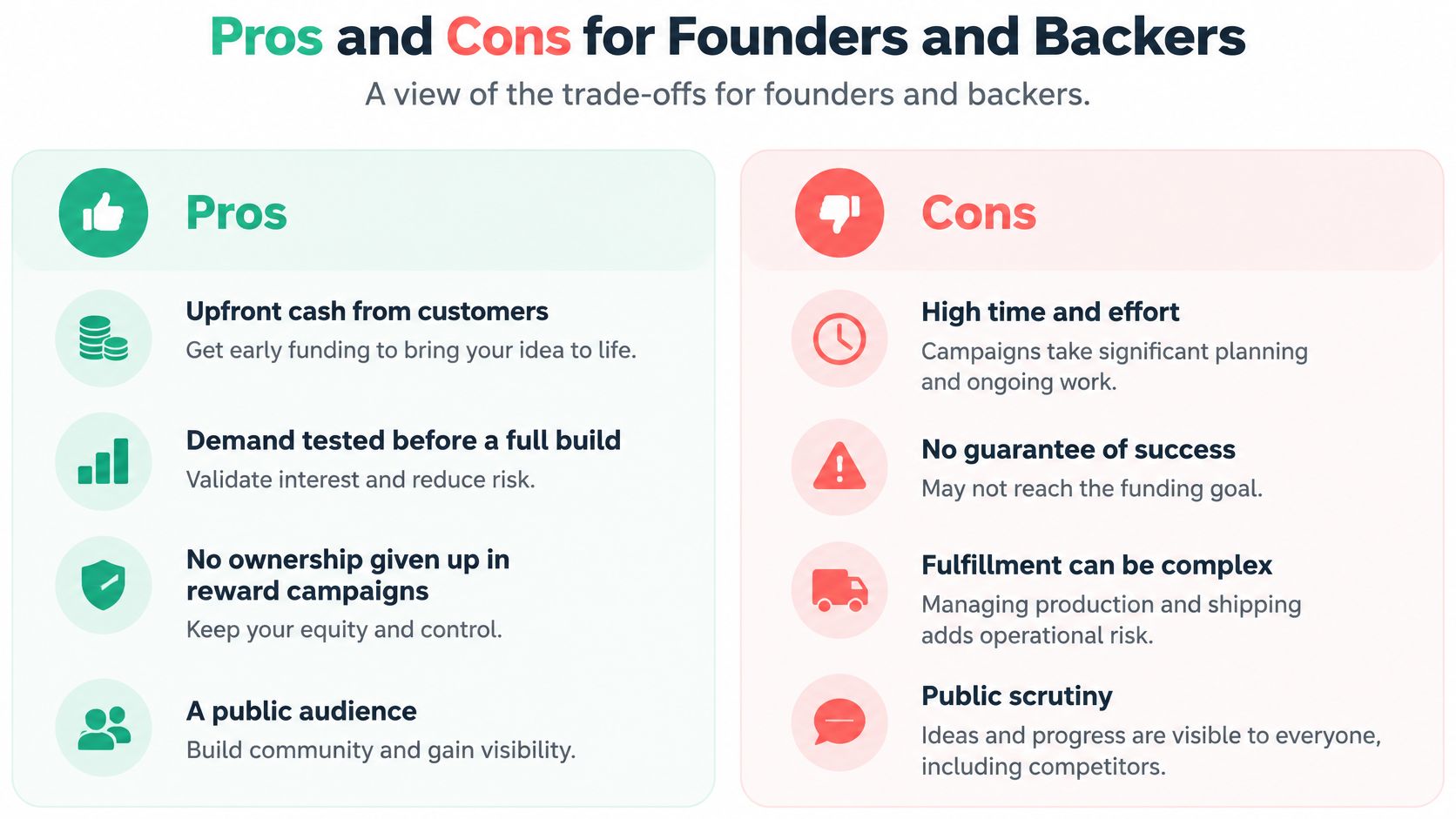
Pros
- Upfront cash from customers: Money arrives before a full production run, so you aren't funding every unit from savings.
- Demand tested before a full build: Real pledges show whether strangers will pay, not just whether friends like the idea.
- No ownership given up in reward campaigns: You keep your equity because backers bought a product or perk, not shares.
- A public audience: A visible campaign can bring press, early users, and feedback while you're still shaping the offer.
Cons
- Fulfillment risk: You still have to manufacture, ship, support, and handle returns after the excitement fades.
- Fees reduce the total: Platform fees and card processing come out before the money becomes usable working capital.
- Public failure: A weak launch is visible to customers, partners, and future investors.
- Weeks of marketing time: Most backers don't find you by accident, so audience building starts well before launch.
- Equity dilution and compliance cost: Equity campaigns add ownership complexity and regulated disclosure work.
The backer side is less forgiving than most campaign pages admit. Research summarized in a Semantic Scholar paper on reward-based crowdfunding accountability notes that as many as 75% of reward-based campaigns have experienced fulfillment delays, while regulatory protections and practical legal recourse for backers remain limited. That figure changes how you should read a polished pitch. Demand doesn't prove a creator can source parts, manage a supplier, or ship on schedule.
Say a software founder shows strong signups but has no support process, no refund reserve, and one contractor building the core feature. The traction is real, and the delivery risk is also real. Both facts matter.
Before pledging, check four things. Confirm the delivery date, what happens if that date slips, how a refund works, and whether the creator has shipped something comparable before. If crowdfunding still looks like the wrong trade, compare it with other routes in this guide to crowdfunding alternatives for founders before you commit weeks to a launch.
Legal and Financial Limits Behind Each Model
Equity crowdfunding isn't just a campaign page with shares attached. In the United States, the SEC guidance on Regulation Crowdfunding permits an eligible startup to raise up to $5 million across all offerings during a rolling 12-month period. The same framework limits how much each non-accredited investor, meaning an investor who doesn't meet accredited-investor standards, can put in.
| Investor profile | Annual investment limit |
|---|---|
| Income or net worth below $124,000 | Greater of $2,500 or 5% of the larger figure |
| Both income and net worth at least $124,000 | 10% of the larger figure, capped at $124,000 |
Read the table slowly. When either annual income or net worth is below $124,000, the investor may invest the greater of $2,500 or 5% of the larger figure. When both are at least $124,000, the limit rises to 10%, capped at $124,000. Those caps are aggregate exposure limits, so they control total risk across offerings, not just one pledge on one page.
Where Reward Campaigns Sit
Ordinary reward contributions are generally not investments. They don't create ownership, debt, or a right to financial return. The securities-law limits above don't directly govern a normal product pre-order, but they're a useful benchmark for keeping rewards clearly separate from equity or debt.
Your page should state exactly what contributors receive. Avoid words like return, profit, dividend, or ownership unless you're deliberately running a regulated offering and you've taken advice on it. Vague language creates the exact misunderstanding backers later call misleading.
Obligations You Carry Either Way
Founders owe backers accurate, complete, and non-misleading descriptions of the project, its goals, and its intended use of funds. You should respond in good faith to complaints, keep auditable records of contribution terms, and deliver the rewards you promised. A platform doesn't absorb that duty for you.
Financial planning needs the same discipline. Platform fees and card processing reduce the amount that arrives, and funds received are usually taxable income, so set money aside instead of spending the headline total. Keep a clean record for every contribution, reward tier, promised date, and later change.
Practical rule: If you're unsure whether your model triggers securities law, get advice before launch, not after the money arrives.
That timing matters because the legal character of the offer is set by what you promised when people paid. You can't reliably fix an equity-like promise later by renaming it a perk.
Choose a Platform, Set the Goal and Run to Payout
Start by judging platforms on mechanics, not homepage design. The right platform supports your model, moves money in a way you understand, shows fees before launch, fits your category, and gives backers proof they can check.
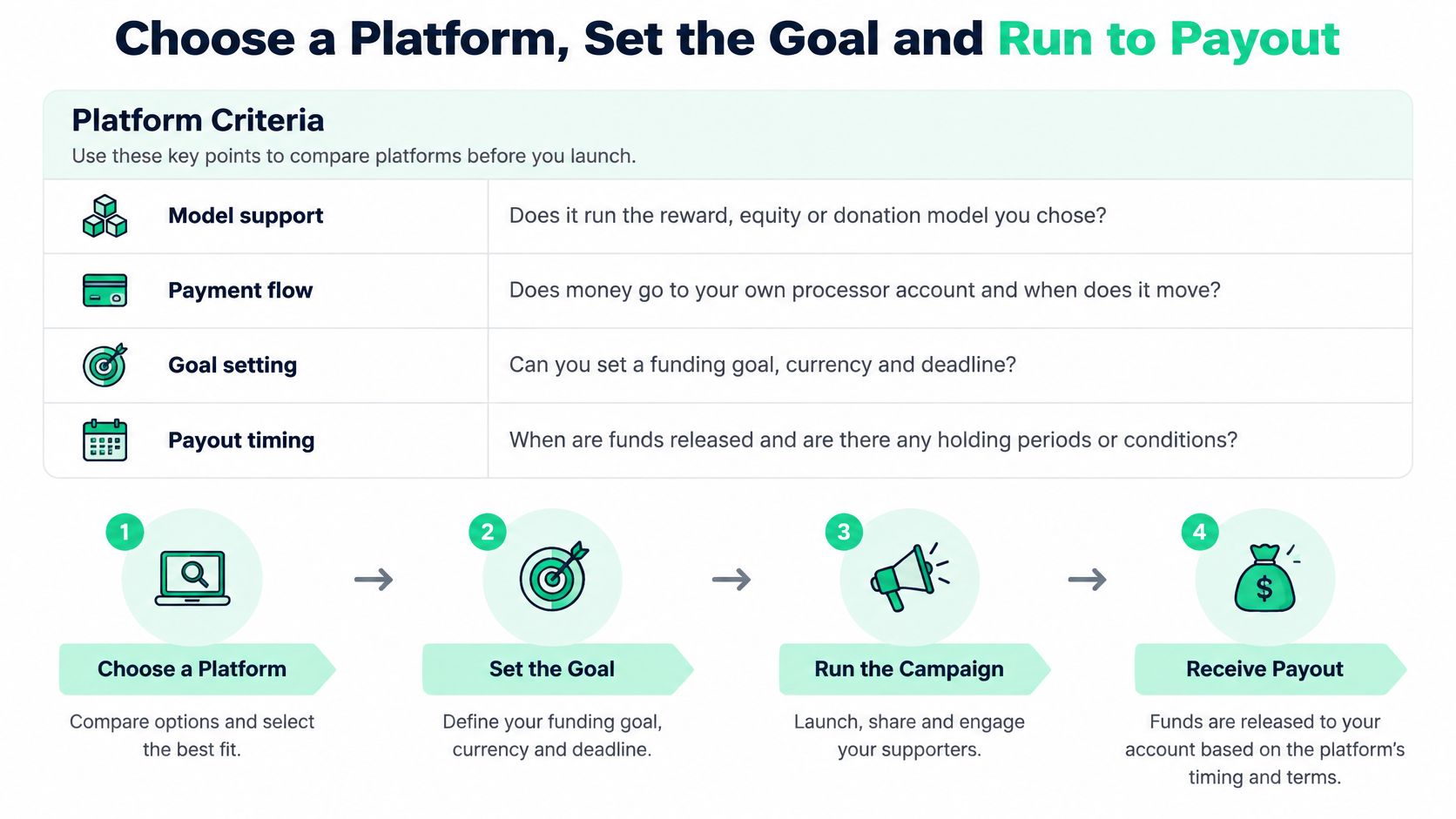
| Criterion | What to check | Red flag |
|---|---|---|
| Model support | Whether it runs the reward, equity or donation model you chose | Equity-only platform for a product pre-sale |
| Payment flow | Whether funds go to your own processor account and when they move | Platform holds funds and sets its own payout timing |
| Fees | Platform fee, card processing and deductions before transfer | Fees not shown until after launch |
| Category fit | Comparable projects already funded in your category | No comparable campaigns to benchmark your goal |
| Proof tools | Verified data pulled from connected accounts and refreshed automatically | Screenshots or manual numbers only |
Payment flow deserves close reading because payout timing affects when you can order parts or pay contractors. This explanation of crowdfunding payment processing and payout flow helps you separate the moment a backer pays from the moment you can safely spend the money. Ask who holds funds, who can issue refunds, and what happens if a payment account is closed.
Equity platforms sit on a specific legal track. The SEC report on Regulation Crowdfunding explains that the Jumpstart Our Business Startups (JOBS) Act was signed into law on April 5, 2012, and the exemption became available on May 16, 2016. By December 31, 2018, the SEC estimated 1,351 offerings had been initiated, excluding withdrawn filings. Regulatory access therefore created many relatively small offerings, not a simple shortcut around investor scrutiny.
Build the Goal From Costs
Don't start with a round number that sounds ambitious. Start with the minimum viable delivery budget, meaning the smallest amount that lets you deliver every promised reward without cutting corners.
Say a hardware kit costs you $18 to build and $6 to ship in a worked example. For 500 units, that's $12,000 before fees, support, replacements, and a reserve for returns. If your goal doesn't cover that full chain, a successful campaign can still leave you short.
Category matters too. An academic analysis of Kickstarter campaign data finds the effects of project category, campaign theme, launch timing, and funding goal are nonlinear and vary across categories. Test your goal against comparable outcomes, then watch early conversion instead of treating the target as an aspiration.
The short video below walks through the campaign sequence in visual form, which is useful when you're turning these criteria into a launch checklist.
Run to Payout
Choose a fixed window and work it daily. Say you pick a short, defined run so backers have a clear deadline and you have a clear reporting rhythm. Then follow the payout sequence your platform uses.
- Collect funds per platform rules: All-or-nothing platforms move money only when the goal is met, while flexible platforms let creators keep what arrives.
- Deliver or report on schedule: Ship rewards, release access, or publish progress updates at the dates you promised.
- Keep complete records: Save every contribution, reward promise, address change, refund, and delay notice, because missing records turn small problems into disputes.
A completed campaign isn't the day the counter hits your goal. It's funds received, rewards shipped, support answered, and a final backer update that closes the loop. Compare every platform, including newer proof-focused options, on the same five criteria before you share a link.
What a Transparent Campaign Discloses Before Money Moves
Disclosure is the main protection a reward backer has before money moves. Once funds are spent on inventory, contractors, or tooling, getting them back can be slow or impossible. A transparent campaign therefore explains delivery risk while the backer can still choose not to pledge.
State five things in writing. Give delivery milestones with dates, define refund triggers as the conditions under which money goes back, and name the budget reserve you'll keep for replacements or failed units. List manufacturing dependencies such as suppliers, tooling, app review, or a single contractor. Then explain how you'll communicate delay or failure, including how often you'll update backers when news is bad.
Traction Is Not a Delivery Plan
Recurring revenue and user growth can show demand. They don't show that you can manufacture at volume, pass quality checks, handle customs, or support a surge of new users. Pair live business metrics with delivery-risk reporting so backers can judge both appetite and execution.
Say your waitlist is strong but your enclosure supplier hasn't approved the final design. Disclose that dependency and the date you expect approval. Hiding it may lift conversion for a week, then damage trust for the life of the business.
Paid promotion needs the same clarity. If creators, affiliates, or influencers are compensated to promote the campaign, understand how to disclose paid partnerships so endorsements don't look like unpaid enthusiasm. Backers should know which voices were paid to speak.
A delay explained early is a management problem. A delay discovered late feels like deception.
Before pledging, look for the delivery date, the consequence if it slips, the refund route, and evidence the creator has shipped before. If a page offers excitement but no milestones, reserve, or failure plan, treat the missing disclosure as part of the risk, not as a formatting oversight.
Traction Metrics That Build Backer Trust
Backers trust numbers they can check. A dated trend from a connected payment, code, or analytics account carries more weight than a bold claim in a headline. Your job isn't to publish every number you have. It's to publish the few numbers that prove demand, use, and delivery capacity, with caveats attached.
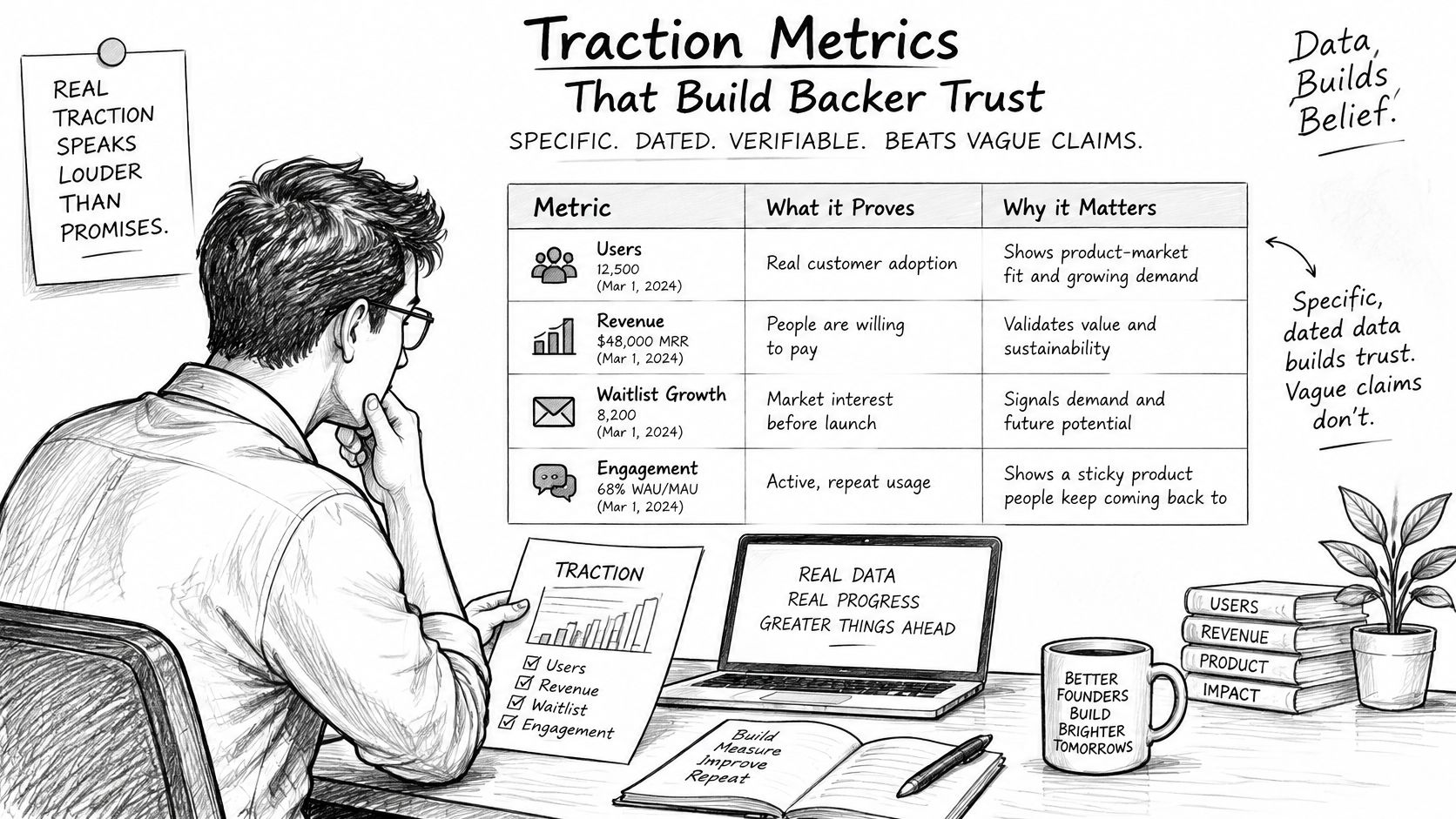
| Metric | What it proves | Caveat to disclose |
|---|---|---|
| Monthly recurring revenue | Paying demand is real | State whether revenue comes from subscriptions or pre-orders |
| Monthly active users | People use the product regularly | Define active and the time window |
| Retention rate | Users keep coming back | Show the cohort and period measured |
| Commit activity | Steady building and shipping | Commits alone do not prove customer demand |
| Refund exposure | How many buyers ask for money back | Disclose the rate and the period it covers |
Monthly recurring revenue, often shortened to MRR, shows customers keep paying. Monthly active users shows people return to use the product, but only if you define active. Opening an app once, logging in, and completing a core task are three different standards.
Read Conflicting Signals Honestly
Rising users with falling retention means acquisition is outpacing value. People arrive, then leave. High revenue with low shipping capacity means demand may exceed your ability to deliver. Frequent code commits without customer growth can mean you're building steadily for a market that hasn't yet proved it wants the product.
None of those signals automatically kills a campaign. Each one tells you what to explain next. If retention is falling, name the cohort and the fix you're testing instead of leading with total signups. If commits are your strongest proof, pair them with user evidence, and compare your claims against benchmarks for startup demand validation so activity doesn't masquerade as demand.
More disclosure isn't automatically better disclosure. A recent analysis of 1,838 European Kickstarter campaigns found sustainability disclosure was associated with substantially higher funds raised and a higher success probability. The lesson isn't to add fashionable claims. It's that clear, comparable, verifiable disclosure can help backers decide.
Use three presentation rules every time. Define each metric and its time window, name its source system, and show the trend over several periods rather than a single screenshot. For concrete page structures, study these crowdfunding campaign examples with visible proof and copy the clarity, not the hype.
Confirm Model, Goal and Proof Before You Launch
Make three decisions in order. First, confirm the model. Choose reward for a validated product, equity only where regulated securities limits fit, and donation for a cause.
Second, confirm the goal against your costed minimum. Include production, shipping, fees, tax set-aside, support, and a reserve. Don't launch with a round number you can't reconcile.
Third, write the disclosures. Set delivery milestones, refund triggers, a budget reserve, and a delay plan before the first pledge arrives. Then publish proof with definitions, sources, and trend lines.
Creating a verified traction page on Fundl is free and does not require any backers, and setting up a project takes about 5 minutes to set the funding goal, campaign timeline, and core project details. Remember the responsibility stays with you. Creators must fulfil the rewards or perks they promised to Funders, and Fundl is not responsible for reward delivery.
Spend one working session setting the goal and drafting disclosures. Create the traction page, check the goal against the costed minimum, then share the campaign link.
Build your campaign around proof backers can verify, not screenshots they have to take on faith. Fundl lets you publish a verified traction page, set a clear reward-based goal, and show live metrics before anyone contributes. Create your page, check it against your delivery plan, and launch only when the numbers and the promise line up.