
Pick the wrong funding route and you'll feel it for years, in equity you can't get back, repayments due in your slowest month, or rewards you promised before you knew you could build them. Pick the right one and the money does more than fund the work. It proves people want what you're making.
That's how you should judge crowdfunding alternatives. Don't start with a list of platforms. Start with three questions. How predictable is your cash flow? How much ownership and control will you give up? And will this route prove demand, or will it just hand you cash and leave the demand question unanswered? Faster capital isn't better capital if it skips the market test and saddles you with a fixed bill.
Table of Contents
- Crowdfunding Alternatives at a Glance
- What Each Option Costs in Equity, Repayment and Control
- Grants, Sponsorships and Angel Capital Entry Requirements
- Which Option Proves Demand Before You Build
- Delivery and Failure Rates Behind Each Option
- Matching Each Option to Your Situation
- Confirm the Funding Path Before You Launch
Crowdfunding Alternatives at a Glance
Reward crowdfunding is one of eight routes, not the default. The right choice depends on how much capital you need, how fast you need it, and what you'll surrender to get it. Use this table as your lookup, then check the details that follow.
| Option | Typical capital | Equity given up | Time to cash | Best for |
|---|---|---|---|---|
| Bootstrapping | Whatever revenue and savings can fund | None | Immediate | Products already earning or low-cost launches |
| Pre-sales | Set by pre-order volume, often low thousands to tens of thousands | None | 2 to 8 weeks of selling | Products with a fixed, short-fulfilment deliverable |
| Reward crowdfunding | Most successful campaigns raise under $10,000 | None | Cash arrives when the campaign closes, typically within its set window | Demand tests and a first production run |
| Revenue-based financing | Advance commonly tied to recent monthly revenue | None | Days to weeks after underwriting | Recurring-revenue businesses with predictable cash flow |
| Grants | Set by the program budget for approved project costs | None | Several months | Research, public-benefit and non-profit-adjacent work |
| Sponsorships | Set by audience size and placement value | None | Weeks | Open-source projects and creator audiences |
| Angel and VC | Often hundreds of thousands to millions at seed | Yes, ownership dilution | 3 to 9 months | Scalable products targeting large markets |
| Equity crowdfunding | Up to $5 million per 12 months under US Regulation Crowdfunding | Yes | Several months, plus compliance | Operating companies able to meet securities rules |
How to read the typical capital column
The scale of reward crowdfunding is real, but so is its ceiling for most creators. Kickstarter's platform statistics had recorded approximately $8.97 billion in total pledges and 282,673 successfully funded projects by July 2025. Historical research on the platform shows almost two-thirds of successfully funded campaigns raised less than $10,000.
That distribution matters more than the headline total. The typical campaign is validation money or first-production money, not venture-scale capital. That's why the table shows typical capital rather than maximum capital. A maximum tells you what's legally or technically possible. A typical figure tells you what to plan around.
If you're raising in the Gulf, a fundraising guide for early-stage UAE founders from Founder Connects is a useful regional reference for how equity routes differ by jurisdiction. Wherever you are, work the table in order. First, find the routes that match your stage. Then check equity and time to cash before you compare anything else. If a route fails on those two columns, its other features won't save it.
What Each Option Costs in Equity, Repayment and Control
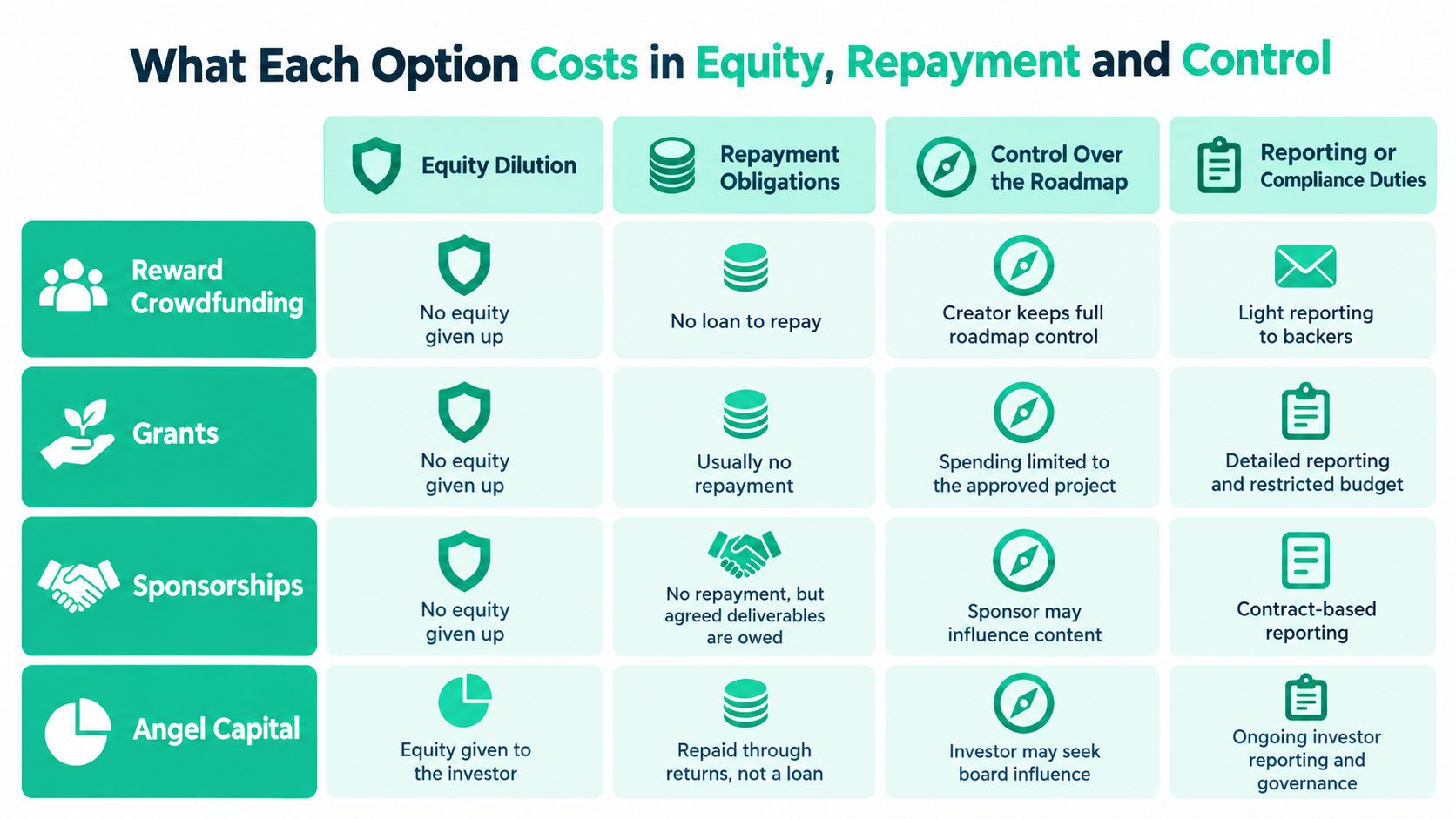
Every route costs you something. The price just shows up in different places: equity dilution, repayment obligations, control over the roadmap, and reporting or compliance duties. Compare routes on all four, not just the cash amount.
Equity dilution
Reward crowdfunding, pre-sales, grants, sponsorships, and revenue-based financing take no equity. You keep full ownership. Our optional reward-based campaign works the same way: contributions are not investments and do not offer equity or financial returns. Angel and VC money dilutes you at signing, and every later round dilutes you again. Equity crowdfunding also dilutes you, spread across many small holders instead of a few large ones.
Dilution isn't automatically bad. It's bad when you give up ownership for capital you could've raised from customers. If buyers will fund the build, don't sell part of the company to fund it.
Repayment obligations
Here's where, "no equity" stops meaning, "no cost." Revenue-based financing has a fixed repayment cap, often expressed as a multiple of the advance, paid as a share of monthly revenue. In strong months that's painless. In weak months the payment still comes out, and it squeezes the cash you need for hosting, contractors, and support.
Reward campaigns and pre-sales carry a different obligation. You owe backers the promised rewards or the product itself, on the date you named. Grants must be spent on approved lines or returned. If you want the trade-offs between debt, equity, and revenue models in one place, the Capital Express financing comparison guide lays out how each structure behaves once repayments start.
Money you never repay and never share is the cheapest only when delivery is realistic.
Control and compliance
Control follows the money, but to different degrees. Bootstrapping and pre-sales leave your roadmap entirely yours, though pre-sale buyers lock you to the deliverable they paid for. Sponsors may ask for placement or content input. Angels often want a board seat or at least a say on major decisions. VC money usually brings board structure, milestone expectations, and pressure toward a large exit whether or not that still fits your plan.
Compliance is where equity crowdfunding separates itself. The SEC guidance on Regulation Crowdfunding for issuers states that an issuer may raise up to $5 million during a rolling 12-month period, while non-accredited investors face investment limits capped at $124,000 across offerings. The same guidance context reports 8,492 offerings and approximately $1.339 billion in total reported capital raised from May 2016 through December 2024.
Those numbers show a working market, but they also show the price of admission: securities disclosures, ongoing reporting, and investor administration. Take on that burden only when your capital need genuinely exceeds what customers will pre-fund and you can staff the compliance work. For a clear deliverable with a short fulfilment cycle, reward or pre-order funding is the simpler, cheaper instrument.
Grants, Sponsorships and Angel Capital Entry Requirements
These three routes share one trait: someone else approves you. Each asks for different evidence, and each stalls for a predictable reason.
Grants require your project to match the program's stated purpose. You'll submit a detailed budget, restrict spending to approved lines, and file periodic narrative and financial reports, sometimes alongside matching funds. Applications stall when the project is good but the fit is vague. A missed report can trigger a clawback, so treat reporting as part of the funding, not paperwork after it. If you're comparing non-dilutive routes more broadly, our guide to non-dilutive funding options for startups covers how grants sit alongside the other no-equity choices.
Sponsorships require an audience the sponsor can measure. That means newsletter subscribers, GitHub stars and contributors, course enrolments, or download counts, plus a defined placement such as a README badge, a sponsor page, or a named mention in release notes. Deals stall when you pitch reach you can't document. Bring screenshots from the actual analytics tool and name the exact placement, duration, and renewal date.
Angel and VC require traction, a credible founder track record, and a pitch showing a path to a large outcome. Prepare your revenue history, growth rate, churn, and market sizing with the assumptions visible. The most common stall is simple: the market is too small to return the fund's check size, so the conversation stays polite and goes nowhere. A solo SaaS with steady profits usually fits sponsorships or grants better. An open-source team with a real user base can credibly approach all three, but should lead with sponsorships, where its audience is the asset.
Which Option Proves Demand Before You Build
Sort the routes by the evidence they create, and the choice gets clearer. Some funding proves customers want the product. Some only prove a funder approved your paperwork.
Direct proof versus borrowed proof
Pre-sales and reward campaigns generate paying or pledging customers. That's direct demand proof you can count. Bootstrapping proves demand only if revenue already exists. Before that, it proves you can spend your own money, which isn't the same signal.
Revenue-based financing needs existing revenue, so it confirms demand that already happened. It can't test a new idea. Grants prove credibility with a funder, not with buyers. A grant panel saying yes tells you nothing about whether users will pay at renewal. Equity rounds sit in between. Investors demand traction before they commit, so a closed round reflects evidence you gathered elsewhere. The round itself doesn't create that evidence.
The test to run: Pick a fixed period, then record visitors, pledges, and conversion every week. If conversion holds as traffic grows beyond your own network, you have demand. If it only works with people who know you, you have goodwill.
The case against skipping the public test
Private, fast money is tempting, and it's growing. Monitor Daily's reporting on small-business lending in 2025 states that non-bank lenders reportedly reached 23% of small-business financing in 2024, up from 18% in 2023. Another survey covered there found 76% of small businesses with working-capital loans avoided applying for traditional bank loans, up from 62% in late 2023.
Speed has a hidden cost. Financing that skips a public campaign removes the market test a campaign would've given you, and it adds repayment risk on an unvalidated product. You can end up owing money on something nobody confirmed they wanted. A campaign, run properly, is fundraising and market research at the same time. If you need a structured way to run that test first, follow our process for validating a startup idea before you commit budget.
On Fundl, every project displays live, source-verified data pulled directly from connected platforms, and backers can see these numbers before they back a project. We connect to Stripe to show revenue (MRR), GitHub to show commit activity, and analytics or other audience signals to show audience size. That turns your campaign page into evidence rather than a promise. Backers aren't trusting your screenshot. They're reading the same numbers your own tools report.
Delivery and Failure Rates Behind Each Option
Raising the money and shipping the product are two different scores. Confuse them and you will misjudge every funding route in front of you.
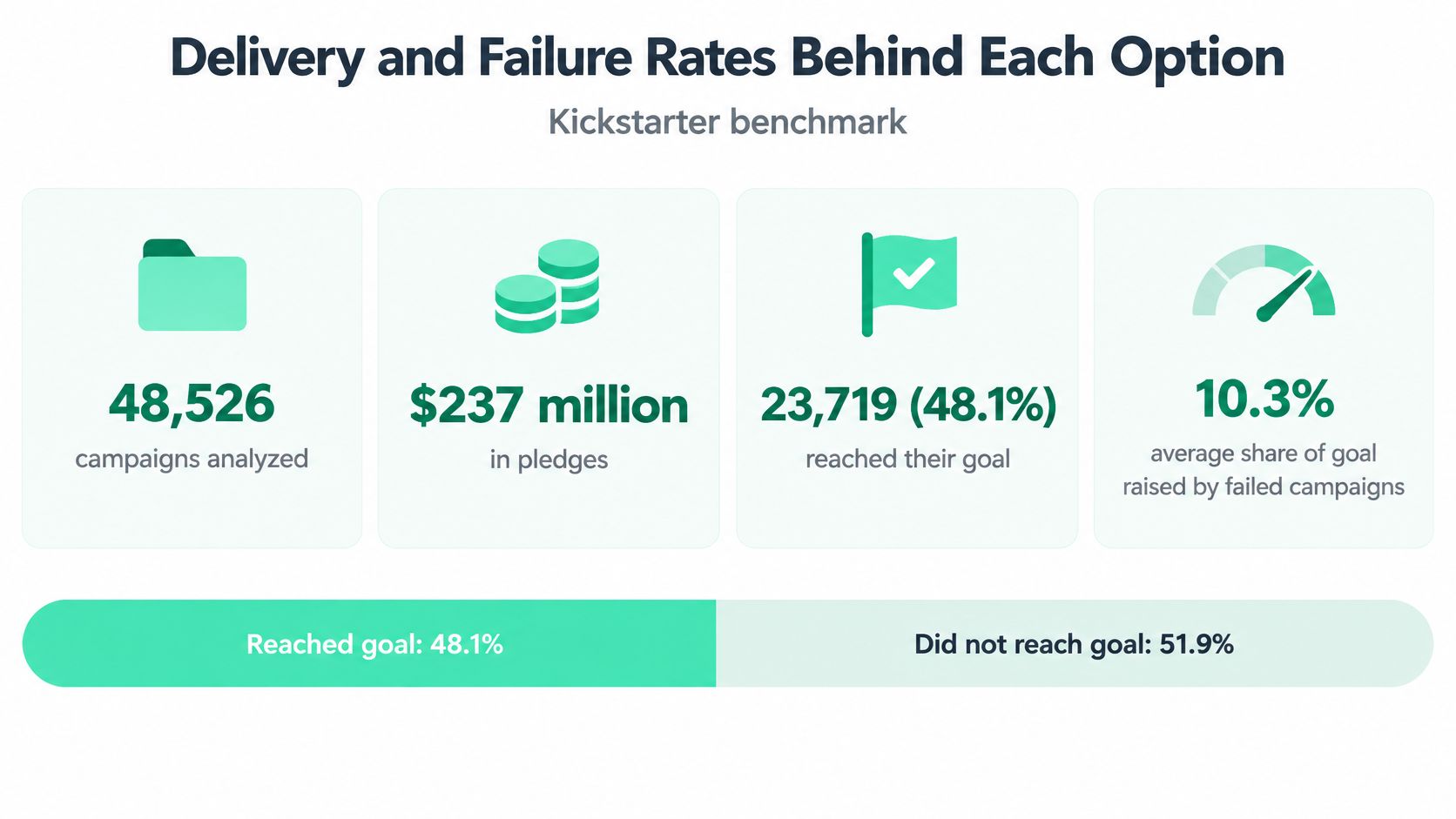
The first score has hard numbers behind it. In one analysis of 48,526 campaigns representing $237 million in pledges, covered in the Dynamics of Crowdfunding research paper, 23,719 campaigns (48.1%) reached their funding goal. Failed campaigns averaged only 10.3% of goal and about $900 in pledges, against $7,825 for successful campaigns. Most failures were visible early. A campaign going nowhere usually shows it inside the first week.
Delivery is the second score, and it runs harsher. Many crowdfunded projects arrive late or never ship, so treat every promised reward as a liability you owe. On Fundl, creators must fulfil the rewards or perks they promised funders; Fundl is not responsible for reward delivery and does not guarantee that any project will be completed or any reward delivered. Because contributions move straight into the creator's own Stripe account with no platform-held escrow, a funder chasing a refund contacts the creator first, then raises a dispute through Stripe or their card issuer if the creator stays silent. Write your milestones and refund rules down before you take the first contribution. A late shipment turns revenue you already counted into refund requests, and that hits cash flow while you are already behind.
Failure patterns by route
| Option | Typical failure pattern | Early warning sign |
|---|---|---|
| Reward crowdfunding | Goal missed, or rewards delivered late | Pledge velocity flat in the first week |
| Pre-sales | Deliverable slips past the promised date | Batch sold before production scope is fixed |
| Bootstrapping | Runway ends before revenue arrives | Less than three months of cash on hand |
| Revenue-based financing | Fixed repayments squeeze cash in slow months | Repayment share rising faster than monthly revenue |
| Grants | Late or incomplete reports trigger a clawback | Milestone reports overdue by more than one cycle |
| Sponsorships | Sponsors do not renew after one cycle | No renewal conversation before the cycle ends |
| Angel and VC | Milestones missed before the next round | Monthly burn running above the agreed plan |
| Equity crowdfunding | Investors cannot sell for years | Reporting obligations slipping while capital is still unspent |
Each row fails in its own way, so watch the warning sign that belongs to your route. The video below shows how campaign shortfalls develop in practice and what creators miss when pledges stall.
Track two KPIs separately and you will read your own results with clear eyes. Use funding conversion for demand: visitors, pledges, and goal attainment. Use milestone completion and delivery latency for execution: how many promised milestones shipped, and how late. A campaign can score well on the first measure and badly on the second. If you only measure the raise, you will call it a success right up until the refund requests start pulling cash back out.
Matching Each Option to Your Situation
Stage decides the answer. The same route that's smart for a SaaS with predictable churn will sink a pre-revenue tool. Find your row first.
| Situation | Best fit | Avoid |
|---|---|---|
| Solo SaaS under about $2,000 MRR needing validation | Reward crowdfunding or pre-sales | Revenue-based financing |
| SaaS above $10,000 MRR with predictable churn | Revenue-based financing | Equity you do not need |
| Open-source team seeking community money | Sponsorships plus a reward tier | Venture capital before adoption |
| Course or AI tool creator with early traction | Pre-sales with a fixed cohort | Equity crowdfunding |
| Hardware or physical run needing fixed capital | Pre-sales with customer deposits | Revenue-based financing without margin to cover repayments |
| Research or public-benefit tool | Grants | Angel expectations of fast growth |
| Startup targeting a large market and needing $2 million or more | Angel or seed VC | Reward crowdfunding alone |
Why these fits work
A solo SaaS under about $2,000 in monthly recurring revenue doesn't need scale capital. It needs proof that strangers will pay. A reward campaign or a small pre-sale delivers that proof and the cash together. Revenue-based financing fails here because there's no revenue base to underwrite and no cushion for repayment in a soft month.
Above $10,000 MRR with predictable churn, the logic flips. Demand is already proven, cash flow is forecastable, and a revenue-based advance can fund a hire or a migration without dilution. Taking equity at that point, when you don't need it, is the expensive option. You'd sell ownership to buy something your own revenue stream could finance.
Say you're an open-source team instead. Your asset is adoption, not revenue, so sponsorships convert that adoption into funding and a reward tier gives individual users a way to contribute. Venture capital before adoption is a dead end because there's no revenue story yet and the return path is unclear. A course or AI tool creator with early traction should pre-sell a fixed cohort. The cohort caps your delivery obligation, funds production, and tells you the actual price buyers accept. Equity crowdfunding adds securities compliance to what's really a product launch.
Hardware changes the math again. A production run needs a fixed sum by a fixed date, and customer deposits match that shape. Revenue-based repayments don't, because thin hardware margins leave nothing to service them before units ship. A research or public-benefit tool belongs in grants, where the funder's purpose matches your output and nobody expects a venture return. If you genuinely need $2 million or more to contest a large market, raise angel or seed VC money. Reward campaigns rarely reach that scale, and pretending otherwise wastes a season. For a fuller walkthrough by stage, see our guide on how to get startup funding.
Routes also combine. Pre-sell a first batch, then use sponsorships to fund maintenance once users depend on the tool. Let a stage change trigger a switch: when recurring revenue becomes predictable, refinancing growth from revenue beats giving up more equity. Judge each switch on cash-flow predictability, repayment capacity, dilution tolerance, and demand proof. Not on platform features.
Confirm the Funding Path Before You Launch
Work through these steps in order before you commit money or time. Each one kills a specific mistake.
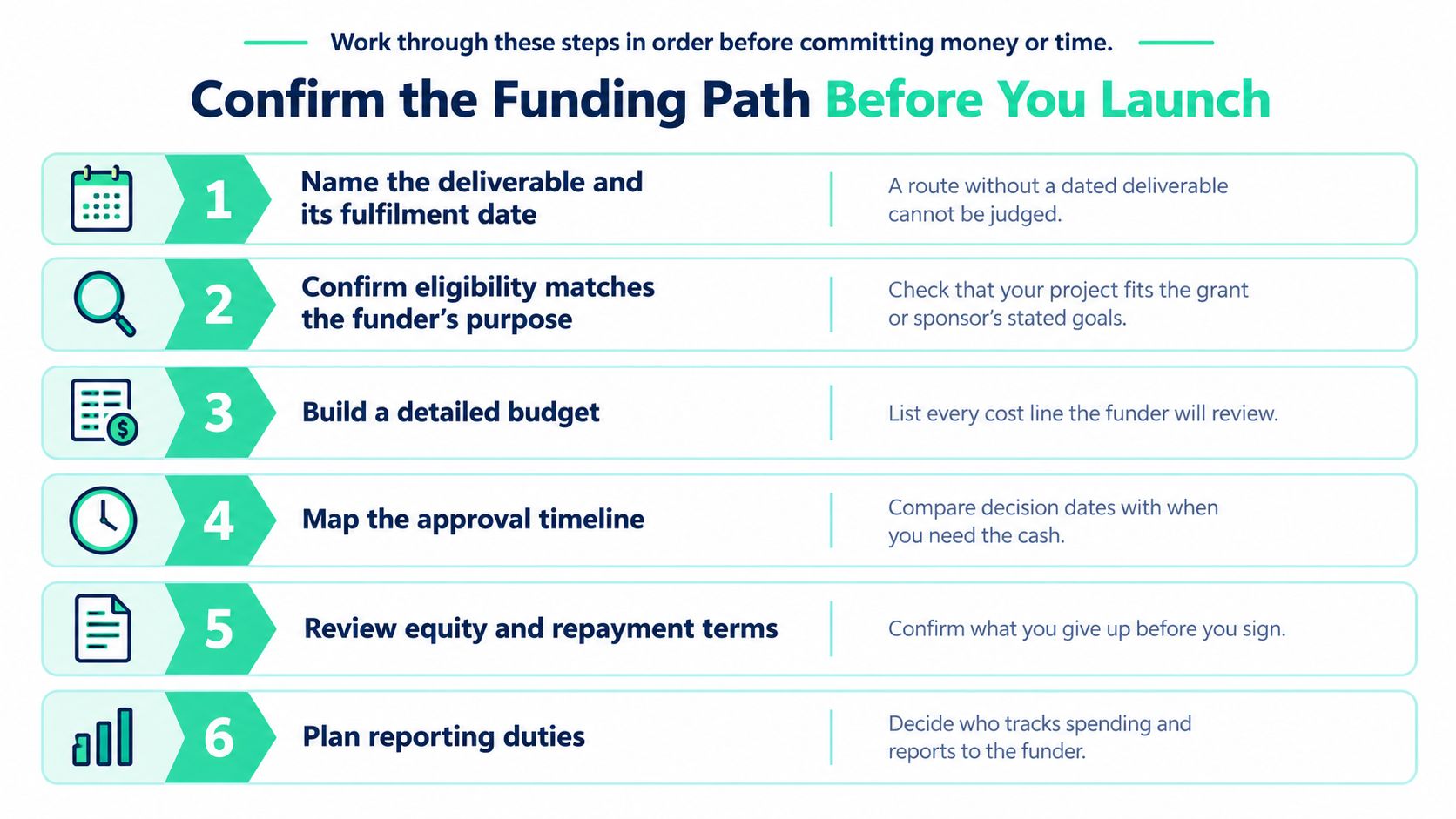
- Name the deliverable and its date: State exactly what the money funds and when it's fulfilled, because a route without a dated deliverable can't be judged.
- Test your weakest month: Check monthly cash flow and confirm any repayment or fixed cost still works in your worst recent month, not your average one.
- Set your limits in writing: Decide how much dilution, board involvement, and reporting you'll accept, then write that limit down before any negotiation starts.
- Run a demand test: Pre-sell or run a small campaign first, using a weekly record of visitors, pledges, and conversion.
- Verify every published metric: Make sure each figure comes from a source system such as Stripe, GitHub, or your analytics tool, and that it's time-stamped, not a screenshot you cropped.
- Separate the four evidence layers: Check verified demand or revenue, execution activity, fulfilment capacity, and terms and risk as four distinct questions.
That last step matters because a fully funded campaign can still fail on delivery, liquidity, or repayment. The MarketIntelo crowdfunding market report notes, in its 2025 market commentary, that equity-crowdfunding positions can remain illiquid for 5 to 10 years and reported platform success rates vary widely, roughly 55% to 80%, depending on platform and the definition of success. Funding alone doesn't clear the other layers. Backers who know this will check them, so prepare the evidence for each one.
If you publish a traction page with us, the mechanics are simple. Creating a verified traction page on Fundl is free and doesn't require any backers, and setting up a project takes about 5 minutes, covering your funding goal, campaign timeline, and core project details. We charge a platform fee on each successful contribution, deducted from the contribution amount before it's transferred to you, and contributions go to your connected Stripe account, which must be valid. Then do the final step: pick the one route that matches your stage, run the small test, and only then commit to a larger raise.
Put your traction where backers can verify it instead of asking them to trust a pitch. With Fundl, you can publish live, source-verified metrics from Stripe, GitHub, and your analytics, then run a reward-based campaign on the strength of real numbers. Create your free traction page today and let your next funding decision start from evidence.