
What good is a perfectly chosen launch date if your most likely backers aren't watching, your latest release is unstable, and your revenue screenshot is already outdated? A strong product can still open to silence when its creator treats launch day as the beginning of promotion rather than the moment prepared supporters act.
The best time to launch a crowdfunding campaign is when audience availability, product readiness, and verifiable traction line up. A midweek slot helps, but it won't compensate for an untested checkout or a waitlist that hasn't heard from you.
Think of launch day as a coordinated release, not a calendar appointment. This step-by-step launch plan for D2C brands offers a useful companion framework for organizing that work.
Use seven timing levers: weekday windows, waitlists, seasonal gaps, shipping streaks, product milestones, teasers, and campaign length. Tie each decision to evidence backers can inspect, and you'll have a stronger reason to launch than reaching your chosen date.
Table of Contents
- 1. Launch Mid-Week During Your Audience's Active Hours
- 2. Build a Pre-Launch Waitlist Before Going Live
- 3. Avoid Major Holiday and Seasonal Competition
- 4. Launch After a Consistent Shipping Streak
- 5. Time the Launch Around a Product Milestone or Release
- 6. Run a Short Pre-Launch Teaser With Live Metrics
- 7. Plan a Campaign Window Long Enough to Build Momentum
- 7 Timing Strategies Compared
- Pick Your Window, Prove Your Traction, Then Launch
1. Launch Mid-Week During Your Audience's Active Hours
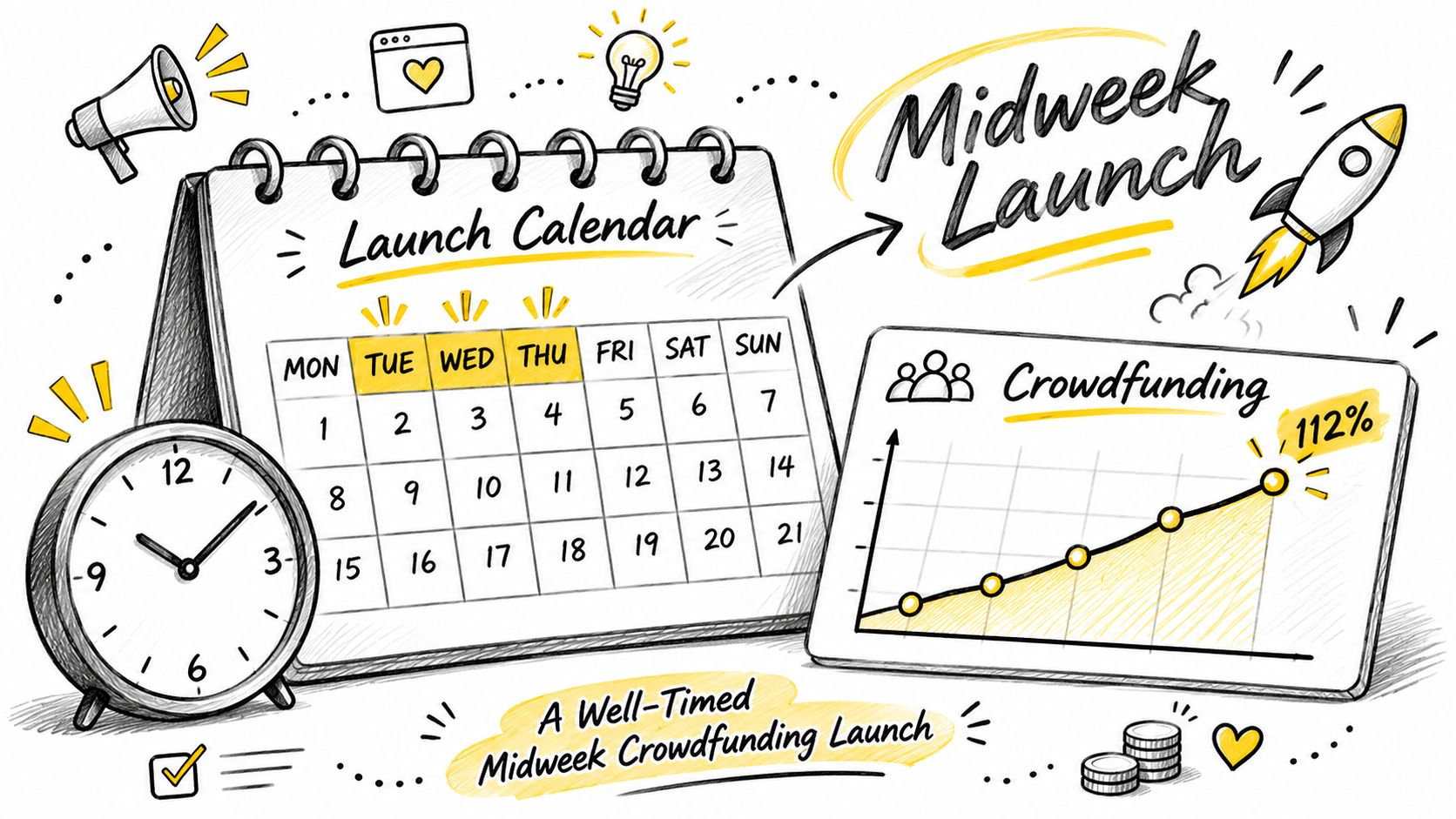
Start with Tuesday, Wednesday, or Thursday, then choose the hour from your audience's behavior. Your own timezone matters less than when prospective backers can open an email, inspect your product, and ask a question.
A review by Adam Webb summarizes a Journal of Engineering Research study of more than 319,000 Kickstarter projects launched between 2009 and 2022, which found higher success rates for weekday launches, particularly Tuesdays, than weekend launches. That supports a weekday preference, not a universal launch hour or a guarantee of success.
Match the window to actual supporters
Say you're a European founder building a developer tool, but most engaged subscribers work in North America. Launching during your morning could mean sending the announcement while those subscribers are asleep. Schedule around their working day and arrange your availability accordingly.
- Check audience location. Compare email engagement, customer locations, and analytics rather than assuming social followers represent likely backers.
- Protect response time. Keep your calendar clear so you can answer reward, compatibility, and payment questions.
- Prepare regional follow-ups. Give supporters elsewhere a relevant announcement when they're active, rather than repeating an identical broadcast.
Test your Stripe connection and inspect the live proof page before announcing anything. Schedule routine posts, but stay available personally.
A slightly less fashionable weekday with an attentive founder beats a Tuesday launch nobody can support. Don't optimize for a launch-platform convention if your own audience behaves differently.
2. Build a Pre-Launch Waitlist Before Going Live
A waitlist isn't ready just because it contains email addresses. It's ready when subscribers understand the product, know what backing involves, and have demonstrated interest beyond collecting a free resource.
Research from the Swiss Federal Institute of Technology Lausanne, reported by Campagna Crowdfunding, analyzed 16,042 Kickstarter campaigns and found that predictions based on data collected three or four hours after launch were already more than 75% accurate. That makes the opening response worth preparing carefully, although prediction accuracy doesn't establish that early contributions alone cause success.
Separate interest from intent
For a SaaS campaign, send subscribers a working demo and a draft explanation of the rewards. Ask which workflow they'd use, what would prevent them from backing, and whether the proposed offer makes sense.
A developer who replies with an integration question gives you different evidence from someone who joined through a giveaway. GitHub stars can identify people to contact, but they aren't commitments to contribute.
Practical rule: Build your opening plan around people who have responded, tested, or explicitly asked for the launch announcement, not your total follower count.
Use those conversations to shape the funding goal and reward scope. If supporters want access to a stable product, don't replace that offer with a complicated bundle of consulting and future features.
Before launch, let interested subscribers inspect your current revenue, development activity, or audience signals on a shareable proof page. Then make the launch email straightforward: what's live, what support enables, what backers receive, and where they can verify your claims.
3. Avoid Major Holiday and Seasonal Competition
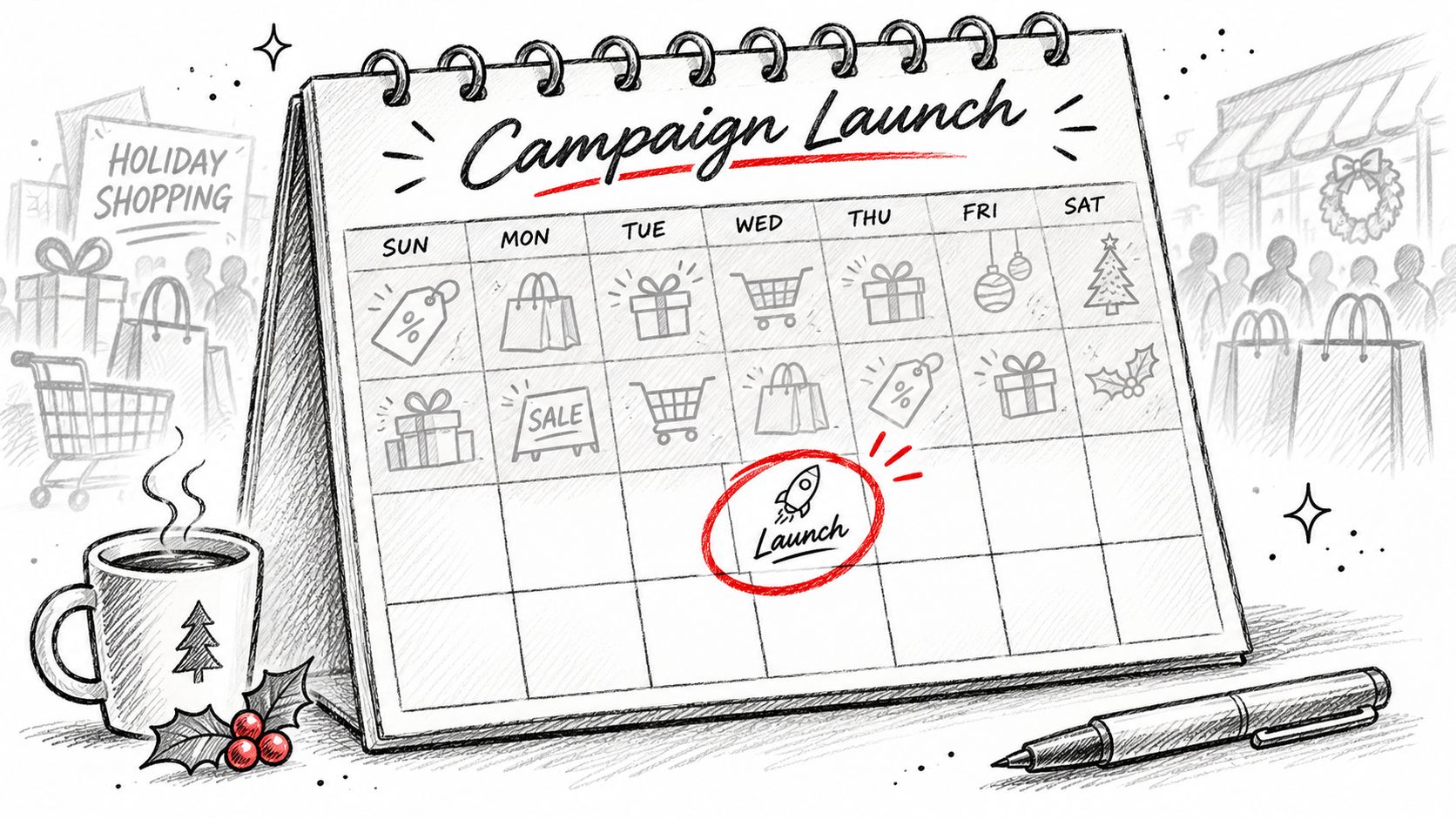
Check your audience's calendar before reserving your own. A quiet week for you might coincide with a national holiday, school vacation, or major industry event in the market where your likely backers live.
An Economics Bulletin study of reward-based crowdfunding on Ulule found contribution volume was 9% lower during summer vacation periods and 14% lower on national holidays. Treat those findings as reasons to examine audience availability, not as a forecast for your particular software campaign.
Choose relevance over a supposedly perfect month
Say you're crowdfunding an AI coding assistant. Launching while your target developers are traveling to a major conference could leave important questions unanswered. But launching alongside a relevant workshop could work if you're participating and attendees can try the product directly.
The distinction is access to an engaged audience, not whether the calendar looks busy.
- Map audience holidays. Check the markets represented in your customer and subscriber lists.
- Check competing commitments. Consider conferences, release freezes, and budgeting periods relevant to your buyers.
- Review your own capacity. Don't launch just before travel or a support blackout.
A holiday-related project may have a legitimate seasonal reason to launch. The approaches in our Christmas fundraising ideas can help distinguish a relevant seasonal offer from a generic appeal competing for attention.
Don't postpone indefinitely for an empty calendar. Choose a manageable window when your strongest proof is current and your audience has a credible reason to care.
4. Launch After a Consistent Shipping Streak
A burst of commits isn't the same as a dependable shipping record. Backers need to understand what changed for users, not merely see that a repository contains activity.
For an open-source developer tool, a useful pre-launch sequence might include resolving installation problems, publishing documentation, improving error messages, and releasing a requested integration. Those changes provide a more persuasive explanation of readiness than cosmetic edits made to fill a contribution graph.
Show a pattern backers can interpret
Prepare your proof page so visitors can connect development activity with usable outcomes. Link release notes, explain the work behind meaningful changes, and distinguish maintenance from new capabilities.
- Make progress legible. Describe the user problem each release addresses.
- Keep definitions consistent. Don't switch between registered users and active users because one looks stronger.
- Explain anomalies. If development pauses while you handle security work or infrastructure migration, say so.
Launch when you can explain the trend honestly, not when you can crop the most flattering screenshot.
Suppose your SaaS revenue has grown because a customer prepaid for a long contract. That's useful commercial evidence, but it shouldn't be presented as recurring growth without the appropriate distinction. Likewise, a busy GitHub repository doesn't establish that onboarding works.
The trade-off is between enough history to demonstrate consistency and waiting so long that you delay useful support. You don't need a flawless upward graph. You need recent progress, clear metric definitions, and a credible explanation of what funding will enable next.
Before announcing, confirm that connected metrics display correctly. A live page helps only when the numbers and your explanation agree.
5. Time the Launch Around a Product Milestone or Release
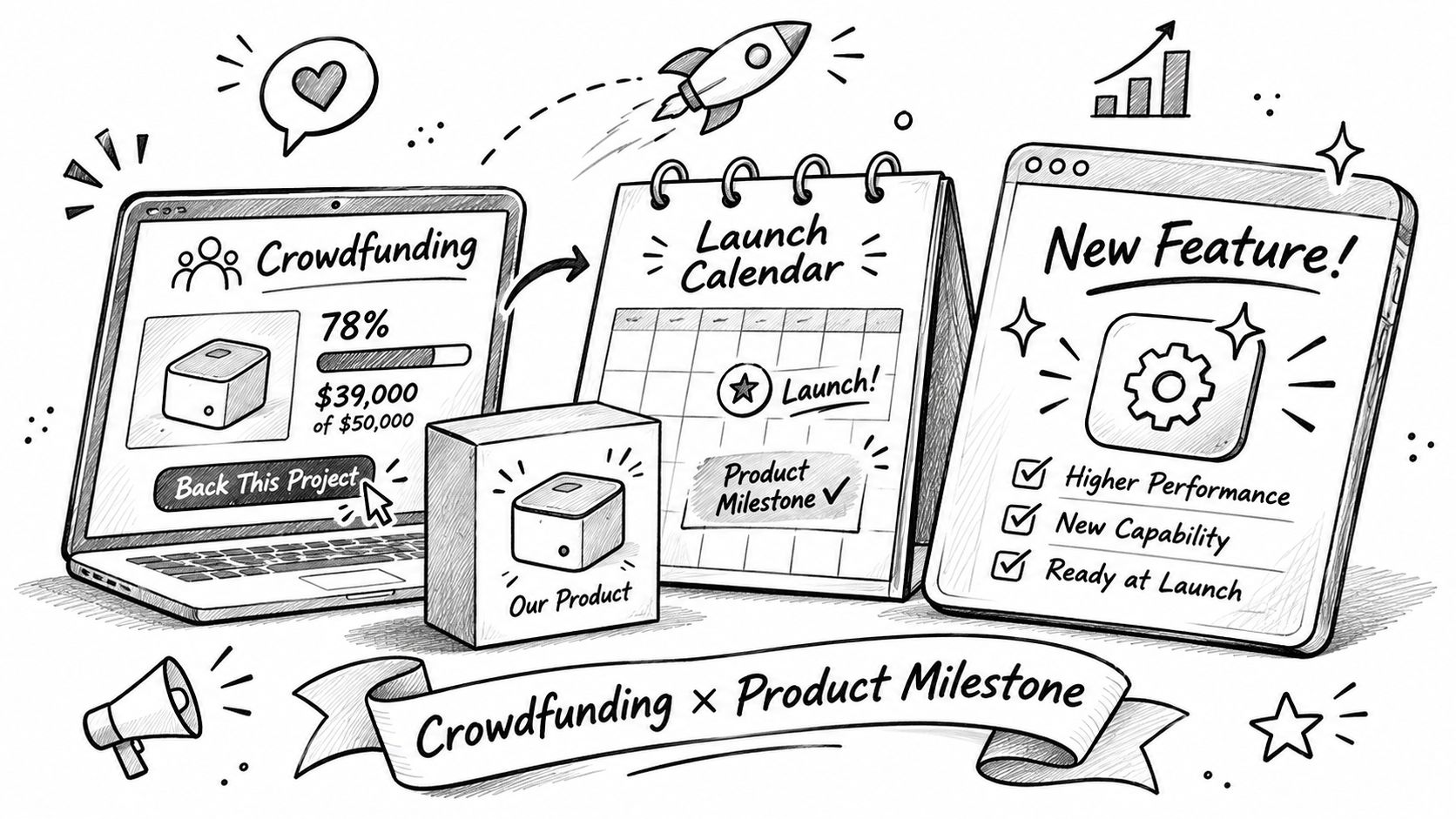
A release gives people a concrete answer to why now? The crowdfunding campaign should explain what supporters can already use and what their contributions will help you deliver next.
Say you're building an education app and have just opened a working beta. That's a stronger launch occasion than announcing an unspecified future course library, provided learners can inspect the experience and you can support access.
Leave room to verify the release
Don't make the funding announcement depend on an untested deployment. Publish the release, check installation or onboarding, resolve blocking issues, and then confirm the campaign date.
Use project milestone tracking to separate completed work from funded commitments. Your campaign should make that boundary obvious: available now, being validated, and planned after funding.
For a software release, include:
- A usable demonstration. Show the actual workflow rather than a concept animation.
- Release notes. Explain what changed and who benefits.
- Relevant traction. Pair the release with current usage or revenue evidence where available.
- Deliverable rewards. Offer access, recognition, or support you can realistically fulfill.
You can reuse the release explanation when turning releases into social posts, but keep the claims consistent across channels.
A milestone doesn't have to be dramatic. Reliable onboarding can justify a campaign better than an ambitious feature that still fails during demos. Launch after the milestone becomes usable evidence, not merely after you've announced it.
6. Run a Short Pre-Launch Teaser With Live Metrics
A teaser should help visitors decide whether to return. A countdown without a working product, meaningful evidence, or a clear offer asks people to remember another date.
For a no-code automation tool, publish a short demonstration, explain the task it handles, and display relevant current traction. Add an email signup that explicitly promises a campaign announcement, so subscribers know what they're agreeing to receive.
Give visitors something worth checking
Choose metrics that answer a backer's likely questions. Recurring revenue can indicate paying demand, active-user signals can show ongoing use, and GitHub activity can provide context about development.
None of those proves future delivery. Explain what each metric measures and avoid implying that verified inputs validate every claim on the page.
- Use current evidence. Replace stale screenshots with source-connected metrics where possible.
- Keep the offer clear. Explain the intended reward and what the funding supports.
- Make the date conditional internally. Don't promote a firm countdown until the product and payment flow are ready.
- Send useful reminders. Share a release improvement or answered objection alongside the launch reminder.
Readiness test: If the teaser attracts questions you can't answer clearly, fix the offer before increasing promotion.
A short teaser period creates a preparation window without requiring an endless public buildup. End it when subscribers understand the proposition and your operational checks are complete.
Don't keep extending the countdown to manufacture anticipation. If you must delay, explain what changed and update the page. An honest revised date is better than implying readiness you haven't achieved.
7. Plan a Campaign Window Long Enough to Build Momentum
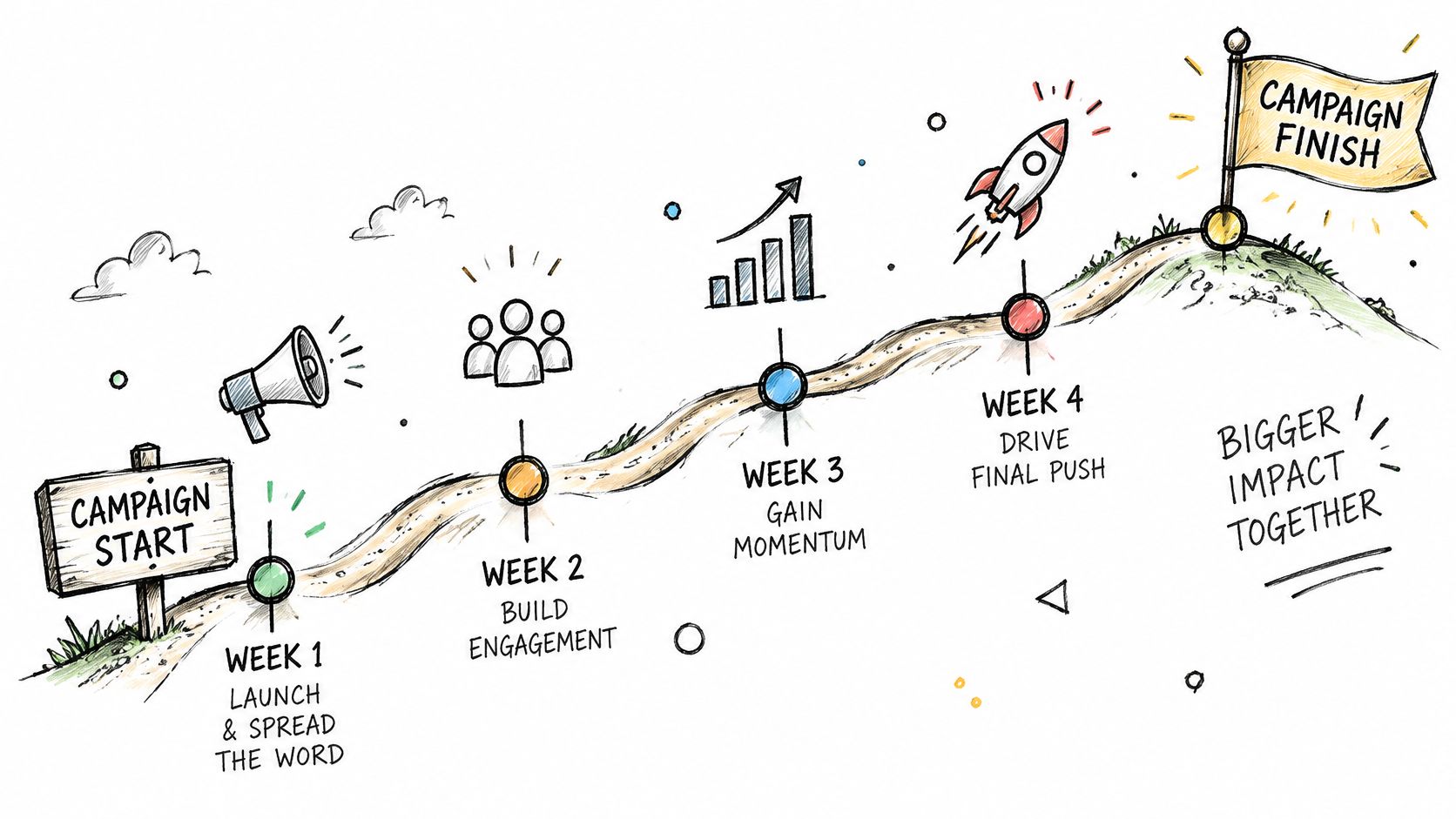
Choose the campaign duration by working backward from the outreach you can deliver. You need room for the opening announcement, substantive proof updates, follow-up conversations, and a clear closing reminder.
University of Texas at Dallas research reported by Dallas Innovates found contributions were highest during the first 10 days, and campaigns were likely to fail unless they reached more than 70% of their funding goal within the first 20 days. Treat that historical pattern as a warning against depending on a late rescue, not a mandatory benchmark for every platform or category.
Plan updates before choosing the deadline
Suppose you're funding an open-source integration. Your opening announcement can demonstrate the current implementation, a later update can address compatibility questions, and the closing message can clarify the remaining work and reward commitments.
Use a campaign launch plan template to assign each announcement an owner, audience, and supporting asset.
Shorter windows demand more preparation. They leave less time to resolve misunderstandings or reach people who missed the opening announcement. Longer windows require sustained communication and enough genuine progress to justify repeated attention.
Don't add time merely because you hope strangers will discover the campaign. Set the initial goal around the work you can responsibly deliver, then choose a window you can actively support.
Live metrics can keep the proof current throughout the campaign, but you still need to explain changes. A refreshed number is context, not a substitute for an update.
7 Timing Strategies Compared
| Strategy | Timing Focus | Best For | Main Risk |
|---|---|---|---|
| Launch Mid-Week During Your Audience's Active Hours | Tuesday to Thursday during peak hours in your main audience's time zone | Reaching active backers, press, and communities early | Competing launches and limited coverage across time zones |
| Build a Pre-Launch Waitlist Before Going Live | Several weeks of audience-building before launch | Generating day-one contributions and validating demand | A small list may not create enough momentum |
| Avoid Major Holiday and Seasonal Competition | Choose a quieter period outside major shopping seasons and industry events | Standing out when attention and promotional noise are lower | Quiet periods may also bring less traffic |
| Launch After a Consistent Shipping Streak | After several weeks of steady commits, releases, or metric growth | Building credibility through visible, ongoing progress | Delaying launch or showing weak metrics may hurt momentum and trust |
| Time the Launch Around a Product Milestone or Release | Pair the campaign with a release, beta opening, or major feature | Creating a timely announcement with a clear news hook | Release delays or launch-day bugs can undermine trust |
| Run a Short Pre-Launch Teaser With Live Metrics | Keep a teaser page live for a few weeks before launch | Building anticipation and testing messaging with early followers | Weak or outdated metrics may discourage interest |
| Plan a Campaign Window Long Enough to Build Momentum | Allow time for multiple promotion waves and a final push | Reaching varied audiences and responding to feedback | Momentum may fade during a long campaign |
Pick Your Window, Prove Your Traction, Then Launch
The best time to launch a crowdfunding campaign isn't a date you discover in a universal calendar. It's the earliest sensible window when your audience is prepared, your product works, and your claims can withstand inspection.
Start with a midweek slot outside major distractions in your audience's markets. Check when engaged subscribers are active, then make sure you'll be available to answer questions and resolve payment or access problems.
Put readiness ahead of calendar preferences
Build the waitlist before announcing the campaign, and use a short teaser to test whether people understand the offer. Review their questions carefully: confusion about rewards, product availability, or funding use is a reason to improve the page, not to send more promotional posts.
Launch after a visible shipping streak or a usable milestone. Show what's complete, explain what remains, and keep your metrics consistent with the story you're telling.
- Choose a provisional window. Match audience availability with your capacity to support the launch.
- Prepare the evidence. Check connected metrics, release notes, demonstrations, and reward details.
- Confirm readiness. Test the page and payment flow before sending the announcement.
Fundl lets you create a free, source-verified traction page, with project setup taking about five minutes. You can share current evidence before asking anyone to contribute, rather than building your entire pitch around promises.
Once that page is ready, identify relevant communities and use this curated list of startup directories to evaluate additional distribution opportunities. Select places where prospective users already look for products like yours, rather than submitting everywhere indiscriminately.
Pick a provisional launch date today, then attach it to concrete readiness conditions. If those conditions are met, launch confidently; if they aren't, fix the missing piece instead of hoping the weekday will compensate.
Create a free verified traction page with Fundl, connect your revenue, GitHub activity, or audience signals, and give prospective backers a shareable view of your progress. Use that evidence to choose your launch window, prepare your opening audience, and launch a reward-based campaign when you're ready.