
You have a product that works, a handful of paying users, and a page that needs to go live this week. The goal field is empty. The budget section is empty. Somewhere in the back of your mind is the easier version of this task: write something moving, set a round number like $20,000, and let momentum handle the rest.
That version is why so many campaigns raise nothing. A fund me page isn't a persuasive essay with a payment button bolted on. It's a proof document: a costed goal, a line-item budget, and metrics a stranger can check without having to trust you. Build it in that order and the writing gets simpler, because every sentence has something factual underneath it.
Table of Contents
- Set a Measurable Goal and Deadline First
- How to Write and Publish Your Page Step by Step
- Add Proof Backers Can Check
- Tell a Story That Holds Up Under Scrutiny
- Share the Page and Keep Backers Updated
- Launch Your Page After This Final Check
Set a Measurable Goal and Deadline First
The most common failure on a fund me page isn't a weak story. It's a request for help with no number attached, or a number picked because it sounds ambitious rather than because it was calculated.
Cost the work before you choose a target. Decide the single outcome you're promising, then add up what delivering it costs. Payment processing comes off every contribution. Tax is owed on what lands in your account. Rewards have to be produced and shipped. Refunds happen when delivery slips. And at least one supplier will be late, because one always is. A goal that ignores those lines is a promise you can't keep even at full funding.
| Cost line | What it covers | How to estimate |
|---|---|---|
| Payment processing | Stripe standard fees plus the Fundl platform fee taken from each contribution | Apply the current published rates to your target amount |
| Taxes | Tax owed on funds you receive | Confirm the amount with an accountant for your region |
| Fulfilment and shipping | Rewards or perks you promised backers | Unit cost multiplied by the number of rewards you expect to deliver |
| Refund reserve | Refunds you may owe if delivery fails | Set aside a share of the target based on how risky your rewards are |
| Contingency | Overruns, delays and unexpected costs | Add a fixed amount sized to how many delivery steps depend on outside suppliers |
Only once those rows are filled do you have a defensible number. If the sum comes out at $7,400, your goal is $7,400, not $15,000 with room to look serious.
The evidence on goal size is blunt. A long-term analysis of crowdfunding projects found that successful campaigns generally used lower funding goals, shorter durations, and more active engagement than unsuccessful ones, and only about 46% of the projects in its dataset succeeded, according to the study of crowdfunding dynamics. The same analysis cites Kickstarter's platform statistics at roughly 42% overall success, with projects that clear 20% of their goal far more likely to finish, about 79%. Momentum is real, and a smaller number is easier to build momentum against.
Work with a guide to setting realistic funding goals while you do this arithmetic, and keep the staged structure it recommends: a minimum viable target, the exact deliverable made available at that level, and stretch goals added only after the core promise is fully costed.
The one-sentence test: if you can't say what the money buys and by when, the goal isn't set yet, no matter how good the copy reads.
Set the deadline from the work itself. If the contractor needs four weeks and shipping adds ten days, your campaign closes before that clock starts, not after. Round numbers chosen for tidiness tend to expire mid-delivery, which is the fastest way to turn supporters into refund requests.
After the campaign closes, the thing you watch changes from planning to delivery. ShipTeaser's checklist of post-launch performance signals covers what to track in those first weeks, and it pairs well with the budget you just built. Before you write a single line of public copy, you should be holding one goal figure, one deadline, and one sentence stating what the money buys.
How to Write and Publish Your Page Step by Step
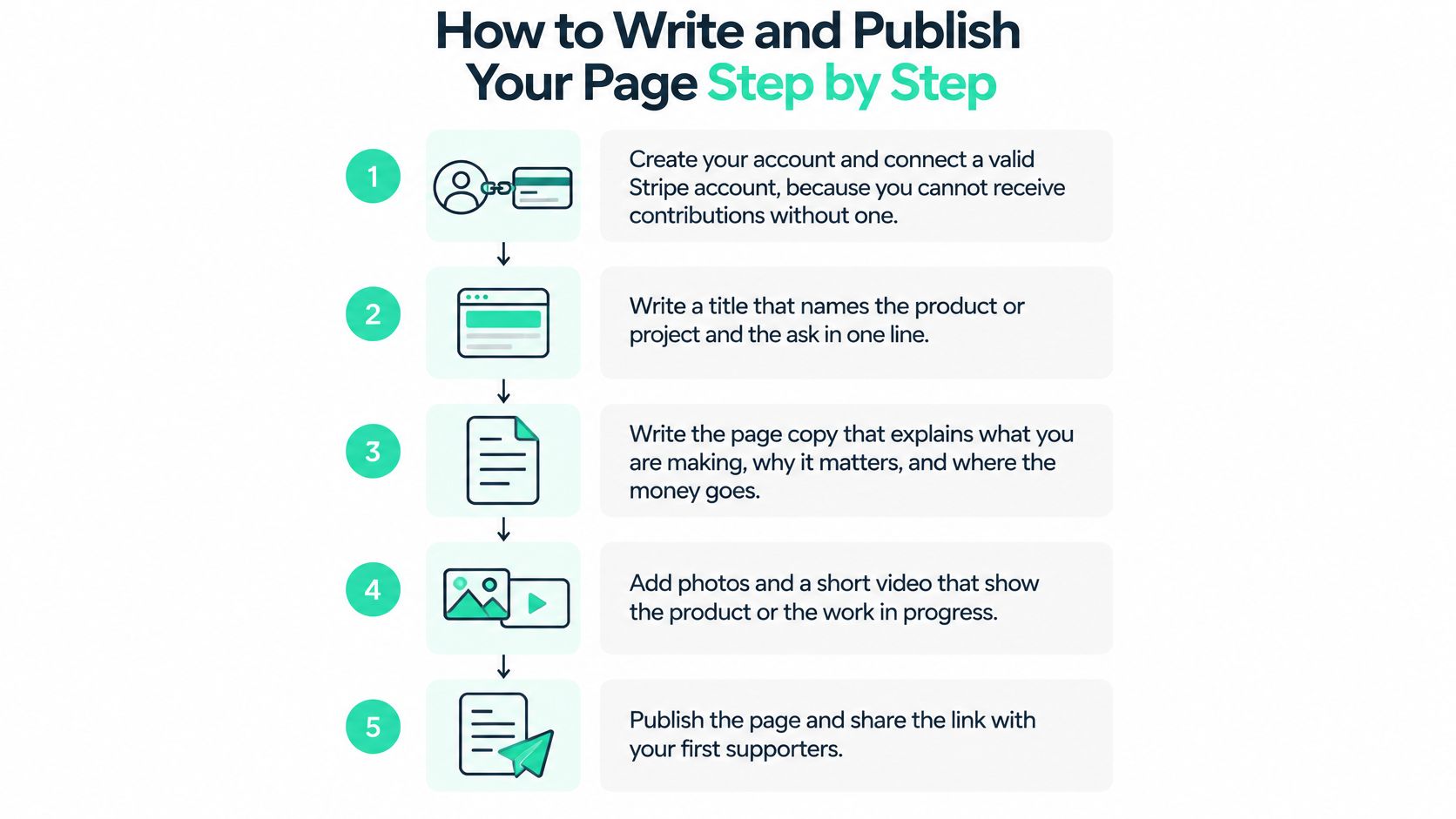
The build itself is short. Setting up a project on Fundl takes about 5 minutes and covers the funding goal, campaign timeline, and core project details. What takes longer is the budget and the writing, and that's where pages are won. Here is the order I'd work in.
- Create your account and connect Stripe first. Creators must connect a valid Stripe account to receive contributions, so confirm it's fully live before writing anything. The usual slip is connecting a test or restricted account and finding out at launch.
- Write the title. Name the product or project and the ask in one line. A specific title, like an export tool for Postgres plus the version you're funding, beats a clever phrase nobody searches for.
- Write the opening paragraph. Three sentences: the problem, who it helps, what the money changes. If it won't compress into three, the offer isn't clear enough to publish yet.
- Enter the goal and deadline from your worksheet. Copy the number you calculated, not an approximation. A goal entered without processing and fulfilment costs is the single most common page error.
- Add a line-item budget. Every row of the worksheet gets an amount and a plain description. A budget that lists only a total tells a backer nothing about whether you've thought it through.
- Add a cover image or short video of real work. Your desk, the prototype, the failing test suite being fixed. Stock photography reads as stock photography, and backers notice within two seconds.
- Connect your data sources. Link Stripe revenue, GitHub commits, or analytics users so the figures refresh on their own rather than being screenshotted once and left to rot.
- Preview on a phone. Many visitors will meet this page on a small screen. Check that every number on it has a source and a stated update cadence before you go further.
- Publish and copy the clean URL. One link, no tracking parameters, no login wall. That link is the thing you'll paste into every message for the next six weeks.
Where the build actually slows down
Steps 1, 4, 5, 8 and 9 are mechanical and fast. Steps 2, 3, 6 and 7 are where a page either becomes credible or joins the pile, because they depend on the story and the proof layer rather than on the form fields.
A complete page just before publishing has a title that states the ask, an opening that a stranger understands on first read, a costed goal, a budget broken into rows, real imagery, and at least one metric pulled from a connected tool. If any of those is missing, you're publishing a draft.
Add Proof Backers Can Check
The first question in a backer's head isn't whether your project is interesting. It's whether it's real and whether it's moving. Every claim on the page should answer that with something a stranger can open and verify in a couple of clicks.
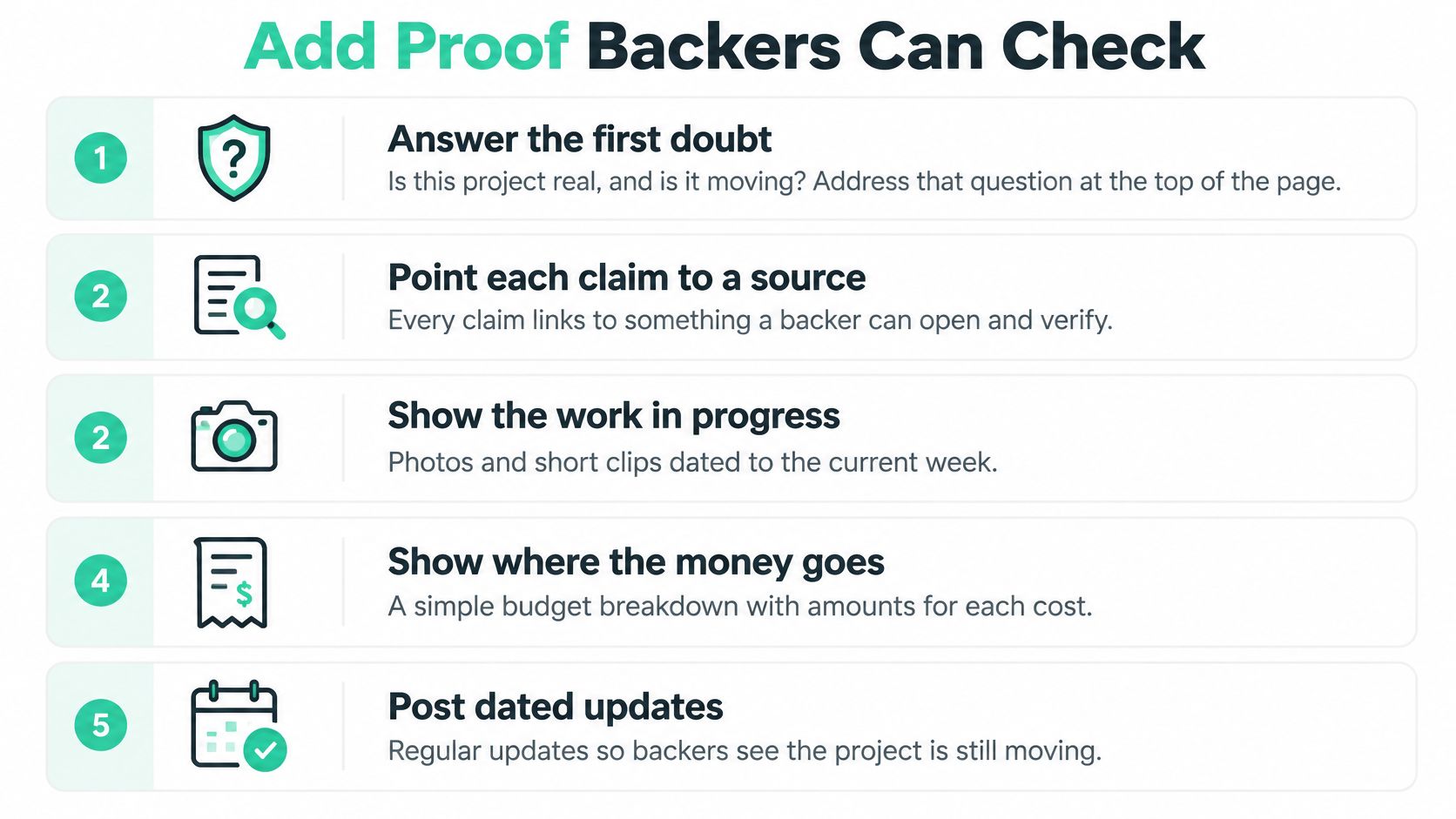
| Proof type | What it shows backers | Source to link | Update cadence |
|---|---|---|---|
| Revenue | Recurring income from paying customers | Connected Stripe account | Refreshes automatically once connected |
| Build activity | Consistent shipping over time | Connected GitHub repository | Refreshes automatically once connected |
| Audience | Active users or reach | Connected analytics tool | Refreshes automatically once connected |
| Milestones | Progress against the funding goal | Dated receipts, release notes or photos | At each milestone |
| Team and identity | Who stands behind the project | Real name or a stated reason for anonymity | Once, then whenever it changes |
The stakes here are larger than most founders assume. U.S. Regulation Crowdfunding filings from May 16, 2016 through December 31, 2024 included 8,492 offerings from 7,134 issuers, but only 3,869 of them reported proceeds, totaling roughly $1.34 billion, according to SEC Regulation Crowdfunding data. The same dataset records 990 withdrawn offerings. Publishing a page has never been the same thing as funding one.
Momentum is information
Campaign design, communication and network effects all shape outcomes, and early support matters more than many expect. A peer-reviewed study of crowdfunding for scientific research reported a 48% success rate in its sample against a cited 36% for Kickstarter projects, and a broader review it draws on identified 106 success factors, finding that lower minimum contributions, attractive supporter benefits, and a credible plan for using funds all improve the odds, as detailed in the PLOS ONE crowdfunding study. Projects with more early supporters or investors tend to have a higher probability of reaching their objective.
That means early traction should be visible as a number, not implied through adjectives. If four people have backed you, show four.
Label verified and projected separately
Every Fundl project displays live, source-verified data pulled directly from connected platforms, and backers can see those numbers before they back a project. The discipline that matters is keeping two categories visibly apart:
- Verified: pulled from a connected source, with the date and the tool named.
- Projected: your own forecast, labeled as an estimate, with the assumption behind it stated in one line.
Say a developer shows commit activity across the last twelve weeks from a connected repository, then adds a clearly marked estimate of next month's users with the growth assumption written out. That reads as competence. A single undated chart mixing both reads as marketing.
The creator verification process explains what identity and source checks involve before you publish. Run one audit before launch: every number on the page has a source, a date, and a plain-English reading that tells a non-technical backer what it means.
Tell a Story That Holds Up Under Scrutiny
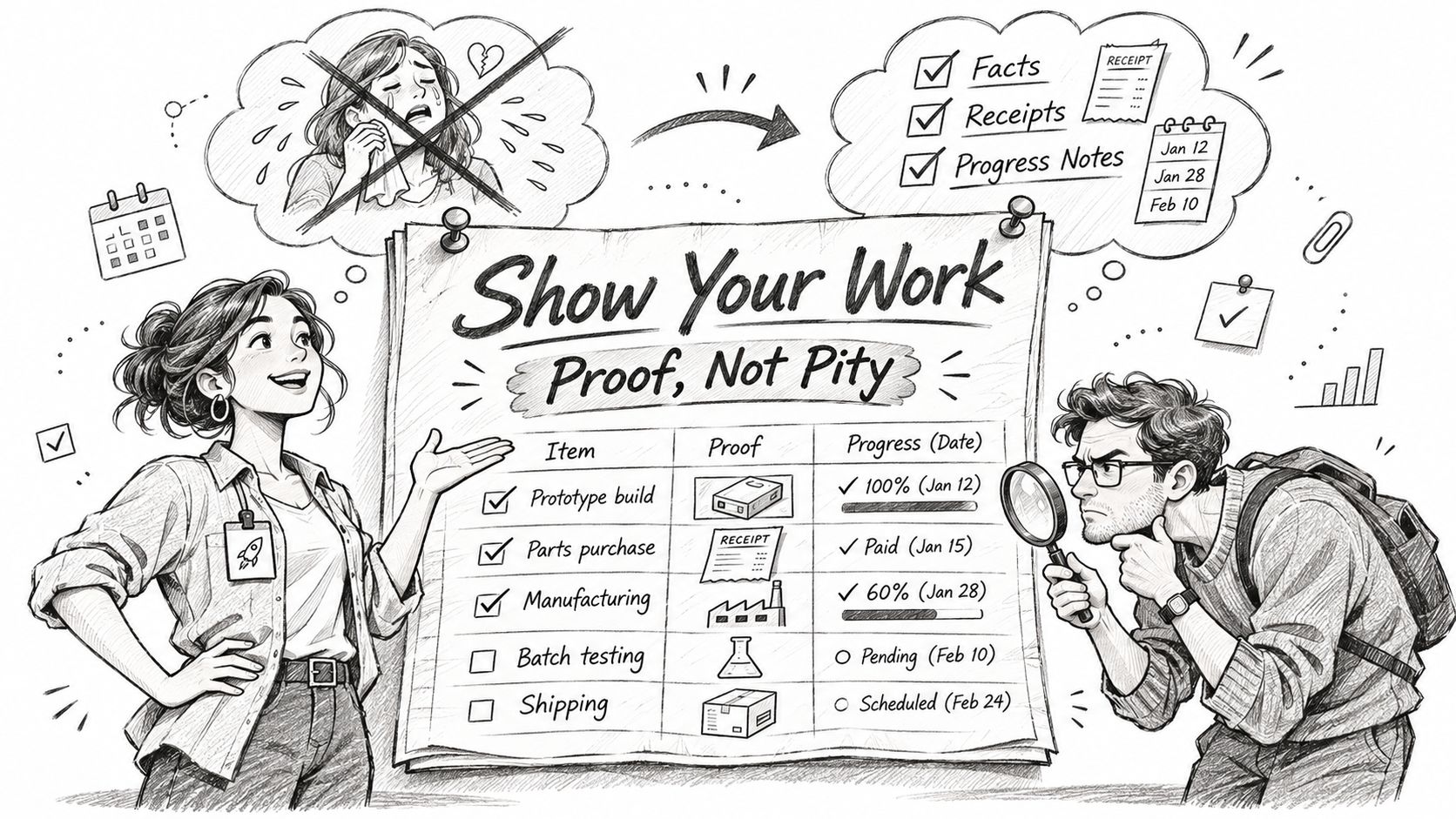
The instinct is to open with urgency. A deadline, a setback, a make-or-break moment. Resist it, because the evidence runs the other way: a 2025 study of 204 Kickstarter campaigns found that subjective credibility cues such as attractiveness and perceived trustworthiness were especially influential in fraudulent campaigns, while functional expertise carried more weight for legitimate ones, per the Journal of Medical Internet Research analysis. Polish persuades people to trust the wrong projects. Evidence persuades them to trust the right ones.
Backers worry about a short, consistent list of things: impersonation, fabricated claims, money spent on something other than what was described, private details exposed, and vague disclosure of what the funds correspond to. Every one of those is answered by structure rather than by tone.
The four-part story, in order
Write it in this sequence and the page holds up under a second read.
- The problem, one paragraph, concrete and specific to who experiences it.
- What you've built or are building, described in terms someone outside your field can follow.
- What the funds change, tied directly to the budget rows.
- Who you are, real name and role, or a clear explanation of why you're anonymous and what verification stands in for it.
Share your role and experience. Don't share a home address, a family member's medical details, or anything that becomes a privacy problem the moment the page gets traffic.
Vague goals and unclear outcomes are themselves a warning signal, which is why the budget does more persuasive work than any adjective. Compare two sentences a stranger might read:
We need support to grow.
The $6,000 goal covers four weeks of contractor work on the export feature, which is the top request from our 140 paying users.
The second one tells a backer what the money buys and why you're the person who can deliver it. The first asks them to feel something and hope.
One more thing belongs in plain words: contributions on Fundl are paid directly to your own Stripe account, and Fundl does not hold creators' funds. Say who controls the money on the page itself. A stranger who can't tell where their payment goes will assume the worst, and they'll be right to ask.
The video below walks through the same principle from the backer's side, which is worth watching before you finalize your draft.
Run the stranger test when you're done. Someone with no context should be able to say what the money buys, by when, and why you specifically can deliver it. If they can't answer all three, the story isn't finished.
Share the Page and Keep Backers Updated
The first 48 hours decide how the rest of the campaign feels. Early contributions build the visible number that later visitors use as a shortcut, so treat the opening two days as scheduled work, not as something that happens after you post once.
Make a named list of 20 to 30 people who already know your work: past clients, beta users who emailed you, the developer who filed the bug you fixed in March. Message each one individually. A group blast to a list of strangers converts close to nothing, and it also signals that you don't have real relationships to draw on.
Then post where self-promotion is allowed, and read each community's rules before you do. A launch post in a subreddit that bans launch posts costs you the account and the audience.
Message template that works: the problem in one line, one verified number, the link. Nothing else. Backers contribute through Stripe Checkout after they've seen the verified data, so the link itself carries the pitch.
Keep a rhythm after launch. Post a progress update weekly or at each milestone, and put a fresh verified number in it rather than restating the promise. Answer every public question within a day. When someone complains, reply in good faith and fix the thing, because a visible, competent reply often influences later backers more than the original page copy did.
If you're distributing the same update across several channels, PostSyncer's walkthrough on how to distribute one post to every network saves you from rewriting it five times and from posting something different on each platform by accident.
A short list of things that damage campaigns:
- Buying followers or fake supporters. It shows in the engagement ratio and experienced backers spot it.
- Changing the goal mid-campaign without an explanation. If the scope changed, say so and say why.
- Long updates. Three sentences and a number beat six paragraphs of gratitude.
- Going silent after a setback. Silence reads as collapse. A dated update about a delay builds more trust than a smooth week with no news.
The crowdfunding promotion playbook covers channel-by-channel sequencing if you want a fuller distribution plan. By the end of this step you should have a shared link, a contacted list of named people, and a dated update schedule you'll keep.
Launch Your Page After This Final Check
Verdict: if the goal came off the worksheet, the budget has line items, every number is labeled verified or projected with a source, and the Stripe connection is live, publish today. If any figure on the page lacks a source, hold it until it has one.
Holding costs you nothing. Publishing an unsourced number costs you the one thing a campaign can't rebuild, which is the assumption that what you say is accurate.
Fundl is built for this specific shape of page. Creating a verified traction page is free and doesn't require any backers to start, setup runs about 5 minutes for the core project details, and connecting Stripe, GitHub and analytics lets the page display monthly recurring revenue, weekly commit activity and audience size that refresh on their own. Each project gets one shareable URL that holds all of its live metrics in one link.
Create the page, copy the link, and send it to your first 20 named contacts this week. That's the whole launch.
A fund me page on Fundl is a proof document by default: a costed goal, a line-item budget and live metrics pulled from Stripe, GitHub and your analytics, all behind one shareable URL that backers can inspect before they contribute. Creating it is free, needs no existing backers, and takes about five minutes to set the goal, timeline and project details. Start your page at Fundl and send the link to the people who already know your work.