
Setup takes about 15 minutes on Fundl when you define your goals, connect Stripe, GitHub, and analytics, then publish a clean URL people can back. That speed matters because a campaign lives or dies on whether visitors see proof, not just promise.
You're probably staring at a draft page right now, wondering why it still feels soft. The copy might be polished, the visuals might be decent, but if a backer can't verify traction, the page asks them to trust you on faith.
Table of Contents
- Why Traditional Crowdfunding Fails Most Creators
- Setting Up Your Campaign on Fundl
- The Evidence-First Approach to Crowdfunding
- Evidence Campaigns vs Traditional Campaigns
- Pre-launch and Launch Day Tactics
- Post-Launch Communication and Growth
Why Traditional Crowdfunding Fails Most Creators
The classic crowdfunding page often looks strong and still underperforms. Creators spend days on a pitch video, reward tiers, and a polished story, then the page opens with a promise that nobody can verify yet. That's where the friction starts, especially for software products where buyers are already trained to look for evidence before they commit.

Historical crowdfunding research finds that smaller funding targets are associated with higher success, while failed projects raise a mean of only 10.3% of their stated goal. Only 10% of failed projects reach 30% of their target, and just 3% reach 50% (Wiley research). That pattern tells you something blunt, if the goal is too aspirational or the proof is thin, visitors read the campaign as a wish list instead of a live opportunity.
The trust problem is bigger than the story
A strong story still helps, but story alone doesn't answer the question backers care about most, which is whether the thing is already moving. In SaaS and developer products, that usually means showing current users, commits, revenue, or shipping activity, not just a promise about what you'll build next.
Practical rule: if a visitor has to infer traction from good writing, the page is doing too much work for them.
That's why evidence-first campaigns feel different. They don't ask for blind belief up front, they show enough live signal that the backer can connect the contribution to an existing pattern of momentum.
For founders learning how to start a campaign, the lesson is simple. Don't build the page around hope and polish alone, build it around proof that can survive scrutiny when the audience is skeptical.
Setting Up Your Campaign on Fundl
Start with a funding target that matches delivery costs, not ambition. If you cannot explain where the money goes in plain terms, the campaign feels abstract, and abstract campaigns are harder to back because people cannot see what their contribution changes.
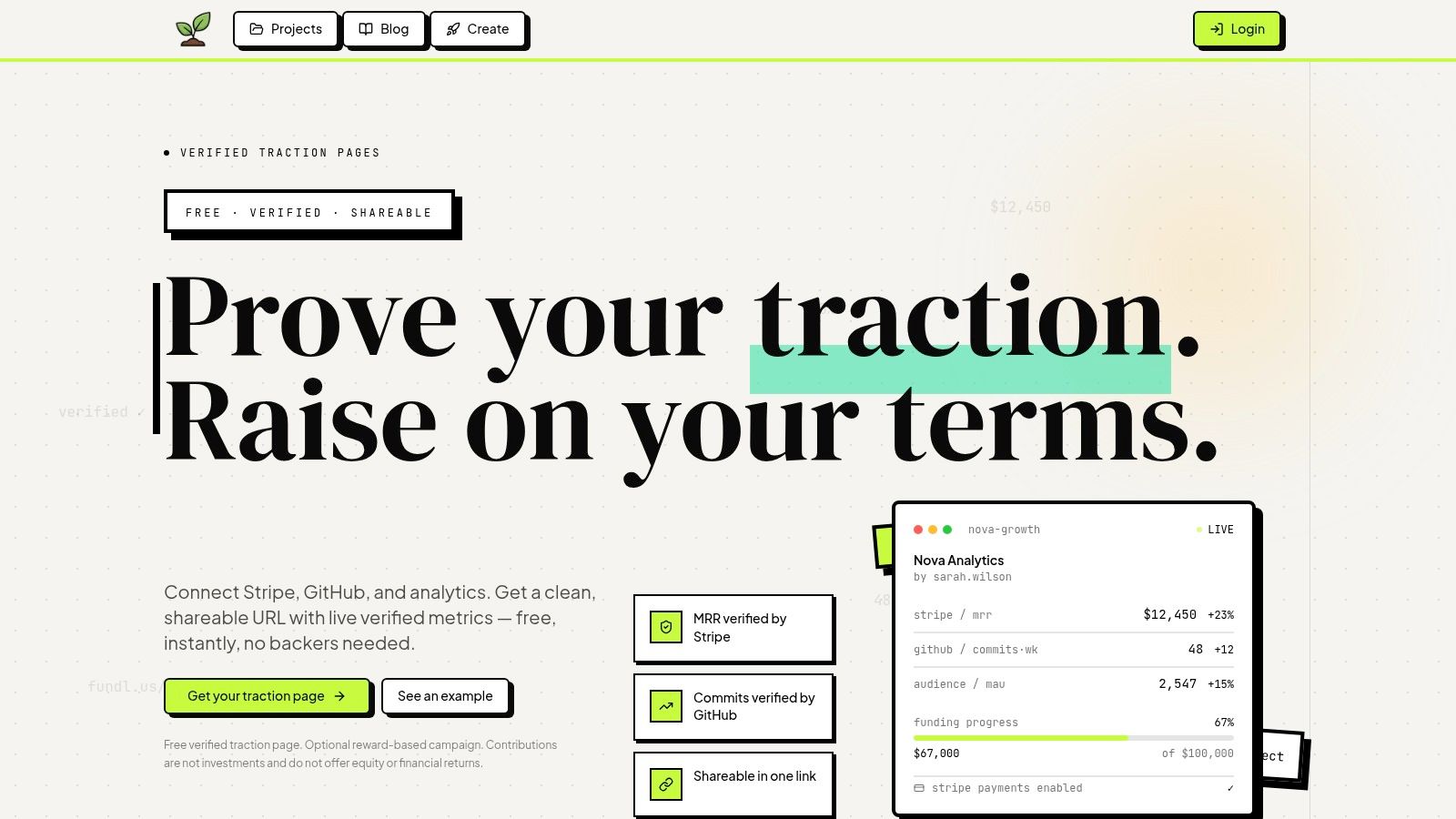
On Fundl, the setup flow is straightforward. You set the goal, connect live data sources, publish the clean URL, and start taking contributions directly. The platform's setup flow is documented in its Fundl's SaaS crowdfunding platform guide, and the order matters more than the clock. Stripe should come first if you want payment data to appear cleanly. Add it last, and you end up backfilling the most sensitive signal after the page is already live.
What to connect first
GitHub comes next for teams that want commits and shipping activity to count as proof. Analytics closes the loop by showing whether the page is attracting attention, or just sitting there. That mix gives visitors a live read on movement instead of a static pitch.
Keep the page divided between promise and evidence. The promise explains what the campaign funds, while the evidence section shows what is already happening now. For SaaS founders, that split usually makes the difference between a page that reads like a request and one that reads like a working product asking for support.
- Set the funding goal from real costs: hosting, contractors, compliance, or product work.
- Connect live sources early: Stripe, GitHub, and analytics give backers a current view instead of a static pitch.
- Keep the URL simple: people share cleaner pages more often when the link is easy to read and explain.
- Write one short use-of-funds breakdown: backers should see where money goes without digging.
If your launch includes video, pair the campaign page with a workflow for scaling video content with automation. Launch assets need to keep pace with the page, and video is usually the first thing that falls behind when a team moves too slowly.
The Evidence-First Approach to Crowdfunding
Transparency works best when it's relevant, not when it's noisy. A 2025 theory-centered review found that transparency is linked to campaign success, but different disclosures can have both positive and negative effects, and product or service characteristics matter more than financial disclosures alone (SAGE review).
That's the core reason live metrics matter. A backer deciding whether to support a SaaS campaign usually wants to know if the product is real, used, and moving, not whether the founder can assemble a dramatic narrative.
Pick metrics that answer one question
Each metric should answer a specific credibility question. Revenue shows whether someone is paying, active users show whether the product is being used, and commits show whether the team is shipping.
Don't dump every available number onto the page. Explain the time window, define the source, and say what a backer should infer from it. That makes the data readable instead of intimidating.
A good evidence page doesn't flood people with numbers. It gives them the minimum proof needed to trust the next step.
Live traction becomes a trust mechanism. Once the page updates itself, every visit can reinforce the same signal, that the project isn't frozen, and that progress is happening in public.
For teams that want practical guidance on what to show and how to format it, data-driven fundraising is the right lens. The goal isn't to reveal everything, it's to publish the evidence backers can verify without guessing.
Evidence Campaigns vs Traditional Campaigns
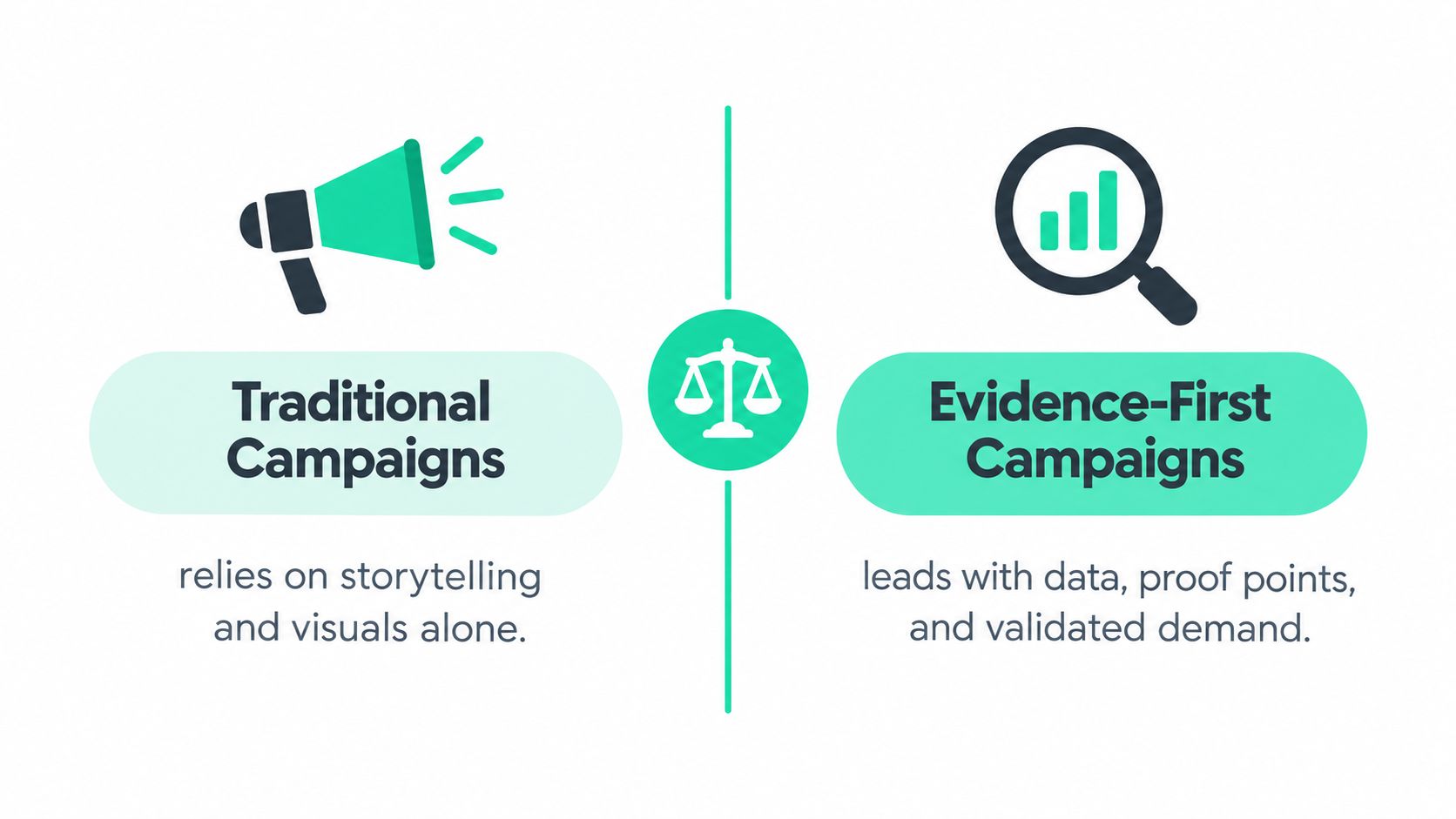
Traditional campaigns lean on mood, visuals, and aspiration. Evidence-first campaigns lean on proof, progress, and a visible record of execution, which is why they tend to fit software products better than one-off consumer items.
The U.S. benchmark makes the scale clear. From 2016 through 2024, the SEC recorded 8,492 initiated Regulation Crowdfunding offerings involving 7,134 issuers, with reported proceeds totaling approximately $1.339 billion, averaging about $346,100 per reporting offering (SEC data). That history shows crowdfunding isn't a niche stunt anymore, it's a real funding channel where structure and proof matter.
Which model fits your product
If you're launching a physical product or an idea-driven brand, a narrative-heavy page can still work well. People respond to emotion, identity, and design when the product itself is easy to understand before purchase.
If you're launching SaaS, AI tools, or developer products, evidence-first usually wins because buyers want validation before they contribute. They're not buying a dream, they're backing a system they can inspect.
Use the model that matches buyer behavior, not the one that looks prettiest in a template.
The trade-off is clear. Traditional pages are easier to launch quickly, but they can feel vague. Evidence-first pages take a little more setup, yet they remove doubt faster once someone lands on them.
Pre-launch and Launch Day Tactics
The first day usually rewards preparation that happened before anyone saw the campaign. Research shows that updates and comments in the first week matter more than those posted later, especially for underperforming campaigns and less-experienced creators (SAGE study).
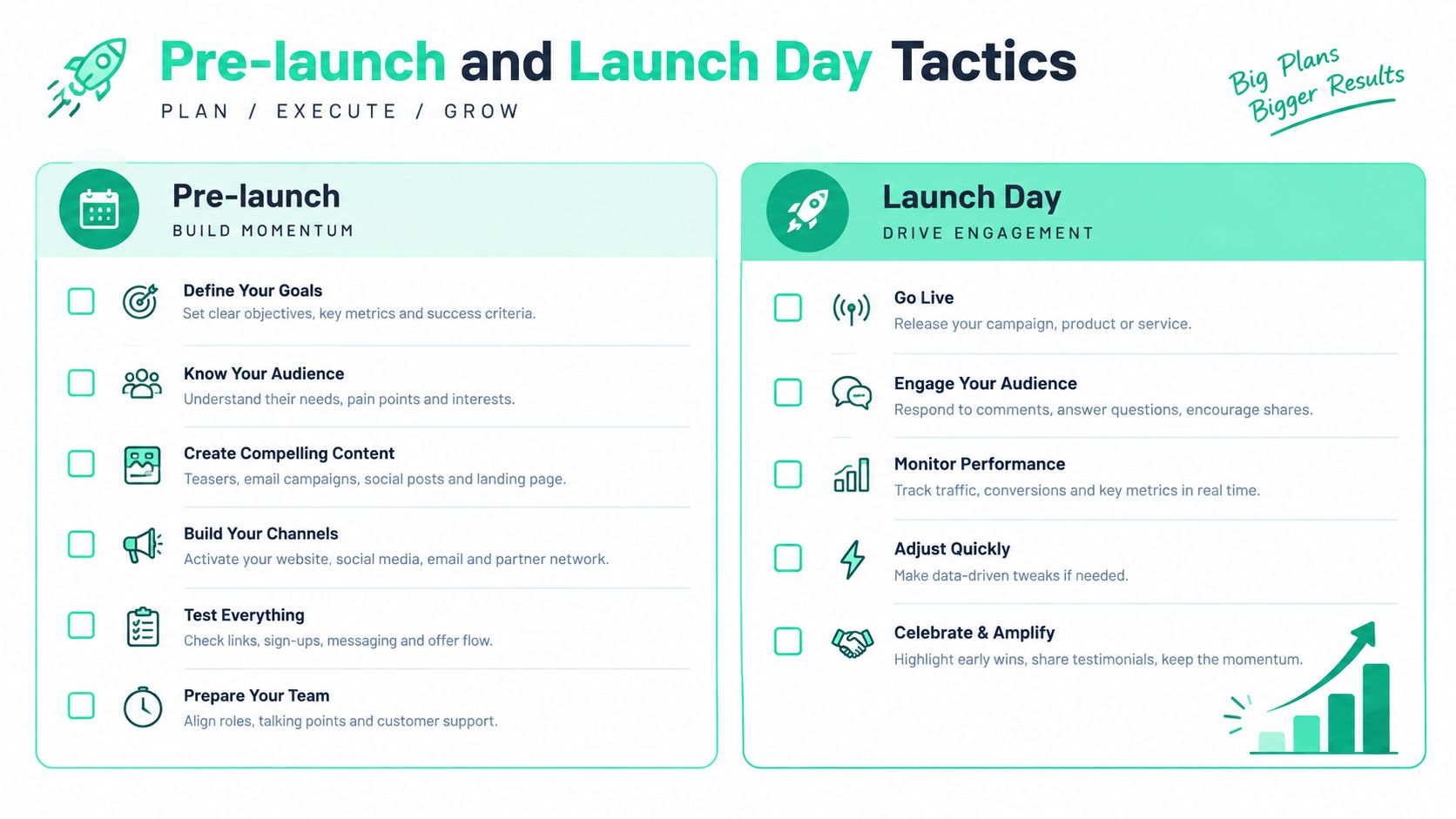
The launch doesn't begin when you hit publish. It begins when you already know who's likely to contribute first, what proof they need, and which questions they'll ask the moment the page goes live.
Build the first wave before launch
Get a short list of likely supporters ready in advance. Those people should understand the product, the target, and the proof page before the public link goes out.
Your first update should cover five things, the problem, the current proof, the funding milestone, the implementation plan, and the risk disclosure. That structure keeps the message readable and keeps you from sounding like you're hiding the hard parts.
A campaign launch is also a project-management exercise. If your team needs help turning a brief into a public launch sequence, creative brief to campaign launch is a useful reference because it forces the planning work to happen before the page is live.
The cleanest way to think about launch day is simple, answer questions fast, track what's converting, and adjust the proof if traffic is healthy but pledges are slow. For promotion tactics that support this, how to promote a crowdfunding campaign is the companion piece worth keeping nearby.
Post-Launch Communication and Growth
After launch, the page needs motion, not silence. Backers read updates as evidence that the team is awake, honest, and still pushing toward the next milestone.
A solid update does more than announce activity. It connects a measurable change to the next step, such as new users, shipped features, retained customers, or stronger contribution flow.
Keep the rhythm visible
Long silent periods make even a good campaign feel stalled. Unreadable explanations do the same, because people won't work to decode what changed or why it matters.
Use updates to show outcomes, not just effort. If the team shipped, say what changed. If a metric moved, explain what the movement means. If something slipped, state the issue plainly and name the next action.
When the campaign starts spreading outside your immediate network, directory placements can help widen the surface area. For SaaS founders, directory submissions for SaaS founders can support that distribution layer without replacing the need for real proof on the page.
The strongest update is the one that makes a skeptical visitor feel less skeptical after reading it.
For a live campaign, that's the standard. Every post should make the next funding decision easier by showing that progress is real, visible, and still compounding.
If you want to launch with verified traction instead of polished guesswork, build your campaign on live proof and keep the page honest from day one. Fundl gives you a way to connect Stripe, GitHub, and analytics, publish that evidence publicly, and raise with a page that updates as you ship, so visit Fundl and start turning metrics into a campaign people can evaluate immediately.