
You've got a working SaaS product, a few paying users, and a steady stream of commits. The problem isn't proof that you can build. It's finding a funding path that recognizes recurring revenue and product usage instead of asking for a polished deck, a venture network, or a finished physical product.
That's where a SaaS crowdfunding platform can fit. Rather than presenting one frozen campaign page, you can show how the product is performing now, how quickly you're shipping, and whether customers keep using it. Backers get a clearer way to judge a software project before contributing, while founders can turn operating data into part of the pitch.
Table of Contents
- Why SaaS Founders Need a Different Kind of Crowdfunding
- What a SaaS Crowdfunding Platform Actually Is
- Why Reward-Based Funding Fits SaaS and Developer Products
- How to Evaluate a SaaS Crowdfunding Platform
- Traction-Driven Platforms vs Traditional Reward-Based Sites
- How Fundl Puts Live Traction at the Center
- Choosing Your Path and Raising on Your Terms
Why SaaS Founders Need a Different Kind of Crowdfunding
A traditional crowdfunding page often works like a launch poster. It tells people what you plan to make, shows a video, lists rewards, and asks supporters to trust that the project will become real. That model makes sense for a new gadget, album, or board game, where the campaign captures a specific creative moment.
SaaS behaves differently. The product changes every week, customers pay repeatedly, and the strongest evidence often sits inside tools such as Stripe, GitHub, or an analytics platform. A founder might have modest recurring revenue and consistent shipping activity but no dramatic prototype video. Their progress is real, yet a static campaign page can make it look like a promise.
Crowdfunding itself has software roots. ArtistShare launched in 2001, and the Free Blender campaign in 2002 sought €100,000 to help open-source Blender 3D while offering community benefits to donors. Those early examples show that software fundraising grew partly from creator and open-source communities, not only from equity deals.
A SaaS campaign should answer more than “What are you building?” It should also answer “What is happening in the product right now?”
For an indie hacker, the relevant questions are practical. Are customers paying every month? Are active users returning? Is the founder still shipping? Can a backer compare those signals with another project without relying on screenshots?
This guide focuses on that verification problem. You'll learn what a SaaS crowdfunding platform does, why reward-based funding often suits software builders, how to assess payment and data architecture, and how traction-driven platforms differ from conventional reward sites. The central idea is simple: your metrics can become your pitch, provided backers can understand where they came from and how current they are.
What a SaaS Crowdfunding Platform Actually Is
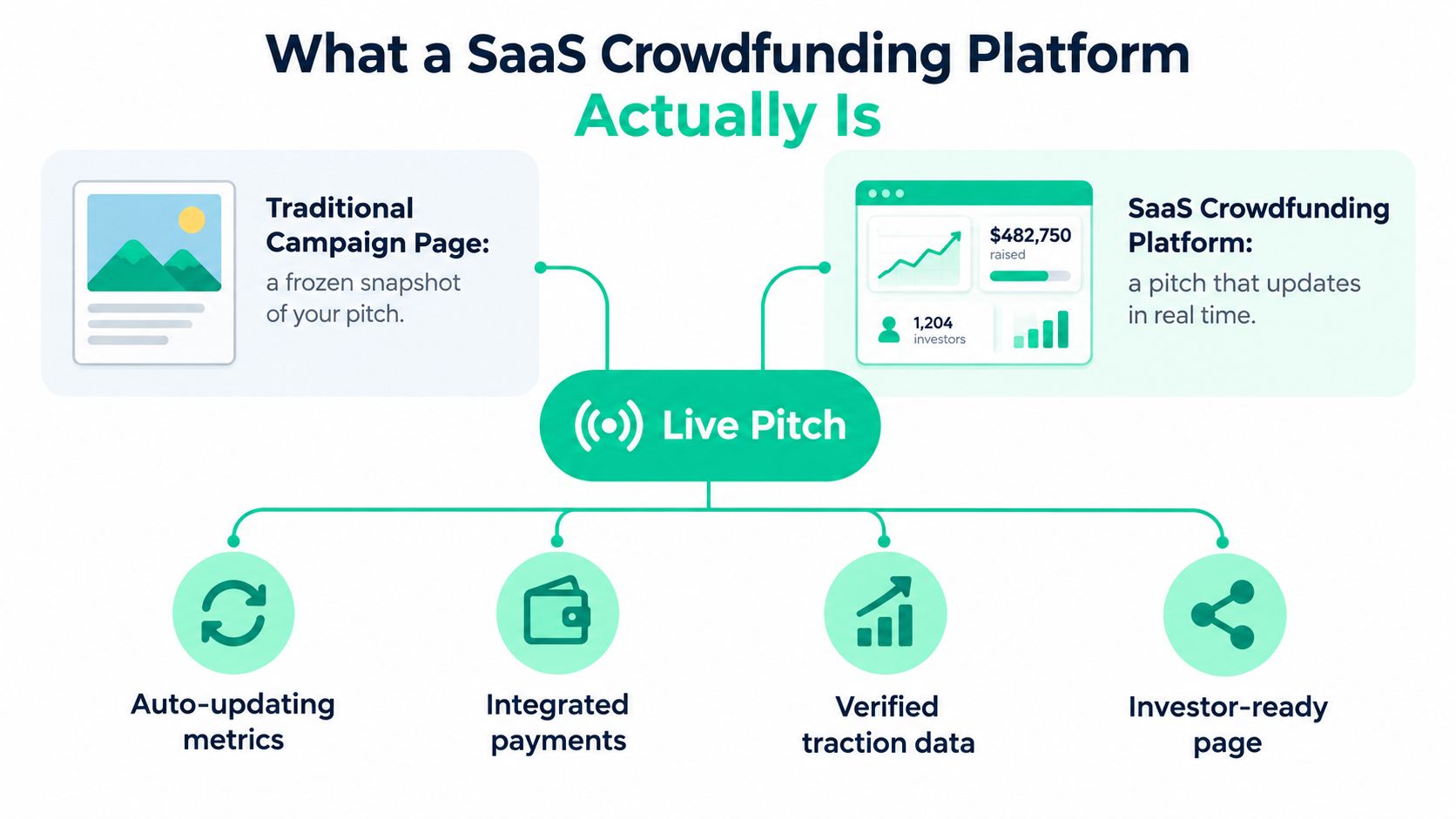
Think of a conventional campaign page as a photograph. It captures the product, story, and funding goal at one point in time. A SaaS crowdfunding platform is closer to a live dashboard. The page still includes the founder's explanation and rewards, but it can also display connected evidence that changes as the business changes.
That distinction matters because software has operating signals that physical products often lack. A SaaS project can show recurring revenue, active usage, retention, release activity, and other indicators of ongoing demand. A developer product can show whether the team continues to commit code and maintain the service. These signals don't guarantee success, but they help a backer evaluate what exists beyond the campaign copy.
The live-pitch model
A useful SaaS crowdfunding page combines four layers:
- Founder context: What the product does, who uses it, and what the funding will achieve.
- Connected metrics: Revenue, usage, or other operating signals pulled from relevant services.
- Progress evidence: Shipping activity, product updates, and visible movement toward the stated goal.
- Contribution mechanics: A clear way for supporters to choose a reward and pay.
The platform's job isn't to replace the founder's story. It's to make the story easier to test. If someone claims that a product has paying demand, a connected revenue source can provide stronger context than a manually uploaded screenshot. If the founder says the team ships consistently, linked repository activity can help backers assess that claim.
Three funding models
The word crowdfunding covers several arrangements. Donation-based campaigns ask supporters to contribute without expecting a product or financial return. Reward-based campaigns offer something in exchange, such as early access, a paid plan, a private community benefit, or another non-equity reward. Equity crowdfunding gives contributors an ownership interest and brings a different legal and operational burden.
Most early SaaS and developer projects naturally fit the reward-based model. The founder can offer access to the product or a defined supporter benefit without giving away ownership. Backers aren't buying shares. They're helping a product move forward and receiving an agreed reward.
The difference is not “crowdfunding versus software.” It's a static promise versus a campaign that can show software's ongoing behavior.
Why Reward-Based Funding Fits SaaS and Developer Products
Reward-based funding gives a software founder a middle path between bootstrapping alone and negotiating an equity deal. You can ask customers, users, and supporters to fund a defined outcome without turning every contribution into a discussion about ownership. For an indie hacker, that might mean financing a feature, infrastructure work, or a focused product expansion while keeping control of the company.
The model also tests willingness to pay. A survey or waitlist can show interest, but a contribution demonstrates a stronger form of commitment. Backers choose to support the project under stated terms, and the founder gets feedback about which reward feels valuable enough to motivate action.
That makes reward-based crowdfunding useful for several kinds of builders:
- Indie hackers can validate an app with early adopters before investing more personal time or money.
- Open-source maintainers can ask a community to support continued maintenance, hosted features, or documentation.
- AI-tool creators can fund access, usage credits, or early features while refining the product with real users.
- Education-product creators can offer course access, workshops, or product bundles tied to a software launch.
The market context supports taking this channel seriously. One independent estimate puts the global crowdfunding market at $21.4 billion in 2025, with reward-based crowdfunding representing 38.5%, or about $8.2 billion, of that total, according to the Dataintelo crowdfunding market report. The same source projects growth from $18.54 billion in 2026 to $57.69 billion by 2035, at an 11.6% CAGR. These figures are market estimates, not a guarantee that any individual SaaS campaign will succeed, but they show that reward-based funding is a substantial category.
The trade-off founders accept
Rewards create obligations. If you promise lifetime access, private support, or a major feature, contributors will expect you to define the terms and communicate progress. SaaS founders should avoid vague rewards that gradually become unpaid consulting or unlimited support.
A good reward has a clear boundary. Early access, a defined subscription period, a founder-supported onboarding session, or a community tier is easier to explain than “help shape the future of the platform.” State what the backer receives, when they receive it, and what happens if the roadmap changes.
Reward-based funding also depends on audience trust. A founder who shares bad news early can preserve credibility. A founder who disappears after collecting contributions turns a useful funding channel into a customer-service problem.
How to Evaluate a SaaS Crowdfunding Platform
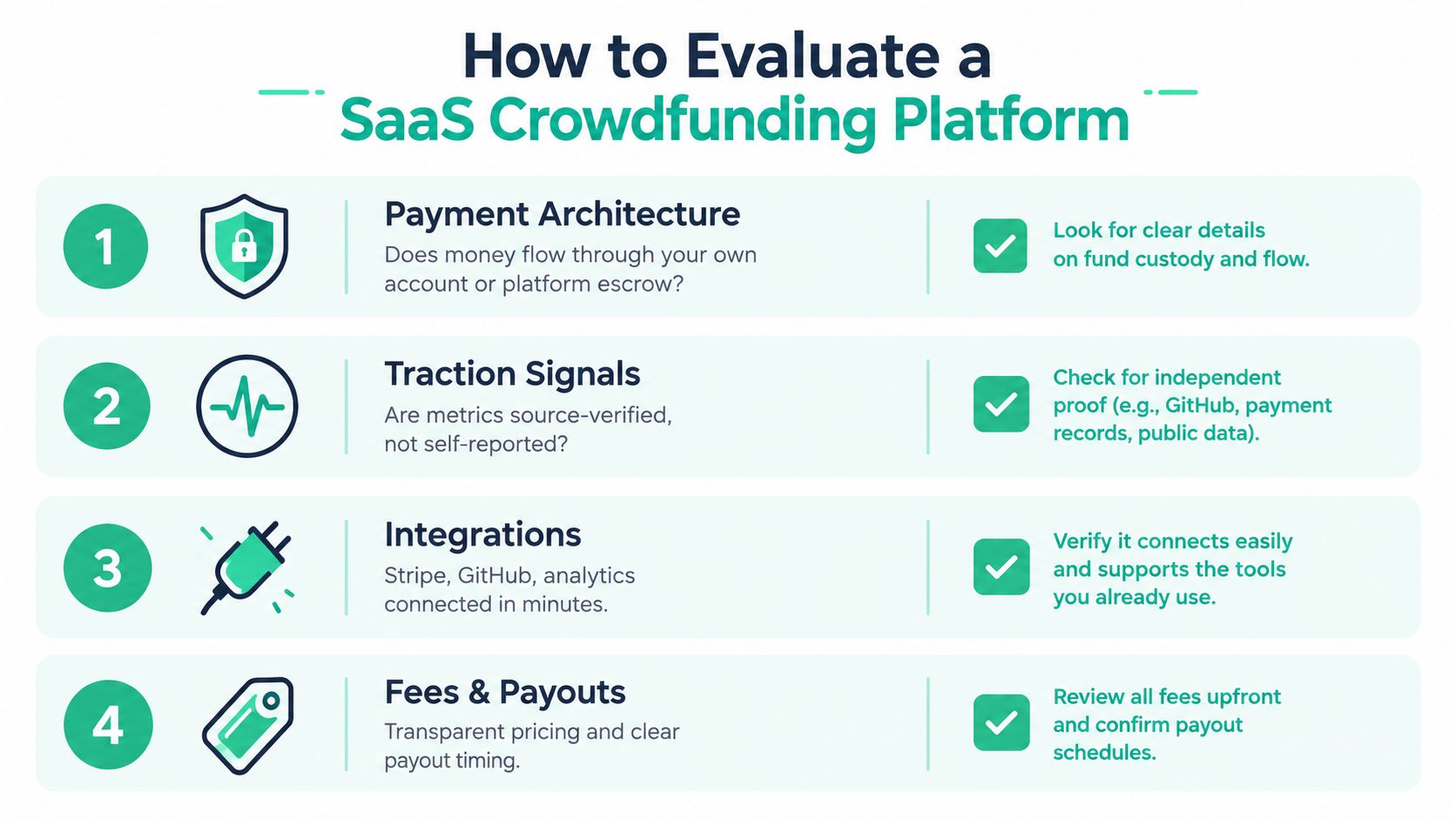
A founder can find a platform with polished campaign pages, then discover that the important details are harder to verify. Backers need to know whether reported traction comes from a connected source, how quickly contributions reach the creator, and what fees reduce the campaign's proceeds. Evaluate the platform itself, not only the project presented on it.
Check payment architecture and payout timing
Start by asking where a contribution is recorded and when the creator can access it. Stripe explains that Connect direct charges place each charge in the connected account balance rather than the platform's balance. That detail helps a backer understand the platform's role in processing payments.
Keep this review focused on timing and accountability. Does the platform state when funds become available? Does it identify processing fees, platform fees, payout delays, and the party responsible for payment questions? These answers affect both the founder's cash flow and the backer's expectations.
Inspect the proof behind each metric
A live metric is useful only when its origin and update time are clear. Backers should be able to distinguish a source-connected number from a manually entered figure or a screenshot that may no longer reflect the product.
For SaaS, examine Monthly Recurring Revenue, active-user growth, retention, and shipping cadence. Industry guidance places early SaaS traction commonly around the $1k to $10k MRR band, while consumer momentum is often discussed around 10% to 15% week-over-week active-user growth, as described in this startup traction guidance.
Treat those figures as reference points, not pass-fail tests. A small product with strong retention may merit attention below a benchmark. Rapid user growth means less if users do not return. Commit activity, release frequency, and dated product updates can add context to revenue and usage data because they show whether the team continues to build.
Compare the economics
Read the full fee and payout terms before comparing headline percentages. Check the platform fee, payment-processing treatment, payout schedule, integration charges, and any costs that apply when a contribution is refunded.
A lower platform fee may not be the cheaper option if payout timing is vague or the fee rules are difficult to calculate. Use the project evaluation guide alongside the platform's own terms to assess the project and the service supporting it.
Judge the backer experience
A supporter should be able to understand a project, inspect its evidence, choose a reward, and see what happens after contributing. Comparable labels, consistent time periods, visible update dates, and clear reward terms make that process easier.
| Criterion | What Good Looks Like | Red Flag |
|---|---|---|
| Payment Architecture | Clear account ownership, payout timing, and fee details | The platform does not explain how payments are handled |
| Traction Signals | Source-connected metrics, commit activity, and visible update timing | Screenshots or manually curated numbers only |
| Fees and Payouts | Plain pricing, processing details, and defined schedules | Vague fees or delayed payout information |
| Backer Experience | Comparable metrics, understandable rewards, and transparent updates | A page built for excitement but weak on evidence |
A credible platform cannot remove every risk. It can show the evidence, costs, and timing clearly enough for a backer to make an informed decision.
Traction-Driven Platforms vs Traditional Reward-Based Sites
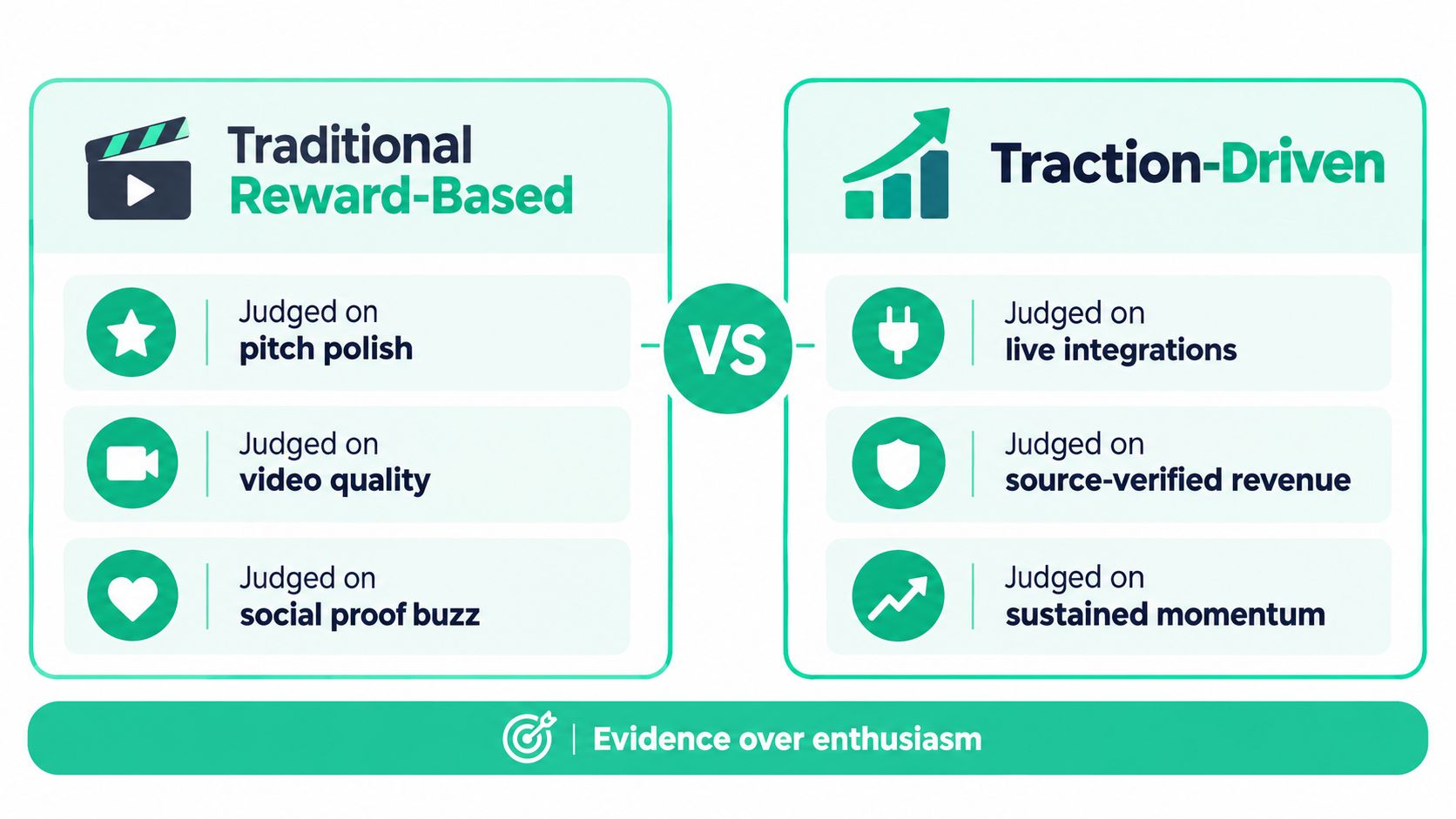
A backer reviewing a traditional campaign often makes a decision from the launch package: the video, product images, founder story, audience, and rewards. That approach suits a physical product or creative release, where the finished experience is easy to show. A SaaS product gives backers less to inspect visually, so the question becomes whether the business is active and still earning trust.
A traction-driven platform puts operating evidence beside the pitch. Backers can look for paying customers, returning users, and continued development instead of judging only presentation quality. The campaign becomes a current view of the product, not a launch announcement that can age quickly.
The difference in proof
A traditional site can make a strong narrative and a large audience central to the decision. That is not automatically a weakness. Backers may support a project because they trust the founder, identify with the problem, or want the idea to exist.
The limitation appears with technical products that have little visual spectacle but meaningful usage data. A developer tool may be valuable without a cinematic trailer. For that kind of project, Monthly Recurring Revenue, active users, repository activity, and retention can reveal more than polished promotional material.
Backers still need the story around the numbers. Revenue may come from a small customer group, commits may reflect maintenance rather than new features, and active users may not indicate willingness to pay. Live signals help only when the page defines each metric, identifies its source, and shows when it was updated. A funder is checking whether the evidence describes durable activity or a short-lived spike.
Payment changes the trust equation
Payment setup changes what a backer must verify before contributing. If money goes directly to the creator's account, the platform is not holding it as a buffer. Backers should therefore read the published refund terms and confirm who handles a failed campaign or an unfulfilled reward.
The payment documentation describes this separation between payment flows. Founders need to state the refund process plainly, while backers should know which party is responsible if the promised software benefit does not arrive.
A live metric can improve confidence, but only when the page also explains its source, meaning, and limits.
Traditional presentation still matters for people who do not work with software. A clear explanation shows why the product deserves support, while traction signals help backers compare projects without relying solely on marketing skill. The reward-based crowdfunding model can support both approaches. A strong SaaS page combines an accessible story with connected evidence about revenue, usage, and development.
How Fundl Puts Live Traction at the Center
Consider an independent founder preparing to fund a developer-focused SaaS product. The founder already has customers, a repository with regular activity, and product analytics, but the campaign draft is full of copied screenshots. Each screenshot explains what was true on the day it was captured. None shows whether the product is still moving.
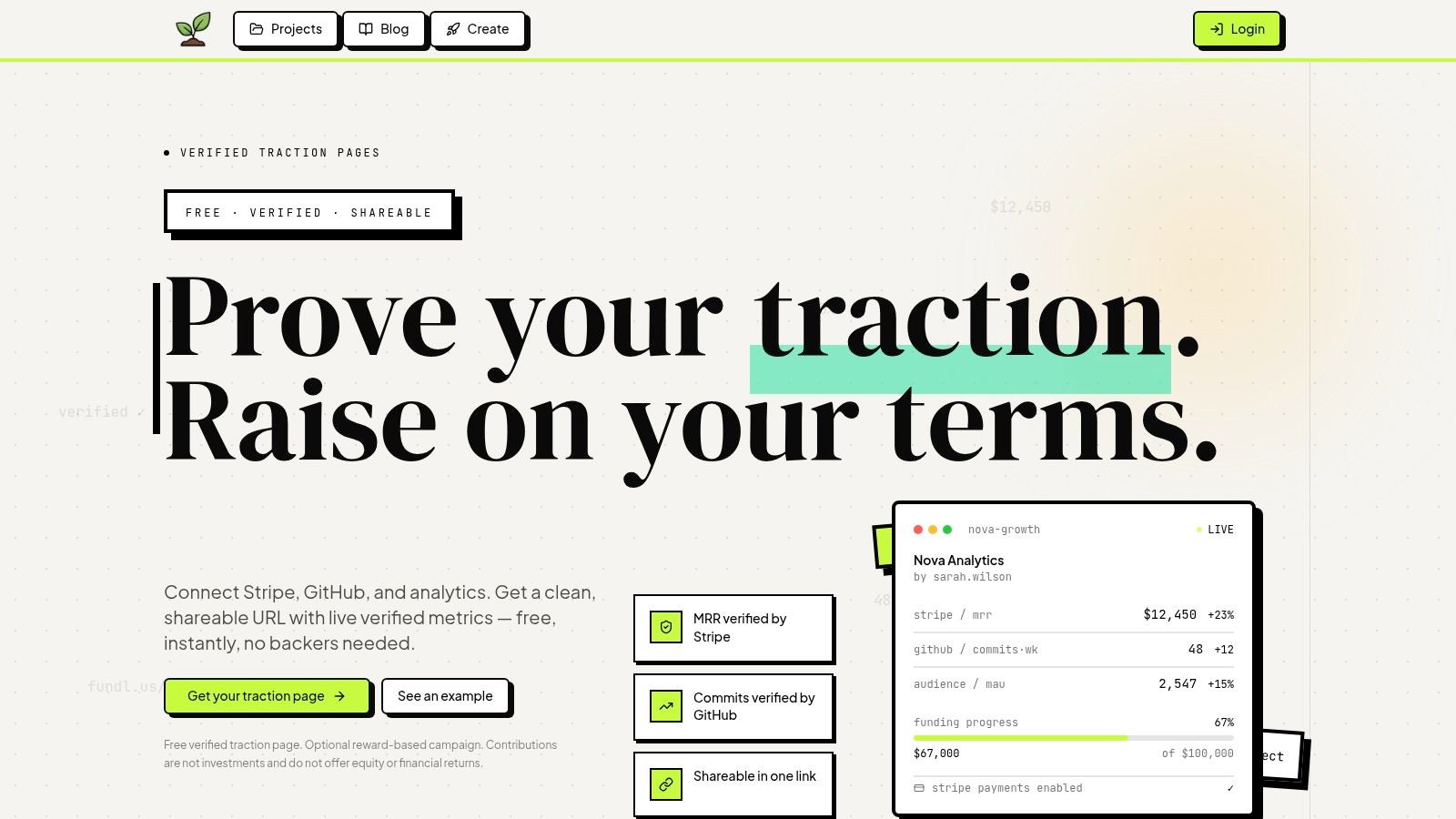
With Fundl, the founder connects Stripe, GitHub, and analytics during setup. The resulting page can display source-verified Monthly Recurring Revenue, weekly commits, and Monthly Active Users. Those metrics auto-refresh, so a backer can return later and see current signals rather than relying on an old update.
What the founder proves
The founder still writes the campaign story. The live data doesn't explain the customer problem, product direction, or intended use of funds. It does support the parts of the story that are easiest to exaggerate manually, such as revenue, audience activity, and continued development.
The page can offer rewards without requiring the founder to sell equity. Depending on the project, those rewards might include early access, a premium plan, or another clearly defined software benefit. Contributors pay directly through the creator's own Stripe account, so the arrangement doesn't rely on Fundl holding campaign money in platform escrow.
That direct-processing structure requires clear expectations. The founder should publish what happens if the funding goal isn't reached, how refunds are handled, and when rewards become available. Connected data supports trust, but it doesn't replace responsible campaign terms.
What the backer compares
A backer can review several projects through similar proof layers. Instead of asking which founder has the strongest launch copy, they can examine whether a project has recurring revenue, active usage, and visible development activity. The comparison remains imperfect, but standardized evidence narrows the gap between a technically strong project and a highly polished one.
Fundl's real-time metrics dashboard reflects this approach. The page is designed to make operating signals part of the campaign itself, not an attachment that the founder remembers to update.
Fundl describes setup as taking about 15 minutes, from setting goals and linking data to sharing the page and receiving contributions. That timing is a product claim from the publisher, so founders should still confirm the current workflow and integration requirements before planning a launch around it.
Choosing Your Path and Raising on Your Terms
Start by listing the proof you already have. If you're pre-launch, a classic reward campaign may suit you because the story, prototype, and community response carry more weight. If you have recurring revenue, active usage, or steady shipping activity, a traction-driven platform gives those signals a more visible role.
Next, inspect payment ownership, data verification, fees, payout rules, and the backer comparison experience. Don't choose a platform only because its campaign pages look attractive. Choose the model that makes your strongest evidence easiest to understand.
SaaS fundraising is moving toward clearer, more data-native decisions. You don't need a venture-style pitch deck to show that a product is alive. If you're building with real users and measurable momentum, your metrics can be the pitch.
Fundl lets SaaS, AI, open-source, and developer-product creators publish reward-based campaigns with live traction signals connected to Stripe, GitHub, and analytics. Visit Fundl to turn current operating data into a shareable funding page and invite backers to evaluate your progress with evidence.