
The counterintuitive truth about how to promote a crowdfunding campaign is that more reach can make a weak campaign fail faster. An Oxford-linked study found that successful equity crowdfunding campaigns had already accumulated 17.5% of their target by the end of day one and 51.2% after the first week according to the study. Early momentum matters, but it only helps when visitors understand the offer, trust the creator, and can pledge without friction.
The practical answer is to treat promotion as a conversion system. Build a page worth sharing, prepare assets before launch, route each channel to a measurable job, and turn verified traction into proof that skeptical visitors can inspect.
Table of Contents
- Why Most Campaign Promotion Quietly Fails
- Pre-Launch Preparation That Sets Up a Win
- Launch Day Execution Playbook
- Channel-Specific Promotion Strategies
- Using Verified Traction to Supercharge Promotion
- Keeping Momentum After the Launch Buzz
- Measuring Success and Troubleshooting Stalls
Why Most Campaign Promotion Quietly Fails
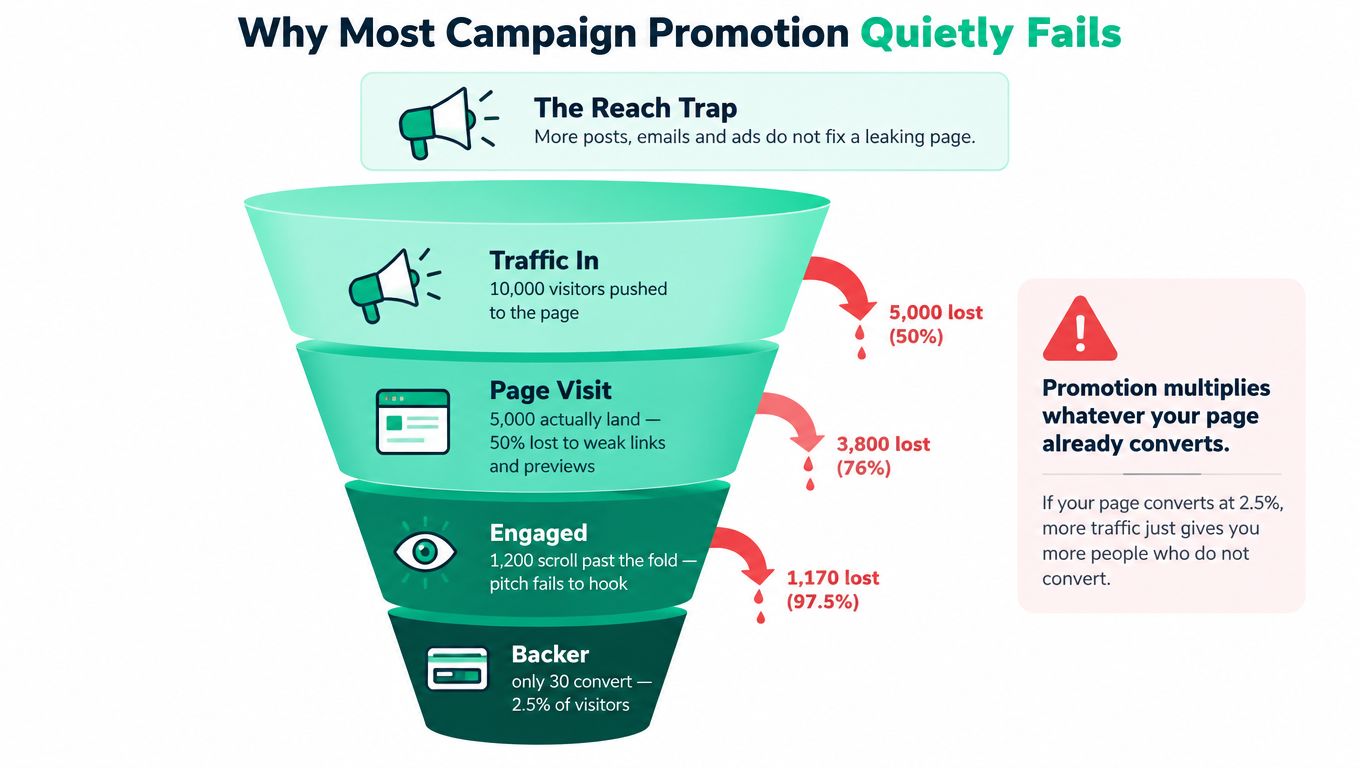
Most creators treat promotion as a reach problem. They publish more posts, send more emails, buy ads, and assume the campaign will eventually convert. That approach ignores the page itself, where unclear rewards, a vague promise, missing proof, and checkout friction can undermine every channel.
Traffic doesn't repair a weak offer. It multiplies the number of people who encounter the same confusion.
Diagnose the leak before adding volume
Start with a simple path:
- Source click: Identify whether visitors came from email, social, community posts, press, influencers, or paid campaigns.
- Page engagement: Check whether people scroll, open reward details, watch the video, and reach the pledge area.
- Pledge action: Compare engaged visitors with completed contributions.
- Support quality: Look at which channels bring backers who share, comment, or return for updates.
A high click-through rate with weak pledges usually points to a message mismatch. The post promised one thing, while the page delivered another. Strong page engagement with low checkout completion suggests reward confusion, payment friction, or insufficient trust.
Practical rule: Don't buy more attention until you know what a new visitor is supposed to understand and do within the first screenful of the page.
The research literature supports this diagnostic mindset. Reviews of crowdfunding campaigns associate success with visuals, campaign description, video, comments, internal social capital, founder education, and update activity, while larger goals and weak preparation create additional pressure as summarized in this crowdfunding literature review. These aren't decorations. They answer the visitor's silent questions: What is being built? Why does it matter? Can this creator deliver? Why should I act now?
Promotion also includes repeated, recognizable exposure. If you're trying to build recall across Reddit, communities, or social feeds, the practical guidance in these Reddit tactics for brand recall can help you create consistent hooks instead of posting disconnected announcements. The point isn't to flood communities. It's to make the campaign easy to recognize and easy to explain.
Before amplifying, fix the page's promise, proof, rewards, mobile experience, and tracking. A campaign page that converts gives every later promotion a fair chance.
Pre-Launch Preparation That Sets Up a Win
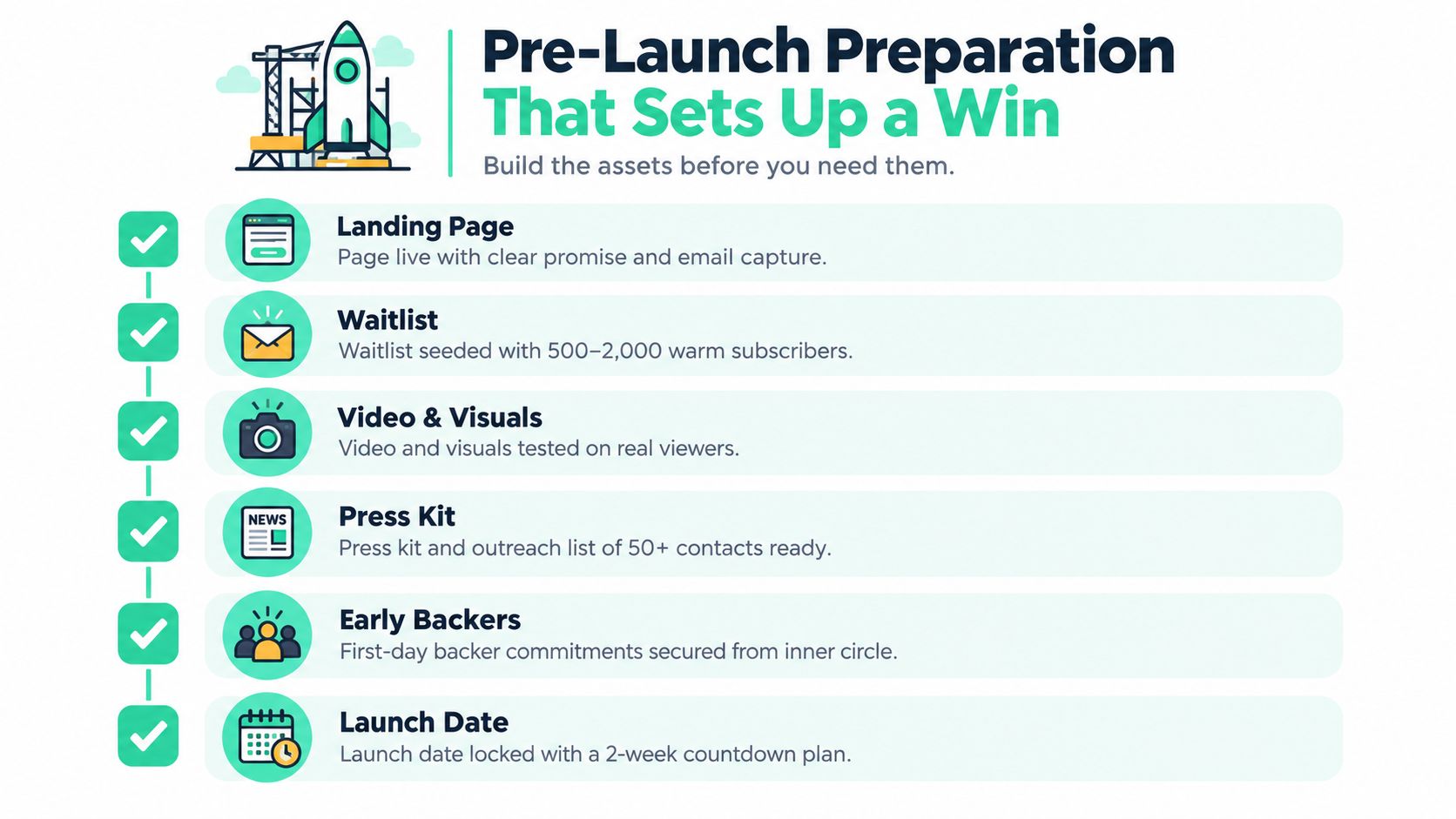
Pre-launch is where campaign promotion becomes operational rather than hopeful. Assign an owner and deadline to every deliverable, then test the complete journey before asking strangers to fund it.
Define the offer before designing the launch
Write the campaign promise in one sentence. A backer should understand what you're making, who it's for, and what their contribution enables without decoding internal product language.
Then map the reward tiers. Keep the differences obvious, show what each tier includes, and explain delivery risks clearly. Stretch goals should extend the original promise rather than introduce an unrelated wishlist. If your team can't explain why a tier exists, remove or rewrite it.
The campaign page is the next deliverable. Test it on mobile, where cramped reward tables, oversized media, and slow-loading sections can interrupt the pledge path. Ask people who aren't close to the project to summarize the offer after reading the page. Their confusion is more useful than compliments from friends.
A practical preparation sequence looks like this:
- Page owner: Publish the landing page with a clear promise, proof, email capture, reward explanation, and analytics.
- Content owner: Produce a 60-second pitch video, three short vertical clips, ten social tiles, and three email sequences. Test the video and message with real viewers before launch.
- Audience owner: Build a warm list segmented into backers, interested contacts, and cold contacts. The brief's launch checklist calls for a substantial warm audience, while the campaign team should define its own credible target based on existing relationships rather than inflate a list with unqualified addresses.
- Partnership owner: Recruit allies, micro-influencers, and community moderators who agree to share on day one. Give each person a prepared caption, image, link, and posting window.
- Operations owner: Confirm support coverage, payment flow, reward details, tracking links, and an update calendar.
Turn interest into launch-day evidence
A waitlist is useful only when it represents people who understand the offer and have a reason to return. Segment subscribers by relationship and intent. Someone who has tested the product needs a different message from someone who merely clicked a post.
Prepare proof assets before the campaign is live. Product usage, pilot feedback, open-source activity, partner interest, or existing customer conversations can become a short founder note, a chart, a testimonial, or a launch email. Don't present unverified enthusiasm as demand. State what happened, who participated when appropriate, and what the signal does and doesn't prove.
The crowdfunding marketing strategy guide is useful as a planning reference for coordinating audience building, launch assets, direct outreach, and campaign updates. Use it to turn preparation into a dated production schedule, not a collection of ideas.
The strongest pre-launch asset isn't a polished slogan. It's a credible reason for someone to believe that other people already care. That proof gives launch-day messages substance and helps early backers feel they're joining a movement rather than taking a blind risk.
Launch Day Execution Playbook
Launch day is a runbook, not a creativity contest. The team should know which message goes to which audience, which link identifies the source, and who responds when questions appear.
Use the first 24 hours deliberately
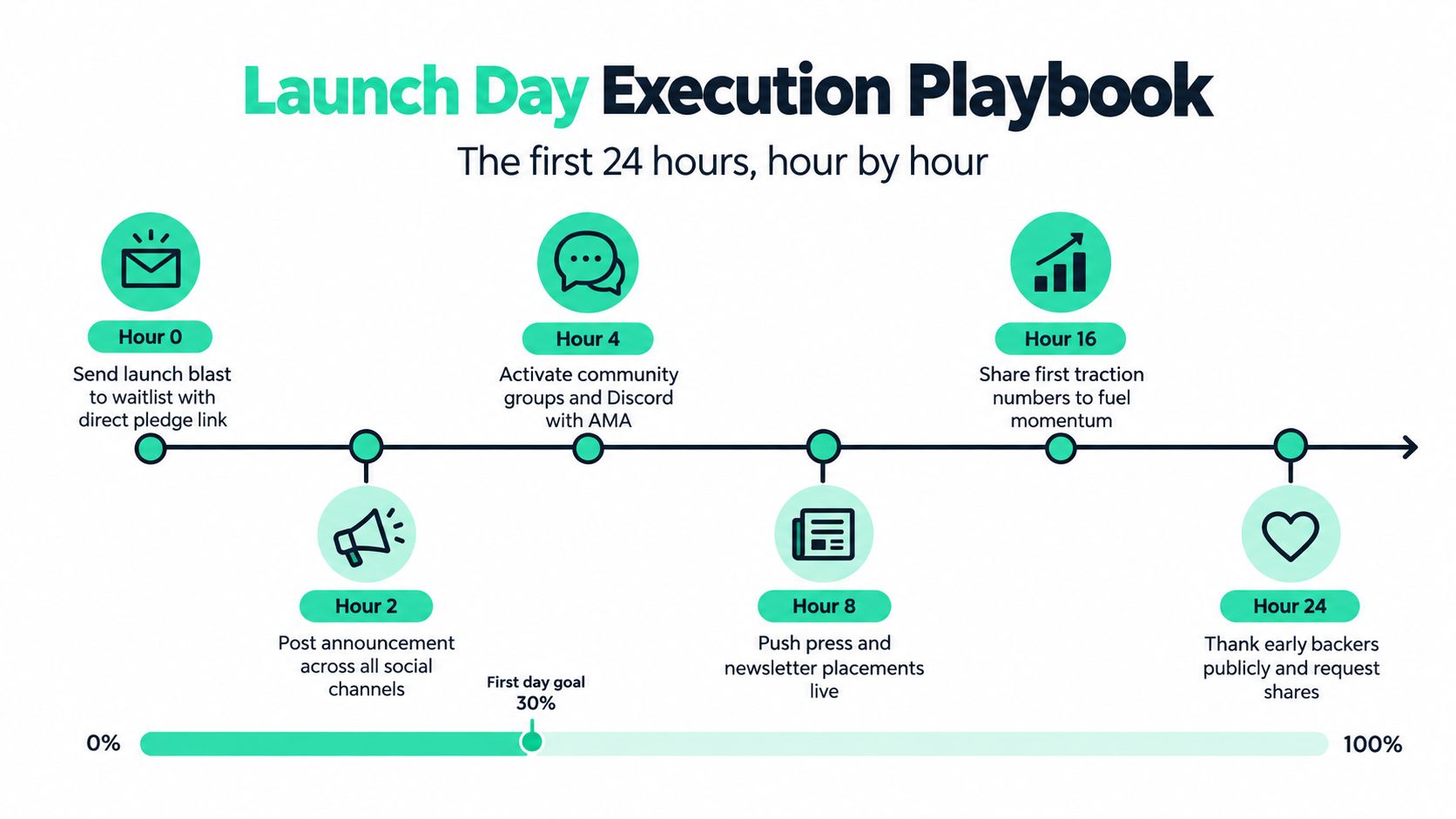
Two hours before launch, test the campaign URL, tracking links, payment flow, mobile page, support inbox, and every scheduled asset. Confirm that allies have the correct copy and that the founder can answer predictable questions about delivery, risks, rewards, and use of funds.
At launch, email the warmest audience with a direct pledge link and a personal subject line. Publish platform-native posts on owned social profiles rather than copying one format everywhere. Notify allies with ready-to-post assets, then watch which sources send engaged visitors instead of merely counting clicks.
During the next several hours, activate niche communities where the campaign fits. Answer questions publicly, host an informal discussion or AMA, and give each community a tracked link. A community post should explain why the project matters to that audience, not just announce that funding is open.
Later in the day, pitch relevant journalists, newsletters, and creators with a concise story angle and evidence. Retarget visitors who engaged but didn't pledge only after the page and message have passed basic checks. Send a follow-up to non-openers with a different subject line and a concrete proof point, not a louder version of the first email.
Publish evidence while attention is high
Your first founder update should explain the mission, acknowledge early supporters, and state what the team is learning. Don't manufacture certainty. If visitors ask the same question repeatedly, update the page so the next visitor gets the answer immediately.
Launch-day promotion works when every touchpoint leads back to one clear page and the page gets better as real questions arrive.
For a broader launch workflow covering audience preparation, messaging, and distribution, these SupaBird product launch tips offer useful context. Crowdfunding adds an important layer, though. Backers aren't just discovering a product. They're evaluating execution risk, so live answers and visible progress carry more weight than polished launch language alone.
Channel-Specific Promotion Strategies
Every channel has a different job. Email is usually closest to conversion because the audience already knows the creator. Social networks widen awareness and provide visible activity. Communities can produce highly relevant visitors, while PR offers third-party validation that paid copy can't replicate.
| Channel | Primary Role | Best Asset Format | Key Metric |
|---|---|---|---|
| Warm the list and drive launch-day pledges | Personal launch email, progress update, non-opener follow-up | Click-through and pledge conversion | |
| Social | Create awareness and visible social proof | Native short video, founder post, milestone graphic | Engaged visits and shares |
| Long-form content | Explain the problem and earn search visibility | Founder essay, build log, comparison article | Qualified organic visits |
| PR | Add independent credibility | Focused pitch with evidence and a clear news angle | Relevant coverage and referral pledges |
| Paid ads | Re-engage known visitors | Retargeting creative tied to one proof point | Cost per pledge and return on spend |
| Niche communities | Reach high-intent audiences | Helpful discussion, AMA, technical explanation | Qualified visits and comments |
| Influencers | Extend into pre-qualified audiences | Briefed demonstration, review, or personal endorsement | Tracked pledges and assisted conversions |
Match the asset to the channel
Email needs a reason to act now. A founder note that explains what changed, who has already contributed, or what milestone the campaign is approaching often feels more credible than a generic announcement. Segment by relationship so previous backers, interested subscribers, and cold contacts don't receive identical appeals.
Social works best when the content can stand alone in the feed. Show the product, the build process, a customer problem, or a visible campaign milestone. Use separate links for each network and creator so you can distinguish attention from contribution.
Long-form content earns trust slowly. Publish an article that answers an actual question, such as why the product exists, how rewards work, or what delivery risk remains. The content ideas for social media resource can help turn one campaign story into platform-specific posts without repeating the same announcement.
PR only works when you offer more than a funding link. Give journalists a relevant development, a founder perspective, a transparent obstacle, or evidence that makes the story useful to their readers. Paid ads should start with warm audiences and small tests. If retargeted visitors don't pledge, inspect the page and offer before increasing spend.
Influencers and communities require restraint. A trusted moderator or specialist with a smaller but relevant audience can outperform a broad account whose followers don't understand the problem. The same principle applies when learning how to grow your interview podcast audience. Consistent positioning and a clear reason to listen or act matter more than indiscriminate distribution.
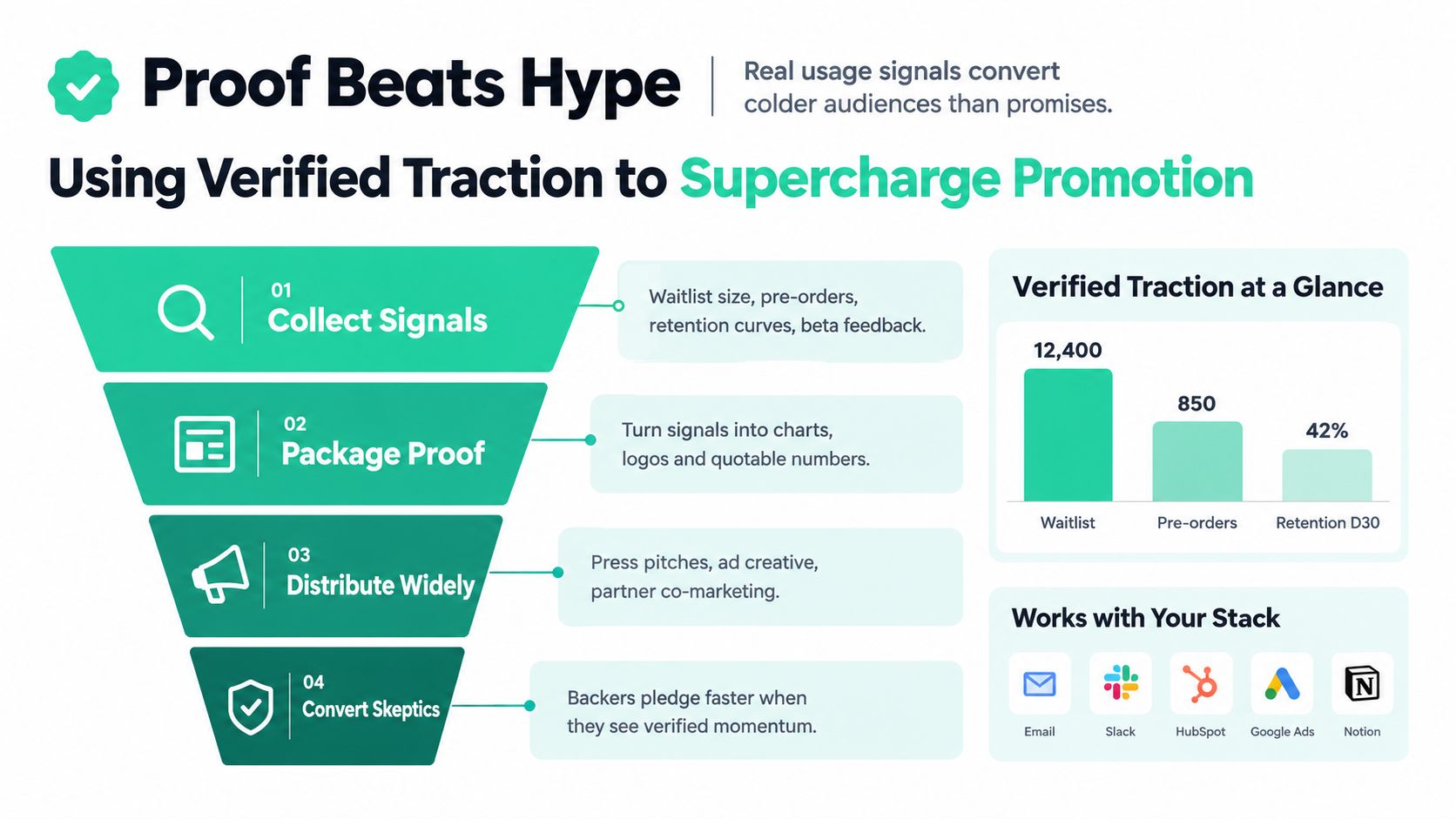
Using Verified Traction to Supercharge Promotion
Hype asks people to believe a promise. Verified traction lets them inspect evidence. For software, AI, open-source, and education projects, that evidence might include active users, recurring revenue, shipping activity, integration usage, pre-orders, pilot feedback, or returning customers.
Collect only signals you can explain and verify. A raw number without context can mislead. A change in product usage, a customer quote tied to a real workflow, or a public build record gives the audience something concrete to evaluate.
Package proof for moments of hesitation
Turn raw traction into small, reusable assets:
- Public proof page: Put the source, definition, and update date beside each signal.
- Milestone graphic: Show what changed and why it matters, without implying more than the data supports.
- Short social hook: Pair one verified observation with one campaign action.
- Founder update: Explain the decision or customer insight behind the movement.
- Partner asset: Give collaborators a concise chart, quote, or product demonstration they can share accurately.
Timing matters. Use product evidence when a visitor first questions the offer, a new milestone when the campaign plateaus, and a transparent progress update when urgency increases near the close. The asset should answer the hesitation already visible in comments, support messages, or page behavior.
Fundl can connect creator data sources such as Stripe, GitHub, and analytics to a shareable traction page with source-verified metrics that refresh over time. It presents reward-based contributions through the creator's Stripe account, so the promotional claim remains connected to inspectable product activity rather than a static screenshot. For a broader credibility framework, see how to build credibility.
Don't publish a metric merely because it looks impressive. Publish it because it helps a backer decide. A smaller, clearly defined signal often carries more weight than a large claim that nobody can verify.
Keeping Momentum After the Launch Buzz
The post-launch period is a cadence problem. Once the initial attention fades, supporters need fresh reasons to return, share, ask questions, and contribute.
Set a repeating weekly rhythm:
- Product update: Share one meaningful change, customer insight, prototype decision, or delivery development.
- Backer moment: Give early supporters a private preview, direct response session, or clear thank-you that recognizes their role.
- Retargeting push: Reconnect with people who visited, watched, or engaged but didn't pledge. Change the message when the hesitation has changed.
- Community conversation: Ask for user stories, objections, or use cases that can improve the product and future campaign content.
Reuse strong material without making the campaign feel stale. A launch video can become a short demonstration, a founder thread, a product comparison, or an answer to a recurring question. A backer comment can become a permissioned testimonial. A progress update can become a newsletter item for people who discovered the project after launch.
The mid-campaign lull is normal, but passivity makes it worse. Independent crowdfunding research links communication, interaction, comments, visuals, and preparation with stronger outcomes in this academic review. Treat comments as research input, not just a moderation task.
Stretch goals can restore attention when they deepen the original product rather than distract from delivery. State the requirement, the benefit, and the implementation risk clearly. Announce the end date early enough for supporters to plan their final share, then reserve the closing push for a specific reason to act, not an endless sequence of countdown graphics.
Measuring Success and Troubleshooting Stalls
Use three campaign objectives: grow a qualified pre-launch list, convert attention during launch, and sustain funding after the first burst. Track click-through rate, pledge conversion, average pledge, acquisition cost, return on ad spend, and net new backers, but read them as a connected funnel rather than isolated scores.
A flat first 48 hours calls for a channel audit. Check whether messages were delivered, links worked, allies posted, and visitors matched the intended audience. Strong traffic with weak pledges points to the page, offer, or trust layer.
A drop after the first week usually needs a new proof asset, a sharper update cadence, community re-engagement, or retargeting. A stalled final week may require a credible stretch goal, relevant press outreach, and direct ally activation. Don't choose paid amplification until you know the page converts warm visitors. Don't rewrite the page when the core problem is that nobody qualified is seeing it.
Dashboard checklist: source-tag every link, review page behavior, publish verified progress, answer objections, thank backers, and assign one owner to the next promotional action.
The evidence favors front-loaded momentum and regular communication. Campaigns with updates have been reported to raise more than campaigns without them, and one widely cited summary reports that campaign owners who update supporters every five days raise an average of three times more in its crowdfunding statistics overview. Treat those figures as directional evidence, not a promise. Your own funnel tells you where the next decision belongs.
Fundl helps creators turn live product activity into a shareable traction page, connecting sources such as Stripe, GitHub, and analytics so backers can evaluate evidence instead of relying on stale screenshots. If verified traction fits your campaign, visit Fundl to set up your proof layer and give every launch channel a more credible destination.