
Most micro-SaaS products stay small: a 2025 analysis of more than 1,000 micro-SaaS businesses across 15 countries found that 70% generated less than $1,000 in monthly revenue, according to RockingWeb's micro-SaaS revenue analysis. That figure changes the question from “How fast can I build a huge software company?” to “Can I solve a specific problem for a small group of customers, and keep them?”
Micro-SaaS can be a practical way to build a focused software business without a large team or outside investment. But headline success stories aren't a useful forecast. To assess your own idea, choose a realistic business model, measure whether customers stay, and compare your results with products that resemble yours.
Table of Contents
- What Micro-SaaS Is and How Small Most Products Stay
- Business Models That Fit a Small Software Product
- Metrics That Show a Micro-SaaS Is Actually Working
- Pricing a Tiny Product Without Leaving Money on the Table
- Growth Paths Behind Typical Micro-SaaS Examples
- Raising Community Funding With Verified Traction
- Confirm Your Micro-SaaS Idea Before You Build
What Micro-SaaS Is and How Small Most Products Stay
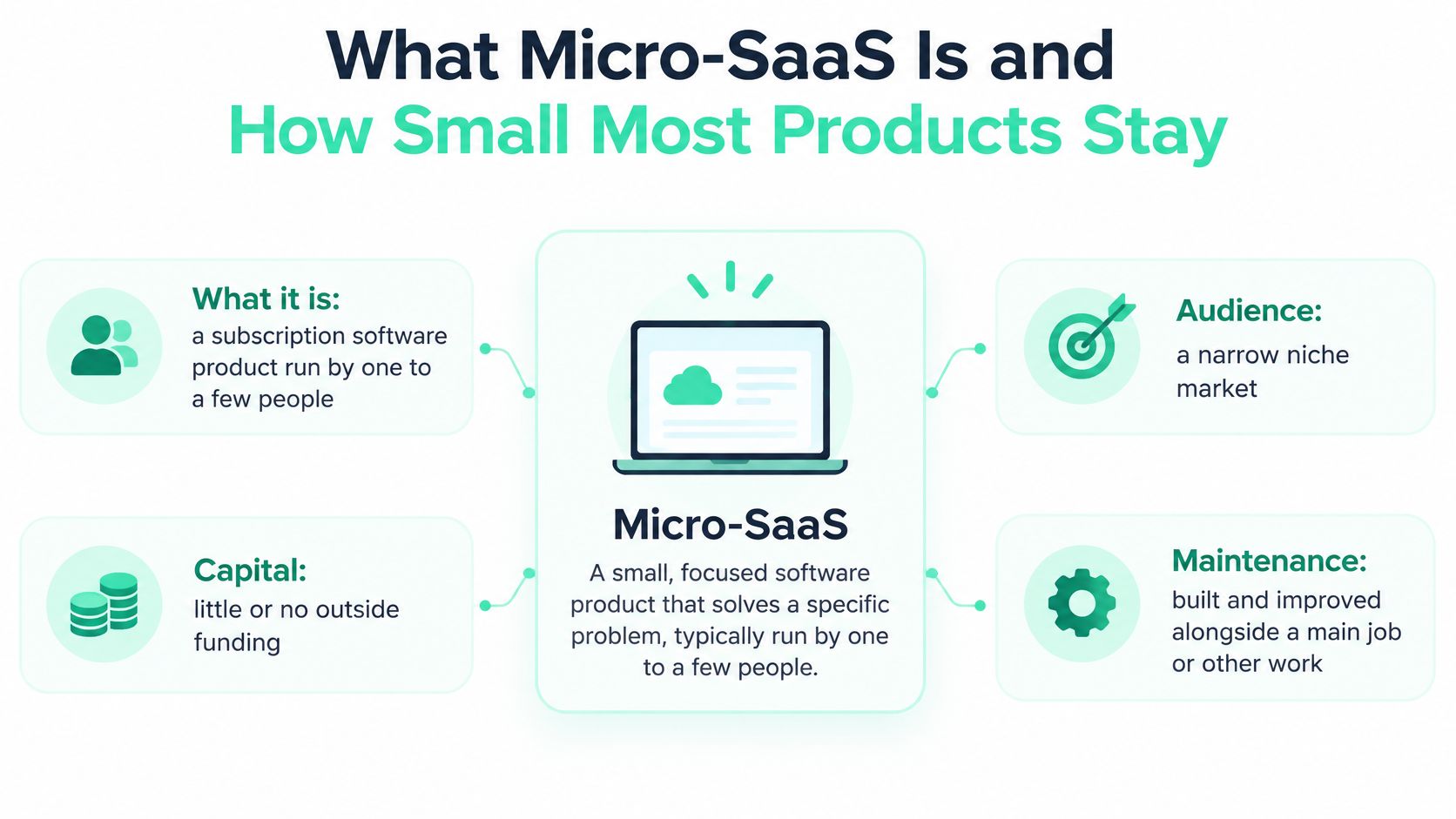
A micro-SaaS is subscription software run by one person or a small team, usually with little or no outside funding. It tends to serve a narrow audience, and it often gets built, sold, supported and improved alongside other work. No official revenue line separates a micro-SaaS from a small SaaS. The word describes how the business operates, not a monthly income threshold.
A well-run corner shop is a closer comparison than a venture-backed chain. A few dozen regulars can make a genuine business, even if the shop never dominates its market. Published founder surveys show how small that can look in practice. In the MicroConf 2024 State of Independent SaaS survey, which covered 469 independent SaaS founders canvassed in late 2023, 28% of companies generated less than $1,000 in monthly recurring revenue (MRR), the largest single revenue group. The same survey found that 65% of companies had only 1–10 paying customers.
| Typical micro-SaaS scale from published surveys | Reported Share | Sample and Source |
|---|---|---|
| Companies with under $1,000 monthly recurring revenue | 28% | MicroConf 2024 State of Independent SaaS, 469 founders |
| Companies with 1–10 paying customers | 65% | MicroConf 2024 State of Independent SaaS, 469 founders |
| Products under $1,000 monthly revenue | 70% | RockingWeb 2025 analysis of more than 1,000 micro-SaaS businesses in 15 countries |
Those samples answer a narrow question: how small is small for independent founders? They are not a census of software startups worldwide, and they say nothing about how large one product might eventually become. A separate 2025 analysis of more than 1,000 small subscription-software businesses across 15 countries reported average monthly revenue of $83,300 among its successful top performers. Read that number beside the 28% figure and the confusion clears. Averages follow the biggest earners. If nine founders bill $500 a month and one bills $40,000, the average reads like a healthy income while almost nobody in the group earns anywhere near it. The mean is not a typical founder's target.
So what should you measure against instead? Two things. Choose a peer group that resembles your product: the same kind of buyer, a similar price point, a comparable market. Then watch retention, because a micro-SaaS that keeps most of its customers each year and one that loses half of them can report identical MRR this month and be in completely different businesses a year from now.
For a founder automating documents inside small businesses, a practical first step is to explore no-code tools for document automation and identify the one repetitive job worth improving. Then locate your own customer count and MRR in the bands above before you set a target. A handful of paying users is meaningful early traction. Whether those users renew is the test that follows.
Business Models That Fit a Small Software Product
| Micro-SaaS business models compared | How Customers Pay | Best Fit | Main Risk |
|---|---|---|---|
| Monthly or annual subscription | Recurring fee per account | Tools needing continuous access | Silent cancellations compound over time |
| Per-seat subscription | Fee per user each month | Team tools where headcount grows | Seats shrink during downturns |
| Usage-based | Pays per unit consumed | Products whose value varies with use | Unpredictable bills and hard forecasts |
| Hybrid base fee plus usage | Fixed floor plus metered extras | Variable value with a predictable baseline | Two pricing mechanics to explain |
| One-time purchase or lifetime deal | Single payment | Small utilities with low upkeep | No recurring revenue to fund maintenance |
| Productized service with software | Setup fee plus subscription | Niche tools needing onboarding | Hands-on work limits scale |
A monthly or annual subscription fits a tool customers need to access continuously, such as a scheduling system or a reporting dashboard. A recurring fee supports ongoing maintenance, but it doesn't guarantee that customers will stay. Annual billing can simplify cash flow, while monthly billing gives customers more flexibility.
Per-seat pricing makes sense when the value grows with the number of people using the product. A shared workflow tool might charge by user, for example. The tradeoff is that customer teams may reduce seats when budgets tighten, so a founder shouldn't assume that a company account will keep the same size.
Usage billing suits products where customers get more value as they consume more: API calls, automation runs, file storage, or AI inference. A hybrid model, combining a base fee with usage charges, can give the business a predictable floor while letting customer costs grow with consumption. Both approaches require a clear unit of measure and an easy way for customers to understand their bill. Founders can compare options and practical approaches in these monetization guides.
A one-time purchase or lifetime deal brings in cash without creating recurring revenue to fund later support and improvements. It can fit a small utility with low ongoing upkeep, but the founder needs to plan for continued costs. A productized service with software adds a human setup or onboarding component. That can help customers get value from a niche tool, though founder time may become the limit on growth.
Practical rule: Choose a model you can explain in one sentence on your pricing page.
Write what the customer pays for, then check that the billing unit matches it. If customers pay for automated jobs, charging by the number of jobs may be intuitive. If they pay for ongoing access to a workspace, a per-account subscription may fit better.
Metrics That Show a Micro-SaaS Is Actually Working
A micro-SaaS can look healthy on a signup chart and still be losing ground. Average revenue figures are especially misleading because they mix products with very different price points, buyers, and sales motions. The better question is whether a product clears the right benchmark for its peer group, not whether it resembles a headline success story.
| Retention and churn benchmarks by context | Reported figure | Context to check |
|---|---|---|
| Median gross revenue retention, private B2B SaaS | 91% | 2025 survey of more than 1,000 companies, possibly skewed toward established firms |
| Median retention, businesses below $300,000 ARR | 53% | Billing-based data, which may include early self-serve products |
| Monthly customer churn, below $25 average revenue per account | 6.1% | Small-ticket products |
| Monthly customer churn, above $500 average revenue per account | 2.2% | Higher-ticket products |
Track MRR, paying customers, activation-to-paid conversion, and retention. Break churn into parts as well: logo churn counts lost customers, revenue churn measures lost recurring revenue, failed-payment churn identifies involuntary cancellations, and cohort retention shows whether customers who joined around the same time keep paying. These measures answer different questions. A product can keep most logos and still lose revenue if a few large accounts leave.
The figures above come from different samples and measurement approaches. A 2025 survey of more than 1,000 private B2B SaaS companies reported median gross revenue retention of 91%. Billing-based analysis discussed alongside that survey found median retention as low as 53% for businesses below $300,000 in annual recurring revenue (ARR). The same discussion reported monthly customer churn of 6.1% for products below $25 average revenue per account (ARPA), compared with 2.2% above $500 ARPA.
Those numbers are not interchangeable. A retention rate works like a height chart: the number matters only next to the right comparison group. Founder surveys can overrepresent more established or successful companies, while billing data may include early-stage self-serve products. The offer itself can matter, too: a card-required trial and a free plan attract different levels of commitment, so churn can move with the structure of the offer rather than with product quality alone.
Compare like with like. Segment your results by price, customer type, and acquisition channel, then choose the closest benchmark before deciding a product is underperforming. A low-priced self-serve tool and a high-priced sales-led platform are not peers, and judging one against the other hides the signal you need.
If you're working through customer value and retention together, Chartsy's guide to customer lifetime value can help connect retention patterns with the revenue a customer brings over time. For a concise view of product activity, review SaaS usage metrics. Then calculate monthly churn by cohort for the last few months, and look for a trend instead of relying on one blended number.
Pricing a Tiny Product Without Leaving Money on the Table
Pricing isn't a choice between a subscription and a one-time payment. The more useful question is whether the billing unit matches the value customers receive. Start by describing the problem your product solves, then check comparable tools in the same niche. Set a starting price that one customer can justify in a sentence, based on the time saved, revenue gained, or risk reduced.
Illustrative example: Suppose a bookkeeping tool removes a repetitive task that takes a bookkeeper several hours each week. A founder could price access at a modest fraction of the value of that saved time, then offer an annual option for customers who want a predictable bill. The specific price should follow customer conversations and purchase behavior, not a guess about what all SaaS products charge.
Usage-based pricing deserves careful testing rather than automatic adoption. Orb's pricing-model benchmarks report median net revenue retention of 108% for usage-based companies and 98% for seat-based companies in its 2026 benchmark. Its 2025 comparison shows gross revenue retention of 92% for usage-based pricing, compared with 88% for subscription and hybrid models. These are associations, not proof that a pricing model causes stronger retention. The products or markets using each model may differ in other ways.
| Reported retention by pricing model | Retention Metric | Reported Figure | Source |
|---|---|---|---|
| Usage-based | Median net revenue retention (2026) | 108% | Orb 2026 benchmark |
| Seat-based | Median net revenue retention (2026) | 98% | Orb 2026 benchmark |
| Usage-based | Gross revenue retention (2025) | 92% | Orb 2025 comparison |
| Subscription and hybrid | Gross revenue retention (2025) | 88% | Orb 2025 comparison |
Before adding a meter, ask whether customers understand the unit, whether your revenue forecast can handle fluctuating use, and whether users need alerts or a spending cap to avoid surprise bills. A base fee can make sense when a product has ongoing value alongside variable usage. APIs, automation, storage, and AI inference often have naturally variable consumption. By contrast, a tool whose value comes from continuous access may make customers anxious if every action feels metered.
Judge pricing experiments by activation-to-paid conversion, expansion and contraction, billing-related support requests, and retention by usage band. Pricing model validation can help structure those tests. Use usage pricing only when customer value clearly scales with consumption.
Growth Paths Behind Typical Micro-SaaS Examples
Consider a niche workflow tool built for one profession, such as an intake organizer for independent tutors. Its founder starts by speaking directly with potential customers in professional forums, learns which step they find frustrating, and offers a small paid version that handles that job. Early progress comes from finding repeatable demand, not from building every feature a tutor might eventually request.
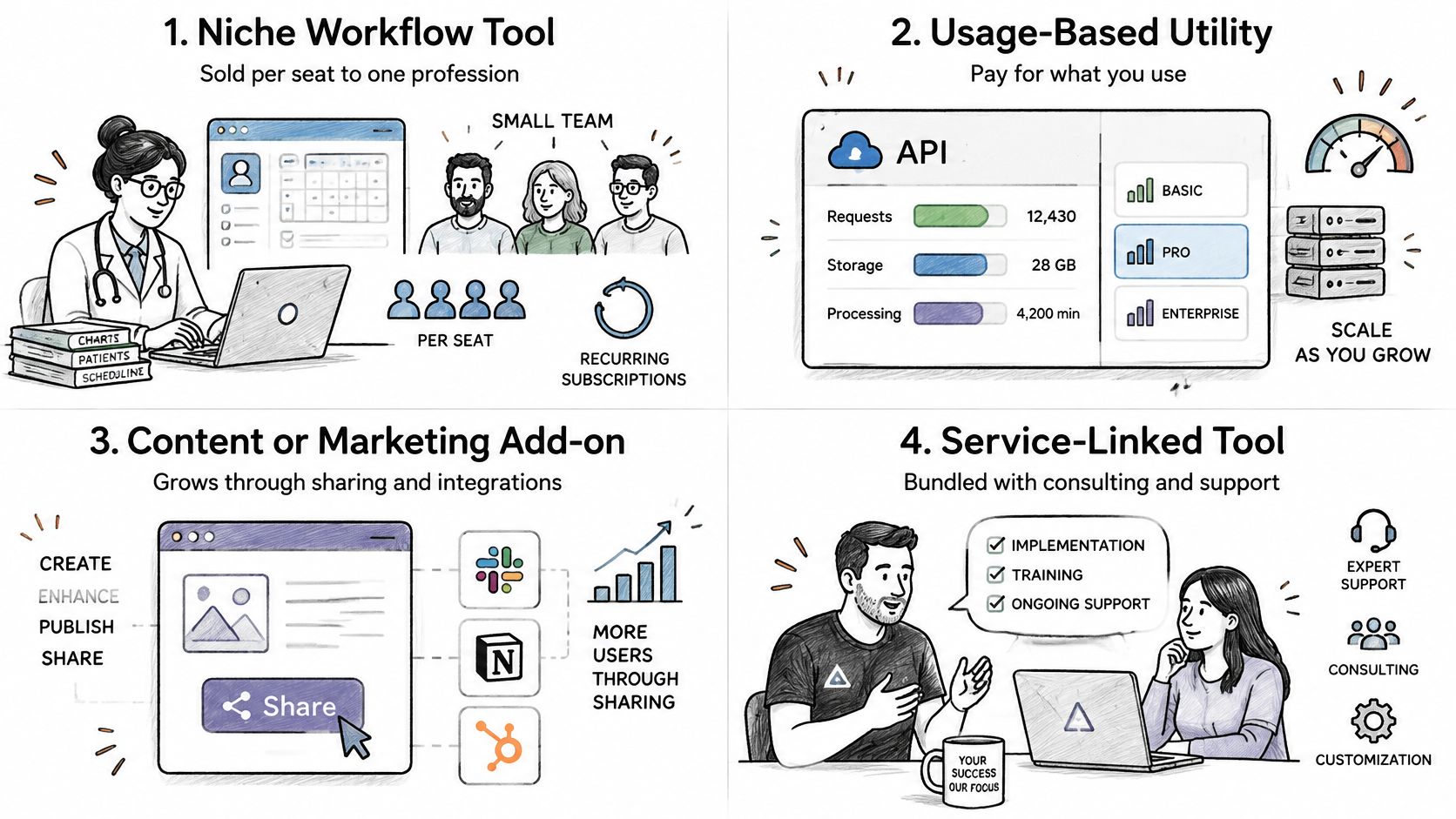
This is a composite example, not a named company. The useful pattern is to begin with a narrow customer group, reach people where they already discuss their work, and use direct conversations to improve the product. A per-seat price can fit when several tutors use the same workflow together. The founder should watch whether new users activate and keep using the feature that solves the core problem. A common mistake is building a broad platform before confirming that customers will pay for the small job.
Other product types call for different paths:
- Developer API: Publish clear documentation, runnable open-source examples, and a free tier that helps developers test real usage. Move toward paid plans when a user has a recurring workload. Track whether trial users return to the API, and don't treat signups alone as proof of demand.
- One-time utility: Launch through a relevant product directory, then create a focused comparison page for the specific problem the tool solves. Track purchases from that audience. The risk is building a product that requires frequent maintenance without recurring revenue to pay for it.
- Productized AI tool: Show the result in short demonstrations, invite interested people to a waitlist, then combine a base price with usage charges if consumption reflects value. Watch how often prospects reach the useful result. Avoid adding AI features just because the product can support them.
Each archetype suggests a first distribution channel and a metric to watch. A professional tool may depend on conversations and repeat use; a developer API may depend on returning usage; a utility may depend on purchase intent from targeted discovery. Pick the pattern closest to your product, borrow its first channel, and track the single behavior that shows customers are getting the intended value.
Raising Community Funding With Verified Traction
A micro-SaaS founder can raise support without taking a loan or selling equity. Community funding can help pay for a defined milestone, such as improving onboarding or finishing an integration, but a campaign is more credible when backers can see what the product is doing. Clear proof doesn't eliminate risk; it helps people make a more informed choice.
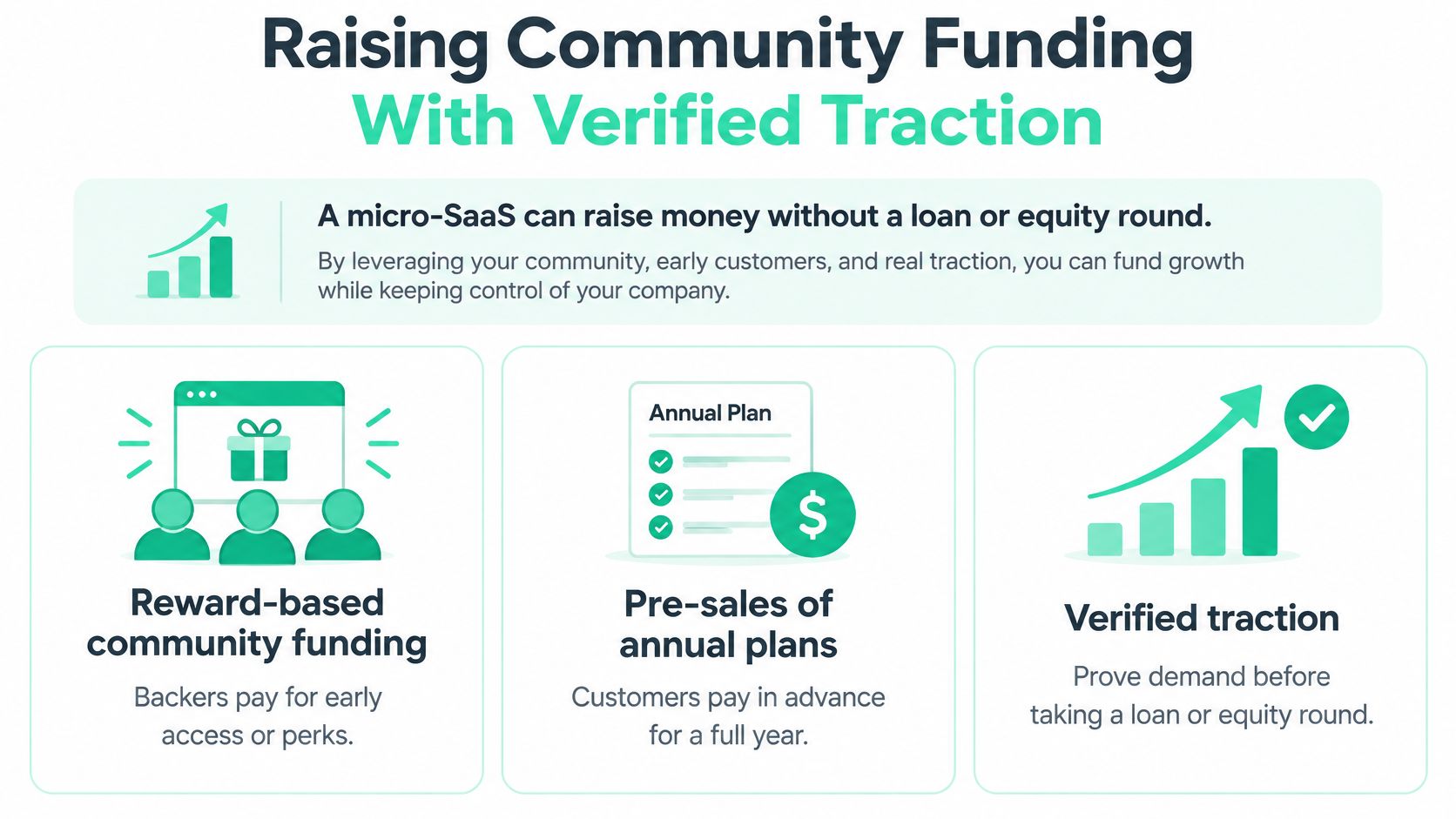
There are a few ways to structure a campaign. In reward-based community funding, backers contribute in return for early access or other perks. Pre-sales let customers pay in advance for an annual plan. A verified traction page can show revenue, product activity, or audience signals so a potential backer can assess the project before pledging. For a closer look at campaign approaches, read this guide to software crowdfunding.
Backers usually want more than a polished pitch. They may look at the direction of MRR, paying customer count, retention, shipping activity, and whether an audience engages with the product. A revenue screenshot captures one moment. A source-connected metric can provide more context about the business as it changes.
Prepare the campaign with a short, concrete checklist:
- Tie the goal to a milestone. State what the funds will help you finish, such as customer onboarding, a core integration, or a specific product improvement.
- Connect the evidence. Fundl can connect to Stripe to show MRR, GitHub to show commit activity, and analytics or other audience signals to show audience size.
- Publish one shareable page. Each Fundl project receives a shareable URL that shows its live verified metrics in one link.
- Explain where the money goes. Tell backers what the contribution will fund and how that work relates to the project's next milestone.
A public page works best when revenue and retention are stable enough to show a trend. If the product is still changing week to week, explain that uncertainty rather than presenting early numbers as a settled forecast. Verified metrics are additional context, not a guarantee of delivery or future performance. Fundl provides its platform on an “as is” and “as available” basis, without warranties of any kind, so backers should read the project's own plan and make their own assessment.
The video below provides another way to think about community-backed software projects.
Confirm Your Micro-SaaS Idea Before You Build
Use the next four weeks to test a specific idea instead of building from assumptions.
- Week 1: Write one sentence describing the job the product does. Decide who pays, what they pay for, and which billing unit reflects that value.
- Week 2: Find people in the intended niche who'll talk to you. Ask how they handle the problem now, and record their words instead of replacing them with your own product language.
- Week 3: Build the smallest version that delivers the core job. Invite interested people to commit through a pre-sale or waitlist, and watch whether they take a meaningful next step.
- Week 4: Track MRR, paying customers, and cohort churn. Compare your numbers with a peer group that resembles your price, customers, and sales approach, not an exceptional success story.
Continue when paying customers grow and retention stabilizes against an appropriate comparison. If interested customers convert but churn remains high, revisit the product's value, price, or business model before adding more features.
Once you have live numbers, Fundl can connect to Stripe, GitHub, and analytics or other audience signals, then display verified metrics on a shareable project page. Take the next step by writing your one-sentence customer problem and asking a potential buyer whether they'd pay for a solution.
Fundl helps creators raise reward-based community support using a shareable page with live, verified traction metrics, including revenue, shipping activity, and audience signals. If you're ready to show your product's progress and invite backers to support a clear milestone, visit Fundl.