
You've built enough of your software to show someone, but not enough to fund the next stage comfortably. A few people have tried the beta, your roadmap is getting longer, and the usual investor pitch feels premature. You don't need another polished promise. You need a way to show what already works, what users are doing, and what their support will make possible.
That's where software crowdfunding fits. The strongest campaigns don't ask strangers to believe in an idea from a slide deck. They let potential backers inspect the product, review the development activity, and decide whether the evidence justifies a contribution.
Table of Contents
- What Software Crowdfunding Actually Means
- How the Model Evolved Into Its Own Story
- How a Software Campaign Actually Works
- Comparing the Main Platform Types
- Why Live Traction Has Become the Center
- Metrics Backers Actually Look For
- From One-Time Campaign to Always-On Funding
- Your First Three Moves This Week
What Software Crowdfunding Actually Means
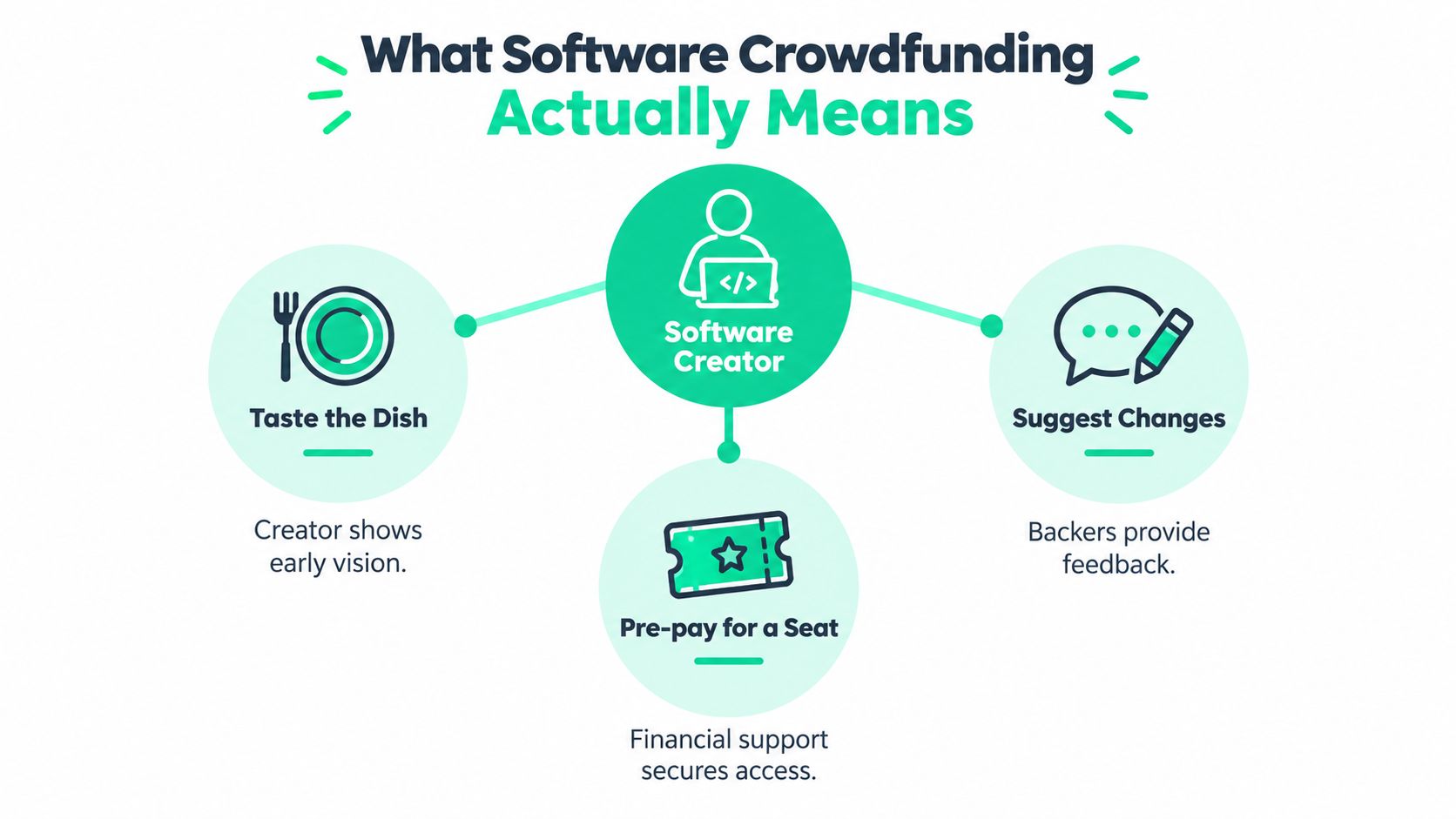
A software creator using crowdfunding is like a chef who opens the kitchen before the restaurant is finished. Future diners can taste an early dish, suggest changes, and pre-pay for a seat. The chef receives money and feedback, while the diners gain a clearer view of what they'll receive.
Software crowdfunding means raising money from a group of supporters to build, launch, or grow a digital product. The deliverable usually isn't a box shipped from a factory. It's an account, a license, access to a hosted tool, a premium tier, or source code released under stated conditions.
That difference changes the risk. In a conventional rewards campaign, backers may judge a physical prototype, manufacturing plan, and delivery schedule. In software, you can often give people a live demonstration before they pledge. They can test the interface, follow a repository, inspect documentation, or join a waitlist.
The product can speak before the campaign closes
A physical product may exist mainly as a rendering or prototype. A SaaS product can provide a working URL. An open-source tool can provide a public repository. An AI product can let users test a narrow workflow before the full vision exists.
This makes working evidence more valuable than concept art. A creator who shows a stable onboarding flow and active issue tracker gives backers something concrete to evaluate. A creator who shows only a future feature list leaves the audience to estimate delivery risk.
Delivery becomes an execution problem
Software can often reach supporters through an account invitation, download, or repository permission. That doesn't make delivery effortless. Hosting, security, integrations, support, and continued development still require discipline.
The risk shifts from manufacturing complexity toward shipping capacity and operational follow-through. Backers want to know whether you can keep improving the product after the campaign ends, not merely whether you can publish a first build.
Access can continue after the campaign
A one-time contribution can fund an initial release. Recurring support can fund maintenance, hosting, documentation, or ongoing open-source work. Those models overlap, but they aren't identical. A reward campaign usually promises a defined access tier, while community funding can support the project as long as supporters continue to value the work.
That distinction matters when you choose a platform, define rewards, and publish proof. The rest of the model depends on whether you're funding a specific milestone, a durable product business, or an open project that needs continuing participation.
How the Model Evolved Into Its Own Story
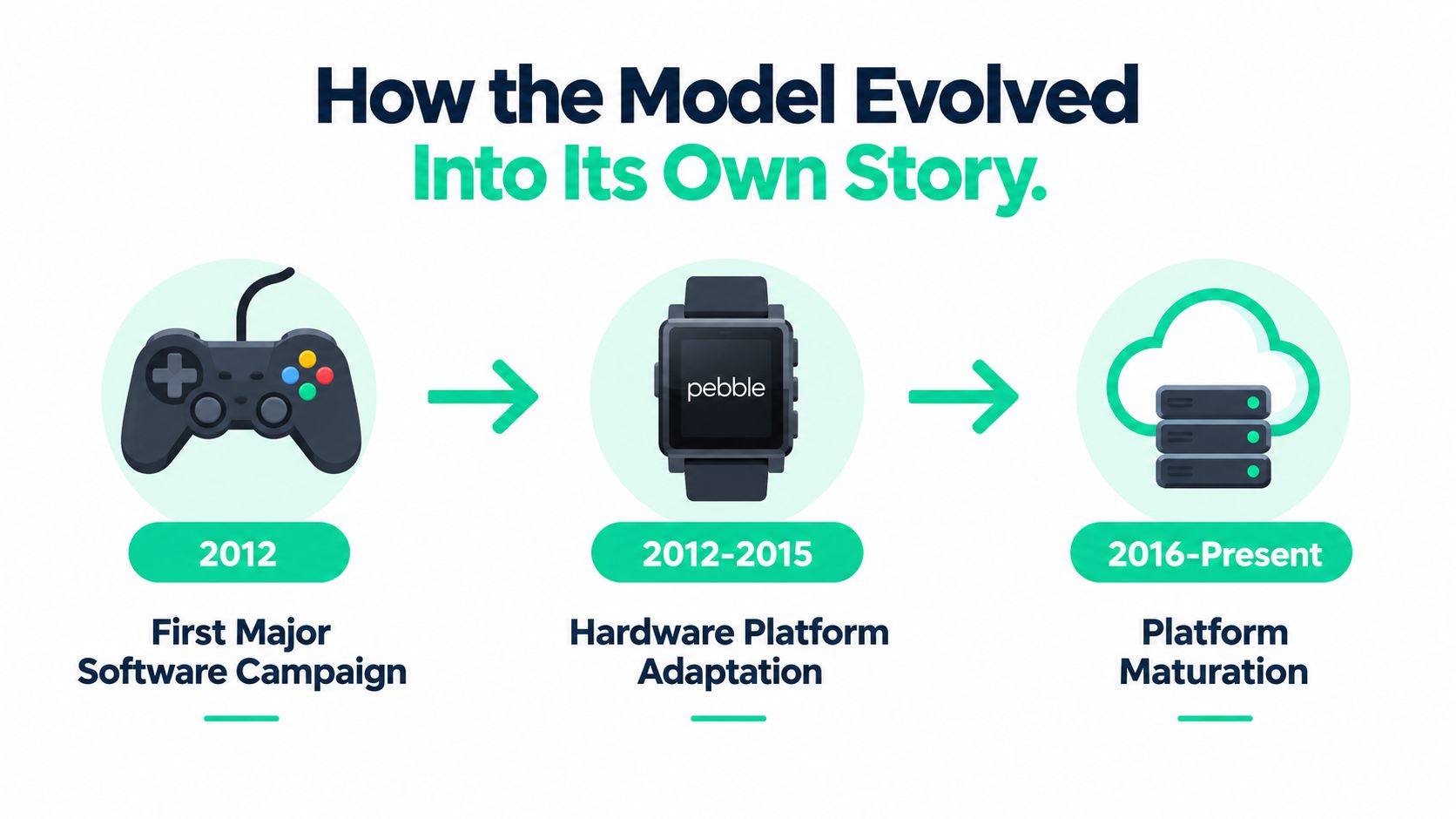
Software crowdfunding didn't begin as a perfectly designed category. Early creators often used broad rewards platforms built for games, gadgets, and creative projects. Software had to explain why an intangible deliverable deserved the same kind of support as a physical product.
The model became more credible as creators demonstrated that communities would fund development before a finished release. Reward-based crowdfunding launched with ArtistShare in 2003, and software and open-source funding models gained visibility in the 2010s. Bountysource relaunched as an open-source funding platform in 2013, and its largest fundraiser at that point, JS-Git, had raised $34,596 according to the historical account.
That history matters because each stage changed the question backers asked. First, they asked whether a digital product could attract supporters. Then they asked whether creators could deliver it. Now they ask whether the project is still moving.
Open-source projects helped push that expectation forward. A repository, contribution record, issue history, and release log can give supporters evidence that a project exists beyond its campaign page. A SaaS creator can offer a similar layer through product access, usage reporting, and a visible roadmap.
The important shift is from promise to continuity
A campaign used to function mainly as a launch announcement. Today, a creator can build an audience before asking for money, keep supporters involved during development, and continue selling access after the initial funding period.
That creates a different standard for credibility. A creator doesn't need to reveal every internal detail, but they should show enough public evidence for a backer to answer three questions:
- Does the product exist?
- Are people using or contributing to it?
- Can this creator keep shipping?
The software category is also expanding. Market estimates place the global crowdfunding software market at $1.55 billion in 2025, with a projection of $4.82 billion by 2034 at a 13.5% CAGR in one report, while another estimates $1.83 billion in 2025 and $5.91 billion by 2034 at a 13.7% CAGR. These estimates differ, so treat them as directional rather than as a single precise market measurement. The market report also identifies cloud deployment and North America as leading segments in its analysis.
The durable lesson is simple. Every era increased the amount of proof supporters expected. A modern software campaign should assume that a working build and visible traction carry more weight than an ambitious narrative alone.
How a Software Campaign Actually Works
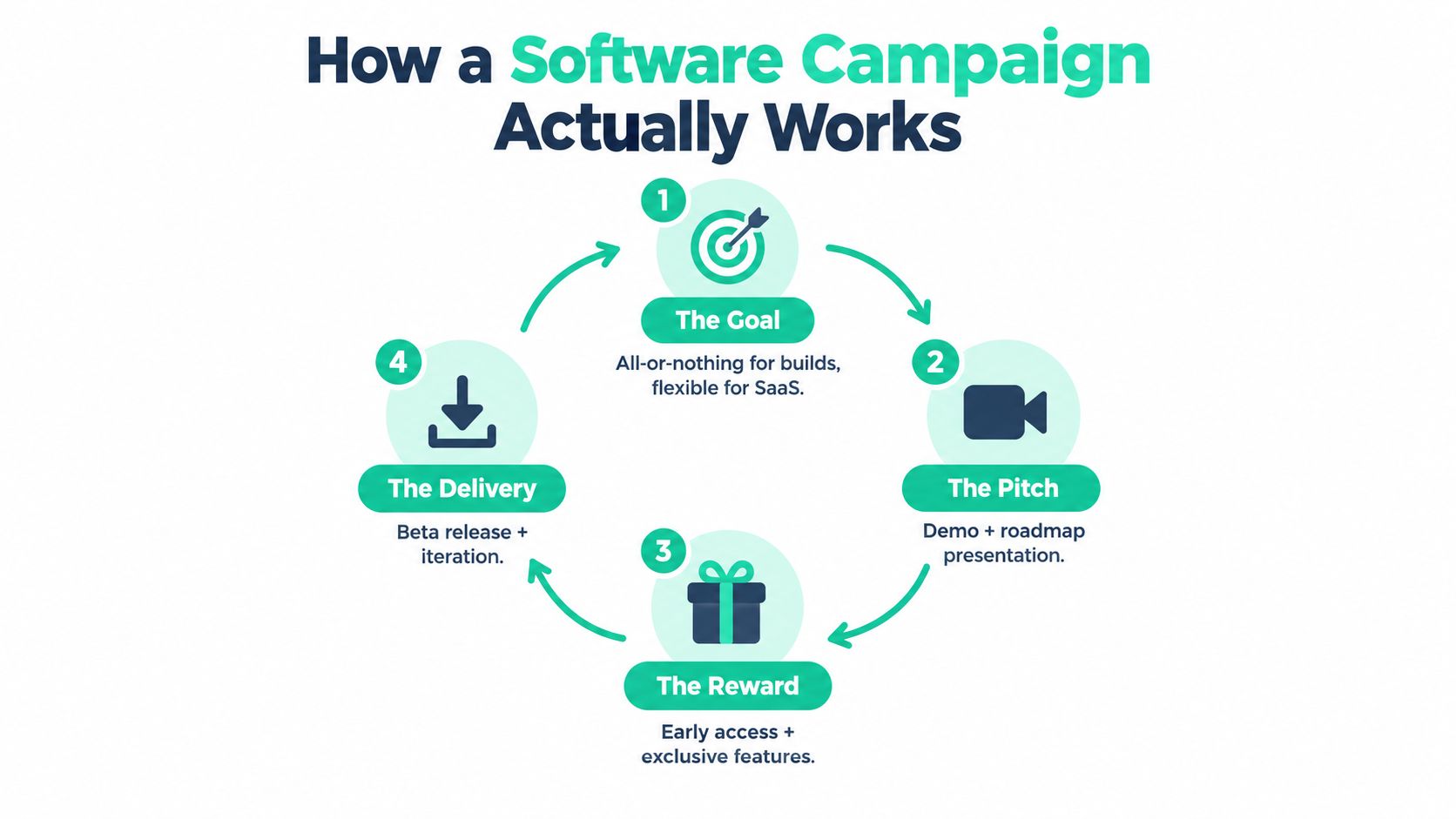
Most campaigns contain four connected parts: the goal, the rewards, the proof layer, and the payment flow. Treat these as separate design decisions. A weak campaign often fails because the creator combines them into one vague promise.
Start with a goal tied to a deliverable
Your goal should answer, “What will this money allow us to finish?” For a developer tool, that might mean completing team permissions, improving documentation, or supporting a hosted version. For an open-source project, it might fund maintenance, security work, or a dedicated contributor.
All-or-nothing funding can make sense when partial funding would leave you unable to deliver the promised milestone. A flexible goal can suit SaaS when you can ship a smaller version with less funding and add capabilities as support grows. Neither approach is automatically safer. The right choice depends on whether you can responsibly deliver at different funding levels.
Base the goal on a real operating plan. Include development time, infrastructure, customer support, taxes, payment costs, and contingency. A round number chosen for visual appeal won't tell backers what their money accomplishes.
Design rewards around access
Software rewards replace physical product variations. You might offer:
- Early access: Supporters receive an invitation to the beta before general availability.
- Founder pricing: Backers keep a defined price or feature tier under clearly stated terms.
- Team access: A company receives multiple seats or workspace permissions.
- Source access: Contributors receive repository access or a promised release under a stated license.
- Recognition: Supporters receive credit in documentation, the README, or a launch page.
Recurring support is a parallel model, not a substitute for a campaign. It works when the project provides continuing value, such as hosted access, regular releases, moderation, or maintenance. Explain what happens if someone stops paying, and don't describe ongoing service as a one-time reward.
Build a proof layer before you write the pitch
A credible campaign can include a live demo, a public roadmap in Trello or Linear, an open GitHub repository, and a dashboard that supporters can refresh. You don't need to expose private customer data. You do need to show enough evidence to distinguish active development from an abandoned prototype.
Before choosing a funding route, work through practical steps for fast validation. Validation helps you avoid asking a crowd to finance a product that hasn't yet established a clear user problem.
Explain how money moves
Platforms differ in when they capture contributions, how they handle failed goals, what happens during refunds, and how funds reach creators. Some models involve a platform-controlled holding process, while others route payment directly through the creator's payment account. Read the current terms before you promise delivery or calculate your net funds.
The four blocks remain the same even when platforms rearrange them. Your goal defines the milestone, rewards give support a clear exchange, proof reduces uncertainty, and payment rules determine what you can use. That's why platform choice should follow campaign design, not lead it.
Comparing the Main Platform Types
Platforms aren't interchangeable storefronts. Each one attracts a different kind of supporter and creates a different relationship between the creator and the audience. Choose based on the type of proof you can show and the kind of support you want to maintain.
| Platform Type | Funding Model | Typical Fees | Best For | Main Tradeoff |
|---|---|---|---|---|
| All-or-nothing rewards platforms | Supporters pledge toward a defined goal, and funding depends on the platform's rules | Varies by platform and payment method | A product with a clear milestone and broad public appeal | Deadline pressure and the risk of missing the target |
| Flexible funding platforms | Creators may receive contributions without reaching the full target, subject to platform terms | Varies by platform, location, and payment processing | SaaS products that can release in stages | Partial funding can create delivery obligations without enough budget |
| Equity and revenue-share platforms | Supporters invest for ownership or a share of future revenue | Varies by offering structure and jurisdiction | Companies seeking investment rather than pre-paid access | Ownership dilution, legal complexity, and investor reporting |
| Community-driven funding hubs | Supporters contribute directly or through recurring memberships | Varies by service and payment arrangement | Open-source maintainers and projects with an existing community | Less built-in discovery and more responsibility for audience development |
Kickstarter-style rewards platforms work best when you can tell a compact story: this product exists, this milestone is next, and this reward gives you access. Flexible funding suits a product that can make useful progress at several funding levels.
Equity and revenue-share models change the conversation. Backers are not just buying access. They are evaluating a business and accepting a different kind of financial relationship. That may suit a growth-oriented startup, but it's excessive for a maintainer who needs support for documentation and issue resolution.
Community hubs are often the natural home for open-source work. The audience may already understand repositories, maintainers, and release cycles. You'll usually need to bring more of that audience yourself, but you can build a longer relationship instead of depending on one campaign deadline.
Use this guide to crowdfunding options for apps as a further comparison point, then make the decision rule concrete:
Choose the platform that matches your strongest proof. A working consumer app with a compelling access tier can use rewards crowdfunding. A project with recurring usage may fit flexible funding. A company seeking capital for expansion should examine equity options. An open-source project with active contributors should start with a community funding hub.
Why Live Traction Has Become the Center
A polished pitch reduces uncertainty only for a few minutes. Live traction reduces it every time a backer checks the product.
Software creates an unusual advantage for creators. People can often try the product, inspect the code, read release notes, or observe user activity before they contribute. That means the campaign doesn't need to manufacture confidence from scratch. It needs to organize existing evidence into a clear decision.
Research on open-source projects supports this logic. A mixed-method study using Kickstarter data and a randomized experiment found that projects presenting an OSS approach were perceived as more trustworthy and achieved stronger financing outcomes. The explanation goes beyond communities just liking open source. Backers can inspect code, contribution history, and development practices, which helps them estimate delivery risk. The study describes this credibility effect in its analysis of OSS crowdfunding.
Evidence answers different backer questions
A repository with recent commits suggests that someone is actively working. It doesn't prove that users want the product. A revenue figure suggests willingness to pay, but it doesn't show whether the team can maintain the codebase. A roadmap shows intent, but not execution.
Backers therefore read several signals together:
- Maintainer activity indicates whether the project has a living owner.
- Commit cadence shows whether development is moving at a consistent pace.
- Issue response reveals how the team handles friction.
- Usage or revenue shows whether people receive enough value to return or pay.
- A public roadmap makes the next funding milestone easier to understand.
A screenshot can support a story, but it's weak proof on its own. A refreshable dashboard or public activity record gives the audience a way to verify that the story remains current.
Creators who want to present these signals clearly can study how a real-time metrics dashboard organizes live product evidence. The specific tool matters less than the principle: show the underlying activity, explain the time period, and avoid presenting a vanity metric without context.
The campaign page should compress evidence, not replace it.
Without live traction, even an attractive pitch forces backers to make a prediction. With live traction, they can evaluate a product that is already producing signs of life. That difference is especially important for SaaS, developer tools, and open-source products, where the distance between a promise and a usable build can be inspected directly.
Metrics Backers Actually Look For
A backer rarely needs every metric your analytics stack can produce. They need a small set that answers whether people want the product, whether the product works, and whether you can keep improving it.
Consider a fictional SaaS creator with a polished homepage and a screenshot of MRR. The screenshot looks reassuring, but it doesn't show the period covered, whether the revenue is recurring, or whether customers are still active. A stronger presentation explains the metric and connects it to usage, retention, or customer count.
Revenue signals
MRR and ARR growth help supporters understand recurring demand. Pair them with paying-customer count and churn so the audience can distinguish new sales from durable retention. A creator who shows MRR without explaining cancellations gives an incomplete picture.
Use a source-verified payment view where possible, while redacting customer identities and sensitive information. A screenshot can be useful as a visual summary, but a verifiable data connection gives backers more confidence than a manually edited image.
Usage signals
MAU, DAU, activation rate, and retention curves describe what users do after signing up. A waitlist can show interest, but active usage shows whether the product solves a problem repeatedly.
For example, “many people joined the beta” is weak if you don't explain how many returned. “Users complete the core workflow and continue returning” is stronger when supported by a clearly defined activation event and retention view. Always define what counts as active, because the same label can describe very different behaviors.
Development signals
Weekly commits, release cadence, contributor count, and issue close time help backers evaluate execution. A large GitHub star count may indicate awareness, but it doesn't prove recent progress. A commit graph paired with release notes shows both activity and outcomes.
An open-source creator should explain whether commits come from one maintainer or several contributors. A SaaS founder can show shipped improvements, incident updates, and roadmap movement instead of publishing a raw activity chart without interpretation.
Community signals
Waitlist size, Discord activity, NPS, customer feedback, and GitHub stars can reveal audience interest. They become more useful when combined with revenue or usage evidence.
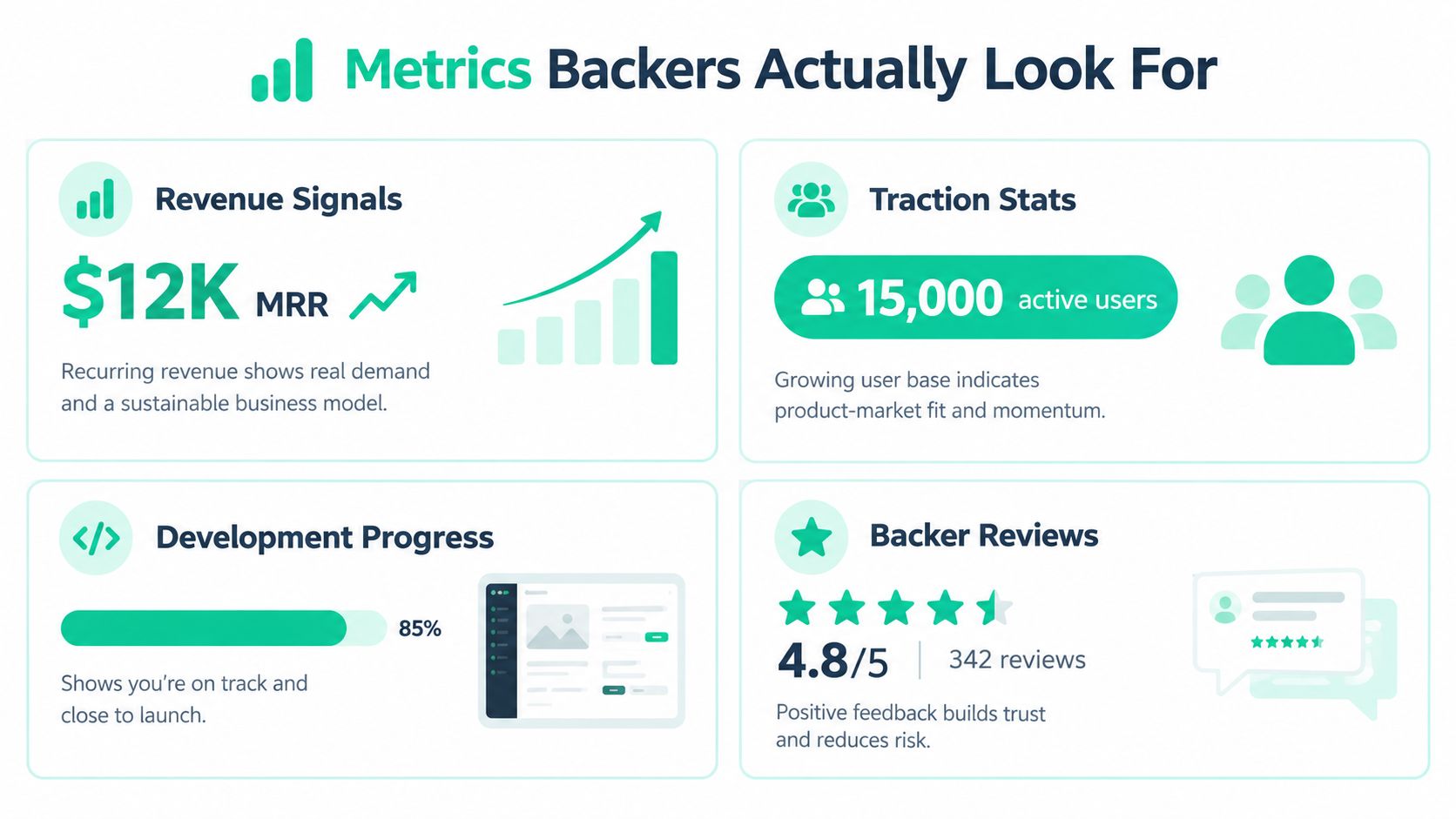
A strong campaign triangulates. Revenue says someone paid. Usage says someone returned. Development activity says the product is moving. Community signals say people care enough to discuss and recommend it. None of these metrics should be treated as a universal success threshold. Their value comes from the relationship between them.
From One-Time Campaign to Always-On Funding
A software product doesn't stop changing when a campaign closes. New releases create new reasons to contribute, and public progress can keep the project visible between formal funding pushes.
That makes the traditional campaign window feel too narrow for many creators. A SaaS founder can publish a roadmap, share a shipping note, and update a traction page without waiting for a new launch. An open-source maintainer can explain which issue a contribution will fund and report what changed after the work is complete.
Recent market coverage describes crowdfunding as moving toward an always-on launch system that combines pre-launch communities, late pledges, pledge management, and post-campaign sales. It also describes platforms becoming broader commerce systems, which raises the importance of continuous operational transparency. The coverage discusses this shift and the continuing role of technology projects in crowdfunding.
Every release can become a funding event
A release doesn't need a donation request attached to it. The release itself creates evidence. If supporters can see the feature, read the changelog, and understand the next milestone, they have a reason to reconsider the project.
Creators can keep the funding surface warm by:
- Publishing shipping notes: Explain what changed, who it helps, and what remains unfinished.
- Refreshing the dashboard: Show current revenue, usage, or development activity instead of recycling an old campaign screenshot.
- Maintaining reward tiers: Offer access to new capabilities while preserving clear expectations for earlier supporters.
- Reporting setbacks openly: A missed milestone is easier to understand when the creator explains the cause and revised plan.
This approach changes creator behavior. Instead of staying silent until launch day, the team operates transparently by default. Supporters stop evaluating a single promise and start evaluating pace, responsiveness, and consistency.
Research on the future direction of crowdfunding projects that about 52% of platform development will focus on recurring engagement, specialized financing, creator monetization, community participation, and deeper fintech integration. The same research estimates that roughly 63% of campaign interaction is increasingly connected to mobile, social, or integrated digital channels. These projections are described in the market research report.
Treat those figures as forecasts, not guarantees for an individual campaign. The practical lesson is more durable: software creators should build a support relationship that can survive beyond a single deadline.
Your First Three Moves This Week
Don't begin by writing a dramatic campaign video. Begin by finding the strongest evidence you already have.
1. Audit your public signal
List your current GitHub stars, MRR, waitlist size, churn, active users, release activity, and customer feedback. Then choose one headline metric that most credibly demonstrates product-market fit for your specific product.
A developer tool may lead with repository activity and repeat usage. A SaaS product may lead with recurring revenue and retention. An open-source project may lead with contributor activity and issue resolution. The metric should be easy to define, difficult to misinterpret, and connected to the funding milestone.
2. Choose the audience before the platform
Match the platform to the people most likely to understand your proof. A SaaS-friendly community may respond to product usage and recurring revenue. An open-source hub may value repository activity and maintainer continuity. A general rewards marketplace may suit a consumer product with a clear early-access offer.
Review the platform's payment rules, funding model, geographic availability, refund process, and audience behavior. Use this practical guide to starting a crowdfunding campaign while you turn those decisions into a concrete launch plan.
3. Warm up for fourteen days
Use the preparation period to make the product more legible:
- Publish two behind-the-scenes updates that show a real problem, design decision, or implementation tradeoff.
- Ship one visible improvement so prospective backers can see that the project is active.
- Announce the upcoming raise seventy-two hours before launch, using your headline metric and a plain explanation of what funding enables.
Your campaign doesn't need theatrical urgency if the product already creates evidence. Software crowdfunding rewards ongoing discipline, clear reporting, and consistent shipping. Build the proof this week, then ask supporters to fund the next visible step.
If you're building SaaS, an AI tool, an app, or an open-source project, Fundl lets you connect sources such as Stripe, GitHub, and analytics to publish a shareable traction page with live metrics. Set your goal, show verified progress, and invite supporters to contribute directly through a reward-based funding model.