
Most advice about a unique selling proposition starts with a template: “For [audience], we offer [benefit].” That's useful only after you know whether the benefit matters, whether competitors can claim it, and whether your business can prove it.
A USP isn't a slogan you polish once and paste across your website. It's a market-positioning hypothesis. You're making a focused promise about why a particular customer should choose you, then testing that promise against buyer behavior, competitor alternatives, and operational evidence. If the claim sounds distinctive but nobody can verify it, you've written advertising copy, not a defensible position.
Table of Contents
- Defining the Core Concept
- From Advertising History to Modern Proof
- Crafting Your Evidence-Backed Proposition
- Tailored Examples for SaaS, Open Source, and Creators
- Validating with Live Traction Metrics
- Common Misconceptions and Final Takeaways
Defining the Core Concept
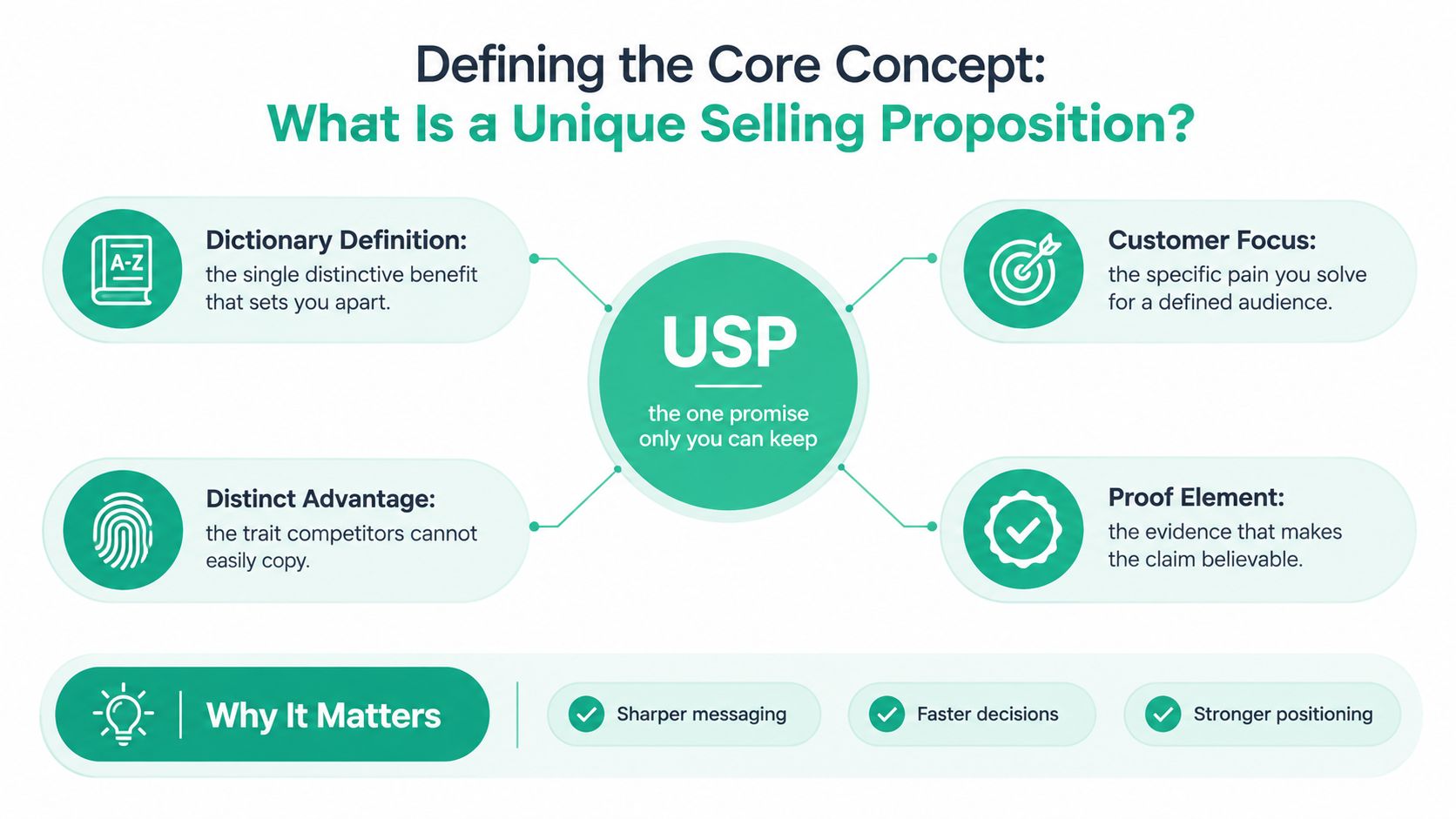
A unique selling proposition is a market-positioning hypothesis, not a polished slogan. It states why a defined customer should choose your offer, identifies the decision criterion behind that choice, and makes a claim your business can test with evidence.
“High quality,” “easy to use,” and “great support” rarely qualify. Several competitors can repeat them, and buyers cannot assess them without more context. A stronger USP names a specific problem, underserved audience, or operating advantage that customers can recognize and your company can deliver consistently.
A promise, not a description
A product description lists what you sell. A USP explains why your offer deserves preference.
Consider the difference:
- “Project management software with automated reports” describes a feature.
- “Automated reports for agencies that need client-ready updates without rebuilding them every week” connects that feature to a customer and a buying criterion.
The second statement remains a hypothesis. You must establish that agencies experience the reporting problem, that competing options address it differently, and that your product produces the promised result. Customer interviews, usage patterns, retention, conversion behavior, and sales objections can test the claim more reliably than copy review alone.
A practical standard is to make the proposition a short, testable claim tied to a customer decision. Identify the buyer, the factor influencing the decision, and the reason to believe the claim. Without those three elements, the sentence may sound distinctive while offering no defensible position.
The four-part test
Use this sequence before writing headline copy:
- Audience: Which customer is choosing between alternatives?
- Problem: What specific friction or unmet need affects that choice?
- Difference: What do you do differently in a way the customer can observe?
- Proof: What evidence makes the promise credible?
Your USP does not need to appear word for word in every campaign. It should guide the landing page, onboarding, sales conversation, product experience, and proof shown to prospects. A headline promising simplicity loses credibility if setup is confusing.
Founders testing demand can compare the proposition with customer need through market-fit research, including this resource on product market fit for NZ startups. The aim is not a clever phrase. It is a focused promise that your current business can credibly keep for the customers it intends to serve, then validate through live market response rather than static copy alone.
From Advertising History to Modern Proof
The term unique selling proposition was coined by advertising pioneer Rosser Reeves and formalized in his 1961 book Reality in Advertising. The idea was already being used in the early 1940s at Ted Bates & Company, where Reeves worked on a disciplined approach to product differentiation. His framework required a specific consumer promise, a claim competitors could not or did not make, and enough strength to attract a mass audience, as documented in this history of the unique selling proposition.
That framework solved a real advertising problem. Instead of giving audiences a pile of product attributes, a campaign selected one dominant benefit and repeated it consistently. Reeves used this style in campaigns for products such as Anacin during the 1950s. The discipline was powerful because it forced marketers to choose.
The weakness appears when founders treat historical uniqueness as a permanent business advantage. A claim can be distinctive in a campaign but fragile in the market. Competitors copy features, match pricing, adopt similar language, and train customers to expect the same category benefits.
From functional difference to strategic position
By the 2000s, saturated markets had made pure functional uniqueness harder to find. Marketers and scholars began discussing related ideas such as the unique emotional selling proposition, shifting attention from what a product does to how the buyer wants to feel or identify after choosing it. This evolution is outlined in the history of USP strategy from UPP B2B.
Emotional differentiation isn't a substitute for evidence. It adds another layer to the decision. A creator might promise confidence, independence, or belonging, but buyers still look for signals that the product delivers the underlying experience. A software company may position itself around calm operations, yet its process, reliability, and customer support have to make that feeling credible.
Why slogans fail as strategy
A slogan is a memorable expression. A USP is a decision-making argument.
“Built for modern teams” is slogan-shaped, but it doesn't identify a customer problem or a defensible difference. “A review workflow that keeps regulated teams on one evidence trail” is more useful because it points toward a buyer, a problem, and a product behavior that can be inspected.
Historical lesson: Choose one meaningful promise. Modern lesson: Bring proof that you can keep it.
The concept has lasted because it gives teams a way to make choices in crowded markets. Its modern application requires a stricter question than “Does this sound unique?” Ask instead, “What remains uniquely credible after competitors copy the surface?”
Crafting Your Evidence-Backed Proposition
A USP should survive contact with a customer, not merely sound distinctive in a headline. The difficult work begins before copywriting: identify a market problem, form a positioning hypothesis, and gather evidence that the business can deliver the promised difference.
Start with market research, customer needs, competitor gaps, and claim testing. A competitive advantage becomes useful when customers recognize it, value it, and can distinguish it from available alternatives. Treat the proposition as a claim to test, not an assertion to decorate with polished language.

Start with customer language
Collect the words customers use when describing the problem. Review sales calls, support conversations, onboarding questions, cancellation reasons, product reviews, and comparisons with alternatives. Repeated decision criteria matter more than isolated compliments.
“Your dashboard is nice” provides little positioning value. “I chose this because I could show the evidence to my client without exporting anything” points to a specific outcome and a reason to choose the product.
Map every meaningful alternative. Include direct competitors, spreadsheets, internal processes, doing nothing, and adjacent tools. Customers compare the cost, risk, and effort of available workarounds, not only the companies listed on your competitor slide.
Draft the claim around a reason to believe
Use this working structure:
For [specific audience] facing [decision problem], [offer] provides [distinctive outcome] through [credible mechanism or proof].
Keep the sentence internal at first. Check whether the audience recognizes the problem, whether the outcome can influence a purchase, and whether the mechanism creates an advantage competitors cannot easily reproduce.
Feature-based positions weaken because features travel. A competitor can copy a dashboard, integration, workflow, or AI capability. A stronger position may rest on the process around the feature, the quality of the underlying data, a narrow audience focus, a trusted distribution channel, or a consistent record of delivering the outcome.
For a closer examination of durable positioning against copycat offers, this guide to differentiating from competitors keeps attention on credibility rather than novelty.
Test before you announce
Put candidate propositions in front of customers and ask questions that reveal choice instead of approval:
- Which part would make you consider switching?
- What would you need to see before believing this?
- Which alternative do you use today?
- What would make this promise irrelevant?
- What words would you use to describe the benefit?
Avoid asking, “Do you like this tagline?” People are polite about taglines. Ask what they expect the product to do, which evidence they would trust, and whether the claim changes how they evaluate alternatives.
The shift toward emotional selling propositions in the 2000s shows why functional uniqueness can weaken in saturated categories, as described by UPP B2B's history of USP development. Pair an emotional outcome with operational proof. “Feel in control” becomes credible when the product gives customers a visible, repeatable way to monitor and act on the problem.
Practical rule: If your team cannot name the evidence behind a claim, remove the claim or change the business.
Tailored Examples for SaaS, Open Source, and Creators
A SaaS founder, an open-source maintainer, and an education creator can sell similar categories of value while using completely different proof. The right USP depends on the buyer's risk and the evidence that reduces it.
SaaS
Suppose a SaaS product helps small teams publish client reporting. “Automated analytics platform” is descriptive and easy to copy. A sharper position might focus on client-ready reporting from connected source data, provided the product maintains that workflow and customers choose it for that reason.
The evidence could include product demonstrations, connected data sources, support patterns, and visible shipping activity. A SaaS founder shouldn't claim reliability just because the interface looks polished. The buyer wants to know whether the workflow survives real usage and whether the vendor keeps improving it.
SaaS teams can organize the evidence around the metrics that explain product health. This SaaS growth metrics guide offers a useful vocabulary for connecting the proposition to actual business signals instead of feature inventory.
Open source
An open-source project might claim “fast, flexible developer tooling.” That says little. A better position could focus on a particular implementation problem, a transparent maintenance process, or a community that helps users adopt the project safely.
The differentiator may be visible issue handling, documentation quality, release discipline, or compatibility with a defined workflow. Code quality matters, but buyers and contributors also evaluate whether the project is active, understandable, and supported.
The strategic decision between closed and open development deserves its own assessment. Teams comparing those models can use Refact's guide on whether to use proprietary software to examine trade-offs around control, collaboration, and distribution.
Creators
A creator selling an AI workflow course might say, “Learn to use AI for productivity.” That audience is too broad, and the promise is difficult to verify. A stronger position could target a specific type of worker and show the actual workflow, curriculum, examples, and audience response.
Creators have an advantage that many software companies lack. They can show the work in public. A proposition can draw credibility from published lessons, product usage, repeat audience questions, completed projects, or transparent traction. The proof must support the promise, not decorate it.
Shopify's discussion of customer-centered USP positioning captures the central issue: modern guidance increasingly treats a USP as a customer need connected to real proof, rather than a catchy differentiator. The same principle applies across all three models. The claim changes, but the test remains consistent: does this audience care, can you deliver it, and can you show evidence?
Validating with Live Traction Metrics
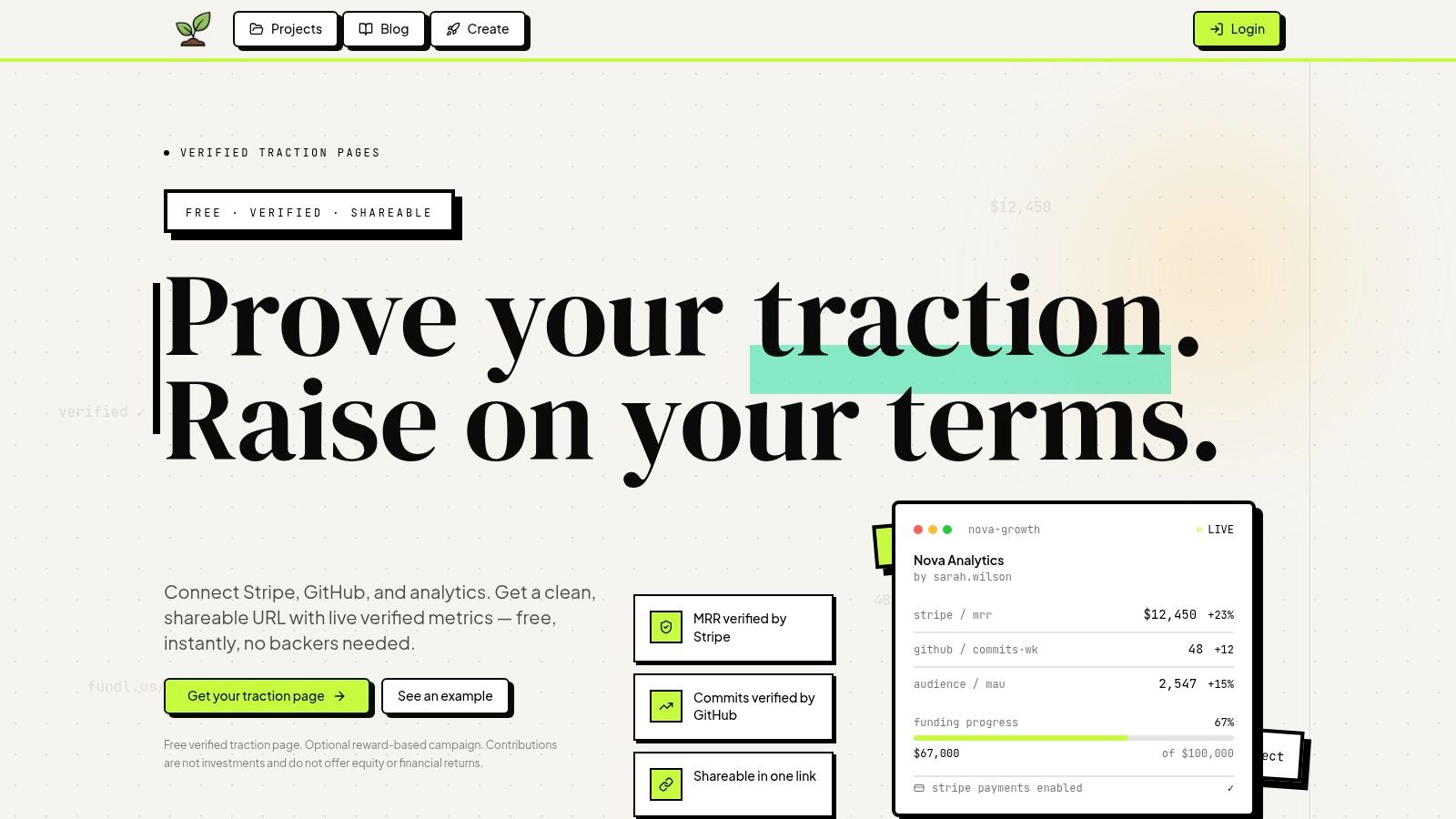
Static screenshots are weak evidence because they freeze a moment and leave the buyer to trust your interpretation. A live traction page changes the conversation. Instead of saying that the product has demand or that the team ships consistently, you can show connected signals that update as the business changes.
Match proof to the promise
Your evidence should mirror the claim.
- A SaaS product positioned around commercial demand needs revenue or customer activity signals.
- An open-source project positioned around active maintenance needs visible repository activity and release evidence.
- A creator positioned around audience trust needs engagement or usage signals that demonstrate an active relationship.
The metric itself isn't the USP. It's the reason to believe behind the USP. Monthly Recurring Revenue can support a claim about paid demand. Repository activity can support a claim about ongoing development. Active users can support a claim about continued adoption. None of these signals proves every business outcome, so don't stretch them beyond what they show.
Fundl is a crowdfunding platform built around verified traction. Creators can connect Stripe, GitHub, and analytics to publish shareable traction pages with source-verified data, allowing live metrics to support a funding pitch instead of relying only on promises. That makes the proposition easier to inspect for backers who want evidence before contributing.
Replace persuasion with inspection
A proof-first page should answer practical questions quickly:
- What is being built?
- Who is using or supporting it?
- Which connected sources support the claim?
- Is the activity current?
- What action can a backer take?
Auto-refreshing information matters because stale evidence creates doubt. A founder may have strong traction today, but a screenshot from an earlier period can't show whether the signal is continuing. Live data doesn't remove judgment, but it gives the buyer a cleaner basis for making it.
For founders still testing demand, this guide to validating product-market fit provides a useful way to connect customer need with observable traction. Validation isn't a single launch event. It's an ongoing comparison between what you promise and what people do.
A short walkthrough can make the difference between abstract claims and an inspectable process:
The strongest evidence pages don't dump every available metric on the visitor. They select signals that directly reinforce the proposition, explain where those signals come from, and leave enough context for a backer to interpret them responsibly.
Proof standard: Show the metric that a skeptical buyer would ask for first, then make its source and freshness clear.
Common Misconceptions and Final Takeaways
The most expensive USP mistake is treating positioning as a copywriting task. A founder writes a line, adds it to the homepage, and moves on while the market, competitors, customer priorities, and product capabilities continue to change.
A USP should guide decisions, not merely decorate them. It helps determine which customers to target, which features deserve investment, what proof to collect, and which prospects aren't a good fit. If the statement doesn't influence those choices, it's probably a slogan.
What a USP isn't
- Not a feature list: Features become meaningful only when they resolve a customer decision problem.
- Not a generic compliment: “Trusted,” “simple,” and “cutting-edge” need a specific reason to believe.
- Not a permanent artifact: Competitors imitate visible advantages and customers change what they value.
- Not a promise without delivery: Sales, support, product behavior, and proof must reinforce the same position.
- Not an appeal to everyone: A focused proposition may exclude buyers who don't value the chosen difference. That focus is useful.
Markets don't require every claim to be unprecedented. They require the claim to be relevant, observable, and credible for the segment you want. A product can win with a familiar benefit if it delivers that benefit through a meaningfully different process or serves a customer group others ignore.
Review your proposition when customer language changes, competitors adopt similar claims, or your evidence no longer supports the promise. Keep a record of the claim, the decision criterion it targets, the proof behind it, and the signals that would disprove it. That turns positioning into an operating discipline rather than a branding exercise.
The practical sequence is simple: identify the buyer's decision, locate the gap, state one promise, attach a reason to believe, and test whether the market responds. Then keep collecting evidence. A defensible USP isn't the cleverest sentence in your category. It's the promise your business can continue to demonstrate while alternatives make similar claims.
Fundl lets creators publish shareable traction pages using source-verified data connected from tools such as Stripe, GitHub, and analytics. If your USP depends on proving demand, shipping activity, or audience traction, visit Fundl and put current evidence behind the promise.