
The fastest way to launch a SaaS today isn't to build in silence, but to prove demand first with live metrics and fund the final push through a platform like Fundl. The warning is stark: 42% of failed startups cited a lack of market need as a major reason, while global SaaS revenue is projected to rise from approximately $408.21 billion in 2025 to $465.03 billion in 2026.
A launch isn't a ceremonial release date. It's a sequence of proof points that should answer one question at every stage: are the right people taking increasingly valuable actions? If prospects join a waitlist, use a prototype, return to the product, and pay for a defined outcome, you have evidence. If they only compliment the idea, you have encouragement.
I've learned to treat launch planning as a capital allocation problem. Every hour spent coding, every dollar spent on acquisition, and every promise made to backers should follow observable demand. Build enough to create a value event, measure what happens, and let those signals determine what you ship next.
Table of Contents
- Why Most SaaS Launches Fail Before They Start
- Validating Your Idea with Real Market Signals
- Building the Right MVP for Early Growth
- Choosing Between Per-Seat and Usage-Based Pricing
- Tracking Metrics That Actually Matter
- Using Fundl to Validate and Fund Your Launch
Why Most SaaS Launches Fail Before They Start
The most dangerous SaaS assumption is simple: build a useful product, announce it, and wait for customers. A widely cited CB Insights post-mortem analysis of startup failures found that 42% of failed startups identified the absence of market need as a major reason for failure, making it the most frequently cited cause in that analysis.
That finding matters even more for subscription software. A one-time purchase can succeed because of timing, curiosity, or a strong launch campaign. SaaS needs customers to keep using the product and renewing their plans. A polished onboarding flow can't compensate for a problem that isn't frequent, costly, or urgent enough to change behavior.

Replace building speed with learning speed
Solo founders often interpret speed as writing code quickly. The better interpretation is reducing the time between an assumption and a real-world test. A landing page with a specific promise, a manual service that simulates the product, or a narrowly scoped prototype can reveal more than another month of infrastructure work.
Waiting for perfection creates a particularly expensive trap. You postpone exposure to real users, so you don't discover whether the positioning is wrong, whether the workflow is too difficult, or whether the buyer has authority to purchase. By the time you launch publicly, you've converted uncertainty into sunk cost.
Practical rule: Don't ask whether people like the product. Ask what action they're willing to take because they need it.
Validation doesn't mean collecting endless opinions. It means asking a defined customer segment to commit time, data, access, money, or reputation. A pilot, a paid design partnership, a deposit, or repeated prototype usage carries more weight than enthusiastic interview language.
Promotion still matters, but it should amplify proof rather than hide its absence. Once you have a clear message and an initial audience, guidance on SEO and content promotion for new sites can help you earn durable discovery instead of depending entirely on launch-day attention. Distribution works better when the underlying promise has already survived contact with real buyers.
Validating Your Idea with Real Market Signals
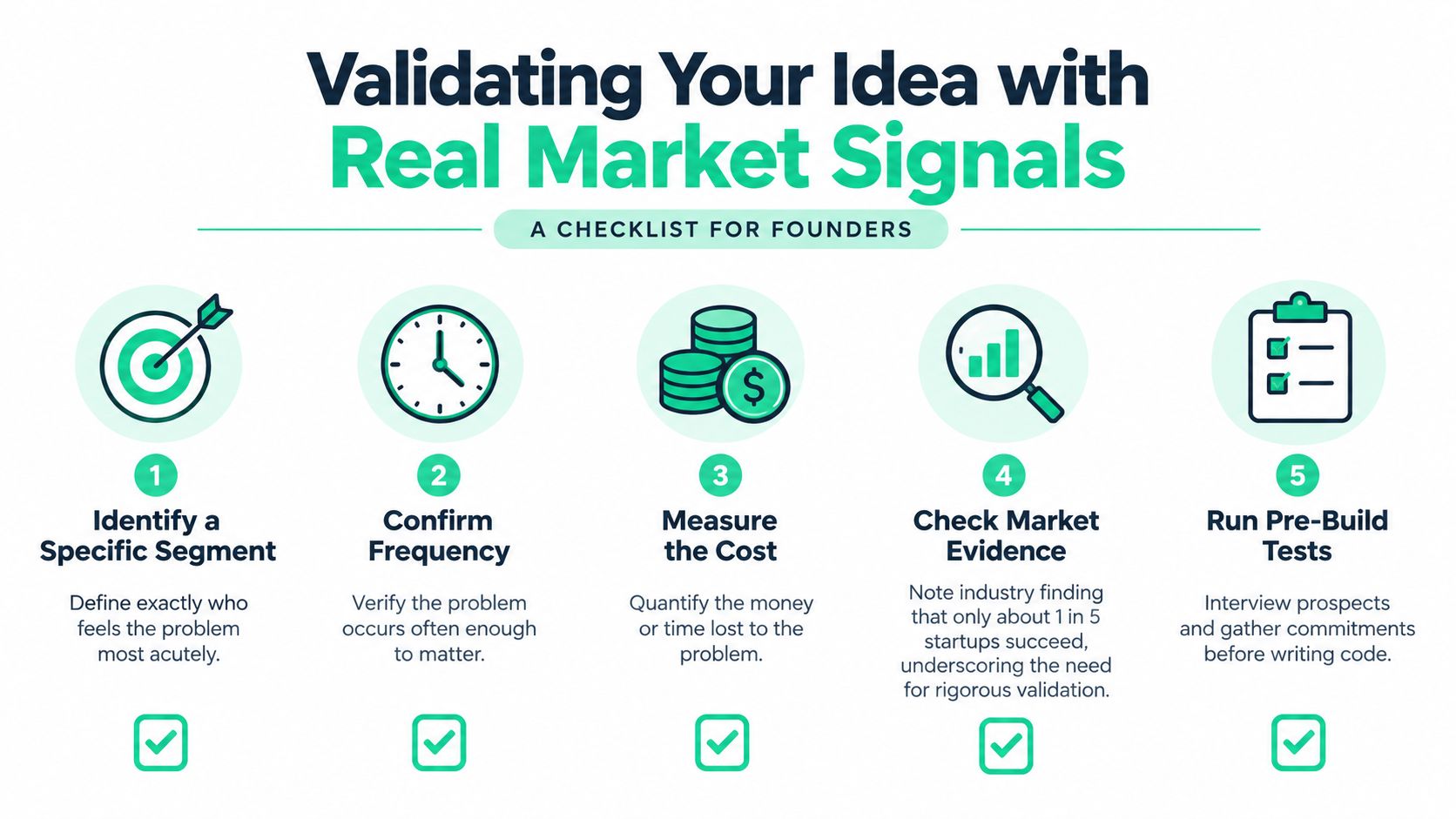
Start with a customer segment, not a feature list. “Small businesses” is too broad to guide product decisions. A useful segment might be independent agencies that reconcile client reporting manually, or engineering teams that need to detect a specific class of deployment issue. Name the role, the workflow, and the moment when the problem becomes painful.
Then test the problem in a fixed order.
Find pain that repeats
Ask prospects to describe the last time the problem occurred. What triggered it? How did they handle it? What did the workaround cost in time, money, missed revenue, or risk? Specific past behavior is more useful than a hypothetical promise to use your product later.
Industry summaries suggest that only about one in five startups validate their market before building, while startups that spoke with more than 100 potential customers had 25% better odds of succeeding. Those figures are directional, not universal benchmarks, but they point to a practical discipline: speak to enough people to detect repeated patterns, not just a few friendly opinions. The underlying figures are summarized in Fundl's guide to validating a startup idea.
Turn conversations into commitments
Use a lightweight experiment for each major assumption:
- Segment test: Write a landing page for one narrowly defined buyer and send it to places where that buyer already seeks help.
- Problem test: Ask prospects to show you their current workflow, including spreadsheets, tickets, exports, or manual steps.
- Solution test: Demonstrate the smallest usable workflow, even if you perform part of it manually behind the scenes.
- Payment test: Offer a paid pilot, an early plan, or a defined deposit. Don't treat a positive interview as proof of willingness to pay.
- Retention test: Invite early users to repeat the workflow and record whether they return without being chased.
Pricing belongs in validation because a product can solve a real problem without creating enough value at a sustainable price. Test the buyer's reaction to a concrete offer, what the plan includes, what usage it covers, and what happens when the customer grows.
Your milestone isn't a large waitlist. It's repeated behavior from a specific group. When users complete the same value-producing action, return to it, and accept a commercial commitment, you can decide whether to iterate, reposition, or begin measured acquisition.
Building the Right MVP for Early Growth
An MVP isn't a cheap version of the complete roadmap. It's the smallest reliable product that delivers one meaningful outcome and produces evidence about what customers do next.
The opportunity is large, but broad opportunity doesn't make a broad product easier to launch. One market analysis projects global SaaS revenue will increase from approximately $408.21 billion in 2025 to $465.03 billion in 2026, a 14.1% year-over-year rise. The estimate, available in this analysis of global SaaS market size, describes market expansion, not a guarantee that an undifferentiated product will find customers.
Choose a narrow wedge
Pick one profession, workflow, or developer use case where the problem is clear and the buyer is reachable. A strong wedge gives you a short path from first touch to first value. It also makes product decisions less political because you can judge features against a specific job rather than an imaginary mass market.
Your first version should answer three questions:
- What action creates value? Define the event that means a user has successfully received the product's core benefit.
- What must happen before that action? Remove setup steps, optional configuration, and integrations that don't support the first outcome.
- What evidence follows it? Track whether users return, invite others, expand their use, or ask to keep the service.
The product can be narrow without feeling fragile. You might combine a simple interface with manual operations, a single integration, or a constrained workflow. Customers care about the outcome first. Your job is to learn which parts must become automated before growth makes manual work uneconomic.
Build the measurement layer with the product
Instrument activation from the first usable release. Track the value event, return usage, conversion to paid use, monthly recurring revenue, cancellations, and the acquisition source. If your product involves code, weekly commits can indicate shipping consistency, but commit volume alone doesn't prove customer value. Pair build activity with product behavior and revenue.
A useful MVP backlog has three categories:
- Required: The shortest path to the core value event.
- Observable: Events, feedback capture, billing, and account data that let you diagnose behavior.
- Deferred: Features requested by one prospect, broad integrations, advanced permissions, and polish that doesn't change activation.
Don't build a feature-complete product to avoid criticism. Build a product that can teach you what deserves to exist. The principles in this guide to minimum viable products are useful when the roadmap starts expanding faster than the evidence.
Choosing Between Per-Seat and Usage-Based Pricing
Pricing is part of the product, not a packaging task for the final launch week. It tells customers what they are buying and determines how revenue changes as their usage changes. Choose the model from observed customer behavior, then verify the choice with paying users.
Per-seat pricing is easy to explain. Customers pay for the number of people using the system. It fits products whose value grows through collaboration, permissions, or active operators. It creates friction when many people need occasional access, automated processes generate most activity, or buyers worry that adding teammates will steadily increase their bill.
Usage-based pricing ties payment to an activity such as processed records, API calls, storage, or automated jobs. It fits products where the usage unit is visible, measurable, and closely connected to customer value. If consumption is difficult to estimate, however, the model transfers forecasting risk to the buyer and can delay the purchase.
A 2025 pricing analysis found that per-seat pricing fell from 64% of SaaS companies in 2024 to 57% in 2025, while usage-based pricing reached 43% and hybrid pricing reached 61%. Those figures come from the SaaS pricing statistics analysis by Radixweb. The shift shows that SaaS companies are using more than one default model. It does not justify copying the most popular option.
Match the meter to the value
Use this test before setting tiers:
| Pricing question | Per-seat fit | Usage or hybrid fit |
|---|---|---|
| Does value increase with the number of collaborators? | Strong | Possible |
| Does value increase with measurable processing or output? | Weak | Strong |
| Can a buyer predict consumption before purchase? | Usually easier | Requires careful design |
| Will occasional users create unnecessary seat costs? | Risk | Often better |
| Does the base platform need a variable component? | Limited | Hybrid can work |
A hybrid plan combines a predictable platform fee with a usage allowance. Customers get a stable starting cost, while your revenue can expand when the product creates more value. Set clear usage ceilings, show consumption inside the product, and explain overage rules before purchase. An unexpected bill can destroy trust before customers experience the product's full benefit.
AI features need the same discipline. Although 44% of SaaS companies reportedly charge for AI-powered features, one 2025 pricing analysis found that only 8% of all net-new customers adopted AI add-ons. Those figures are reported in the same 2025 pricing analysis cited above. An AI label does not create willingness to pay. Charge for a measurable outcome, test the add-on with real buyers, and remove it from the paid tier if customers neither use it nor connect it to value.
Start with a paid pilot instead of treating the first price as permanent. Use live customer conversations, invoices, usage records, and renewal behavior to learn which unit buyers understand and consider fair. Adjust pricing alongside activation and retention. Competitor screenshots show what others charge, not what your validated customers will pay.
Tracking Metrics That Actually Matter
Traffic is easy to celebrate and hard to use. A launch can generate attention without producing activation, retained usage, or revenue, so I don't use visits or sign-ups as permission to increase acquisition spend.
A useful dashboard follows the customer journey from source to outcome. For every cohort, record acquisition source, segment, first meaningful action, time to value, week-four retention, paid conversion, expansion, cancellation, and refund reason. Review the same journey by customer type. A healthy aggregate can hide one segment that carries the business and another that churns immediately.

Diagnose the leak before buying growth
Available 2025 benchmark reporting puts median customer churn at 16.25% and revenue churn at 12.50%, while the benchmark New Customer CAC Ratio is $2.00 for every $1.00 of new ARR. The figures are reported in Orb's SaaS metrics benchmarks. They aren't targets for a new company, but they illustrate why acquisition can magnify a weak retention model.
Use behavior to identify the problem:
- Onboarding failure: Users sign up but don't reach the value event. Shorten setup, remove decisions, and watch assisted sessions.
- Value failure: Users activate but don't return. Revisit the workflow, outcome, and customer segment.
- Segment failure: One group retains while another cancels quickly. Narrow positioning and stop treating all sign-ups as equal.
- Commercial failure: Users retain but don't convert or expand. Rework packaging, payment timing, or the relationship between price and value.
Decision rule: Scale a channel only after a defined cohort repeatedly reaches the value event and remains active. More traffic won't repair a broken first-use experience.
You can connect product events, billing data, and campaign sources in a spreadsheet at first. A web data API such as Context.dev's web data API can also support broader evidence collection when you need structured external signals, but don't add tooling before you know which decision the data must inform.
Use Fundl's SaaS growth metrics guide as a reference for the measurements that belong in your operating rhythm. Review the dashboard weekly, write down the decision each metric supports, and keep acquisition budgets subordinate to retention evidence.
This short video offers another visual way to think about retention and churn metrics:
Using Fundl to Validate and Fund Your Launch
Most funding pages ask founders to describe future traction. An evidence-led launch reverses that order. You first publish what customers are already doing, then ask supporters to finance the next milestone.
Fundl lets creators connect Stripe, GitHub, and analytics accounts to publish a shareable traction page with source-verified data. The page can present revenue, audience activity, and build activity through live, auto-refreshing metrics instead of screenshots that age as soon as they are published.
Turn traction into a funding argument
A credible campaign page should connect each metric to a specific claim:
- Revenue evidence: Show whether customers are already paying and whether recurring revenue is developing.
- Product evidence: Show usage signals that indicate people are returning to the product.
- Shipping evidence: Show consistent development activity and explain which milestone it supports.
- Funding request: State what the next contribution will enable, such as onboarding improvements, an integration, or infrastructure work.
- Supporter outcome: Explain the reward clearly and avoid promising a result the product hasn't validated.
Fundl uses reward-based contributions, and payments are processed directly through the creator's own Stripe account rather than platform-held escrow. That structure gives the founder control over the transaction flow while giving backers a cleaner way to compare revenue, activity, and audience signals.
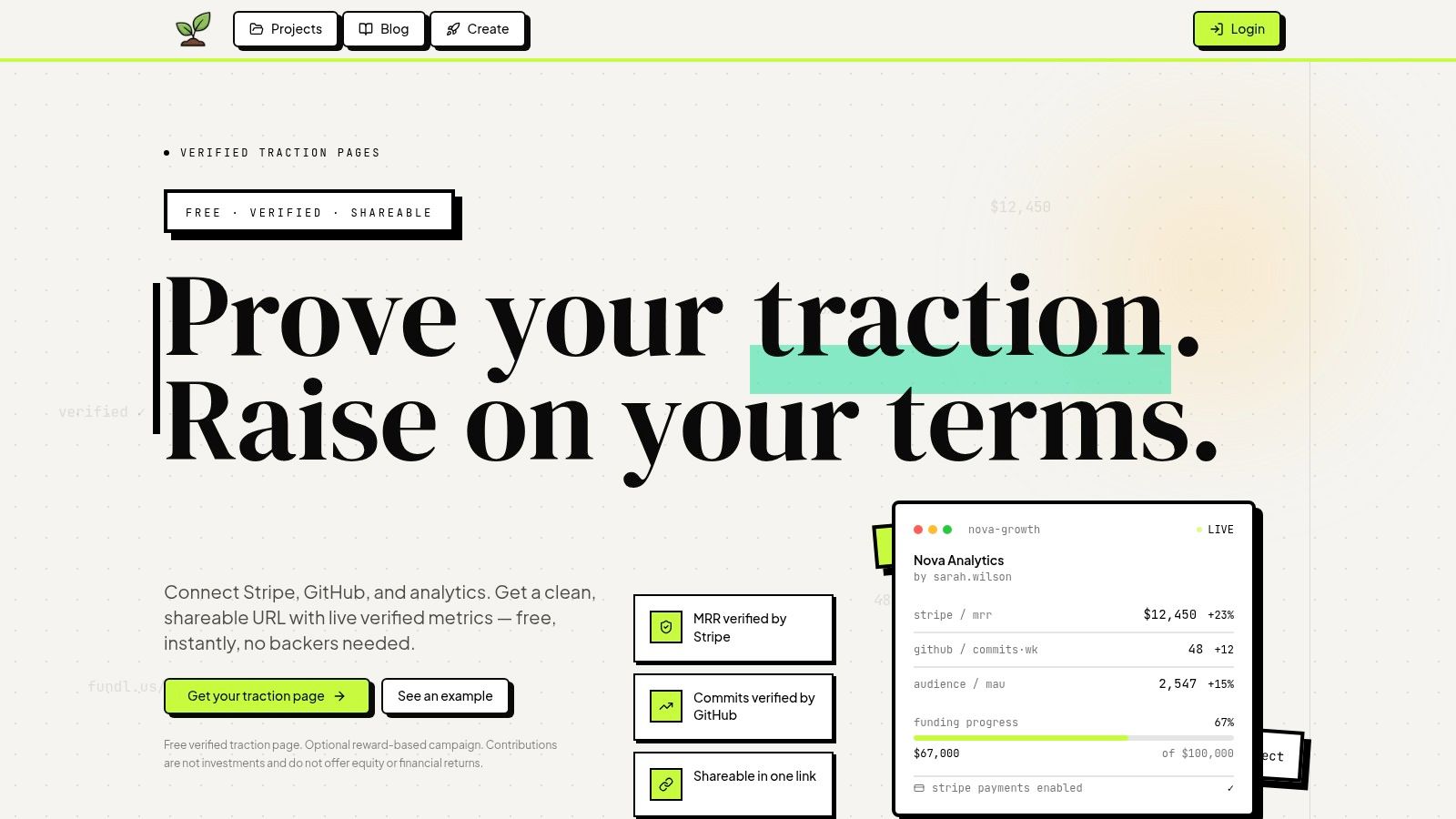
Don't wait until the product looks finished to publish the page. Set a concrete milestone, connect the sources that support it, share the clean URL with early users, and use supporter questions as another validation loop. If contributions arrive but users don't return, the evidence is telling you to improve the product before buying more reach. If usage and revenue move together, you have a stronger basis for the final push.
Fundl gives SaaS founders a shareable traction page built from live, source-verified revenue, usage, audience, and shipping signals, with reward-based contributions processed through their own Stripe account. Connect your data, define the milestone you need to reach, and visit Fundl to turn proven demand into a clearer launch and funding plan.