
Most advice about crowdfunding vs venture capital starts with the wrong question. It asks whether you want speed or dilution, as if every founder is choosing between two interchangeable cash machines. You're not. You're choosing what kind of evidence to produce, how much control to retain, and when to bring outside capital into the business.
A solo SaaS founder with paying users, a maintainer with a trusted open-source community, and a startup building for a huge enterprise market shouldn't follow the same funding playbook. The right path depends on what you can prove today, what you still need to learn, and whether your next milestone needs customers, capital, or institutional help.
Table of Contents
- The Real Question Behind Crowdfunding vs Venture Capital
- What Each Funding Model Actually Means in Practice
- Side-by-Side Comparison on Control, Dilution, and Speed
- Scale and Access What the SEC Data Shows
- Which Founders Fit Each Path
- What Research Says About Campaign Outcomes and Growth
- Using Traction-Based Crowdfunding as a Pre-VC Validation Layer
- Decision Framework and Your Next Step
The Real Question Behind Crowdfunding vs Venture Capital
The popular advice says crowdfunding is for founders who want to avoid dilution, while venture capital is for founders who need serious money. That framing is too shallow to guide an actual decision.
The better question is: what can your business prove right now? A pre-order campaign can demonstrate that people will pay for a product before it's fully built. A securities crowdfunding campaign can show that a wider community will invest. A VC round can signal that professional investors believe the company can become large enough to support a fund-sized return.
Those are different forms of evidence. They aren't interchangeable.
Practical rule: Choose the funding route that tests your biggest unresolved assumption.
If your uncertainty is demand, crowdfunding puts the product in front of customers or supporters. If your uncertainty is whether the company can scale through a large market, VC investors will pressure-test growth, retention, margins, hiring, and follow-on financing. If your uncertainty is execution, neither a successful campaign nor a signed term sheet solves it. You still have to ship.
The historical record supports a complementary view rather than a winner-takes-all contest. The World Bank crowdfunding report describes crowdfunding as an internet-enabled way to connect many contributors with projects that might otherwise struggle to secure capital. The model expanded as entrepreneurs faced tighter conventional financing conditions, but it didn't replace institutional finance.
That distinction matters for indie hackers, open-source teams, and niche SaaS founders. Your audience may be globally distributed, highly engaged, and commercially useful without matching the pattern a VC fund needs. Crowdfunding can turn that audience into observable evidence before you accept institutional terms.
For some founders, the strongest route is crowdfunding first, VC later. For others, a campaign creates unnecessary work when the company clearly needs a concentrated institutional round. The rest of this guide is a decision tool for separating those cases.
What Each Funding Model Actually Means in Practice
“Crowdfunding” covers several financing relationships. Treating them as one thing leads founders to misunderstand both the obligations and the signal they're creating.
Reward-based crowdfunding is a customer transaction. Backers pre-order a product, purchase early access, or receive a perk. You don't give them equity, but you do owe them a credible delivery plan, clear communication, and a product that can be shipped at sustainable economics. Your work looks like campaign production, audience activation, payment processing, manufacturing or development, fulfillment, refunds, and customer support.
Securities crowdfunding is an investment offering. Under U.S. Regulation Crowdfunding, eligible companies can raise through registered intermediaries from both accredited and non-accredited investors. Regulation Crowdfunding became effective on May 16, 2016, and an issuer can raise up to $5 million across crowdfunding offerings during a 12-month period, subject to the applicable rules and investment limits described by the SEC's Regulation Crowdfunding data.
That route requires formal disclosures, financial information, offering documents, investor communications, and ongoing reporting. The workload isn't just posting a pitch page. You'll need legal and accounting support, a campaign narrative, financial statements where required, a system for handling investor questions, and a plan for managing many small holders or an investment vehicle.
Venture capital is a negotiated private financing round. A fund or group of professional investors reviews your market, product, team, financial model, traction, ownership structure, and growth plan. If interested, they may offer a term sheet covering valuation, security type, board rights, information rights, protective provisions, and future participation.
Day to day, VC changes the company's operating rhythm. You'll prepare investor updates, attend board meetings, explain misses against the plan, recruit against agreed priorities, and manage a stakeholder who may have meaningful influence over major decisions. To understand the diligence questions behind that process, founders can use this guide to how VCs evaluate startups.
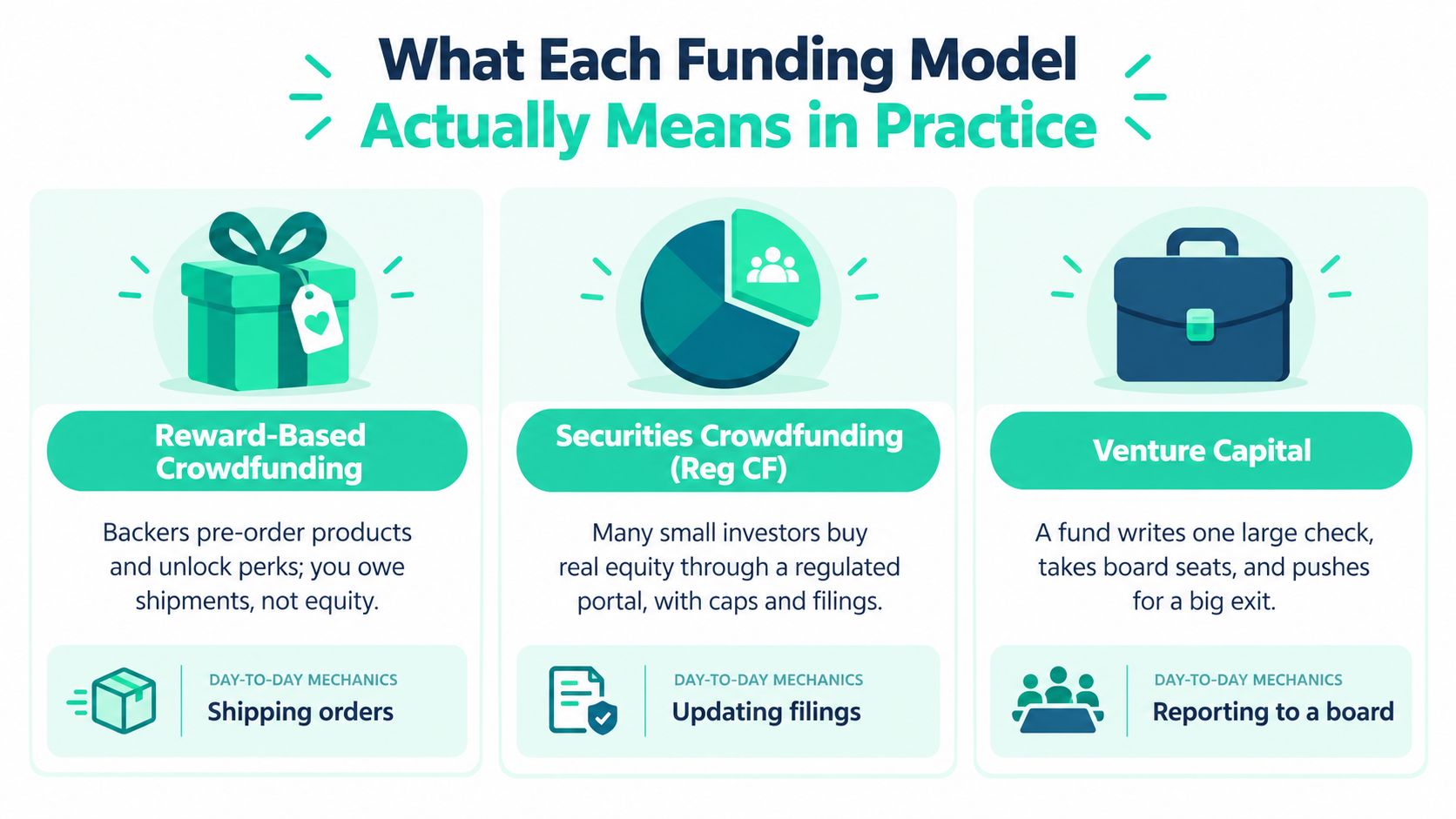
A reward campaign asks, “Will customers fund this product?” Reg CF asks, “Will investors fund this company under a regulated offering?” VC asks, “Can this company become a large institutional outcome, and can this team execute that plan?” Before choosing a platform or contacting funds, write down which question you need answered. The practical distinctions in what crowdfunding is will help you separate customer support from investment capital.
Side-by-Side Comparison on Control, Dilution, and Speed
The headline difference between crowdfunding and VC isn't just that one is fast and the other is expensive. The meaningful differences appear in control, capital concentration, evidence, and ongoing obligations.
| Dimension | Crowdfunding, Reward / Reg CF | Venture Capital |
|---|---|---|
| Board control | Reward backers have no equity rights. Reg CF investors typically have dispersed influence, depending on the instrument and structure. | A lead investor may negotiate board representation, consent rights, and information rights. |
| Equity dilution | Reward funding doesn't dilute equity. Reg CF can dilute founders through equity, SAFE, or convertible instruments. | Equity financing dilutes ownership, with terms negotiated around valuation and investor rights. |
| Time to capital | A campaign can launch quickly if the product, audience, disclosures, and assets are ready. | Fundraising requires outreach, meetings, diligence, negotiation, and legal closing. |
| Capital size | Usually fragmented across many contributors. The legal ceiling for Reg CF is not the same as a typical campaign outcome. | Capital is concentrated in larger checks and can include follow-on financing. |
| Investor involvement | Reward backers expect delivery and updates. Reg CF investors expect disclosures and communications, but usually don't run the company. | VC investors can help with hiring, partnerships, strategy, governance, and the next round. |
Control is a strategic choice
A reward campaign gives you customer obligations without handing a backer ownership. That can suit a founder who wants to keep product decisions internal while testing demand. Reg CF can preserve more day-to-day autonomy than a round led by one institutional investor, but the legal instrument still determines investor rights.
VC brings a concentrated relationship. That concentration can be a burden when the investor pushes the company toward a strategy you don't believe in. It can also be exactly what you need when one experienced partner can recruit a key executive, open enterprise doors, or lead the next financing.
Dilution depends on the security, not the label
A founder might compare a hypothetical 15% Reg CF raise with a hypothetical 20% seed round, but those percentages only matter alongside the rights attached to each deal. An equity issue, SAFE, convertible security, or debt instrument creates different future outcomes. Reward funding avoids that ownership question entirely.
Don't accept “non-dilutive” as a loose synonym for crowdfunding. Ask what backers receive, what converts, who controls approvals, and how the instrument affects the next priced round.
Speed and check size shape the operating plan
Crowdfunding demands a public launch, campaign assets, conversion work, and backer communication. VC demands repeated private conversations, diligence materials, negotiation, and a willingness to expose the business to investor scrutiny before money arrives.
A founder with a small, specific milestone may not need a large institutional round. A startup hiring aggressively, entering a capital-intensive market, or building toward a large outcome may waste time trying to assemble that budget from individual contributions.
Founder-level test: If the money only needs to prove one milestone, don't automatically sell the company's long-term financing strategy to fund it.
Scale and Access What the SEC Data Shows
Regulation Crowdfunding is a high-volume, relatively small-ticket channel. It is not a smaller version of venture capital. It addresses a different access problem and gives founders a different kind of evidence.
From May 2016 through December 31, 2024, the SEC recorded more than 8,400 initiated offerings by over 7,100 issuers. More than 3,800 offerings reported proceeds totaling approximately $1.3 billion, according to the SEC's published offering statistics. Fewer than half of initiated offerings reported proceeds. A campaign launch therefore proves interest in the offer, not a completed raise.
The dataset reports an average amount raised of roughly $346,000 per offering and an average target of approximately $66,000. Treat those figures as a description of the channel, not a forecast for your campaign. The averages combine many small offerings with a smaller group of larger outcomes.
| Metric | Reg CF, 2022 to 2024 median | Venture capital, seed to Series A |
|---|---|---|
| Typical raise size | The cited SEC dataset does not publish a 2022 to 2024 median raise. | The cited VC source does not provide a directly comparable median check. |
| Access | Eligible companies can solicit many contributors, including non-accredited investors, through registered intermediaries. | Access is concentrated among funds, angels, and institutional networks. |
| Capital structure | Contributions may be fragmented across many investors and instruments. | A small number of investors usually provide concentrated capital under negotiated terms. |
| Primary advantage | Broad participation and public demand or investor validation. | Larger financing capacity, governance support, and potential follow-on capital. |
| Primary limitation | Fragmented capital, campaign conversion demands, and investor communication obligations. | Selective access, diligence requirements, dilution, and investor influence. |
The median issuer in the SEC data was small, with approximately $80,000 in total assets, $13,000 in cash, $60,000 in debt, $10,000 in revenue, and three employees. That profile explains why crowdfunding can serve businesses that are too early, too small, or too community-oriented for institutional VC.
VC operates at a different scale and follows a different return logic. Recent industry analysis in the Crunchbase Q1 2025 funding overview reported $113 billion in global venture funding in Q1 2025, including $81 billion for late-stage companies, $24 billion for early-stage funding, and $7.2 billion for seed funding. Seed funding was down 14% year over year. Strong total VC figures can therefore coexist with difficult access for a very young company.
Crowdfunding gives you breadth and public evidence. VC gives you concentrated capital and investor support. Choose based on the financing job, the evidence you can show, and how much control you need to retain.
Which Founders Fit Each Path
The founder archetype matters because funding only works when it matches distribution and execution.
Indie hackers
A micro-SaaS founder with a small but active customer base usually has a demand problem, not a billion-dollar capital problem. If you have a newsletter, a product community, or a paying beta cohort, a reward campaign can fund a defined feature release, onboarding improvement, or productized expansion without adding a board layer.
The useful signal isn't a large audience by itself. It's repeated willingness to pay. A small group of customers who renew, refer others, or commit to a concrete product milestone tells you more than a broad social following.
Open-source maintainers
Open-source traction is real, but it doesn't automatically translate into the revenue growth or ownership economics a VC fund needs. A maintainer may have trusted contributors, active issue discussions, and users across many countries while still operating without a clear commercial model.
Community funding, sponsorships, grants, and reward campaigns can fit better when the immediate goal is documentation, hosted infrastructure, a paid support layer, or a maintained core project. Crowdfunding lets the community finance the work it already values, while the founder preserves the option to pursue VC later if a scalable commercial product emerges.
Education creators
An educator can validate a cohort, course, or workshop before recording every module. Pre-selling a defined learning outcome creates a direct demand test, but it also creates a delivery obligation. The creator must specify what students receive, when it arrives, how feedback will work, and what happens if enrollment or production doesn't go to plan.
A paying beta cohort is the trigger. If people commit to a specific curriculum and participate actively, crowdfunding can finance production. If the creator has a repeatable acquisition engine and a large expansion opportunity, VC may become relevant later.
No-code builders
No-code founders often learn quickly because they can change a workflow, landing page, or prototype without a large engineering cycle. That speed favors a focused campaign over months of pitching, especially when the product serves a narrow professional audience.
The best trigger is not a polished demo. It's a live group of users who can describe the problem, test the workflow, and pay for access. Use a simple traction dashboard, such as the framework in this guide to tracking startup metrics, to keep revenue, active usage, retention, and shipping activity visible.
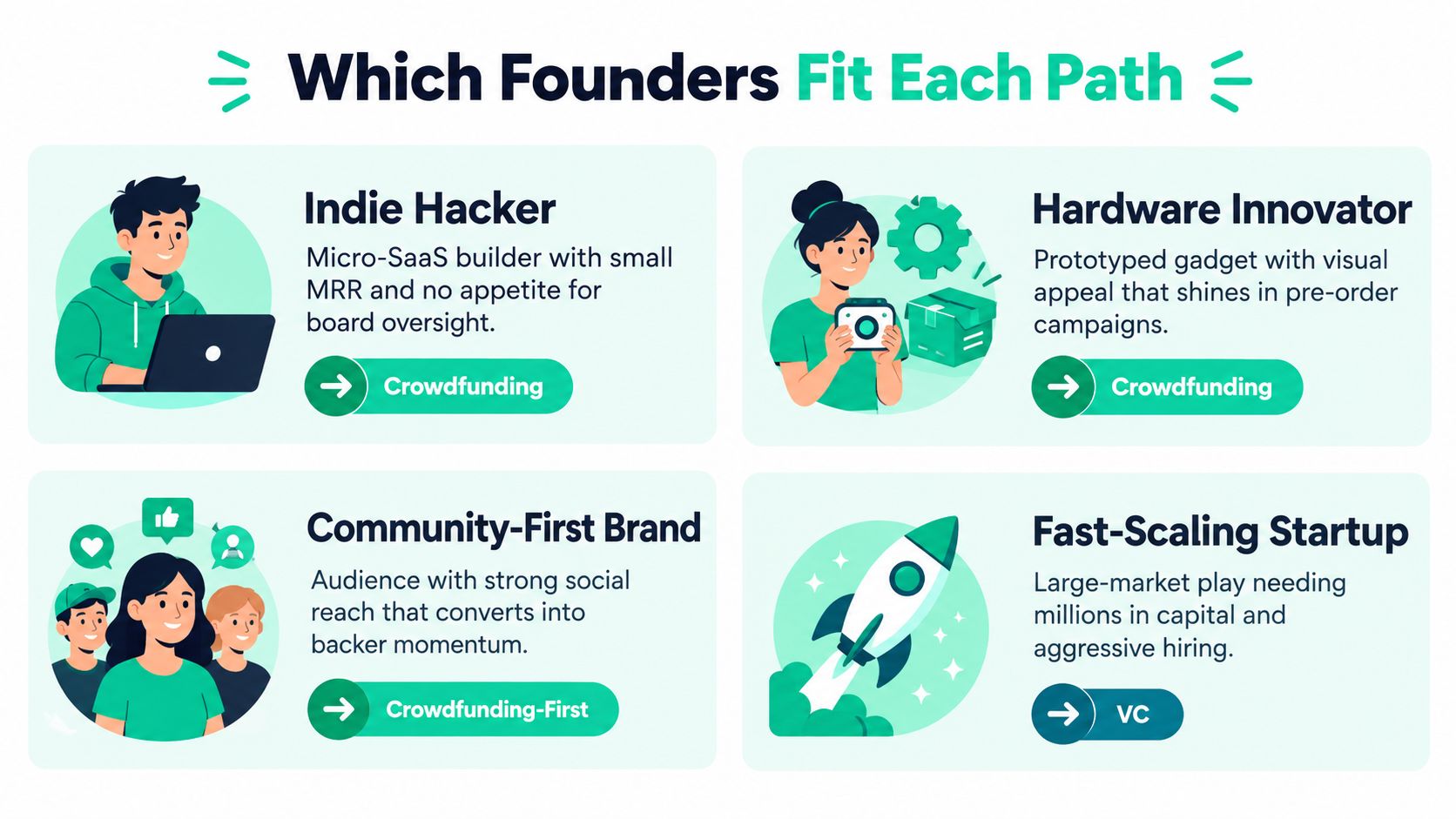
A hardware founder with a visual prototype and a community that wants the product should usually test pre-orders. A fast-scaling startup entering a large market and needing substantial hiring capital should usually speak with VC investors. For founders looking beyond equity, non-dilutive funding for startups can also widen the options before a priced round.
What Research Says About Campaign Outcomes and Growth
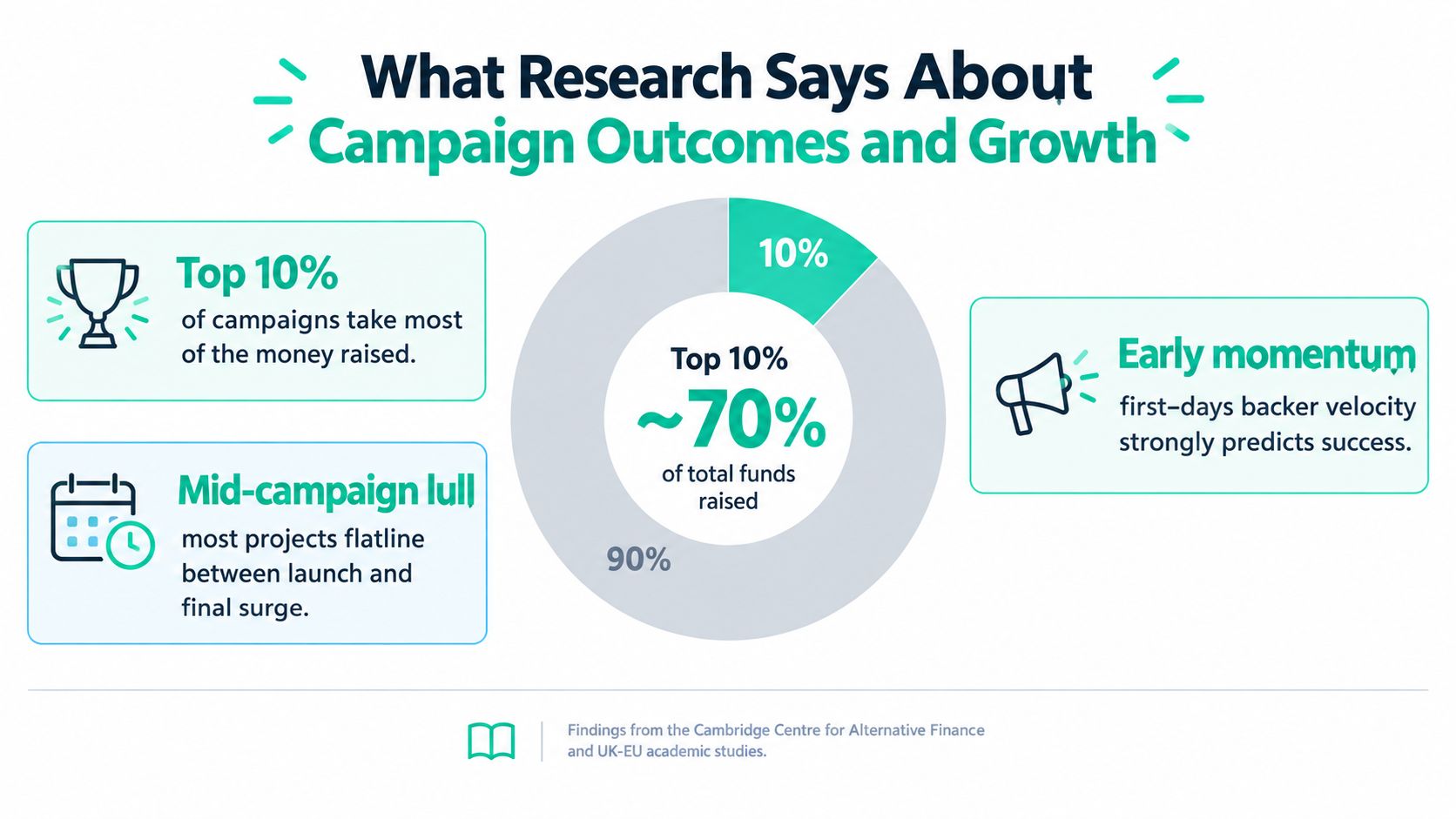
Crowdfunding popularity can create a useful signal, but it isn't the same as investor-quality evidence. A campaign can attract attention because of its story, timing, audience, or presentation while leaving unanswered questions about retention, margins, fulfillment, and repeatable growth.
Peer-reviewed comparative research makes the difference clear. A Cambridge Judge Business School study that controlled for startup selection found that crowdfunded startups raised less money, were less likely to obtain successful investors in a later financing round, and were less likely to achieve a successful exit than comparable venture-backed firms. Research covering 2,514 ventures across the United Kingdom, Germany, France, and Italy also found significantly higher asset growth among VC-backed ventures and lower post-investment growth among companies that had previously used equity crowdfunding compared with companies backed solely by VC, as reported in the Cambridge study on elites and masses.
That doesn't make crowdfunding a failure. It means founders must distinguish financing friction from growth quality. A campaign can help test willingness to pay, build a community, and create a public record of interest. It doesn't guarantee that customers will retain, margins will hold, or the team will execute after the raise.
Founders should keep the same operating evidence visible through either financing route:
- Retention and cohorts: Show whether users or customers remain active after the initial purchase.
- Revenue quality: Separate one-time contributions from recurring revenue, recognized revenue, and gross margin.
- Acquisition efficiency: Explain where customers come from and whether the channel can repeat.
- Product velocity: Publish release notes, shipped milestones, and the operational work behind them.
- Runway discipline: Connect the funds raised to a dated milestone and the cash required to reach it.
Campaign momentum may open doors, but only operating performance keeps them open. The headline total is an event. The trend beneath it is the evidence.
Using Traction-Based Crowdfunding as a Pre-VC Validation Layer
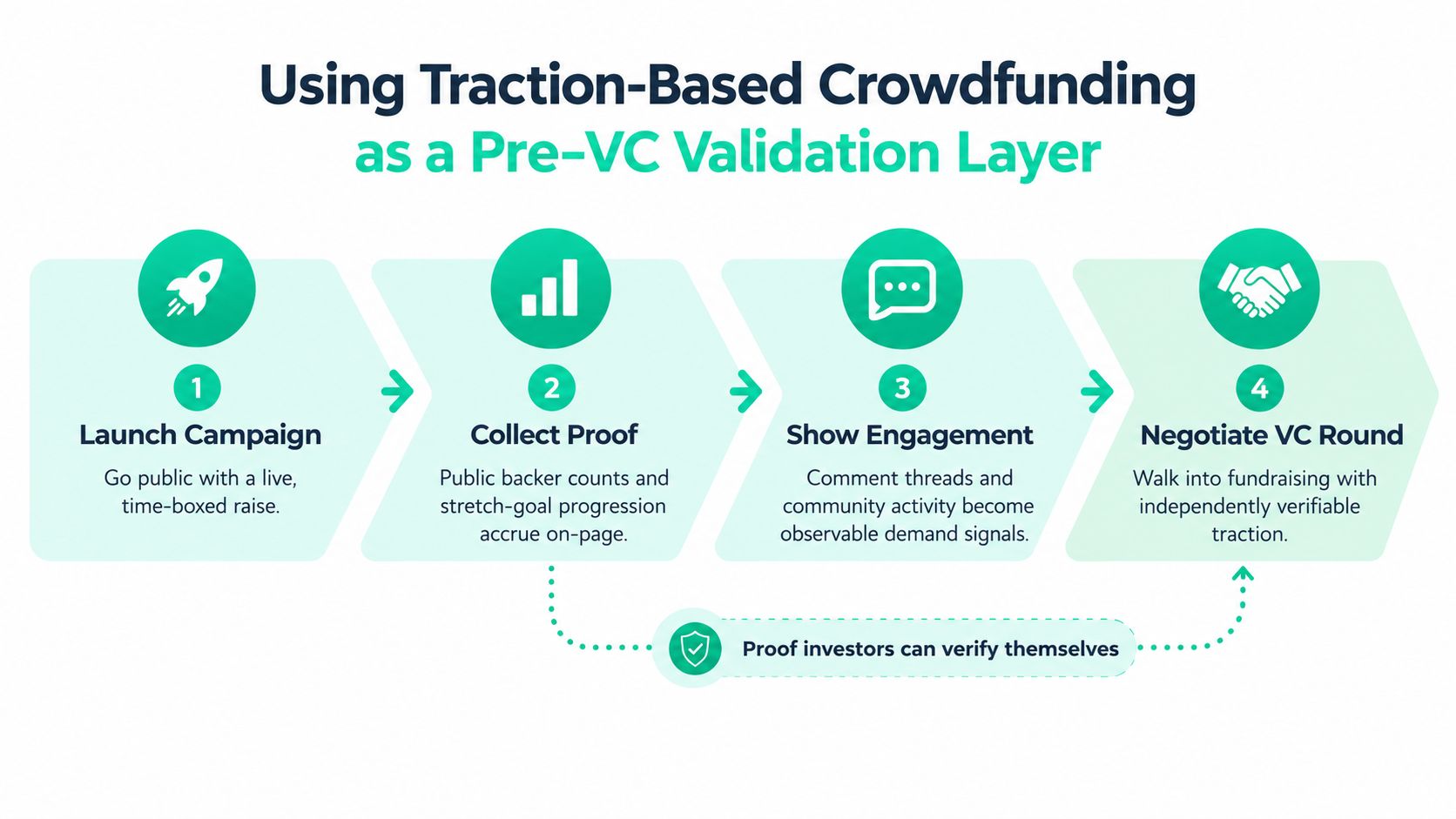
Crowdfunding is most valuable when it creates proof that an investor can inspect without taking your word for it. That makes the campaign a deferred diligence artifact, not necessarily the final destination.
A strong campaign leaves a trail:
- You launch a time-boxed offer tied to a specific product or milestone.
- Backers commit, comment, ask questions, and respond to updates.
- You ship against the commitments and publish what changed.
- You package the evidence for the next financing conversation.
For a monetized SaaS company, keep MRR, MAU, retention, cohort revenue, gross margin, acquisition efficiency, and runway current. For a developer product, add weekly release notes, GitHub activity, issue resolution, and the number of users moving from trial to paid use. For a consumer product, show orders, refunds, fulfillment progress, repeat purchases, and customer feedback.
Don't publish a single vanity number and call it traction. A VC meeting goes better when the investor can see how the campaign affected product usage, revenue behavior, and shipping discipline.
The campaign should answer three investor questions: Did people commit? Did the team deliver? Did usage or revenue improve after delivery?
Store the evidence in a simple data room. Include the campaign page, dated updates, customer or backer segmentation, revenue exports, retention views, product release history, cap table, and a short explanation of what the raise funded. Keep gross contributions separate from net cash available after fees, refunds, production, taxes, and support.
This approach also protects optionality. You can raise a reward-based campaign without selling equity, learn whether the market responds, and approach VC investors with more than a pitch deck. If the company later needs institutional capital, a focused pre-seed funding process can build on evidence already visible to customers and supporters.
A public campaign won't make weak retention look strong. It will make the operating reality easier to inspect. That is precisely why it can improve a later fundraising process.
Decision Framework and Your Next Step
You can narrow the choice in about 15 minutes by answering three questions:
- Do you have an audience that can fund or promote the offer?
- Do you have a product or milestone you can deliver against?
- Is your immediate target check size below $1 million?
Use the answers. An audience without a shippable offer is attention, not financing readiness. A product without an audience may need distribution before it needs a campaign. A large capital requirement usually calls for concentrated investors.
| Founder Signal | Recommended Path | Next Action This Week |
|---|---|---|
| Audience and shippable offer, modest capital need | Pure crowdfunding | Choose the campaign model, define the deliverable, and draft the campaign brief. |
| Audience, early traction, and a future need for larger capital | Crowdfunding then VC | Set a proof milestone, publish live metrics, and build a dated investor evidence folder. |
| Large market, repeatable growth, substantial hiring or infrastructure need | Straight VC | Turn the latest traction into a one-page memo and book meetings with relevant investors. |
| No audience and no validated demand | Don't raise yet | Interview users, sell a beta, and prove the problem before choosing a financing route. |
For reward crowdfunding, write down the exact promise, delivery date, unit economics, refund policy, and campaign audience. For a VC process, prepare retention, cohort revenue, gross margin, acquisition efficiency, runway, product velocity, ownership, and the milestone the round will buy.
My recommendation is direct. Use crowdfunding when your community can validate a specific product or milestone. Use VC when the company already has evidence of a large, scalable opportunity and needs concentrated capital plus investor support. Use crowdfunding first when you want proof before accepting dilution.
Fundl lets creators raise reward-based support through a shareable page connected to live Stripe, GitHub, and analytics data, so backers can review verified traction instead of relying only on promises. Visit Fundl to connect your sources, set a goal, and publish a transparent crowdfunding page.