
91% of recent SaaS capital went to scaleup rounds of $100M or more, while only 2% went to startups under $15M. In this market, proof beats promises, and fundraising works better when you present recurring revenue, growth, retention, product activity, and customer commitment as one verified evidence bundle.
The most popular fundraising advice still starts with the pitch deck. Polish the story, sharpen the vision, build a compelling market slide, then send the deck to as many investors as possible. That sequence is backwards for most SaaS founders. Investors now want evidence they can underwrite before they spend serious time on the narrative.
SaaS fundraising has become evidence-driven. Recurring revenue, growth rate, retention, paid pilots, customer usage, and product velocity tell investors whether the company is becoming more valuable without relying on a founder's optimism. A strong story can open a conversation, but live proof is what keeps the conversation alive.
Table of Contents
- Why SaaS Fundraising Now Demands Live Proof
- Building a Proof Bundle Before You Ask
- Running a Fundl-Style Campaign Like a Founder
- Choosing Between Reward Crowdfunding, Angels, and VC
- Engineering a Realistic Investor Pipeline
- Fixing the Metrics and Momentum Mistakes
- Putting It All Together for a Repeatable Raise
Why SaaS Fundraising Now Demands Live Proof
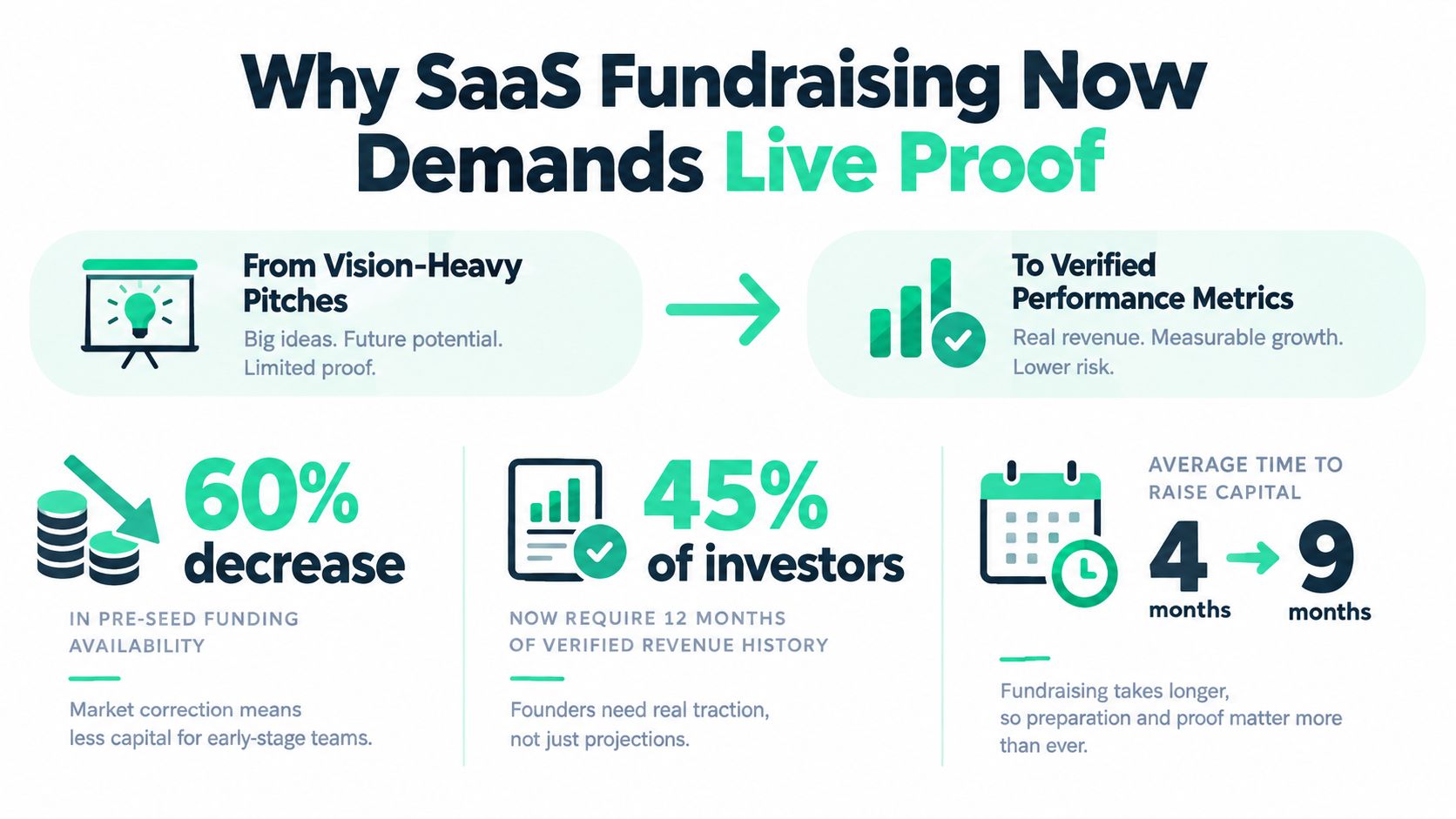
Capital concentration changes the preparation required from SaaS founders. Recent SaaS funding statistics show that large scaleup rounds absorb far more funding than early-stage raises. Smaller teams cannot rely on a strong vision or a polished deck to carry the conversation. They need evidence investors can verify before committing serious time.
Investors are asking whether current performance supports the assumptions behind a large outcome. A screenshot of last quarter's ARR answers one narrow question. It does not show whether customers continue paying, usage is increasing, the team keeps shipping, or the underlying records can withstand scrutiny.
The middle zone needs a different financing logic
Many software companies stall between roughly $50K and $200K MRR. They can appear too mature for some seed investors while remaining too small for traditional VC appetite, a tension described in coverage of the SaaS “death zone” (the SaaS fundraising death zone). The problem may be financing fit rather than product quality.
Founders in this position should match the financing route to the evidence they can produce. A venture-backed company with explosive scale may present a different case from a company with stable revenue and strong customer commitment. The practical package combines recurring revenue, renewal behavior, active users, customer references, consistent releases, and a specific use for the money.
A Fundl-style reward campaign can turn that proof into a live test of demand. The campaign should present a clear customer benefit, define the reward and delivery terms, and track purchases, engagement, and follow-up interest. Those signals do not replace investor diligence, but they show whether people will commit money or attention to the product now.
That operating discipline is central to data-driven fundraising. Verification comes before persuasion. Rather than asking investors to accept that demand exists, founders give them several ways to observe it directly.
Practical rule: Do not lead with the amount you want to raise. Lead with the evidence that makes the amount rational.
Live proof also limits the risk of overfundraising. A high valuation can create pressure to grow into expectations the business has not earned. A smaller, appropriately structured round, a reward campaign, or an angel-led raise may preserve more control while giving the team time to build stronger evidence.
Building a Proof Bundle Before You Ask
A proof bundle is not a spreadsheet dump. It's a compact operating record that lets someone understand what customers buy, why they stay, and whether the team can keep improving the product.
Start with a metrics inventory. List recurring revenue, new revenue, churn, retention, active users, conversion behavior, paid pilots, customer commitments, and product activity. Do not include a metric just because it is available. Include it because it answers an investor's question about demand, durability, or execution.

Make every number inspectable
For each headline metric, record the source, date, definition, and owner. “Active users” should mean something specific for your product. “Churn” should distinguish lost customers from downgraded accounts if that distinction matters to the business. MRR should reconcile with billing records rather than appearing as a manually edited figure in a presentation.
A useful proof bundle contains:
- Revenue evidence: Show current recurring revenue, the movement over time, customer concentration, and the difference between contracted and collected revenue.
- Retention evidence: Explain renewals, expansions, cancellations, and the behavior of customer cohorts. A founder who can explain why customers leave sounds more credible than one who only reports a favorable aggregate.
- Usage evidence: Connect active usage to the customer action that creates value. For a developer tool, that might include commits or active projects. For a workflow product, it could be recurring tasks completed or teams returning to the product.
- Execution evidence: Show release notes, shipped capabilities, paid pilots, and meaningful product changes. Activity alone isn't traction, but consistent delivery can support the case that the team converts feedback into product value.
The point is not to overwhelm a reader. A potential backer should be able to move from a headline to its source without asking you to rebuild the report manually. A real-time metrics dashboard can help organize that presentation when the underlying integrations are configured correctly.
Match the package to the financing path
Institutional investors may focus on recurring revenue quality, growth, retention, market size, and the scale of the opportunity. Community backers may care more about whether the product works, whether the creator keeps shipping, and what their contribution gains them. Angels often evaluate both the operating data and the founder's ability to turn a focused round into the next milestone.
Recent U.S. SaaS seed benchmarks place a typical round around $3.0M to $3.5M, with pre-money valuations near $14M to $17M and dilution commonly around 12% to 20% (2026 seed round benchmarks). Those figures are reference points, not entitlements. They make weak evidence more dangerous because a founder may anchor on market terms before proving that their company belongs in the relevant comparison set.
Before outreach, prepare one shareable page, one detailed data room, and one short explanation of the next milestone. The page earns attention. The data room supports diligence. The milestone gives the capital a job.
Running a Fundl-Style Campaign Like a Founder
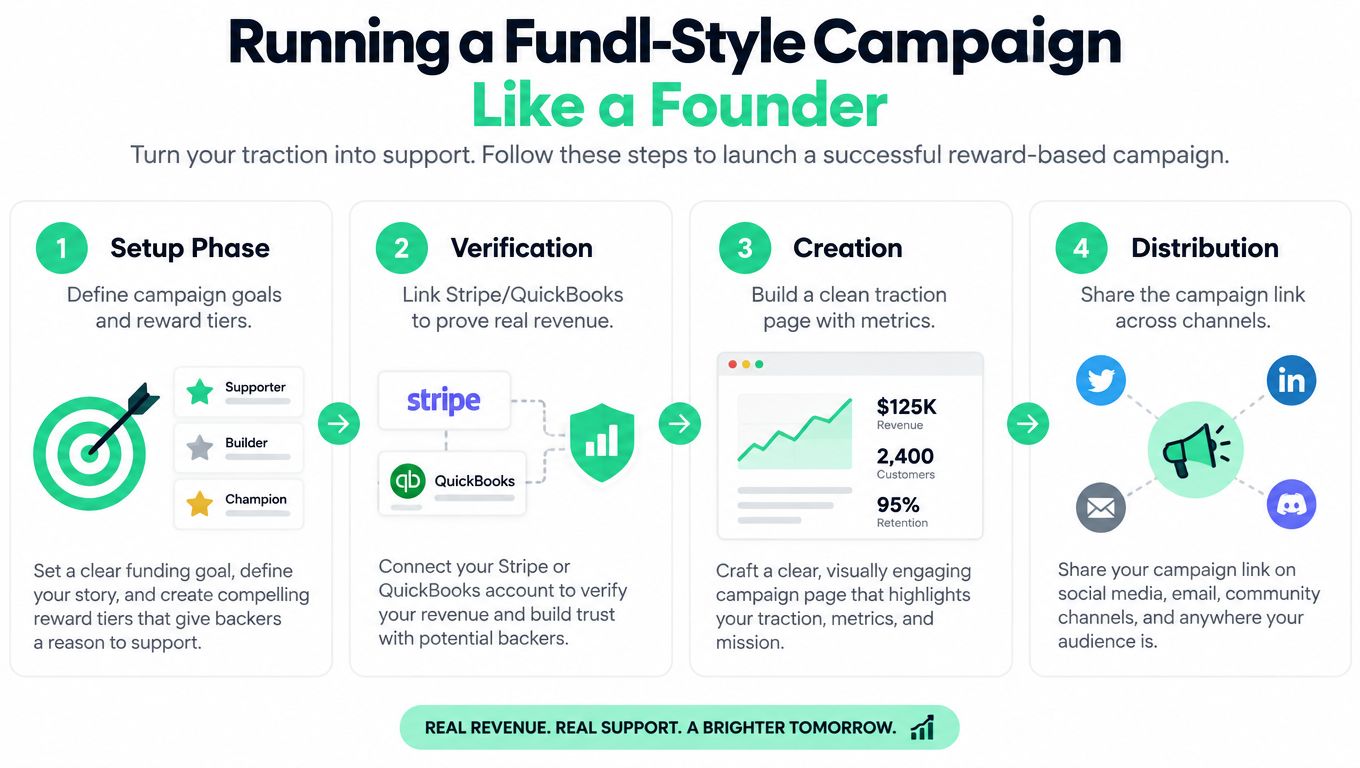
A reward-based campaign should feel like a product launch with transparent funding attached, not like a desperate substitute for investor interest. The founder defines what the community is helping create, offers concrete rewards, and makes the operating evidence visible before asking people to contribute.
Start with a deliverable, not a vague target
Choose one fundable outcome. It might be a new integration, a public beta, expanded hosting capacity, documentation for an open-source project, or a defined set of product improvements. The reward should connect directly to that outcome. Early access, a founder call, a team plan, implementation help, or a limited lifetime package can work when the promise is clear and operationally realistic.
Set a primary goal for the immediate milestone. Add stretch targets only when each one has a defined use and delivery path. A campaign becomes less credible when every extra contribution appears to fund an unspecified future.
Connect the evidence before distribution
Fundl is a crowdfunding platform built around verified traction. It connects tools such as Stripe, GitHub, and analytics so creators can publish shareable traction pages with source-verified signals including monthly recurring revenue, weekly commits, and monthly active users. The metrics refresh from connected sources, which gives contributors a more current view than a static screenshot.
A SaaS crowdfunding platform can be useful when the audience needs a simple way to inspect the product's activity before deciding whether to support it. The important principle applies beyond any specific platform: connect the source first, then write the campaign copy around what the source can substantiate.
Publish, then communicate like an operator
Your campaign page should answer four questions quickly:
- What exists today?
- Who uses it?
- What will contributions fund?
- What will supporters receive, and when?
Share the page with people who already understand the problem, then expand distribution through product communities, email, developer channels, customer conversations, and founder networks. Don't post a link without context. Explain the milestone, show the evidence, and make the reward easy to understand.
The campaign doesn't end when the first contributions arrive. Publish progress updates tied to shipped work, changes in usage, and decisions made with the funds. If a delivery date changes, explain why before supporters have to ask.
A live campaign can also create useful investor evidence. It shows whether people will act when given a clear offer, not merely say that they like the product. That signal won't replace revenue or retention, but it can strengthen the broader proof bundle.
Choosing Between Reward Crowdfunding, Angels, and VC
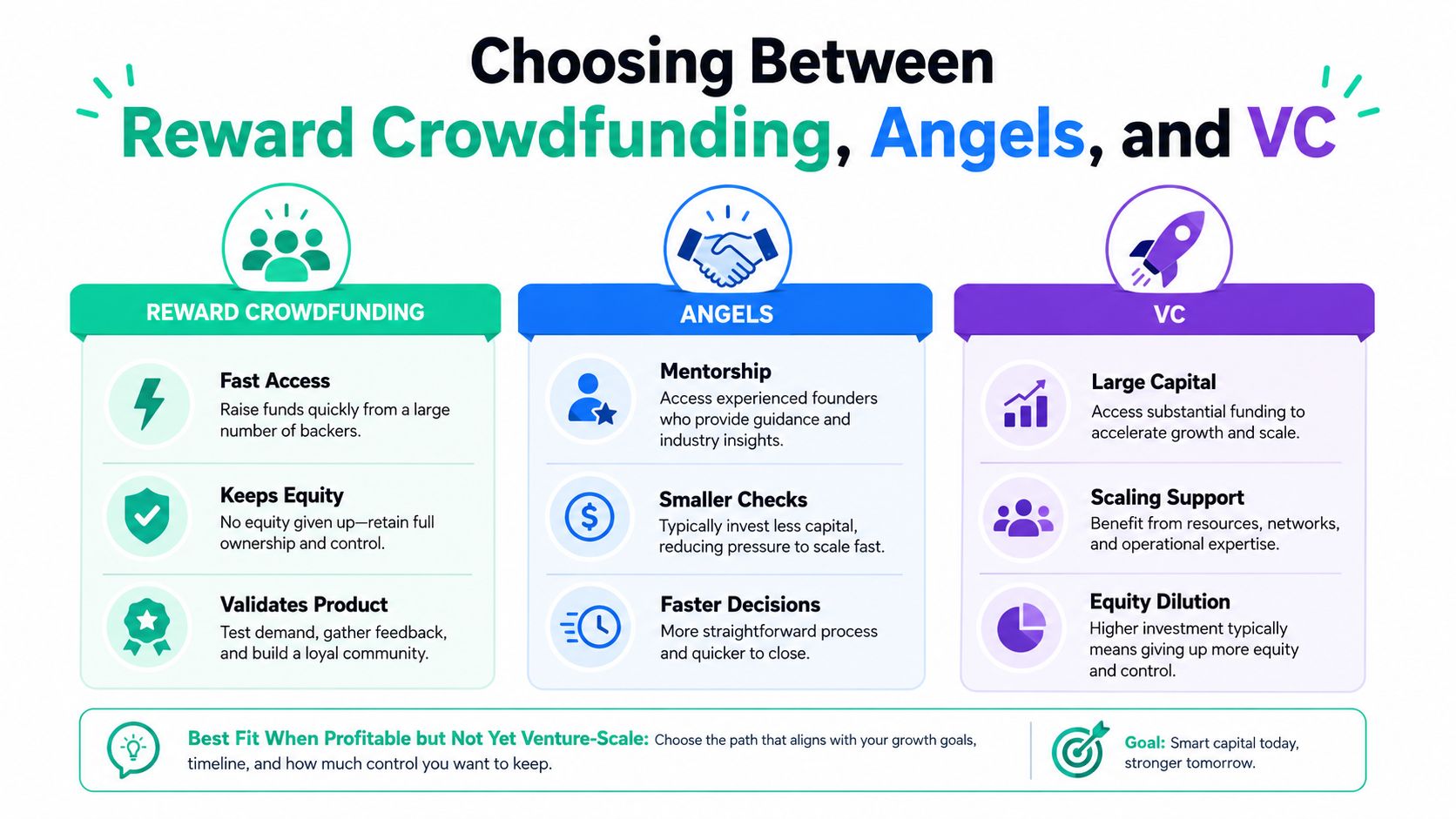
Funding should match the next constraint, not the founder's preferred label. A SaaS company with steady growth may need working capital, customer validation, hiring capacity, or time to reach a stronger milestone. Venture capital can create unnecessary pressure if the business does not need rapid expansion. The right choice depends on the proof already assembled, the capital required, and the control the founder is prepared to trade.
| Route | Where it fits | Main trade-off |
|---|---|---|
| Reward crowdfunding | A product has an identifiable community and a deliverable supporters can understand | The founder must market the campaign and deliver the rewards |
| Angels | The business benefits from personal judgment, introductions, and a smaller financing relationship | The round still requires diligence and usually involves ownership or formal investment terms |
| VC | The company has a large market opportunity and evidence that supports aggressive scaling | The founder accepts dilution, governance expectations, and pressure for a venture-scale outcome |
Reward crowdfunding
Reward funding suits an indie SaaS product, open-source tool, education product, or developer service with a reachable audience. It preserves equity while testing whether users will commit to a specific outcome. A Fundl-style campaign also turns the offer into a live proof point. Contributions show action rather than polite interest, provided the reward is clear and deliverable.
Distribution remains the hard part. A transparent campaign page will not create demand by itself. The founder needs an audience that understands the problem, a reward with manageable support obligations, and enough operational discipline to communicate progress after launch. A campaign can validate demand while still creating delivery work.
Angels
Angels add value when the company needs capital and judgment. A relevant angel may understand the buyer, introduce early customers, or help avoid an expensive mistake. The process can move faster than institutional fundraising, although speed does not remove the need for clear documents, terms, and expectations.
Select angels for fit rather than check size alone. Ask how they respond when a milestone slips, how involved they expect to be, and whether they have backed companies at the same stage. A group with conflicting views can consume more founder time than its capital justifies.
Venture capital
VC fits a company that requires substantial upfront investment and can plausibly support rapid expansion. It can provide larger financing and help with scaling, but dilution, governance requirements, and pressure for a venture-scale outcome become part of the operating model.
The middle zone described earlier, between $50K and $200K MRR, can leave a company poorly matched to standard financing expectations (analysis of the SaaS funding gap). The practical question is whether new capital will make the business more resilient and valuable, or impose growth expectations the current model cannot support. A verified proof bundle, including campaign response, customer behavior, and operating evidence, helps the founder make that choice with more than an ARR screenshot.
Engineering a Realistic Investor Pipeline
Cold outreach fails when founders treat every investor as equally relevant. A seed fund that backs pre-revenue technical teams may not be interested in a steady SaaS business with established customers. A growth investor may admire the product but still consider the round too early. Qualification is not administrative work. It determines whether your scarce fundraising time produces useful conversations.
Build a target list around stage, check size, geography, category, business model, and partner fit. Read the fund's recent investments and identify the partner who leads deals in your category. Ask for warm introductions where they exist, but don't wait for them. A well-researched cold email is better than a generic introduction that says nothing about fit.
Treat meetings as funnel stages
Seed-stage founders typically convert 5% to 10% of first meetings into signed checks, while full outreach-to-check conversion is around 2% to 4% (investor pipeline calculator). Those rates aren't a forecast for your company. They're a warning against building a plan around a small number of conversations.
Track each investor through a defined sequence:
- Qualified: The investor fits your stage, category, and financing structure.
- Contacted: The message includes a clear reason for the match and a specific proof point.
- First meeting: The founder learns whether the investor has conviction, not just whether the investor was polite.
- Diligence: The investor receives consistent metrics, customer context, and answers to open questions.
- Commitment: The founder confirms amount, terms, timing, and decision process.
Use a CRM or a disciplined spreadsheet. Record the last contact, the investor's stated concern, the next action, and the evidence that addresses it. Follow up with new information rather than repeating “just checking in.” A customer renewal, shipped integration, cohort update, or campaign milestone gives the investor a reason to re-engage.
Pipeline discipline: A full funnel is more valuable than a long list of names. If the target list doesn't match your stage, more outreach only creates more rejection.
Founders often need better signals before they can qualify investors properly. CapyScout's funding signal library is a useful reference for organizing the market and identifying evidence that may matter to different funders. Use it to improve research, not to replace direct conversations with investors.
Run fundraising in batches so you can learn from early calls without changing the story for every person. Keep the core facts stable. Adjust the emphasis when a pattern appears, but never change the metric definition because an investor dislikes the result.
Fixing the Metrics and Momentum Mistakes
The fastest way to lose investor trust is to make a number difficult to reconcile. A founder may have excellent retention and a strong product, but if MRR in the deck doesn't match billing records, or if churn changes definition between meetings, the investor starts discounting every other claim.
The first mistake is stale evidence. A screenshot can be useful as a dated record, but it shouldn't be presented as current if the underlying business has changed. Put a date and definition beside each metric. Keep a simple change log so you can explain why a number moved rather than improvising an answer during diligence.
The second mistake is confusing activity with traction. Commits, signups, page views, and feature releases can show interest or execution. They don't prove customers receive value. Pair activity with a business consequence, such as paid conversion, repeat usage, renewal behavior, expansion, or a customer commitment.
Audit the operating story
Use one source of truth for each core metric. Reconcile billing data with the revenue report. Separate contracted revenue from collected cash. Review customer-level changes rather than relying only on a top-line chart. If a metric is estimated, label it as estimated and explain how you calculate it.
Investors increasingly expect executed proof of concepts, paid pilots, meaningful MRR, and cohort data as they evaluate software businesses, according to recent fundraising guidance (funding evidence and investor expectations). That makes the quality of your definitions as important as the size of your headline number.
A practical metrics review asks:
- What changed: Which customers, cohorts, or product actions caused the movement?
- Why it changed: Was the result caused by pricing, acquisition, retention, seasonality, or a one-off event?
- Can someone verify it: Does the source exist, and can you show the relevant period without exposing unnecessary customer data?
- What happens next: Which operating decision follows from the result?
For founders who need a broader framework, research on product metrics can help connect product behavior to business outcomes. The goal isn't to collect every available event. It's to identify the few behaviors that predict durable customer value.
Don't hide the difficult metric
A churn increase, delayed pilot, or weak conversion period doesn't automatically kill a raise. Evasive answers do more damage than imperfect performance. State what happened, what you learned, and what you changed. Investors can underwrite a known problem more easily than an unreliable reporting process.
Momentum also needs a definition. A busy roadmap isn't momentum if customers aren't adopting what ships. A growing waitlist isn't momentum if nobody commits. The strongest update connects a product change to a customer response and then shows whether that response persists.
Putting It All Together for a Repeatable Raise
Start with verification, not outreach. Define every core metric, connect each one to a source, and build a proof bundle that a customer, backer, angel, or VC can understand without a live explanation.
Then choose the financing route that matches the business. A reward campaign can make sense when a community understands the product and a concrete deliverable gives them a reason to contribute. Angels may fit when judgment and relationships matter. VC belongs in the plan when the opportunity and evidence support a larger scaling operation.
For the operating narrative around the raise, keep the same discipline you would use in an acquisition channel. Practical SEO playbook examples can be useful when you need to turn a complex strategy into repeatable actions, owners, and checkpoints. Fundraising benefits from the same habit: define the signal, assign the next action, and review the result.
A 2026 SaaS benchmarks survey found that 47% of founders spent 4 to 6 months actively raising, 31% spent 1 to 3 months, and about 90% reached their target or oversubscribed when they persisted through the full pipeline (SaaS fundraising process benchmarks). Plan for a sustained process, keep the company operating during it, and update the evidence as the business changes.
Fundl lets founders turn connected Stripe, GitHub, and analytics data into a shareable traction page for reward-based fundraising, with live signals instead of stale screenshots. If you're building SaaS, an AI tool, or a developer product, visit Fundl to set your campaign goals, show verified progress, and invite supporters to contribute on your terms.