
Most advice about crowdfunding for small businesses starts with platform selection. That's backwards. A platform can process pledges, but it can't create demand, repair weak unit economics, or rescue a founder who promised more than the team can deliver.
A serious campaign is a public test of three things: whether customers want the offer, whether the business can turn funding into a deliverable product, and whether the founder can communicate clearly under pressure. The headline raise matters, but verified traction and post-campaign cash flow matter more.
Table of Contents
- What Crowdfunding Means for Small Business
- Validating Demand Before You Launch
- Choosing Between Reward-Based and Equity Platforms
- Building a Campaign That Converts
- Managing Post-Campaign Fulfillment Economics
- Setting Realistic Outcomes and Next Steps
What Crowdfunding Means for Small Business
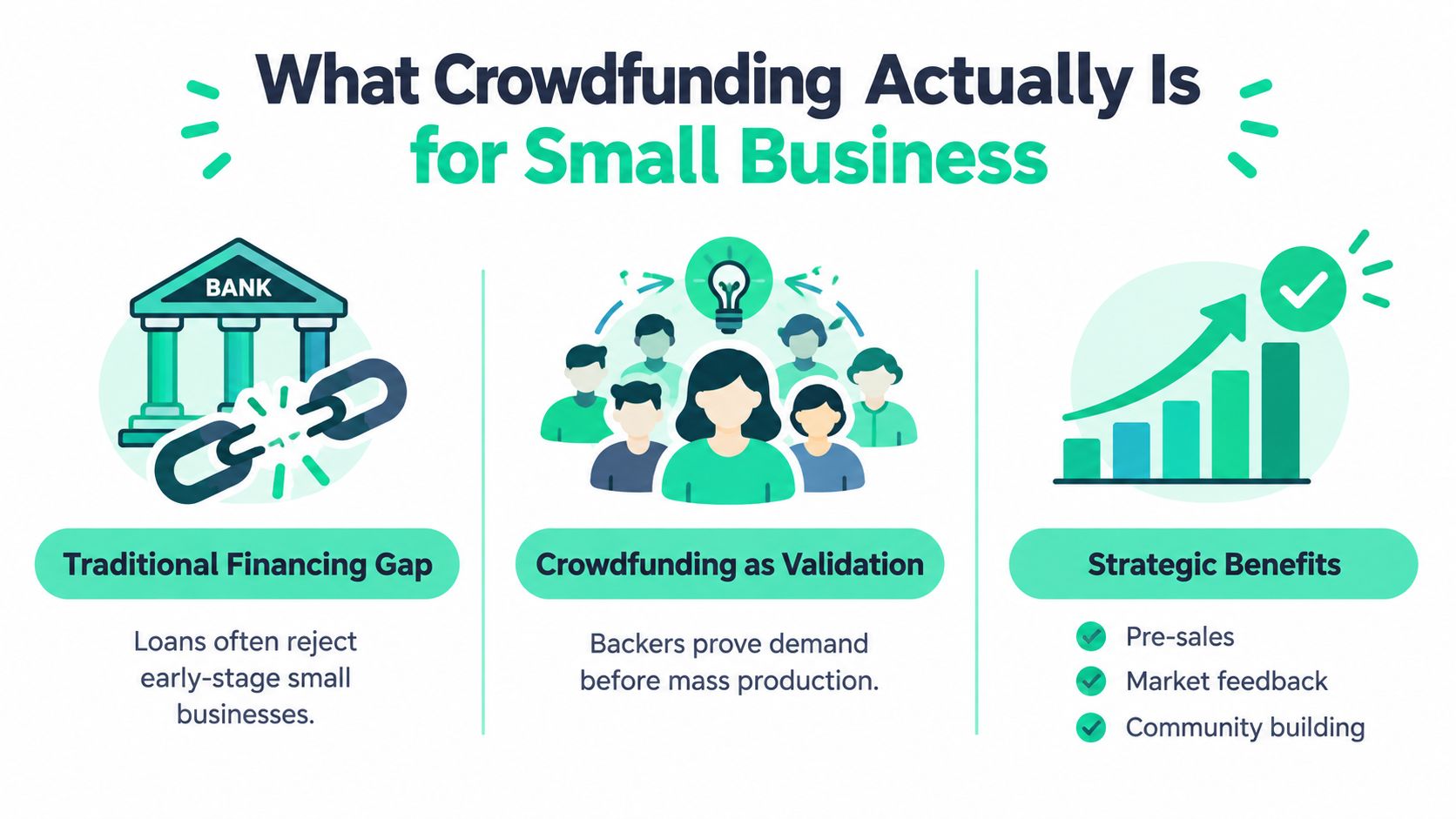
Crowdfunding is a public financing transaction built around a specific offer. Customers, supporters, or investors decide whether the product, service, or project deserves their money before the business has the history a conventional lender expects. A bank typically reviews repayment capacity, collateral, credit history, and established financial records. A crowd responds first to the offer, the evidence behind it, and the outcome promised.
That makes crowdfunding useful for a small business with a clear product but limited assets. The U.S. Securities and Exchange Commission reports that, from the launch of Regulation Crowdfunding through December 31, 2024, more than 8,400 offerings were initiated by over 7,100 issuers, excluding withdrawn offerings. More than 3,800 offerings reported proceeds, with aggregate reported proceeds of approximately $1.3 billion (SEC data on Regulation Crowdfunding offerings).
The typical issuer profile is more revealing than the headline total. According to the same SEC dataset, median total assets were approximately $80,000, including $13,000 in cash, $60,000 in debt, and $10,000 in revenue, with a staff of three people. That is a small operation trying to prove that its next product can earn capital, not a fully established growth company.
Practical rule: Treat the campaign as a financing event and a customer-research project at the same time.
Crowdfunding also extends beyond consumer gadgets and creative projects. In the European Union, more than €1 billion of crowdfunding took place in 2023, based on the provider sample reported by the European Securities and Markets Authority. Professional, scientific, and technical services received 33% of funding, while construction received 21%, showing that business services and capital-intensive work can attract online capital (ESMA's crowdfunding market report).
The money raised is only the starting point. A credible campaign shows live traction, realistic delivery capacity, and enough margin to fulfill every order after fees, production, shipping, support, and refunds. For a concise explanation of the model, read this guide to what crowdfunding means. Then judge the opportunity by the evidence and the post-campaign economics, not the fundraising target alone.
Validating Demand Before You Launch
A public campaign should confirm demand, not discover it. Launching before you know who wants the product, why they want it, and what they will pay for turns backers into unpaid research participants.
Academic reviews group crowdfunding success factors into campaign attributes, participant characteristics, communication, and network effects, identifying 106 individual factors across those themes (academic review of crowdfunding success determinants). You do not need to optimize every factor. You do need evidence in the areas you control, especially demand, delivery capacity, and campaign economics.
Build an evidence stack
Start with behavior, not compliments. A person who says your product sounds useful has shown interest. A preorder, paid subscription, repeat purchase, or continued product use shows commitment.
Collect evidence in layers:
- Demand evidence: Record verified preorders, paid pilots, subscriptions, deposits, or other actions that require commitment.
- Retention evidence: Track repeat use, renewals, repeat purchases, or continued activity. A large sign-up list with no continued use is weak proof.
- Capability evidence: Show what you have already shipped, including product releases, working prototypes, completed client work, or a public changelog.
- Delivery evidence: Map production, onboarding, support, shipping, and refund responsibilities before setting the target.
- Risk evidence: List technical dependencies, suppliers, staffing limits, tax questions, and points where delivery could fail.
A software founder launching a developer tool should publish a traction page with current subscription activity, active usage signals, recent shipping activity, and a clear roadmap. Separate what exists today from what funding will build. “More integrations” is a promise. A working product, documented usage, and a costed integration plan provide evidence.
Set a formal decision checkpoint before launch. A stage gate process mastery guide can help structure the decision around evidence rather than enthusiasm. At the gate, ask whether demand is sufficient, whether the minimum version can be delivered, and whether you can explain the economics without hand-waving.
Set the target from the minimum deliverable
Your funding target should finance the smallest credible version of the promised outcome. Separate delivery costs from optional improvements, then document what each reward or access level pays for. Keep stretch goals outside the base budget and assign each one its own costs and delivery implications.
Model conservative, expected, and strong pledge scenarios before launch. Secure early commitments where appropriate, then use live conversion data to adjust outreach. Do not raise the target because early attention feels encouraging. Every additional commitment creates fulfillment work, support obligations, and potential refund exposure.
Research identifies personal networks, project quality, geography, funding goals, and comment activity as factors associated with campaign outcomes. One cited Kickstarter analysis reported that 44% of projects reached their goal, a platform- and period-specific benchmark rather than a universal probability. Use that context to test your assumptions, not to forecast your result.
Choosing Between Reward-Based and Equity Platforms
The right platform follows the obligation you can meet. Start with what supporters receive, then test whether your evidence and operating capacity support that promise.
Reward-based crowdfunding asks backers to fund a product, service, access pass, or experience in exchange for a defined reward. They do not receive ownership. This model suits a product launch, course, software license, early-access program, or community-supported release when you can state exactly what each contribution finances and how you will deliver it.
Equity crowdfunding sells securities. Backers become investors, while the company takes on disclosure, filing, communication, and investor-management duties. Under U.S. Regulation Crowdfunding, companies can raise up to $5 million in a 12-month period (SEC Regulation Crowdfunding guidance for issuers). That ceiling is not a target. Set the raise against documented use of proceeds, current traction, delivery capacity, and the cost of supporting investors after the campaign.
| Decision | Reward-based model | Equity-based model |
|---|---|---|
| Backer receives | Product, service, access, or another stated reward | Securities and an investment interest |
| Main proof required | Demand and fulfillment capability | Demand, business information, financial disclosures, and compliance |
| Founder's core obligation | Deliver the promised reward or service | Meet securities and reporting obligations |
| Best fit | A defined offer with a clear delivery path | A company prepared to manage investors and regulated disclosure |
| Main risk | Underpricing delivery or overpromising features | Legal complexity, dilution, and investment risk |
Investor limits also shape an equity campaign. Under the same SEC guidance, a non-accredited investor whose annual income or net worth is below $124,000 may invest the greater of $2,500 or 5% of the greater amount. If both are at least $124,000, the limit is 10% of the greater amount, with a $124,000 aggregate 12-month cap across offerings. These rules apply to securities investments, not ordinary rewards or donations.
Choose according to operational maturity
A reward campaign is usually the cleaner route for a small software team with a working product and a defined improvement plan. Offer access, onboarding, support, or a time-limited license only after pricing the ongoing service burden. “Lifetime access” can become an expensive promise when hosting, maintenance, and support continue indefinitely.
Equity fits only when the company can manage outside investors after the raise. It does not bypass documentation. The company must select a compliant intermediary and structure, prepare required disclosures and financial information, calculate the target from planned use of proceeds, and monitor commitments against applicable limits.
Choose the model that matches your post-campaign economics. Reward backers create delivery and support obligations. Equity investors create reporting and relationship obligations. Live revenue, usage, retention, or shipping metrics strengthen a reward campaign because they show current behavior, not just founder confidence. Fundl can connect Stripe, GitHub, and analytics data to a shareable page with live metrics, while contributions are processed through the creator's Stripe account.
You can also review this overview of reward-based crowdfunding before deciding which obligations your offer creates.
Building a Campaign That Converts
A campaign page must answer four questions quickly: what are you offering, why does it matter now, what does each contribution fund, and how will you deliver it? If the page buries those answers under slogans, backers have to do too much interpretation.
Design the offer around delivery
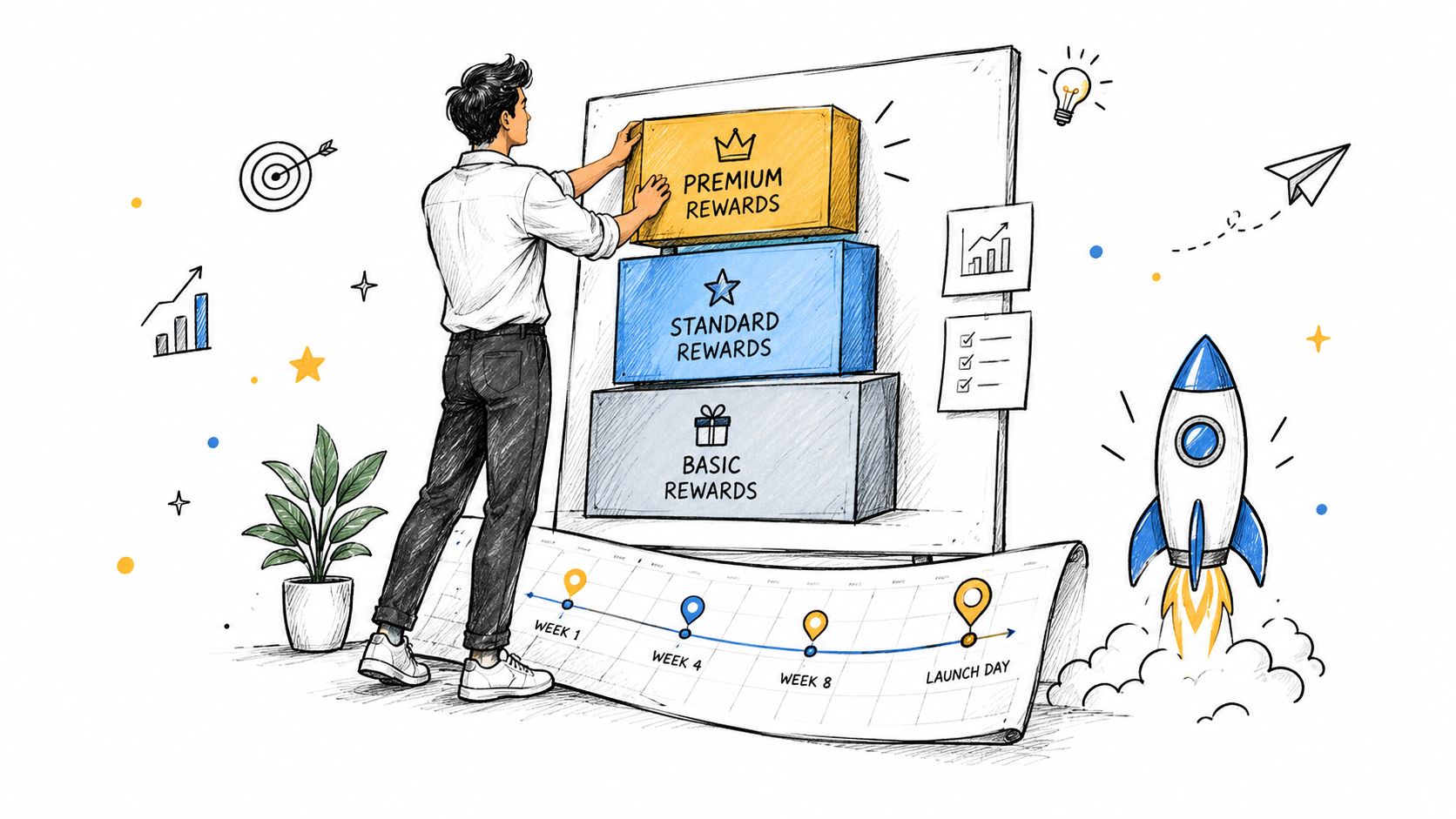
Build the reward ladder from your cost model, not from imagination. Each tier should have a specific purpose and a known support or fulfillment burden.
- Entry contribution: Offer a low-complexity benefit, such as community access, project updates, or early participation.
- Core offer: Make this the clearest exchange, such as early product access, a defined subscription period, or a finished physical product.
- Higher-support tier: Add onboarding, consultation, customization, or team access only if you can deliver the labor.
- Limited tier: Use scarcity only when the inventory or service capacity is real.
- Stretch goal: Add it only after calculating the additional production, hosting, support, and delivery cost.
For software, don't promise a feature because it sounds attractive in a video. Put the feature in the base budget, explain the dependency, and state what happens if the schedule changes. Backers forgive a difficult update more readily than a vague promise followed by silence.
Use a launch sequence with visible proof
A SaaS campaign can use a simple operating rhythm:
- Before launch: Publish the product, traction evidence, scope, delivery schedule, and risk register. Ask prospective backers to identify unclear terms before the page goes live.
- Launch day: Send the campaign to the founder's existing network first. Make the initial message specific, with the problem, offer, deadline, and intended use of funds.
- During the campaign: Post frequent updates showing shipped work, answered questions, product changes, and current delivery status.
- At the midpoint: Review conversion by audience source and reward tier. Improve the explanation where people are visiting but not contributing.
- Final push: State what remains, what the funds enable, and what backers receive. Don't manufacture urgency that isn't tied to a real closing date.
- After funding: Confirm addresses or account details, publish the fulfillment schedule, and report progress against the promises made.
A campaign video should demonstrate the product and the founder's command of the details. If you need production help, specialized explainer video services can improve clarity, but production quality won't compensate for weak evidence or unclear economics.
The supporting media below can help founders think about how a campaign moves from offer design to execution.
Keep updates useful. Show what changed, what remains uncertain, and what decision you made. Backers don't need theatrical optimism. They need enough information to decide whether you understand the work ahead.
Managing Post-Campaign Fulfillment Economics
The funding goal is where most campaign guides stop. That's where the expensive work starts.
The amount raised is not the amount available for growth. Payment processing, packaging, shipping, customs, taxes, replacements, address errors, refunds, customer support, hosting, onboarding, and late product changes can all reduce usable cash. Fulfillment guidance identifies underestimated shipping and packaging, delayed address collection, and unclear international-duty policies as recurring failure points (fulfillment guidance for crowdfunding campaigns).
Calculate contribution margin by tier
For every reward tier, create a separate contribution-margin line:
Contribution margin = contribution received minus payment costs, production or service costs, delivery, tax obligations, replacements, refunds, and expected support.
Do this for domestic and international delivery separately. A physical reward that looks profitable before shipping may become loss-making after packaging, customs handling, address corrections, and replacement shipments. A digital product has different risks, but the same principle applies. Include hosting, onboarding time, support duration, license costs, refunds, and any lifetime-access commitment.
The safe amount to accept is the amount you can deliver without consuming the cash needed to keep the business operating.
Freeze addresses by a stated date, publish who pays international duties, and define what happens when a package is undeliverable. If you're shipping physical products across regions, consult practical regional shipping advice before setting reward prices. Don't wait until backers have paid to discover that your cheapest shipping assumption applies only to one destination.
Treat oversubscription as an operations problem
A larger raise can increase risk. More backers may require more inventory, more support, more warehouse space, more onboarding, and more refunds before the business has reliable production capacity. A campaign can succeed publicly and still damage the company privately if every additional pledge carries a negative margin.
Build a capacity ceiling before launch. Decide how many units, accounts, consultations, or support hours the team can fulfill within the promised window. If demand exceeds that ceiling, use a waitlist, later delivery window, phased fulfillment, or a revised tier. Don't keep accepting orders just because the dashboard is moving upward.
Your payment workflow also deserves scrutiny. Review the operational details in this guide to crowdfunding payment processing, then reconcile expected receipts with actual cash availability. Keep campaign funds separate from ordinary operating assumptions until the fulfillment reserve and tax treatment are clear.
For digital products, track service duration. A one-time contribution can create a recurring cost if the reward includes permanent hosting, updates, storage, or support. Price that obligation as a service commitment, not as free marketing.
Setting Realistic Outcomes and Next Steps
Crowdfunding should primarily produce customer validation, working capital, and a committed community. It isn't a reliable shortcut to venture capital or a promised route to an exit.
The SEC reported that only 0.25% of businesses completing at least one successful offering from 2016 through 2024 later completed an IPO, while 3.4% received venture funding and 2.2% were acquired (SEC private-capital and Regulation Crowdfunding data). Those figures support a grounded expectation: most founders should plan to build the business with customers, not wait for a later institutional round.
After the campaign, keep publishing evidence. Report delivery progress, acknowledge delays early, measure repeat use or renewals, and turn backer questions into product decisions. The campaign ends when pledges close, but the credibility test continues until every promised obligation is complete.
Fundl gives creators a reward-based campaign page built around live, connected traction from sources such as Stripe, GitHub, and analytics tools. If you want to present verified demand instead of stale screenshots, visit Fundl and turn your current metrics into a clear campaign for prospective backers.