
The biggest platform isn't automatically the best platform for your business. A large audience can help with discovery, but it won't solve a weak offer, unclear proof, difficult fulfillment, or a revenue model that doesn't fit what supporters are being asked to do. The right choice starts with the monetization job: are people funding a project with visible traction, subscribing to continuing work, buying a digital product, sponsoring open-source maintenance, or pledging toward a defined launch?
That distinction matters because the creator economy is large but uneven. Goldman Sachs Research estimated approximately 50 million creators worldwide in 2023 and valued the broader market at about $250 billion, while noting that only about 4% of global creators earned more than $100,000 annually. Audience size alone doesn't prove repeatable demand.
This comparison evaluates payment model, discovery, fee visibility, payout control, operational burden, compliance, fulfillment responsibility, and evidence requirements. It begins with evidence-first funding and community support, then moves through memberships, digital commerce, merchant-of-record infrastructure, and campaign-based crowdfunding. If you're comparing the wider market, this guide to the top platform for creators provides useful background, but the practical question remains the same: what must your supporters do before your business earns?
Table of Contents
- 1. Fundl for Proving Traction Before Asking for Support
- 2. Patreon for Building Recurring Membership
- 3. GitHub Sponsors for Funding Open-Source Maintenance
- 4. Open Collective for Transparent Community Funding
- 5. Gumroad for Selling Straightforward Digital Products
- 6. Lemon Squeezy for Merchant-of-Record Operations
- 7. Substack for Paid Publishing and Podcasts
- 8. Kickstarter for Validating a Defined Launch
- 9. Indiegogo for Flexible Campaign Funding
- 10. Paddle for Global SaaS and Digital Commerce
- Top 10 Creator Monetization Platforms Comparison
- Match the Platform to the Way You Earn
1. Fundl for Proving Traction Before Asking for Support
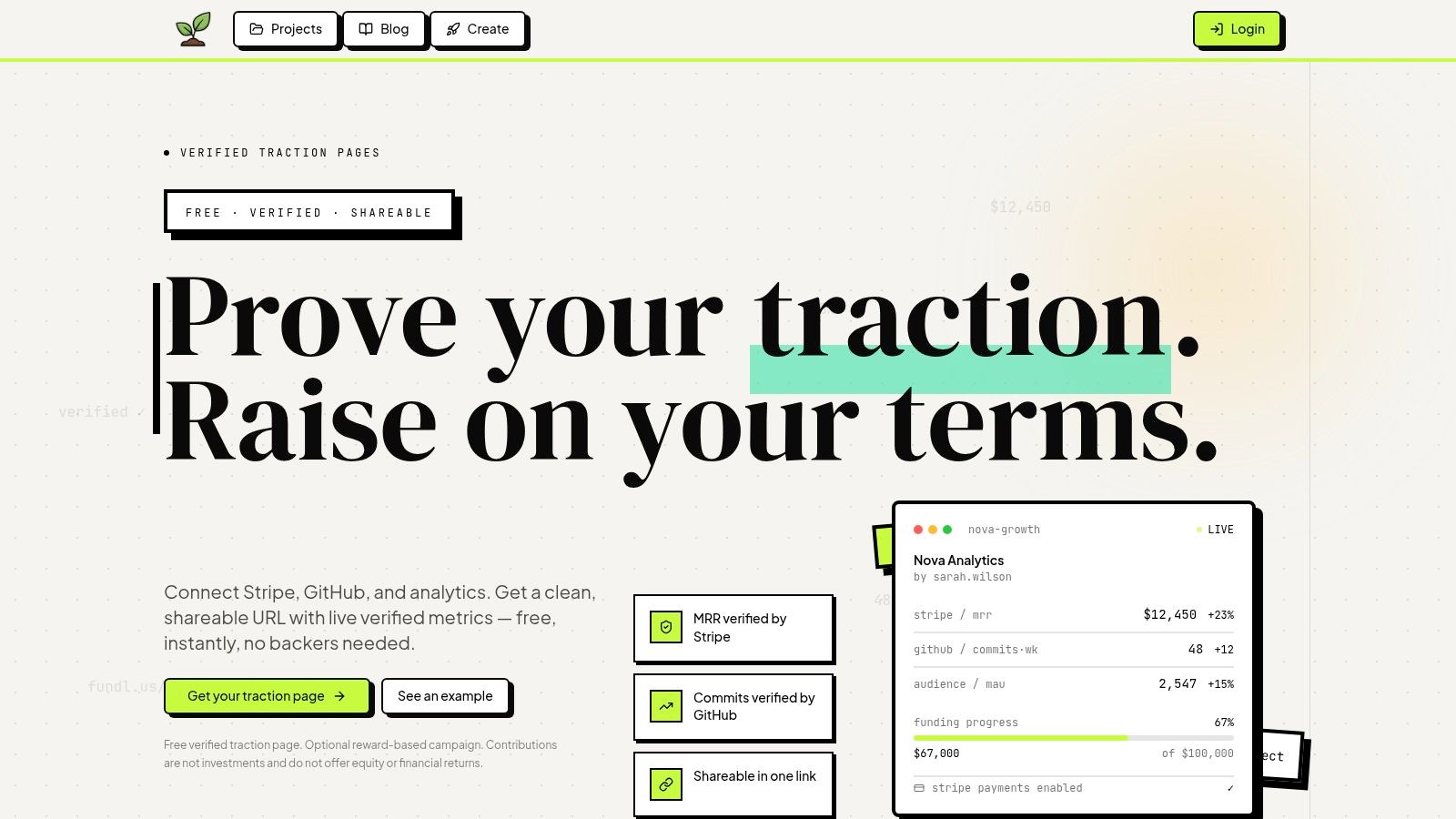
Fundl fits creators with measurable activity who want to turn evidence into a reward-based funding request. Creators can connect Stripe, GitHub, and analytics accounts and publish a shareable traction page showing source-verified signals, including Monthly Recurring Revenue, commit activity, and Monthly Active Users.
The distinction from membership and campaign platforms is operational. Fundl presents current project activity before a supporter contributes, which helps indie hackers, early SaaS and AI builders, no-code makers, education-product creators, and open-source teams assess whether their request has visible support behind it.
Why evidence changes the funding conversation
Fundl's main value is the proof layer before the payment button. A potential backer can review revenue, shipping activity, and audience signals in one format rather than relying only on private claims or polished launch materials. Auto-refreshing metrics also reduce the risk of making a decision from outdated screenshots.
Verified activity still leaves delivery risk with the creator. Active users and regular commits do not prove that a product will reach its next milestone, satisfy every reward, or remain commercially viable. Fundl makes traction easier to inspect, but it does not replace due diligence or clarify every fulfillment obligation.
Practical rule: Connect a meaningful evidence source before using Fundl. Without Stripe, GitHub, or analytics data that supports the request, the page may add little beyond a conventional funding pitch.
Contributions are reward-based. Fundl offers no equity or financial return, and payments run through the creator's connected Stripe account. Direct processing gives the creator payout control, while the absence of escrow or a financial intermediary means backers may have less platform-level protection than in a traditional crowdfunding structure.
Best fit and friction
Setup involves setting a goal, linking data sources, sharing the page, and receiving contributions. The platform says the process takes about 15 minutes, while Fundl's explanation of SaaS crowdfunding outlines why live product evidence can carry more weight than a promise-heavy campaign page.
Choose Fundl when you have verifiable traction and a specific reward-based funding request. It is a weaker fit for speculative, pre-product projects without publishable signals. Before sharing the page, define each reward, explain what the metrics demonstrate, and state which delivery risks remain your responsibility.
Visit Fundl to review its evidence-first funding model.
2. Patreon for Building Recurring Membership
Patreon suits creators whose supporters are being asked to fund continuing access, content, or community. Membership tiers, gated posts, direct messaging, community features, one-time purchases, and digital products give creators more than a simple recurring payment link. The platform's familiarity can also reduce hesitation when a fan is deciding whether to become a paying member.
The economics are different from traction-backed crowdfunding. A Patreon supporter usually isn't evaluating a product's commits or active users. They're buying an ongoing relationship, such as regular episodes, exclusive posts, early releases, or participation in a member community. That makes Patreon a strong fit for podcasters, artists, writers, video creators, and educators with an audience that values continuity.
Patreon reported more than $10 billion in lifetime creator payments by August 2025, compared with more than $3.5 billion by December 2021, according to the reporting summarized by Contrary Research. The same research states that Patreon supported more than 25 million paid memberships by 2025, while podcast creators generated $472 million from 6.7 million paid podcast memberships during 2024. These figures show the scale of direct-to-fan subscriptions, not the typical earnings of an individual creator.
What to verify before committing
New creators generally face a 10% platform fee, introduced for new creators on August 4, 2025, before payment processing. iOS purchases can add Apple's fees, and storefront control remains more limited than with a self-hosted commerce stack.
Patreon also concentrates the workflow inside its ecosystem. That reduces setup work, but creators should check how they'll export customer information, communicate outside the platform, and preserve continuity if policies or discovery conditions change.
Use Patreon when your value is delivered repeatedly and your retention work is as important as acquisition. Don't choose it just because you want a quick tip jar. A recurring membership creates an ongoing promise, so define the publishing cadence, tier boundaries, cancellation experience, and support workload before launch.
For a deeper look at the economics of subscriptions, this guide to recurring revenue provides relevant context.
3. GitHub Sponsors for Funding Open-Source Maintenance
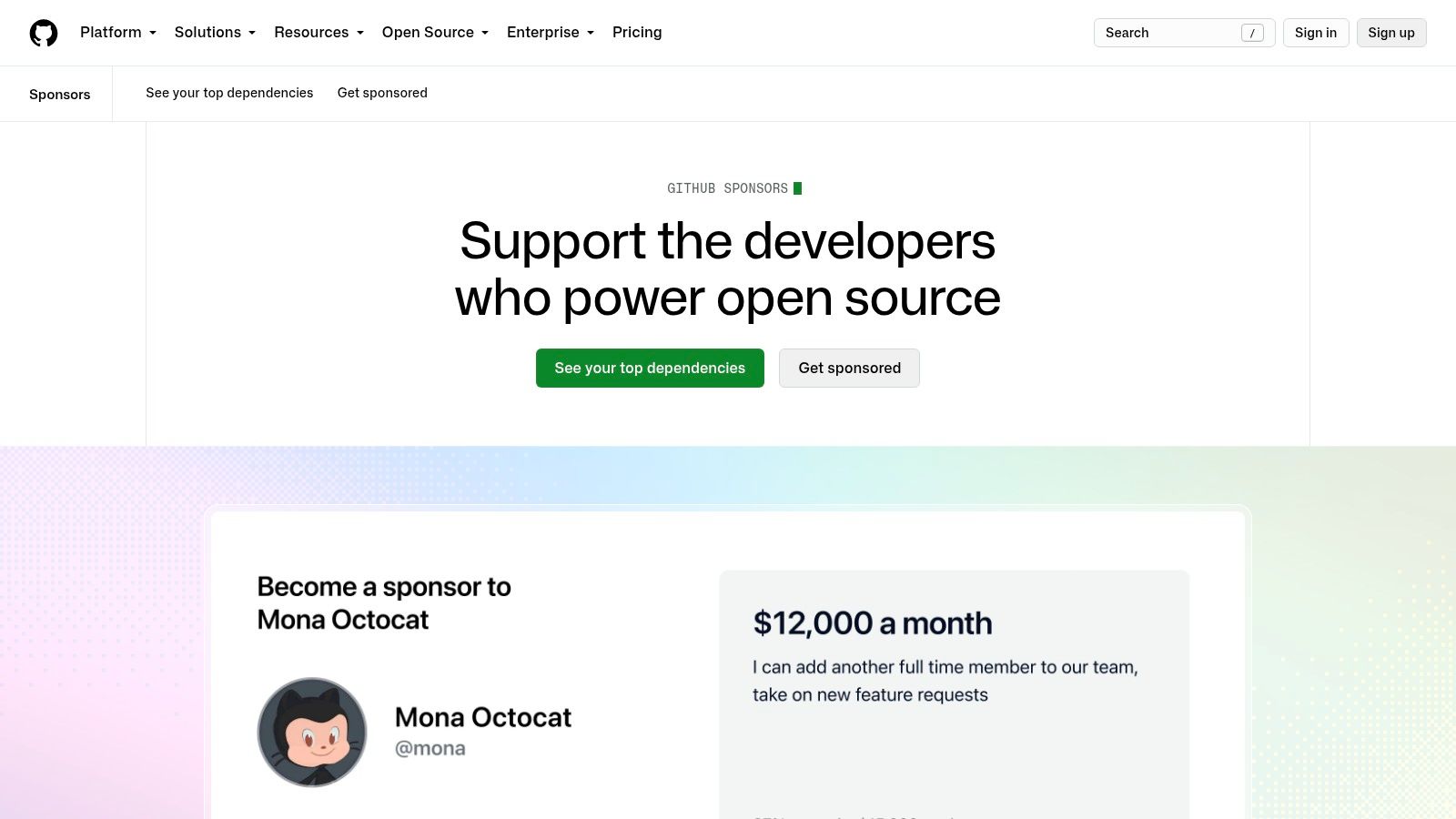
GitHub Sponsors is purpose-built for a different request: support the people maintaining software that others depend on. Sponsorships can be recurring or one-time, and they can appear on developer profiles and repositories where prospective sponsors already encounter the work.
That native placement matters more than a generic storefront would. An open-source maintainer can connect a funding request to a repository, contribution history, issue activity, release work, or a visible roadmap. The platform doesn't need to manufacture a community context because GitHub is already where the technical relationship exists.
GitHub Sponsors is therefore a better fit for maintainers, developer tools, libraries, and open-source teams than for creators selling courses, art, or general fan content. Tiered rewards can give sponsors a reason to contribute, but the strongest case is usually the ongoing public value of maintenance rather than a gated entertainment experience.
The operational question is sustainability
Sponsorship revenue can help fund maintenance, but it doesn't automatically define what sponsors receive. A maintainer should state whether support contributes to bug fixes, security work, documentation, release management, or general project continuity. Vague rewards create pressure later, especially when sponsors interpret a payment as a service-level commitment.
For projects with a single maintainer, GitHub's direct connection between profile and repository keeps the workflow relatively focused. Organizations should examine service fees, administrative responsibilities, tax documentation, and how sponsorship funds are distributed across contributors.
A sponsor is often funding reliability, not purchasing a conventional product. Say exactly what continued maintenance means in practice.
The main trade-off is scope. GitHub Sponsors offers an OSS-native discovery surface, but it isn't a general creator commerce system. It won't replace a full storefront for digital products or a campaign builder for a physical launch. For a broader funding model that emphasizes measurable work and project traction, compare it with open-source project funding approaches.
4. Open Collective for Transparent Community Funding
Open Collective is designed for projects that need more than a payment page. It combines public budgets, expense workflows, recurring and one-time contributions, invoicing, and fiscal hosting for communities, open-source projects, and nonprofit-style structures.
Its defining feature is financial visibility. Contributors can inspect budgets and expenses, while project teams can show how money moves through the collective. That makes Open Collective particularly useful when the funding relationship involves a group, a network of projects, or a community that wants accountability rather than a single creator receiving informal support.
Fiscal hosting can also reduce legal and administrative friction for teams that aren't ready to operate every financial function independently. But it introduces another party into the structure. The collective should understand who handles payouts, documentation, compliance, expenses, and disputes before inviting contributions.
Transparency has a cost
Open Collective's flexibility can make the economics harder to understand than a simple membership tool. Pricing varies by host, and the platform's current host model includes a share of host fees, commonly around 15%, as described in the product brief. Treat that figure as a structural consideration to verify with the relevant host, not as a universal charge for every collective.
Open Collective differs from GitHub Sponsors. GitHub connects support tightly to a developer and repository. Open Collective supports a broader financial operating model, where several contributors, maintainers, or projects may share responsibility.
Choose it when your backers care about where funds go, not only what access they receive. If you're a solo creator selling a template or course, the expense workflow may add unnecessary overhead. If you're coordinating community infrastructure, a visible ledger can be more valuable than a lower-friction checkout.
5. Gumroad for Selling Straightforward Digital Products
Gumroad works best when the product is clear, digital, and easy to deliver. A creator can publish a product page, set a price or pay-what-you-want option, and sell files, memberships, or courses without building a custom storefront.
The platform's simplicity is its main advantage. It suits ebooks, templates, design assets, software keys, guides, and other products where the buyer should move from product description to payment to delivery with minimal configuration. Gumroad also offers affiliate support, a Discover marketplace, and mechanisms for handling sales taxes and refunds.
Gumroad creates a different decision from Fundl or Patreon. The buyer is purchasing an asset or access package, not necessarily supporting an uncertain future. That makes the offer easier to explain, but it shifts responsibility toward product quality, file delivery, customer support, and update management.
Where the economics create friction
Gumroad's plan notes identify a flat per-sale fee that can be significant for low-priced products. Direct sales and Discover marketplace sales also have different economics, so creators should model both routes rather than assume marketplace exposure is equivalent to owned audience revenue.
The platform can help with operational details, but it doesn't prove that an audience wants the product. A polished checkout doesn't validate demand. Test the offer language, identify the problem the product solves, and watch whether buyers return for updates or related products.
Best use: Gumroad is a fast way to test a defined digital product. It isn't a substitute for evidence that the product deserves a larger production effort.
Choose Gumroad when you want low setup overhead and simple fulfillment. Move beyond it when you need advanced customer segmentation, complex bundles, advanced subscription logic, or more control over the buying relationship.
6. Lemon Squeezy for Merchant-of-Record Operations
Lemon Squeezy targets creators selling SaaS, plugins, developer tools, and digital products internationally. Its merchant-of-record model handles parts of tax, invoicing, compliance, payment processing, licensing, and subscription administration that creators would otherwise need to assemble themselves.
That distinction matters for an indie software founder. A DIY Stripe stack may offer more direct control and potentially lower processing economics at scale, but the founder remains responsible for more of the operational surface. Lemon Squeezy exchanges some control and margin for a more managed global checkout.
The platform supports trials, seat or usage pricing, coupons, license keys, webhooks, APIs, and multiple payment methods. These features align with software products that need recurring billing and automated entitlement management rather than a one-time file download.
Check the trade before integrating
A merchant-of-record percentage take can be higher than a self-managed payment stack, particularly as volume grows. Public documentation may not provide every high-volume or custom rate, so ask for the complete commercial terms before rebuilding billing around it.
You should also verify how refunds, chargebacks, tax records, customer support, subscription cancellations, and data exports work in your jurisdictions. Compliance relief only helps if the boundaries of responsibility are clear.
Choose Lemon Squeezy when tax and billing complexity is slowing product work. It's especially suitable for technical creators who can integrate APIs and webhooks but don't want to become the operational owner of every international payment requirement. If direct payout control and source-verified traction matter more than managed commerce, a platform such as Fundl serves a different job.
7. Substack for Paid Publishing and Podcasts
Substack is strongest when the creator's product is ongoing publishing. Writers, analysts, journalists, and podcast creators can combine free content, paid subscriptions, paywalled posts, community features, recommendations, and referral programs in one publishing environment.
That integrated workflow removes several decisions. The creator doesn't need to separately arrange email delivery, a subscription checkout, and a basic publishing archive. Substack's network and recommendation features can also help creators reach readers inside the platform, although discovery shouldn't be confused with ownership of the customer relationship.
Substack takes a 10% revenue share on paid subscriptions, with Stripe processing and billing fees on top, according to the product brief. The fee is easy to understand, but the more important question is whether the platform's discovery and publishing convenience justify the ongoing share for your business model.
Recurring content requires a retention promise
Substack works when readers understand why they should keep paying. That might be analysis, reporting, a podcast, community access, or a consistent editorial perspective. The platform won't decide that promise for you, and it won't eliminate churn caused by irregular publishing or unclear paid benefits.
It also isn't a natural fit for creators whose main offer is a complex course, service, software product, or physical item. Those creators may use Substack as an audience channel while handling commerce elsewhere.
Choose Substack when paid subscriptions are the core product, not merely an add-on. Before publishing a paid tier, define what remains free, what becomes exclusive, how often paid work appears, and how subscribers can export or continue the relationship outside the platform.
8. Kickstarter for Validating a Defined Launch
Kickstarter is designed around a timed, rewards-based campaign. Creators set a funding goal, publish pledge tiers, communicate with backers, and use an all-or-nothing structure to test whether enough people will support a defined launch.
That structure creates useful commitment. A campaign isn't just a standing donation page. It asks supporters to act within a period and ties funding to a stated goal. The model can work for physical products, publishing projects, games, design projects, and other launches where rewards and delivery milestones are understandable.
Kickstarter provides campaign-building tools, backer updates, messaging, category discovery, pledge tiers, and stretch goals. Its built-in audience can help, but creators shouldn't assume discovery will replace pre-launch work. A campaign still needs a credible offer, a realistic delivery plan, and clear communication about uncertainty.
All-or-nothing changes the risk profile
Funds are collected only if the goal is reached. That protects creators from accepting an amount they already know won't cover the promised scope, but it also means a campaign can end without funding. Payouts occur after the campaign ends and verification, which can delay access to production cash.
The more important burden remains fulfillment. Kickstarter provides the campaign mechanism, not a guarantee that a creator can manufacture, ship, support, or update the reward on schedule. Explain dependencies, production risks, refund policies, and what happens if costs or timelines change.
Use Kickstarter when you have a defined launch and a reward that can be fulfilled. Don't use it as a vague substitute for traction evidence. If your project already has active users or recurring revenue, an evidence-first page may establish credibility before a timed campaign asks people to place pledges.
9. Indiegogo for Flexible Campaign Funding
Indiegogo gives creators a choice between fixed funding and flexible funding, then extends the campaign window through post-campaign sales with InDemand. That makes it useful for products that can scale their deliverables depending on how much support arrives.
A fixed campaign resembles the all-or-nothing logic of Kickstarter. Flexible funding lets the creator keep what's raised even if the goal isn't reached, which can be valuable when the project can deliver a smaller version or adjust production volume. That flexibility is also a risk if the collected funds don't cover the actual obligations.
Indiegogo supports perk tiers, add-ons, campaign analytics, promotional tools, and post-campaign selling. InDemand can extend the revenue window after the main campaign, but it doesn't remove fulfillment responsibility or guarantee continuing discovery.
Flexibility needs a delivery model
The creator should decide in advance what changes at different funding levels. Will a smaller amount reduce features, production quantity, geographic availability, or support? If the answer isn't clear, flexible funding can turn a demand test into an underfunded obligation.
Platform and processing fees apply to flexible campaigns even when the goal isn't met, according to the product brief. That makes it essential to calculate the minimum viable delivery plan before choosing the funding mode.
Choose Indiegogo when the project can responsibly operate across funding outcomes and post-campaign sales are strategically useful. Choose a fixed model when partial funding would make delivery unsafe. In either case, tell backers what has been verified, what remains uncertain, and who carries the risk if production changes.
10. Paddle for Global SaaS and Digital Commerce
Paddle is another merchant-of-record option for SaaS and digital products, with a focus on global payments, taxes, invoicing, fraud, chargebacks, subscriptions, trials, localization, and buyer support. It suits creators who'd rather focus on product development and sales than build an international compliance operation.
The platform is especially relevant to software founders selling subscriptions across countries. Its merchant-of-record structure can simplify tax and regulatory responsibilities, while integrations with analytics tools such as ProfitWell Metrics support revenue analysis.
Paddle differs from Lemon Squeezy mainly in the operational choice it represents, not in the basic problem it addresses. Both ask the creator to trade some direct control and potentially lower DIY costs for managed payment and compliance infrastructure. Paddle's exact rates can vary by geography, payment method, and commercial arrangement, so a public feature list isn't enough to evaluate total cost.
Ask about the complete customer journey
Confirm who owns customer support for failed payments, refunds, chargebacks, subscription changes, tax documentation, and disputes. Also check how customer data, invoices, analytics events, and product entitlements move between Paddle and your application.
A managed checkout can remove work, but it won't validate the product. If your SaaS or AI tool has early traction, publish evidence separately and use Paddle for commerce. If your main need is to turn live product signals into transparent reward-based support, a merchant-of-record tool isn't a replacement for a traction page.
Use Stripe payout automation guidance as a useful comparison point when deciding how much payout control you want to retain versus outsource.
Top 10 Creator Monetization Platforms Comparison
| Platform | Core features | UX / Trust | Pricing & Value | Target audience | Unique selling points |
|---|---|---|---|---|---|
| 🏆 Fundl | Live, source‑verified metrics (Stripe, GitHub, analytics); shareable traction page; direct Stripe payouts | ★★★★★ (real‑time verified data) | 💰 Free traction pages; contributions → creator Stripe (no escrow) | 👥 Indie hackers, SaaS/AI builders, OSS teams | 🏆 ✨ Real‑time verified traction as the pitch; standardized proof for backers; ~15‑min setup |
| Patreon | Membership tiers, paywalled posts, digital shop, apps | ★★★★☆ (mature, trusted) | 💰 ~10% platform + payment fees; built‑in monetization | 👥 Creators of recurring content (writers, podcasters, artists) | ✨ Rich creator tooling, discovery & apps |
| GitHub Sponsors | Recurring/one‑time sponsorships on profiles/repos; tiers | ★★★★☆ (GitHub‑native trust) | 💰 No GitHub fee for many individual sponsors + payment fees | 👥 Open‑source maintainers & developers | ✨ Native visibility on GitHub; OSS discovery |
| Open Collective | Public budgets, expense workflows, fiscal hosting | ★★★★☆ (transparent funding) | 💰 Variable host fees; host share (~15% common) | 👥 Communities, OSS projects, nonprofits | ✨ Public budgets & fiscal hosting; clear expense transparency |
| Gumroad | Digital downloads, memberships, courses, pay‑what‑you‑want | ★★★★☆ (fast, simple checkout) | 💰 Per‑sale fees; marketplace vs direct sale economics | 👥 Solo creators selling digital goods | ✨ Quick storefront; tax/refund handling |
| Lemon Squeezy | Merchant‑of‑record checkout; subscriptions, licensing, API | ★★★★☆ (developer‑friendly commerce) | 💰 MoR percentage take vs DIY Stripe at scale | 👥 Indie SaaS, plugins, developer tools | ✨ VAT/GST compliance, licensing keys & webhooks |
| Substack | Paid newsletters, podcasts, paid tiers, discovery | ★★★★☆ (strong reader network) | 💰 10% platform + Stripe fees | 👥 Writers, podcasters, subscription creators | ✨ Built‑in discovery, reader app & recommendations |
| Kickstarter | All‑or‑nothing campaigns, pledge tiers, updates | ★★★★☆ (large discovery audience) | 💰 Fees on successful projects; all‑or‑nothing model | 👥 Product launches, hardware & pre‑sales creators | ✨ Large backer base; proven demand‑validation model |
| Indiegogo | Fixed/flexible funding, perk tiers, InDemand post‑campaign | ★★★☆☆ (flexible but varied outcomes) | 💰 Platform/processing fees; flexible campaigns still charged | 👥 Projects needing flexible funding or post‑campaign sales | ✨ Flexible funding modes; InDemand for continued sales |
| Paddle | Merchant‑of‑record payments, taxes/VAT, subscriptions, compliance | ★★★★☆ (enterprise‑grade payments) | 💰 Percentage take (quote‑based at scale) | 👥 Global SaaS/digital product sellers | ✨ Offloads compliance, chargebacks & tax; analytics integrations |
Match the Platform to the Way You Earn
There isn't one universal winner among creator monetization platforms because the platforms solve different economic jobs. The right choice depends on what supporters are buying, how much evidence you can show, who controls the payment relationship, and whether you can deliver what you promise after the transaction.
Choose Fundl when you already have measurable traction and want transparent, reward-based support. Its source-verified metrics can make revenue, product usage, and shipping activity easier for backers to inspect before contributing. The trade-off is deliberate: Fundl doesn't hold escrow, and it isn't designed for speculative projects with no meaningful data integrations.
Choose Patreon or Substack when recurring community payments are central. Patreon is broader for memberships, gated media, and community benefits. Substack is more focused on paid newsletters and podcasts. Both reduce billing friction, but creators should understand the ongoing revenue share, the limits of platform control, and the work required to keep subscribers engaged.
For open-source work, GitHub Sponsors is the natural fit when funding belongs beside repositories and developer profiles. Open Collective is stronger when a group needs public budgets, expenses, fiscal hosting, or multi-project administration. The choice is less about which interface is easier and more about whether you're funding an individual maintainer or operating a transparent community structure.
For straightforward digital goods, Gumroad keeps the workflow simple. For SaaS, plugins, and global digital products, Lemon Squeezy or Paddle can reduce merchant-of-record, tax, invoicing, and chargeback responsibilities. Those services can save operational time, but compare their total take with a DIY stack and confirm how customer data and support responsibilities are divided.
Choose Kickstarter or Indiegogo when a timed campaign, defined reward, and fulfillment plan fit the launch. Kickstarter's all-or-nothing model can prevent underfunded commitments. Indiegogo's flexible funding and post-campaign selling can suit projects that can scale delivery, but flexible funding doesn't remove the creator's responsibility to fulfill.
Before committing, work through five questions:
- Name the payment model: Is the supporter buying a subscription, digital product, sponsorship, reward, or access to a continuing project?
- Calculate the complete cost: Include platform fees, payment processing, currency conversion, compliance services, refunds, and the labor required to maintain the workflow.
- Confirm control: Identify who holds funds, owns the customer relationship, manages payouts, handles disputes, and permits data export.
- Test delivery: Run the purchase, renewal, download, access, cancellation, refund, and support paths before sending traffic.
- Publish the limits: Explain what your metrics prove, what they don't prove, how rewards will be delivered, and which risks remain with the creator.
The strongest platform is the one whose proof, payment, discovery, and fulfillment model matches the promise you're making. A creator asking for support to maintain an active product needs different infrastructure from a writer selling a subscription or a team pre-selling a physical launch.
Fundl helps creators turn live, source-verified metrics from Stripe, GitHub, and analytics into a shareable traction page for reward-based crowdfunding. If you want backers to evaluate real revenue, product activity, and audience signals before contributing, visit Fundl and build your funding page around evidence rather than promises.