
You've got real revenue coming in, a clear idea for spending it, and no appetite for giving up a slice of your company to get it. A bank wants collateral you don't have. Investors want a valuation you don't want to set yet. Then a funder offers cash now, repaid from a small share of future sales, with no fixed monthly bill.
That's the pitch for revenue based financing, and it's a genuine option for the right business. It's also easy to misprice. Flexible payments feel cheap in a slow month and can get expensive fast when traction accelerates. I would judge any offer by what it costs under slow, expected, and breakout revenue, not by the headline multiple.
Table of Contents
- How Revenue Based Financing Works From Start to Finish
- What a $100,000 Advance Costs Under Three Revenue Scenarios
- Compare RBF With Equity and Bank Debt, Including Drawbacks
- Use Cases for SaaS and Indie Projects
- How to Evaluate an RBF Offer Before You Sign
- Decide Whether RBF Fits Your Next 12 Months
How Revenue Based Financing Works From Start to Finish
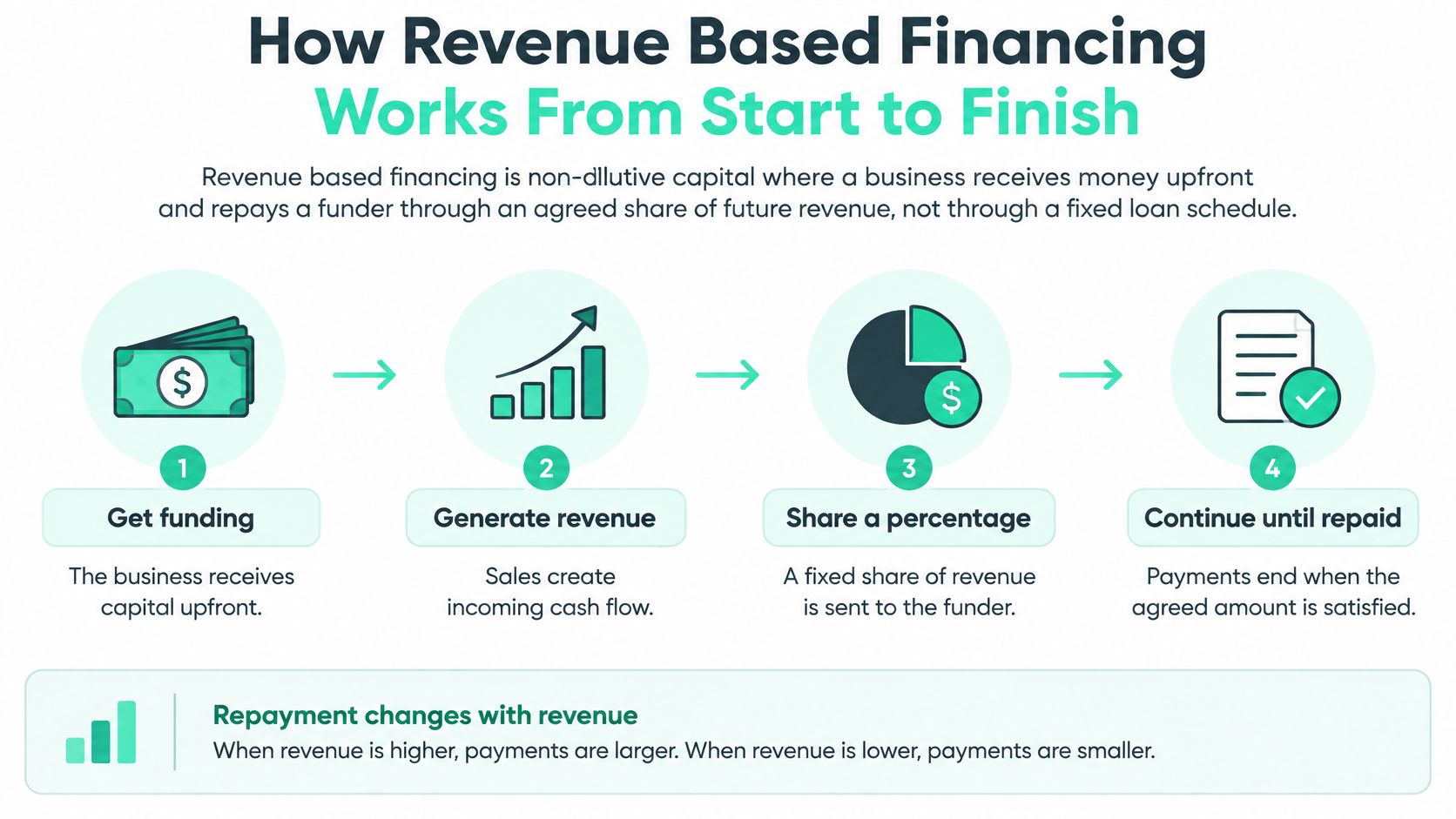
Revenue based financing is non-dilutive capital where a business receives money upfront and repays a funder through an agreed share of future revenue, not through a fixed monthly loan or a sale of equity.
Think of a songwriter's royalty advance. The label pays cash now, then recoups it from each stream. A hit clears the advance quickly. A quiet year stretches repayment out, but the songwriter isn't hit with the same bill in a month when nothing sells.
You get cash now and repay it as a slice of future sales, not as a fixed bill.
The Four Steps in Order
First, the funder advances capital, usually based on observable revenue such as subscriptions or processed payments. Second, you pay a fixed share of realized revenue each period. Third, that payment rises and falls with sales, so a strong month pays more and a weak month pays less. Fourth, payments stop once you hit a repayment cap, a total ceiling agreed upfront.
The model descends from the merchant cash advance, where a transaction was typically characterized as a sale of future receivables and repayment was collected through daily or weekly automated bank transfers, according to a University of North Carolina legal analysis of merchant cash advances. That analysis describes the merchant cash advance as a relatively recent and controversial form of small business finance, and it traces how receivables based products developed into what's increasingly called revenue-based finance.
Subscription software and other digital companies suit this structure because their revenue is recurring, measurable, and easy to verify. A funder can connect to billing data, see monthly recurring revenue, and calculate the share without guesswork. A business with lumpy, cash based, or hard to track sales gives the funder far less to underwrite against.
What you keep is straightforward. You keep ownership, you don't add a board seat, and you don't need a fixed equity valuation. What you accept is a total repayment obligation set by the cap, and an effective cost that shifts with your growth.
That last point trips up most founders. The cap is not an interest rate. A cap tells you the most you'll repay in total. It doesn't tell you how expensive the money is per year, because that depends entirely on how quickly you repay it.
What a $100,000 Advance Costs Under Three Revenue Scenarios
Take a concrete deal. You receive $100,000, you pay 5% of revenue, and your repayment cap is 1.5x, so you repay $150,000 in total and the fee is $50,000. Market descriptions commonly report revenue shares of approximately 2 to 5% and repayment caps of roughly 1.4 to 2.0 times principal, as the Drexel Nowak Lab newsletter on the rise of revenue-based financing explains.
| Scenario | Monthly revenue | Monthly payment (5%) | Months to repay $150,000 | Approx. annualized cost |
|---|---|---|---|---|
| Slow, revenue falls | $40,000 | $2,000 | 75 | about 15% |
| Expected, revenue holds | $100,000 | $5,000 | 30 | about 40% |
| Breakout, revenue doubles | $200,000 | $10,000 | 15 | about 90% |
Repayment and implied cost for a $100,000 advance at 5% revenue share and 1.5x cap. These figures assume flat revenue and exclude refunds, taxes, and fees. The annualized cost is an approximation of the implied rate, not a rate quoted in the contract, so read it as a comparison tool rather than a precise APR.
Walk Through the Expected Row
At $100,000 in monthly revenue, a 5% share is $5,000 a month. You keep $95,000 before your other costs. Repaying $150,000 at $5,000 a month takes 30 months, which works out to an implied annualized cost of roughly 40% because you're handing back the $50,000 fee over two and a half years while the outstanding balance shrinks.
Now look at the slow row. At $40,000 in monthly revenue, the payment drops to $2,000, and you keep $38,000. That drop is the downside protection people talk about, and it's real. A fixed loan payment wouldn't care that sales fell. The trade-off is time. The same $150,000 now takes 75 months to clear, so the obligation hangs over the business for more than six years and may still be open when you want other funding.
Why Faster Growth Raises the Cost
The breakout row is where founders get surprised. At $200,000 a month, you pay $10,000 a month and finish in 15 months. Same $50,000 fee, collected in half the time of the expected case. Because the funder gets its return sooner, the implied annualized cost roughly doubles even though the headline 1.5x never changed.
The trap: a fixed fee collected faster is more expensive money, even when the multiple looks modest.
That doesn't automatically make the deal bad. Run the opportunity cost the other way. Say the breakout company later sells for $10 million, and you'd have given up 10% to raise equity instead. That stake would be worth $1 million at exit, far more than a $50,000 fee. For a company that wins big, equity can be the most expensive option in absolute dollars, even though it costs nothing in monthly cash.
So the question isn't whether 1.5x sounds reasonable. It's whether the return on the $100,000 beats the cost in the scenario you land in. Ask any funder three things before you model anything else. What revenue counts toward the share? Is the cap on principal only, or does it include fees? And what's the payoff date at your own forecast, not theirs?
Compare RBF With Equity and Bank Debt, Including Drawbacks
Flexible repayment reduces short-term cash stress, but it doesn't make capital cheap. That's the assumption worth challenging before you compare anything else.
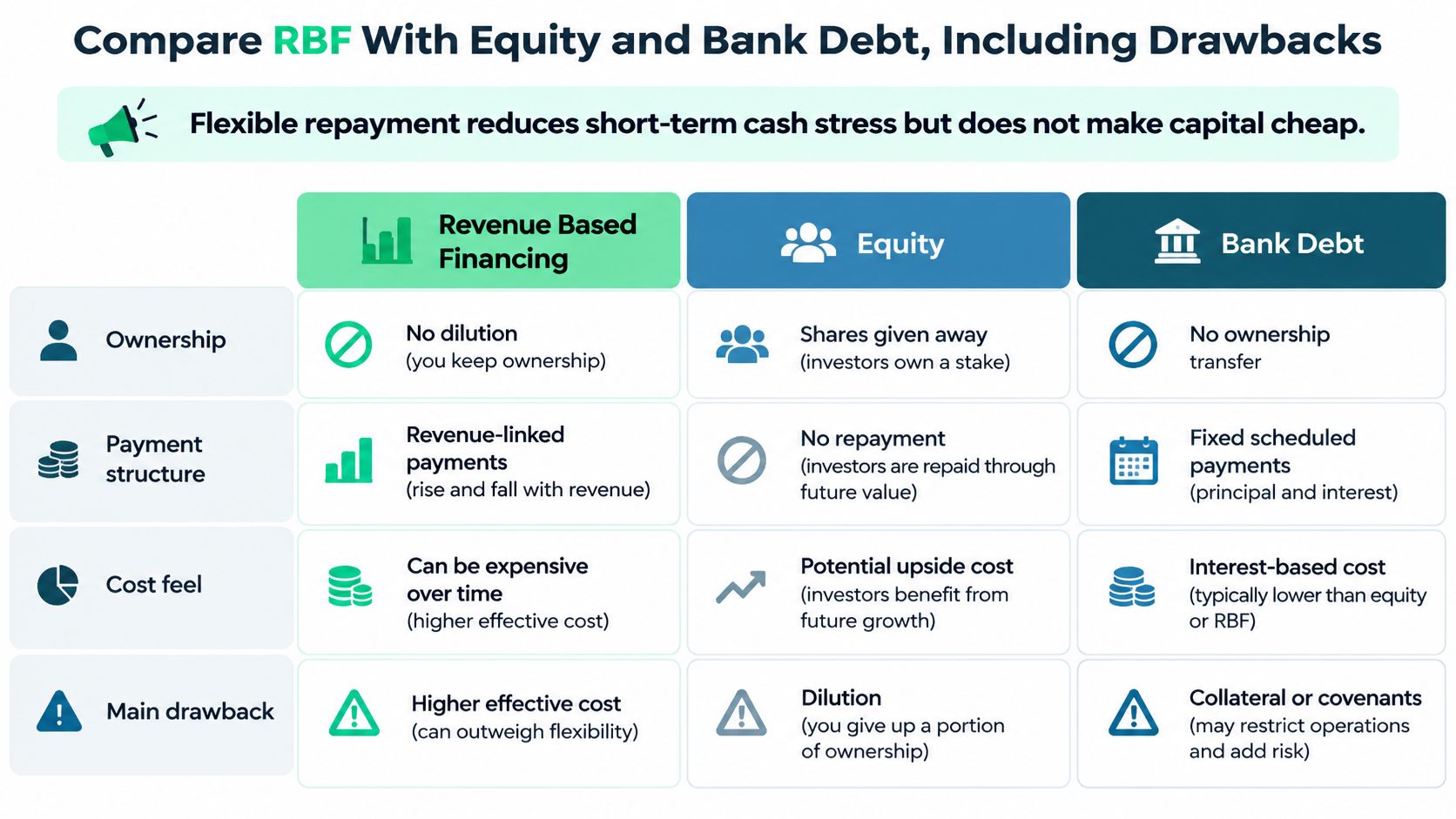
| Factor | Revenue based financing | Equity | Bank term loan |
|---|---|---|---|
| Ownership | No equity given up | Investors receive shares | No equity given up |
| Repayment | Share of monthly revenue until the cap | No repayment, investor shares in exit | Fixed monthly payments |
| Cost signal | Cap of about 1.4 to 2.0x principal | Dilution of future value | Interest rate plus fees |
| Collateral or guarantee | Often no hard collateral, but check for personal guarantees | None | Often collateral and personal guarantee |
| Speed to funds | Weeks, depends on data access | Months | Weeks to months |
| Best fit | Recurring, predictable revenue | Venture-scale growth | Steady cash flow and assets |
The sharpest contrast is how cost behaves. Revenue based financing costs more per dollar as growth speeds up, because payments scale with sales. A bank loan charges fixed interest and fixed payments whatever happens to revenue, which is predictable and unforgiving in a bad quarter. Equity costs nothing in cash, but it permanently gives up a share of future value.
If you're weighing equity instruments specifically, the legal differences between SAFEs and notes from Jumpstart Partners are worth understanding before you sign either one, since conversion and maturity terms change what you give up. It's also worth scanning the broader crowdfunding alternatives for non-dilutive routes so you're comparing against the full set of options, not just the two in front of you.
Where RBF Genuinely Helps
- No dilution or valuation: you don't sell shares or price the company to raise the money.
- Payments fall in slow months: a smaller payment protects runway when sales dip.
- A known ceiling: the cap fixes your maximum total repayment in advance.
- Fast setup with clean data: a funder who can read your billing records can move in weeks.
- Often no property pledged: many deals don't require personal assets as collateral.
Where It Bites
- Cost rises with growth: the same fee collected faster pushes the effective rate up.
- Margin pressure: at a 60% gross margin, a 5% revenue share is about 8% of gross profit. At a 15% margin, it's roughly a third of gross profit, which can starve operations.
- Hard to read terms: caps, performance covenants, and revenue definitions are dense for a small team without counsel.
- Restrictions while open: some contracts limit other debt or new equity rounds until you're repaid.
- Useless before revenue: there's nothing to share and nothing for a funder to verify.
- Routing incentives: if repayment is measured through one processor, there's a temptation to move sales elsewhere.
On collateral, read the document rather than the pitch. Bank loans usually ask for collateral or a personal guarantee. Many RBF contracts avoid hard collateral, but some still require a personal guarantee, which changes your risk completely. Merchant cash advances sit near the RBF end of the spectrum with daily or weekly debits, and they can behave very differently in practice despite similar language.
Thin margin, lumpy sales, and churn heavy consumer businesses are the most exposed, because the share comes off the top line while their costs stay put. The same contract can look cheap in a flat year and expensive in a breakout year. Timing and revenue speed decide which version you get.
Use Cases for SaaS and Indie Projects
RBF fits a narrow band: repeatable revenue, visible cash collection, and enough gross margin to absorb a share that comes off the top line. Demand is clearly growing, even if estimates disagree on size. One 2024 industry report estimated that the global market grew from USD 3.38 billion in 2023 to USD 5.78 billion in 2024, a 70.9% year-over-year increase, according to the Research and Markets revenue-based financing global market report. Treat that as a demand signal rather than a precise measurement, since some estimates count only dedicated RBF products while others fold in merchant cash advances and receivables finance.
A Solo Founder, Worked Through
Say a solo founder runs a small SaaS tool at $12,000 in monthly recurring revenue, with six months of stable Stripe data and 60% gross margins. She wants $40,000 for paid acquisition. Her first job is proving the revenue base is durable, which is why resources on building recurring revenue from anywhere from Mazurly are useful for founders still shaping a subscription offer that can support any kind of repayment.
At a 5% share, she pays $600 a month at current revenue and keeps $11,400. If acquisition works and MRR reaches $18,000, the same share takes $900; at $24,000, it takes $1,200. Whatever the agreed cap, faster growth reaches it in fewer months. That is the trade: the spend did its job, and the implied annual cost rises because the funder collects the agreed return over a shorter period.
If the spend fails and revenue stays flat, the payment stays at $600 and the obligation runs longer. She avoids a fixed debit she cannot meet, and she still carries the balance while testing a different channel.
That profile works because the revenue is verifiable, recurring, and high margin. A consumer app with heavy churn is a poor match, since revenue can fall fast and stretch the payoff for years. A pre-revenue idea is not a match at all.
Funders look for a short list of signals. Consistent monthly revenue over several months. Low refund rates, because refunds muddy what is eligible. Clean reconciliation between payment records and bank deposits, so the numbers they underwrite match the cash that arrived.
| Business profile | RBF fit | Why |
|---|---|---|
| Subscription SaaS with stable MRR | Strong | Recurring, observable revenue supports variable repayment |
| Developer tool or API with usage billing | Good | Metered revenue is trackable, but volume swings need careful caps |
| Course or productised service | Good | Predictable cohort revenue, but refund policy affects eligible revenue |
| E-commerce with thin margins | Mixed | Revenue share can consume margin in slow months |
| Consumer app with high churn | Weak | Revenue can fall fast, so payoff stretches and cost climbs |
| Pre-revenue product or idea stage | Poor | No revenue to share and no data for the provider to verify |
How to Evaluate an RBF Offer Before You Sign
Don't evaluate an offer from the term sheet summary. Work through the contract in this order, because each step changes the numbers in the next one.
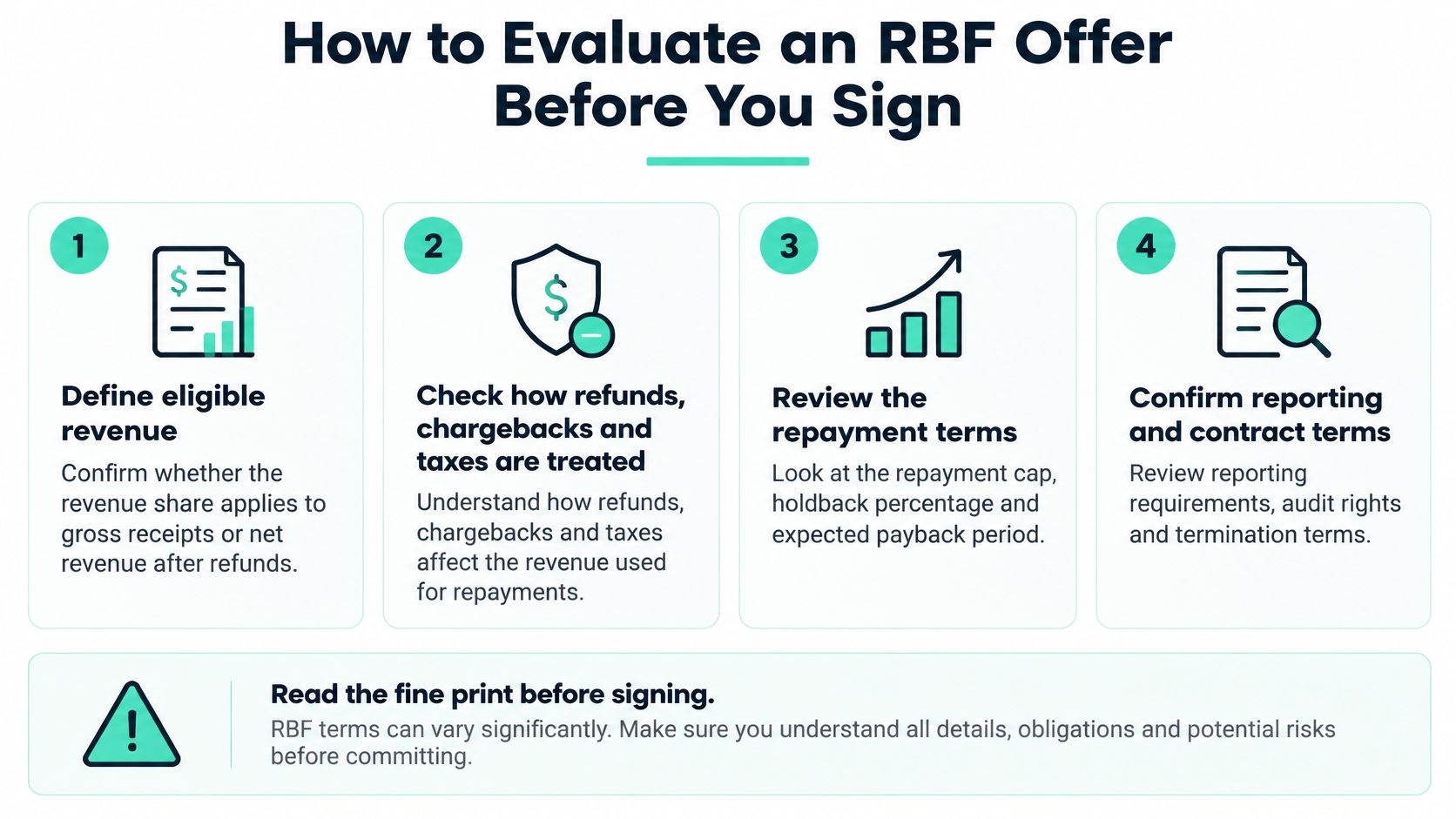
- Define eligible revenue. Confirm whether the share applies to gross receipts or net revenue after refunds. This single definition can move your payment more than the headline percentage.
- Check refunds, chargebacks, and taxes. Ask whether refunded sales still count, and whether sales tax you collect and remit is treated as revenue. You don't want to pay a share on money that was never yours.
- Confirm payment frequency and minimums. Daily, weekly, and monthly debits feel very different in a bank account. If there's a minimum monthly payment, the downside protection you've been sold is partly fictional.
- Model three scenarios. Build slow, expected, and breakout cases and calculate the implied annualized cost for each. Use your own numbers for this, and track them against the SaaS growth metrics that drive your forecast rather than a funder's optimistic curve.
- Pin down the cap. Confirm whether it covers principal only or principal plus fees, and whether late charges sit outside it. A cap that excludes fees isn't really a ceiling.
- Read the audit and data access clauses. See which accounts you must connect, how long access lasts, and what happens if you switch processors. Broad, indefinite access deserves a pushback.
Read the fine print before signing, especially the revenue definition and any minimum payment.
Step 6 carries a real risk for both sides. Transaction-level research from a major South African payment processor found that eight months after financing, financed businesses showed payments through the processor that were about 15% lower than those of observably similar non-financed businesses, according to a Harvard Business School faculty publication on digitally monitored financing. That gap reflects a mix of revenue hiding, adverse selection, and the financing's effect on activity. A funder watching a single processor can miss sales routed elsewhere, which is why stronger setups reconcile processor data against bank deposits, invoices, subscription billing, and refunds, and flag sudden shifts in payment mix.
- Check early repayment and other funding. Ask whether you can repay early, whether doing so reduces the total, and whether you may take other debt or raise equity while the balance is open. A deal that blocks your next round costs more than its fee.
Finish with one blunt test. If your forecast only works when revenue grows, the offer is priced for growth, not for your cash flow. Price it on your flat case and see if you'd still sign.
Decide Whether RBF Fits Your Next 12 Months
Match the instrument to your situation, not to the pitch.
Revenue based financing fits if you've got 6 to 12 months of stable recurring revenue, healthy gross margins, and a specific use for capital that should lift revenue, such as paid acquisition with known payback or a hire who enables a priced tier. Equity fits if you're chasing venture scale growth and need more money than revenue can support. Bank debt fits if you've got steady cash flow and assets you can pledge, and you want the lowest stated rate.
If you're pre-revenue, don't take on repayment yet. Validate demand first. The wider menu of non-dilutive funding for startups is a better starting point than a revenue share you can't service.
Do one thing this week. Pull your last 12 months of revenue, build the three scenario model with your own share and cap, and compare the implied annual cost in each case against the return you expect from spending the money. If the expected case only pencils out because you assumed growth, you're looking at growth priced capital, so negotiate the cap or walk away.
A note on alternatives. Fundl is a reward-based crowdfunding platform that connects Creators seeking funding with Funders who support projects in exchange for non-monetary rewards. It is not a financial institution, investment platform, or payment service provider, and it doesn't offer revenue based financing. A reward-based campaign isn't an investment and offers no equity or financial return, so it tests demand rather than supplying repayable capital. Creating a verified traction page on Fundl is free and does not require any backers, which makes it a low cost way to show live revenue before you approach any funder.
Model the numbers first. Then decide.
If you're building toward an RBF conversation, start by making your traction impossible to argue with. Fundl lets you publish a free verified traction page with live, source verified metrics like monthly recurring revenue pulled from your connected accounts, so funders and supporters see the same numbers you'd put in a model. Set up your page, connect your data, and share one clean link that proves demand before you sign anything.