
The most popular advice about indie hacker tools is to copy a successful founder's stack. That's backwards. You need tools that fit your product's current bottleneck, not someone else's architecture, audience, or revenue.
Most solo founders don't fail because they picked the wrong database. But a poorly matched stack can still consume building time, squeeze margins, and leave you maintaining integrations instead of improving the product. A deployment service won't fix an unclear offer, and an analytics dashboard won't help if you haven't defined what successful usage looks like.
Choose tools by stage: build, ship, measure, sell, then fund. Community and discovery tools help you find people to learn from. Development and infrastructure tools help you deliver something dependable. Payments and analytics establish whether customers value it.
The best stack isn't the one with the most generous free plans. It's the one you can operate, understand, and afford when customers start depending on it.
These picks cover that journey, with the funding option first for founders who already have evidence to share. You don't need every tool immediately. Start with the smallest combination that supports a complete customer journey, then add capabilities when a specific constraint makes the extra maintenance worthwhile.
Table of Contents
- 1. Fundl
- 2. Indie Hackers
- 3. Product Hunt
- 4. GitHub
- 5. Supabase
- 6. Vercel
- 7. PostHog
- 8. Stripe
- 9. Lemon Squeezy
- 10. Resend
- Indie Hacker Tools at a Glance
- Assemble Your Stack, Then Let Your Metrics Do the Talking
1. Fundl
Stage: Fund, after you have measurable traction.
A crowdfunding pitch becomes more useful when supporters can inspect what you've built rather than interpret a collection of screenshots. Fundl brings revenue, development activity, and audience signals into a shareable traction page.
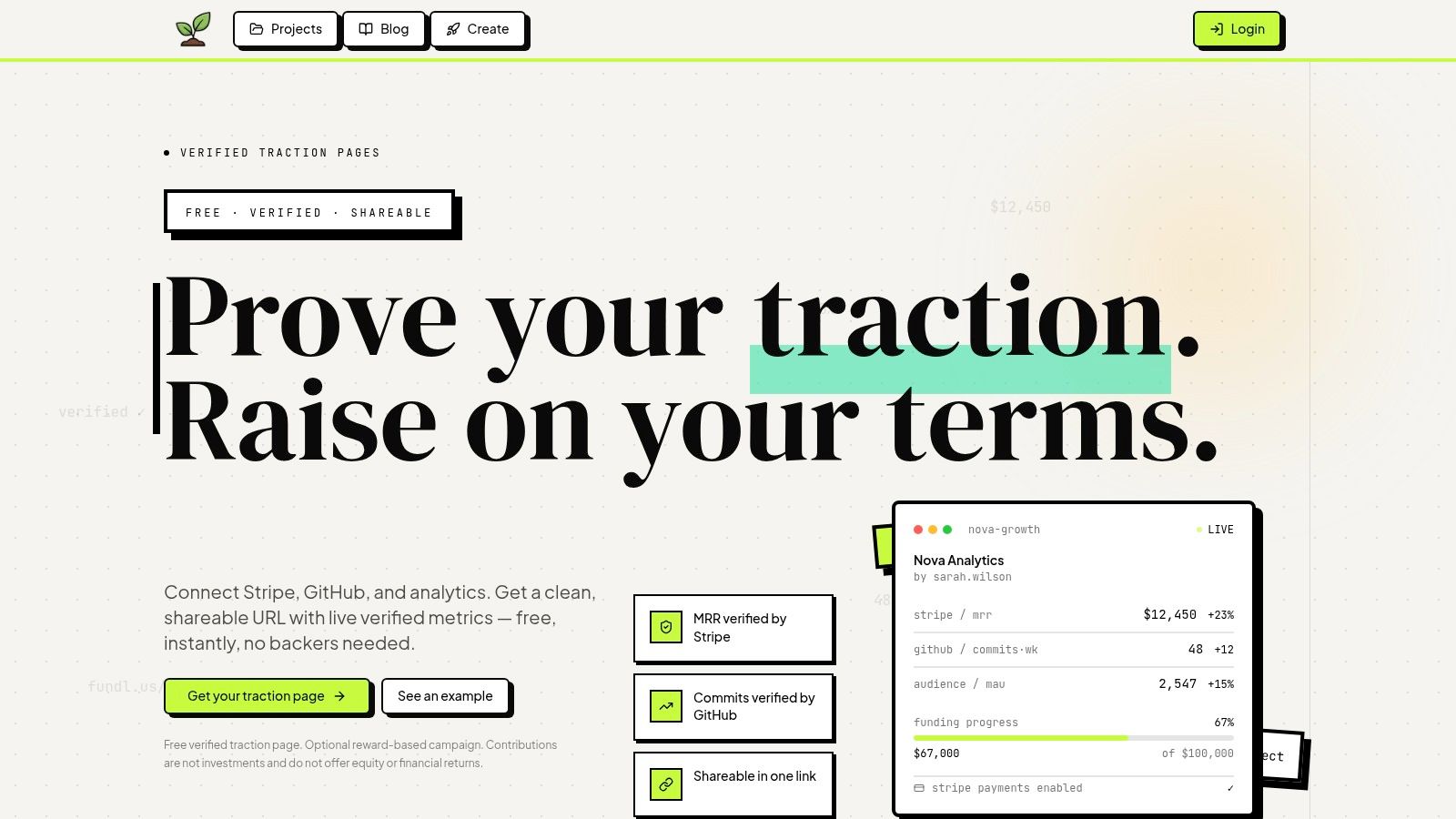
We connect creator accounts such as Stripe, GitHub, and analytics to display live, source-verified metrics, including recurring revenue, commit activity, and audience size. We refresh connected data automatically, so supporters can assess current evidence before backing a project.
Where verified traction helps
For a SaaS founder, revenue provides commercial context while shipping activity helps explain continued development. An open-source team might have stronger development and audience signals than revenue. Neither needs to pretend that every project follows the same business model.
- Strength: We combine connected signals in a shareable URL, reducing the need to assemble and update separate proof screenshots.
- Cost distinction: Creating a verified traction page is free. We charge a platform fee on successful contributions, deducted before funds transfer to the creator.
- Funding model: Supporters contribute for non-monetary rewards, not equity or promised financial returns. Contributions go through the creator's own Stripe account, without platform-held escrow.
The limitation is the evidence available. Compatible accounts and meaningful activity matter; verified metrics don't guarantee delivery or future performance. Creators must still explain their goals and intended use of funds accurately.
I'd recommend this once you can show progress and identify a concrete use for support. Setup takes about fifteen minutes, but defining a credible funding goal deserves more thought than connecting accounts.
2. Indie Hackers
Stage: Validate and find founder peers.
Before you build another feature, find out whether you're solving a customer problem or responding to founder anxiety. Indie Hackers offers founder stories, discussions, build-in-public posts, and a newsletter focused on independent businesses.
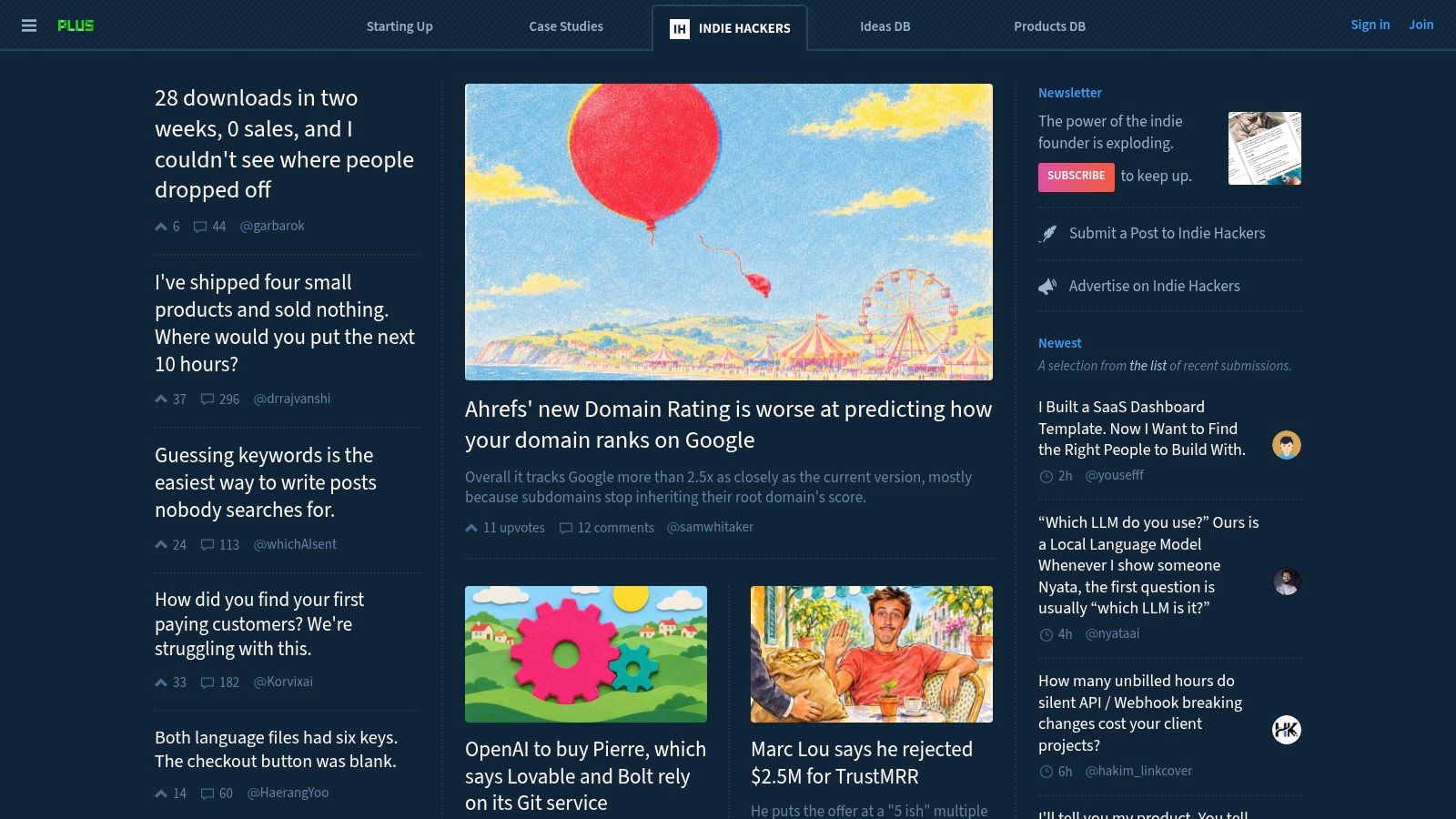
The useful approach is specific: describe the customer, their current workaround, and the decision you're considering. Asking whether an idea sounds good invites encouragement. Asking how founders handle failed subscription renewals invites operational detail.
Use conversations to sharpen questions
The upside is relevance. Discussions about bootstrapping, acquisition, pricing, and small software businesses can help you identify options you hadn't considered. Browsing and participating don't require a paid community subscription.
The downside is selection bias. A persuasive revenue story may omit acquisition costs, an existing audience, or extensive unpaid work. Treat user-submitted outcomes as claims to investigate, not instructions to copy.
If you're weighing outside support, this guide to funding for an app can help frame the decision before you ask peers for feedback.
I'd use the community to improve customer interview questions and find relevant connections. I wouldn't treat positive comments from other makers as proof that your intended buyers will pay.
3. Product Hunt
Stage: Ship publicly and test your positioning.
A launch is a distribution event, not a customer acquisition strategy. Product Hunt gives makers a product page, community comments, voting, and a place to introduce software to people who actively explore new products.
The submission opportunity is useful when your onboarding already works. Visitors should understand the promise, try the core experience, and know what to do next without waiting for a personal walkthrough.
- Prepare the destination: Test signup, checkout, mobile layouts, and transactional emails before promoting the launch.
- Explain the product: Use screenshots that demonstrate the workflow rather than decorative mockups. Maker comments can clarify who it's for and what it replaces.
- Measure useful outcomes: Separate launch visitors from people who activate, return, or purchase. Votes aren't interchangeable with demand.
The trade-off is preparation time against uncertain attention. Submission is free, but writing the page, answering comments, and following up still consume founder time.
For channel selection, evaluate tool discovery platforms by audience fit rather than visibility alone. The distinction between discovery and sustained usage also matters when considering app discovery options.
Best fit: A usable product with clear positioning and a post-launch follow-up plan. If your intended buyers don't browse maker communities, use the launch as a supplementary channel, not your primary route to customers.
4. GitHub
Stage: Build a recoverable, reviewable product.
GitHub should hold more than your latest source code. Use repositories, issues, pull requests, and automation to record what changed, why it changed, and whether it passed checks.
In Stack Overflow's 2025 Developer Survey announcement, GitHub was used by 81% of respondents as a code documentation or collaboration tool. Familiar workflows are helpful when you eventually bring in a contributor or contractor.
Keep the workflow lightweight
Even working alone, use small pull requests for changes involving authentication, payments, and database migrations. Run tests and linting through GitHub Actions, and use Dependabot to surface dependency updates.
The advantage: Public and private repositories are available on the free plan, and issues can replace a separate project-management subscription during early development. A clear issue with acceptance criteria is often enough.
The limitation: GitHub doesn't run your complete production application by itself. Advanced controls and some security features require additional capabilities or paid plans, while Git and automation still take effort to learn.
Practical rule: Automate checks you'd otherwise forget, not an elaborate approval process for a team that doesn't exist.
I'd make GitHub the foundation from the first working prototype. Store setup instructions and migration procedures alongside the code, so recovery doesn't depend on remembering what you configured.
5. Supabase
Stage: Build the backend without assembling every service separately.
A product that needs accounts, relational data, and file uploads has enough backend work already. Supabase combines managed PostgreSQL with authentication, storage, and APIs generated from database schemas.
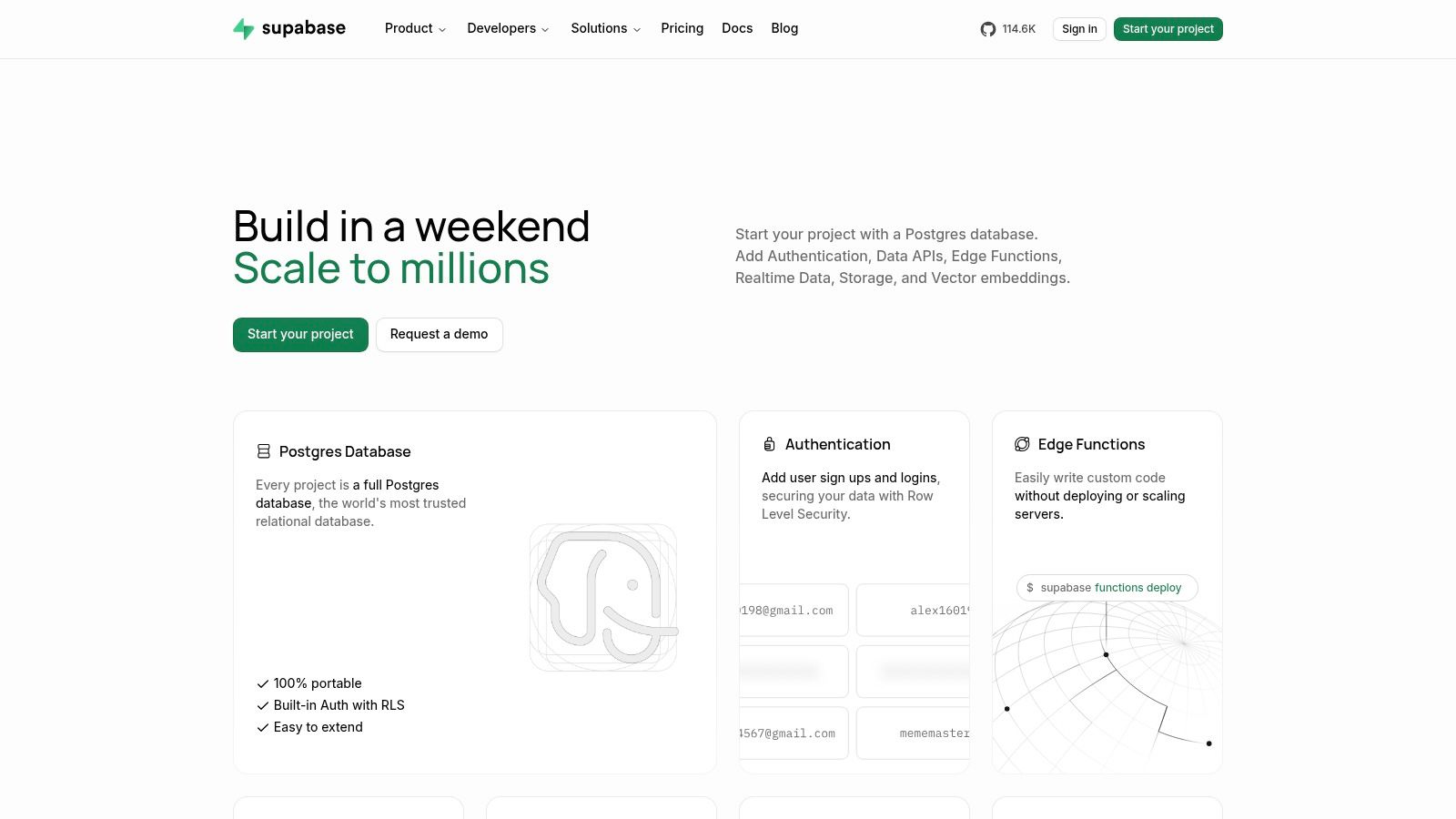
That combination suits applications where relationships matter: customers belong to organizations, organizations own projects, and users have different permissions. PostgreSQL gives you a relational foundation rather than forcing those relationships into application-side workarounds.
Managed doesn't mean maintenance-free
The strongest reason to choose Supabase is integration convenience. The mistake is assuming that convenience removes responsibility for schema design, authorization, and backups.
- What works: Keep schema migrations in version control and write explicit access policies before exposing customer data.
- What needs attention: Test permissions as different users, including unauthenticated visitors. Keep privileged credentials out of browser code.
- Where costs creep in: Compute, storage, and usage can add to the base subscription. A free experimental project isn't a production capacity plan.
Free projects have resource constraints and can pause after inactivity, so account for that before relying on a demo during a sales conversation.
Best fit: A technically capable founder building an application that benefits from SQL and integrated backend services. If you can't explain who may read or modify each table, finish the authorization design before adding more features.
6. Vercel
Stage: Ship web changes with less deployment plumbing.
The useful feature in Vercel isn't merely getting a site online. It's connecting a repository to repeatable deployments and preview environments, so you can inspect a change before customers encounter it.
For framework-based web applications, that removes a chunk of release work. A preview link is useful for checking a pricing-page revision, reviewing responsive layouts, or asking a collaborator to test a workflow.
The benefit is deployment convenience. The trade-off is runtime and billing awareness. You still need to understand how your framework executes server-side code, where secrets live, and how production configuration differs from previews.
Keep deployments predictable
Use separate credentials and appropriate test data for preview environments. Don't let an experimental branch send real customer emails or modify production billing records.
The MeshBase guide to Vercel deployment offers deployment guidance, but your own application still needs a tested release and rollback procedure.
Check commercial-use terms before choosing a plan, since Hobby is designated for personal projects. Monitor usage-based services rather than assuming hosting costs will remain flat.
I'd choose Vercel for a supported web application when deployment maintenance is slowing delivery. I wouldn't force long-running background processing into an unsuitable execution model just to keep everything with the same provider.
7. PostHog
Stage: Measure activation and diagnose friction.
Say people create accounts but never finish importing their data. A visitor counter won't explain that failure. PostHog combines event analytics, session replay, feature flags, experiments, error tracking, and surveys to help investigate product behavior.
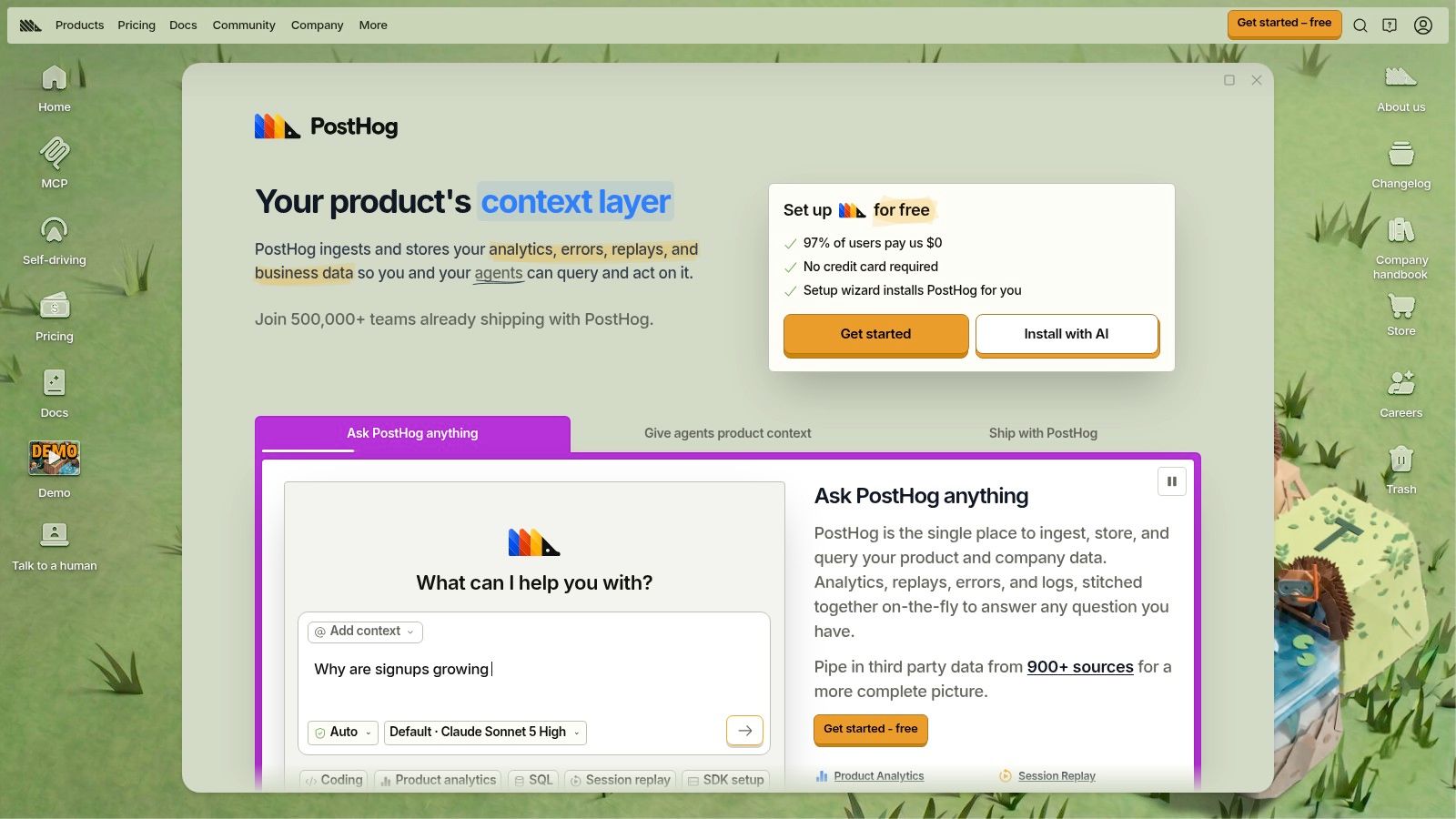
Start with a defined activation event, such as completing an import and producing a useful result. Then instrument the steps leading to it, using consistent event names and properties.
- Main advantage: Funnels and session replays can help you connect a drop-off with the workflow a user encountered, without adopting separate products immediately.
- Main limitation: Incorrect instrumentation produces misleading conclusions. Duplicate events, inconsistent identifiers, and internal testing can distort reports.
- Cost control: Monitor event and recording volume, configure billing limits, and avoid collecting data you can't connect to a decision.
Collect less, interpret better
Mask sensitive inputs and review what recordings capture before enabling them broadly. Payment details, credentials, and private customer content shouldn't become debugging material.
Best fit: A product with real users and a question you can investigate, such as why onboarding stalls or whether an improvement changes repeat usage.
PostHog's breadth is useful, but enabling every feature creates configuration work. Begin with the events needed to understand activation; add experiments or feature flags when you have a concrete reason to use them.
8. Stripe
Stage: Sell with direct control over payments.
Stripe supports both straightforward Payment Links and customized payment integrations. That range is valuable because your first paid offer doesn't necessarily need a checkout flow you designed yourself.
For an early validation offer, a payment link can be sufficient. For a subscription application, the harder work is keeping customer access consistent with subscription state, cancellations, renewals, and failed payments.
Build around confirmed payment events
Don't grant permanent access just because someone reaches a success page. Verify webhook signatures, handle repeated events safely, and record payment-related state transitions so you can diagnose support problems.
Our guide to Stripe payment integration is relevant when you're connecting checkout to the rest of your application.
The upside is flexibility: You can support different purchase flows and retain direct control over payment configuration. The downside is operational responsibility: Processing fees, billing charges, refunds, disputes, and tax obligations all deserve attention.
A working checkout is only the beginning. Test what happens when payment fails, a subscription changes, and a customer asks for a refund.
I'd choose Stripe when custom billing behavior or direct integration matters. Before launch, complete the entire customer lifecycle in test mode, including cancellation and account-access changes, rather than testing only a successful purchase.
9. Lemon Squeezy
Stage: Sell digital products with merchant-of-record support.
The Stripe versus Lemon Squeezy decision isn't just about checkout design. It's about who handles the sale and which operational responsibilities you want to retain.
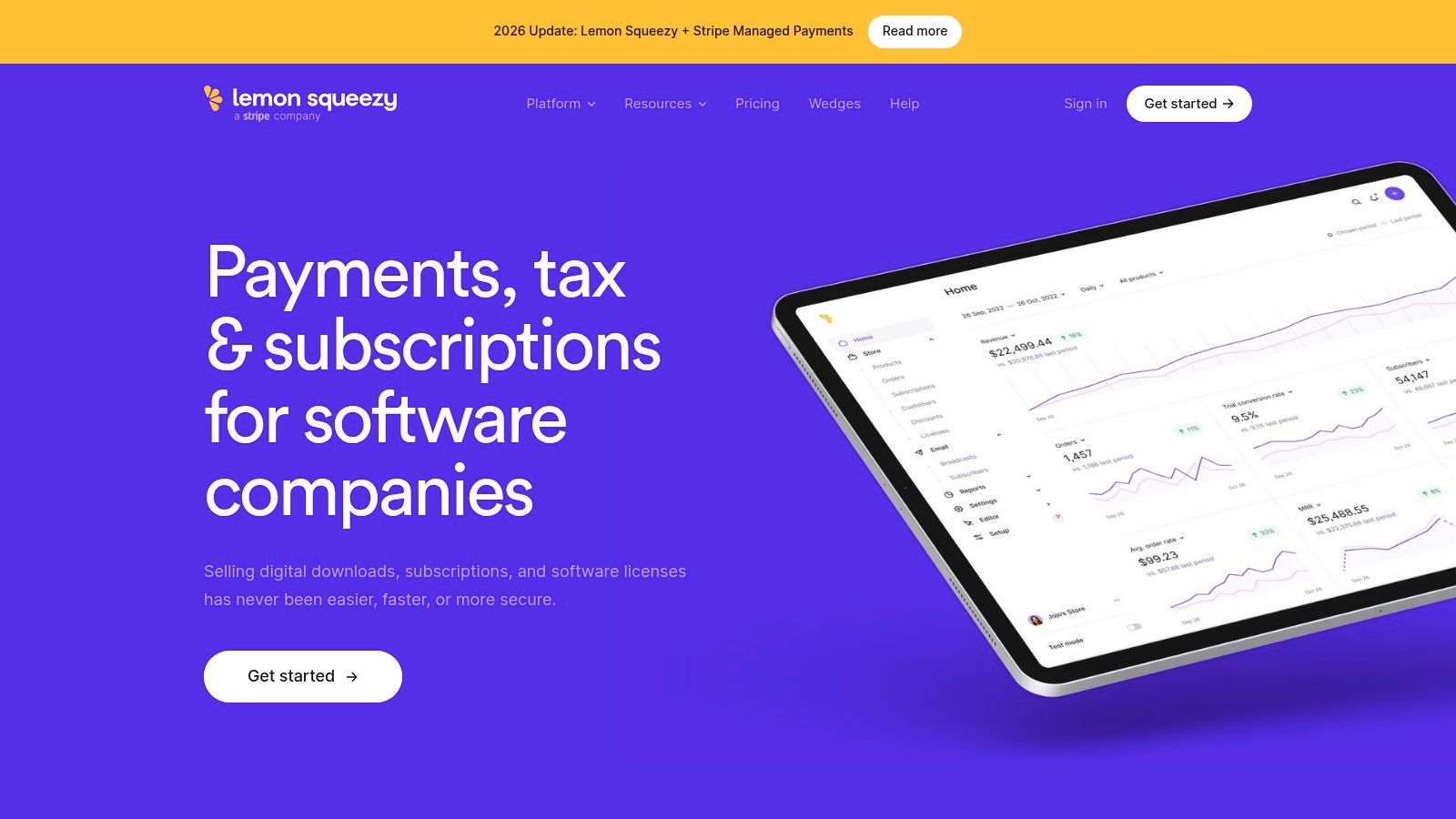
Lemon Squeezy combines hosted checkout, subscriptions, license keys, and merchant-of-record services, including sales-tax and VAT collection for qualifying sales. That can suit a founder selling software downloads or subscriptions who wants less commerce administration.
Compare responsibility, not just transaction fees
A merchant-of-record service changes the relationship between your business, the platform, and the buyer. You gain operational support but accept less direct control over parts of the sales process.
- Good fit: Eligible digital products that benefit from hosted checkout, subscription management, or license-key delivery.
- Trade-off: Transaction charges affect margins, and additional fees may apply. Compare the complete fee structure against your actual product and customer mix.
- Before committing: Review product eligibility, approval requirements, payout arrangements, and the customer-facing purchase experience.
Don't assume merchant-of-record support removes every business obligation. Your own accounting and broader tax responsibilities still need attention.
I'd favor Lemon Squeezy when simplifying eligible digital sales matters more than building a highly customized payment flow. Choose Stripe instead when direct control is worth the additional operational work. Running both without a clear need can complicate support and reporting.
10. Resend
Stage: Support the product with dependable transactional email.
Password resets are part of your product, not a background marketing task. Resend provides an email API, SMTP relay, SDKs, webhooks, and template-building support for messages such as verification links, receipts, and account notifications.

Its developer-oriented approach fits a custom application where email follows a product event. React Email support is useful if you want templates maintained alongside application code rather than edited in an unrelated visual tool.
Treat delivery as an operational workflow
Authenticate your sending domain, configure SPF and DKIM, and establish an appropriate DMARC policy. Keep transactional messages focused on the action the recipient needs to take.
The strength is integration convenience: API calls and webhooks let you connect sending and delivery status to application workflows. The limitation is that an email service can't guarantee inbox placement: Sender configuration, list quality, and message practices still matter.
Free-plan daily limits can constrain a concentrated launch or onboarding push even when overall sending remains modest. Plan against the shape of your traffic, not just average volume.
I'd use Resend for product-triggered email, with retry handling and delivery monitoring. Make reset links expire, prevent repeated requests from flooding recipients, and avoid including secrets or unnecessary personal data in email content.
Indie Hacker Tools at a Glance
| Tool | Category | Free plan | Listed pricing | Best for |
|---|---|---|---|---|
| Fundl | Traction verification and crowdfunding | Free verified pages | Verified pages free; contributions through Stripe | Makers showing verified traction and raising reward-based support |
| Indie Hackers | Founder community | Free to browse and participate | No pricing listed | Independent founders seeking peer advice and connections |
| Product Hunt | Product discovery and launches | Free launch submission | No pricing listed | Makers launching products to early adopters |
| GitHub | Code hosting and collaboration | Unlimited public and private repositories | Team and Enterprise plans available; prices not listed | Managing code, collaboration, and development workflows |
| Supabase | Backend platform | Free plan for experiments | Pro listed at $25/month; usage may add costs | Founders building apps with a managed PostgreSQL backend |
| Vercel | Deployment and hosting | Hobby plan listed at $0/month | Pro listed at $20/month; usage charges may apply | Deploying web apps with Git-connected previews |
| PostHog | Product analytics | Free monthly allowances | Usage-based pricing; rates not listed | Understanding user behavior with integrated product tools |
| Stripe | Payment processing | No free-plan details listed | U.S. cards: 2.9% + 30¢ per successful transaction; Billing priced separately | Accepting online payments and managing subscriptions |
| Lemon Squeezy | Digital commerce and merchant of record | No free-plan details listed | 5% + 50¢ per transaction; possible additional fees | Selling digital products with checkout, licensing, and tax handling |
| Resend | Transactional email | 3,000 emails/month, capped at 100/day | Pro: $20/month for 50,000 emails | Sending transactional email through developer tools |
Assemble Your Stack, Then Let Your Metrics Do the Talking
The strongest indie hacker stacks are boring in a useful way. GitHub holds the code and change history, Supabase supplies backend capabilities, and Vercel handles supported web deployments. PostHog helps you investigate behavior, Stripe or Lemon Squeezy handles sales, and Resend connects product events to customer messages.
You don't need to adopt that entire combination before testing demand. A digital download may need checkout and delivery before it needs product analytics. A collaborative SaaS product needs careful authorization before it needs a public launch campaign.
Add tools against a measurable constraint
For each service, write down the job it performs, its total cost, and the evidence that it helps. Include integration maintenance and time spent checking automated output, not just the subscription invoice.
That broader view matters. In JetBrains' 2025 State of Developer Ecosystem report, 62% of developers identified non-technical factors as critical to performance, compared with 51% identifying technical factors. More software isn't automatically the answer to unclear priorities or poorly defined work.
AI belongs in the same evaluation. In Stack Overflow's 2025 Developer Survey, 84% of respondents said they use or plan to use AI tools in their development process. If you add an assistant, evaluate reviewed output and rework, not how quickly it produces code.
- Before product-market clarity: Favor reversible choices, direct customer conversations, and a complete working customer journey.
- After customers arrive: Improve reliability, instrument activation, and understand the full cost of serving a paying user.
- Before seeking support: Define what funding will enable and present evidence that makes your plan credible.
Prefer integrations that remove duplicate work rather than adding another dashboard to inspect. The same principle underpins choosing tools that reduce product team handoffs: preserve context between systems instead of repeatedly copying it.
Once your product generates meaningful traction, Fundl can turn connected revenue, shipping activity, and audience signals into a shareable funding page. That evidence still needs an honest explanation of what you're building and how support will help.
Pick the tool that addresses your current constraint, ship a useful improvement this week, and measure what customers do next. A stack earns its place by helping you deliver and sustain value, not by looking complete.
Turn the progress from your indie hacker tools into evidence supporters can inspect. Visit Fundl to create a free verified traction page, connect your revenue, development, and audience accounts, and share automatically refreshed metrics. When you're ready to seek reward-based support, explain your funding goal alongside that live proof.