
By one count, Crunchbase reported that AI-related startups raised $212 billion in 2025, up 85% from 2024, yet that headline tells a first-time founder almost nothing about whether any of that money fits their company. A large total can hide a small number of very large rounds, and a large round can hide weak economics. That is why AI startup funding should start with a different question. After you pay for each model call, API request, and cloud bill, do you keep enough from each customer to run a real business?
That question is your gross margin after model costs. Gross margin is what's left from revenue after the direct cost of delivering the product. For ordinary software, serving one more user often costs very little. For AI, one more user can mean thousands more paid requests. If those costs eat most of your price, more capital may only let you lose money faster. If the margin holds, capital can buy speed, better data, and distribution. Use that test to choose between grants, angels, venture capital, revenue-based financing, crowdfunding, and corporate partners, rather than chasing whichever source sounds biggest.
Table of Contents
- Funding Options for AI Startups at a Glance
- Where AI Money Goes and Where Your Startup Sits
- Compute, Data and Model IP Investors Check
- Matching Your Stage to the Right Funding Path
- Crowdfunding and Verified Traction as a Funding Route
- How to Build Your Funding Evidence Pack
- Confirm Your Funding Path Before You Raise
Funding Options for AI Startups at a Glance
| Funding source | Typical stage | What you give up | Repayment or return | Best fit |
|---|---|---|---|---|
| Grants | Pre-seed or research stage | No equity, but reporting duties | None | Research-heavy or public-benefit AI |
| Angel investors | Pre-seed to seed | Equity | None | Founders needing a first check and network |
| Venture capital | Seed to growth | Significant equity and board seats | None | Companies built to scale quickly |
| Revenue-based financing | Post-revenue | No equity | Share of monthly revenue up to a capped amount | Subscription AI products with stable income |
| Reward-based crowdfunding | Pre-launch to early traction | No equity | Delivery of promised rewards | Consumer or developer AI tools with visible demand |
| Corporate partnerships | Any stage | Usually no equity, but possible data or exclusivity terms | Contract terms | Startups with a strategic buyer |
The Two Columns Founders Misread
What you give up and repayment or return sound similar. They're not. Equity means ownership. You don't repay it from monthly cash, but you permanently share future value and, with venture capital, often share control through board seats. Repayment means cash leaves the business on a schedule or as a share of revenue. That protects ownership, but it can strain a company whose inference bills already rise with usage.
Grants don't take equity, but they aren't free in operational terms. You'll track milestones, file reports, and wait through review timelines. Corporate partnerships can also look non-dilutive at first glance, which means they don't reduce your ownership share. Read the contract anyway. A partner may ask for exclusive use in an industry, rights to data created during the project, fixed pricing, or control over how you market the product. Those terms can cost more than a small equity stake if they block your next customers.
Practical rule: Choose funding by what it demands when you're short of cash, not only by what it promises when you're growing.
Say you compare two illustrative offers of $500,000. A revenue-based advance with a 1.5 times repayment cap means you return $750,000 in total, paid as a share of monthly revenue until you reach that cap. You keep your ownership, but every month's payment competes with model and hosting bills. The same illustrative $500,000 from angels for 15% of the company requires no cash repayment. Instead, you've given up 15% of any future exit value, subject to the deal terms. Neither option wins in the abstract. The first fits steady subscription revenue with healthy margin. The second fits a company that needs time to build before revenue can support payments.
Shortlist two or three rows that match your stage and cash pattern. Most startups combine sources over time, for example a grant for research, angels for the first product, then revenue-based financing or venture capital once customer evidence is stronger. Don't pursue all six at once. Each funder asks for different proof, and scattered preparation produces weak applications everywhere.
Where AI Money Goes and Where Your Startup Sits
In 2025, AI companies represented about 61% of the $427.1 billion invested by venture capital worldwide, more than double AI's 30% share in 2022, according to the OECD report on venture capital investments in artificial intelligence through 2025. Global venture-capital investment in artificial-intelligence companies expanded from approximately $8.3 billion in 2012 to $258.7 billion in 2025. AI is no longer a specialist corner of startup finance. It's the main destination for venture money.
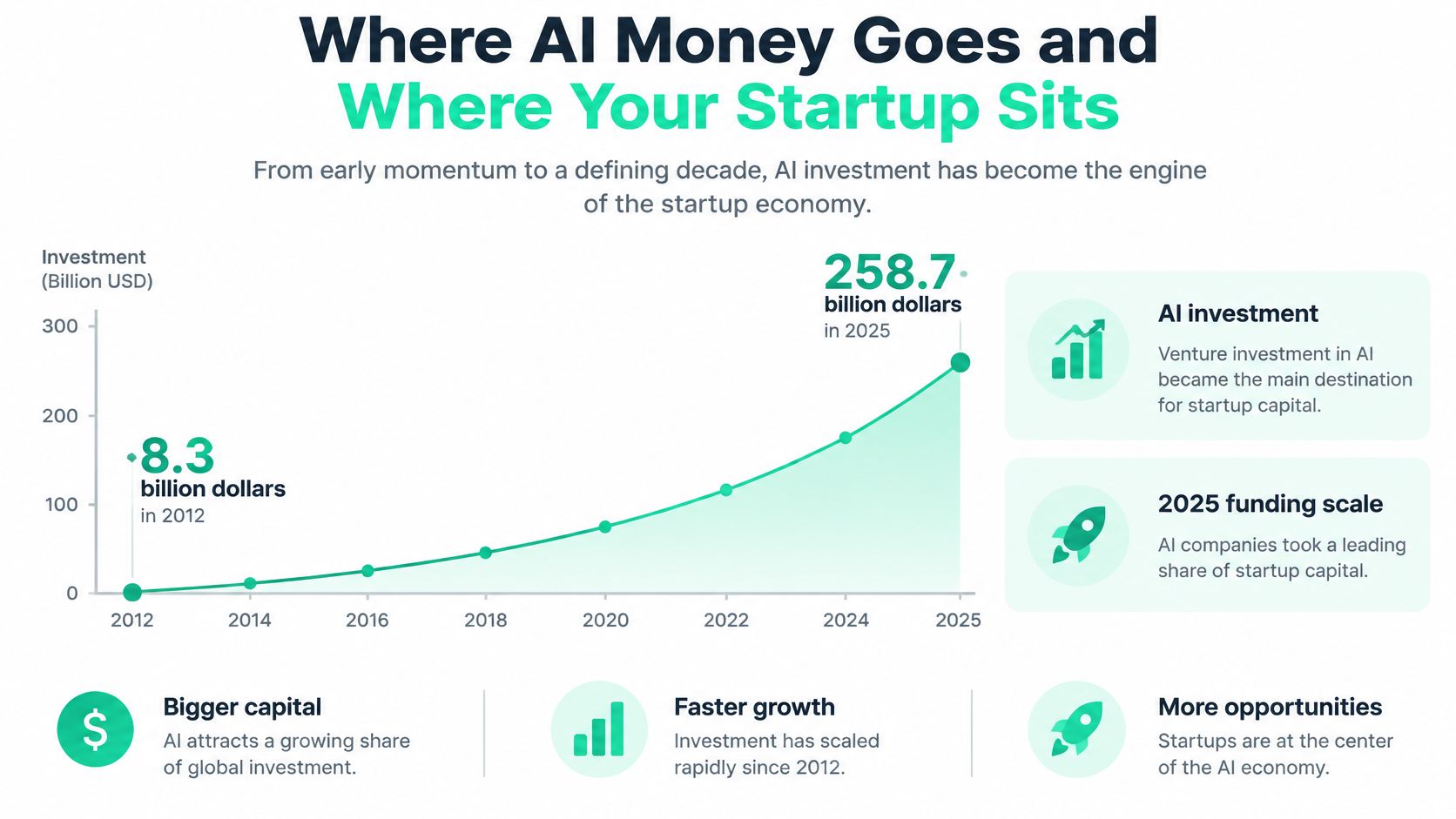
That scale still doesn't mean money is spread evenly. AI companies working in IT infrastructure and hosting attracted $109.3 billion in 2025, while all other AI application industries combined attracted $149.4 billion. In other words, a huge share pays for the systems needed to train, host, and run models. A founder building a small application shouldn't compare their capital need with a company building data centers or foundation models. They're solving problems at different layers, with different costs and different proof.
Name Your Layer Before You Pitch
Think of AI as a stack. At the bottom sits cloud infrastructure and hosting. Above that are data processing, developer tools, model providers, security, and specialized enterprise systems. At the top are applications people use directly, such as a tool that drafts contracts, summarizes support tickets, or checks medical notes for missing details.
- Infrastructure layer: Investors focus on capacity, reliability, unit cost, and whether customers depend on you in production.
- Tools and data layer: Investors look for developer adoption, integrations, retention, and rights to valuable data.
- Application layer: Investors look for paying customers, repeat usage, workflow value, and margin after model costs.
A focused tool for one workflow can be fundable even if it never trains its own model. For example, say you build software that helps insurance teams extract dates and policy limits from claim documents. You're not competing with a model lab. Your value may come from accurate extraction, audit trails, integrations with claim systems, and knowledge of messy real-world forms. State that layer clearly, name the buyer, and show the proof that layer requires. Vague claims about being an AI platform make investors guess, and guessing usually ends in a pass.
Compute, Data and Model IP Investors Check
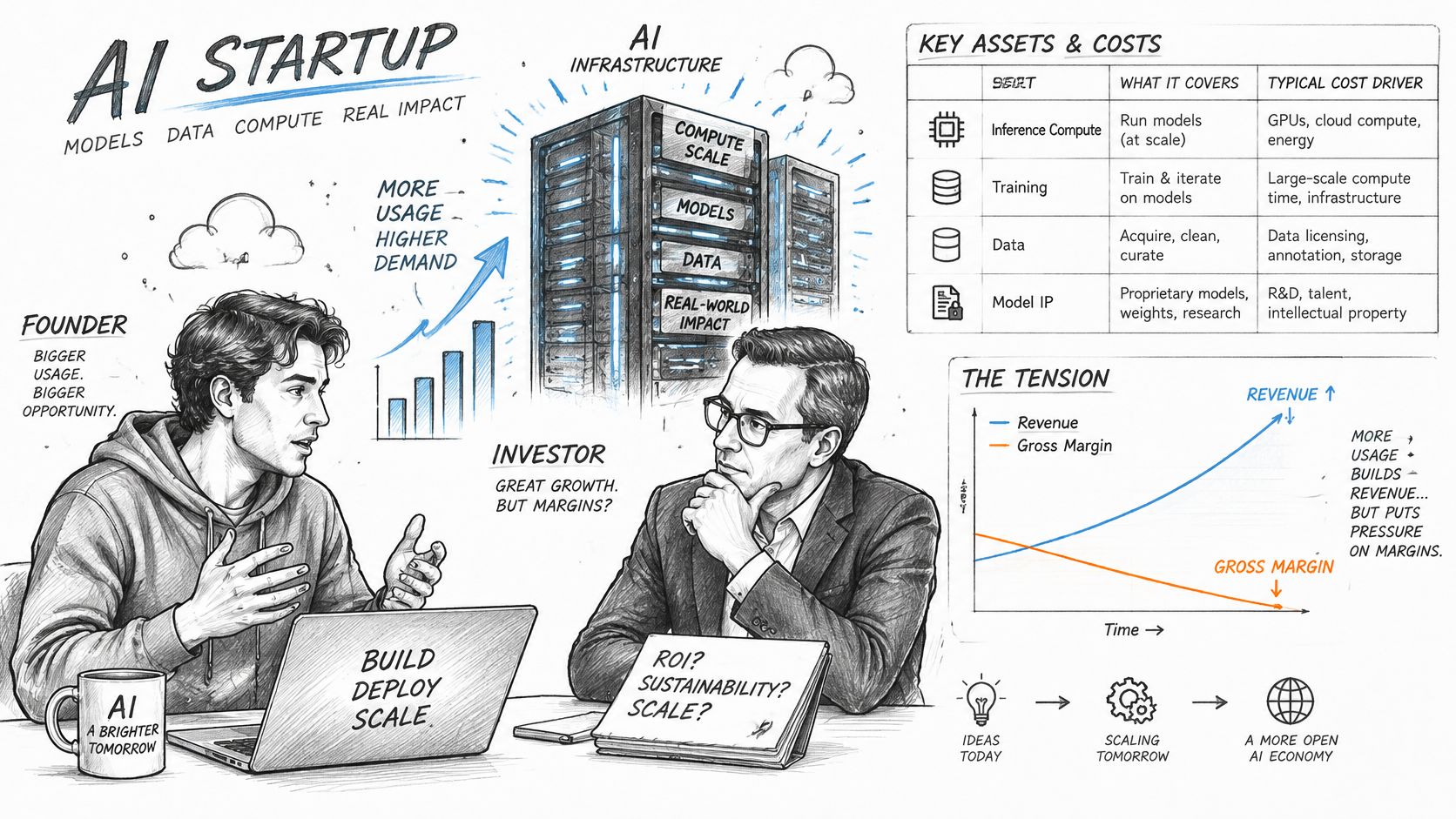
AI changes the funding math because success can raise your costs immediately. Inference is the work a model does when it answers a live request. Every summary, image, search, and agent step can trigger a bill. Revenue may rise while gross margin falls, especially if heavy users consume far more than your flat subscription price assumed. The illustration below captures the conversation you're really preparing for, where growth claims meet the cost of producing each result.
Use this checklist to separate a credible cost story from a hopeful one.
| Cost driver or asset | What to show | Why it matters |
|---|---|---|
| Inference compute | Cost per task and gross margin after model costs | Shows whether usage can grow profitably |
| Fine-tuning or training | Spend by model version and expected benefit | Shows whether training improves quality or lowers cost |
| Data rights | Sources, licences, consent, and retention terms | Shows you can legally use the data behind the product |
| Model IP | What you own, what you rent, and switching effort | Shows what remains if a supplier changes terms |
| Supplier concentration | Share of spend with your largest model or cloud supplier | Shows exposure to price rises or outages |
| Latency and reliability | Response time, uptime cost, and fallback plan | Shows the price of keeping the product fast and dependable |
Work the Margin by Segment
Don't calculate one blended margin and stop. A light user who runs a few tasks may be profitable, while a power user on the same plan may cost more than they pay. Split customers into sensible groups, such as free trial users, small teams, and heavy enterprise users. For each group, show revenue per active user, model and API cost, support cost if it's directly tied to delivery, and the resulting margin. If one segment fails, you may need usage limits, a higher tier, cheaper routing to a smaller model, caching for repeated requests, or a different price. Funding shouldn't be used to avoid that decision.
Model IP needs the same plain treatment. IP means intellectual property, the rights you own in models, code, data, prompts, evaluations, and workflows. If your product depends on a third-party model, say so. Then explain what you own around it, such as proprietary labelled data, customer integrations, evaluation sets, or a workflow users would struggle to replace. Also explain how you'd switch suppliers if price, quality, or availability changes. Dependence isn't automatically fatal. Undocumented dependence is.
Before you watch the discussion below, write down your current cost per successful task, not cost per attempt. Failed calls, retries, and abandoned generations still consume budget, so investors will want the full cost of a completed customer outcome.
Round size doesn't settle these questions. In Q3 2026, AI startups raised $102 billion, or 64% of global venture capital, while the number of billion-dollar rounds reached a record 27, according to Crunchbase's Q3 2026 global startup funding report. Those are market figures, not proof that any one company's economics work. At the Series B stage, around two-thirds of funding went to AI companies. A smaller founder can't compete by copying those cheque sizes. You compete by showing that capital buys something durable.
Capital that buys proprietary data, workflow integration, distribution, or a lower cost per task can strengthen the business. Capital that only pays growing inference bills for unretained users postpones the margin problem.
Matching Your Stage to the Right Funding Path
The right funding path is decided by one question: does your gross margin survive your model costs? A funding source that expects fast payback will hurt if every customer dollar goes to inference. One that tolerates long research timelines will frustrate a founder who already has paying users. Run that margin test first, then look at stage.
A solo builder with a no-code AI tool and a few hundred paying users sits in the clearest position. Demand is visible, revenue arrives monthly, and the product doesn't need a research lab. Reward-based crowdfunding or revenue-based financing can fit because repayment or rewards can follow existing demand. Venture capital may be a poor match if the founder wants a profitable, focused business rather than rapid expansion at any cost.
A three-person team building a model for one industry, with no revenue yet, faces the opposite math. They need data access, evaluation work, and time to prove accuracy before anyone can price the product. Grants fit the research stage first. Angels become realistic once there's a prototype a potential buyer can test and criticize. Revenue-based financing doesn't fit yet because there's no revenue stream to share, and taking on repayment obligations now would compound the margin problem rather than fund it.
A seed-stage team running enterprise pilots, with one large company interested in becoming both customer and partner, has a third profile. A corporate partnership alongside venture capital may work. The danger sits in exclusivity. If the partner blocks sales to competitors for too long, the startup may trade its whole market for one contract. Review data use, pricing, termination rights, and the length of any exclusive period before signing.
Location Changes the Evidence You Need
Capital is concentrated geographically. In 2024, U.S. private AI investment reached $109.1 billion, nearly 12 times China's $9.3 billion and 24 times the U.K.'s $4.5 billion, according to Stanford's 2025 AI Index report. If you're outside the dominant U.S. market, don't rely on total market size alone. Make your local advantage measurable. Show customer acquisition cost by region, inference cost under local hosting requirements, benchmark performance in your customers' language or domain, and conversion or retention differences across markets.
That discipline also helps if you're exploring non-dilutive funding options for startups, because grant reviewers and lenders care about verifiable local demand rather than borrowed U.S. benchmarks. Reconcile recurring revenue to payment records and keep your active-user definition stable. A funder who can't visit your office or call a shared contact needs cleaner evidence, not louder claims.
Run this short match test before outreach:
- Stage: Do you have research, a prototype, paying users, or repeat enterprise demand?
- Revenue: Is income steady enough to support repayment or reward delivery?
- Margin: After model, data, and compute costs, does each customer leave enough over to satisfy this funder's expectations?
- Team: Can you deliver the milestones this funder will require?
- Location: Have you quantified local costs, language performance, and buyer access?
Crowdfunding and Verified Traction as a Funding Route
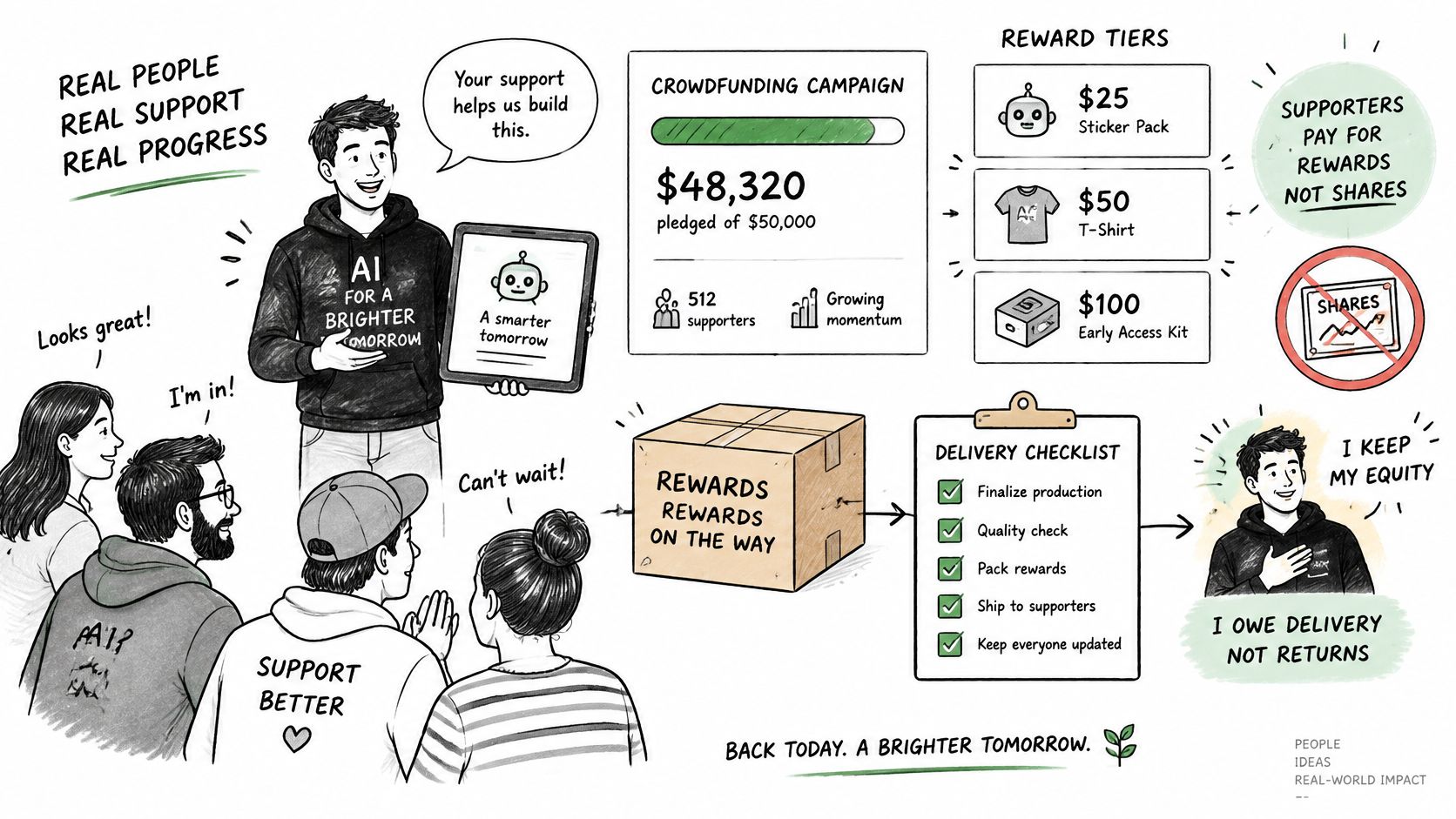
Reward-based crowdfunding is simple once you remove the investment language. Supporters pay money and receive a promised reward, such as early access, a course, a product tier, templates, or a workshop. They don't receive shares. You keep your equity, but you owe delivery and honest communication. For an AI tool with visible demand, that trade can be cleaner than giving up ownership before you know what customers will pay for.
The mechanics matter. Contributions made through Fundl are not investments, and funders don't acquire any equity, ownership, debt, or financial return in any project or in Fundl. Creators must fulfil the rewards or perks they promised, and Fundl isn't responsible for reward delivery. Creators must also respond in good faith to funder complaints or requests relating to their project. Contributions are paid directly to the creator's own Stripe account, and Fundl doesn't hold creators' funds.
How Verified Traction Changes the Ask
A verified traction page connects the systems that already record your progress. Connect Stripe for recurring revenue, GitHub for commit activity, and analytics for audience size. Then share one URL where those metrics refresh automatically. Backers see live data before they pay, rather than a screenshot you selected on your best day. Fundl is one example of a platform built around that evidence-first approach, and comparing it with other crowdfunding alternatives for founders helps you judge fees, reward obligations, and how proof is displayed.
Be honest about the limits. Crowdfunding won't produce venture-scale cheques for expensive training runs or a large sales team. Rewards take time and money to fulfil, and a campaign can distract you from product work if you promise too many tiers. It works best for AI tools, developer products, and course creators who already have users, revenue, shipping activity, or an audience that can be shown in numbers.
If strangers can inspect your revenue, usage, and shipping cadence and still choose to pay, you've tested demand in public. That result is useful evidence even when the amount raised is modest.
How to Build Your Funding Evidence Pack
Build one pack, then tailor the front page for each funder. The infographic below summarizes the preparation flow before the detailed steps.
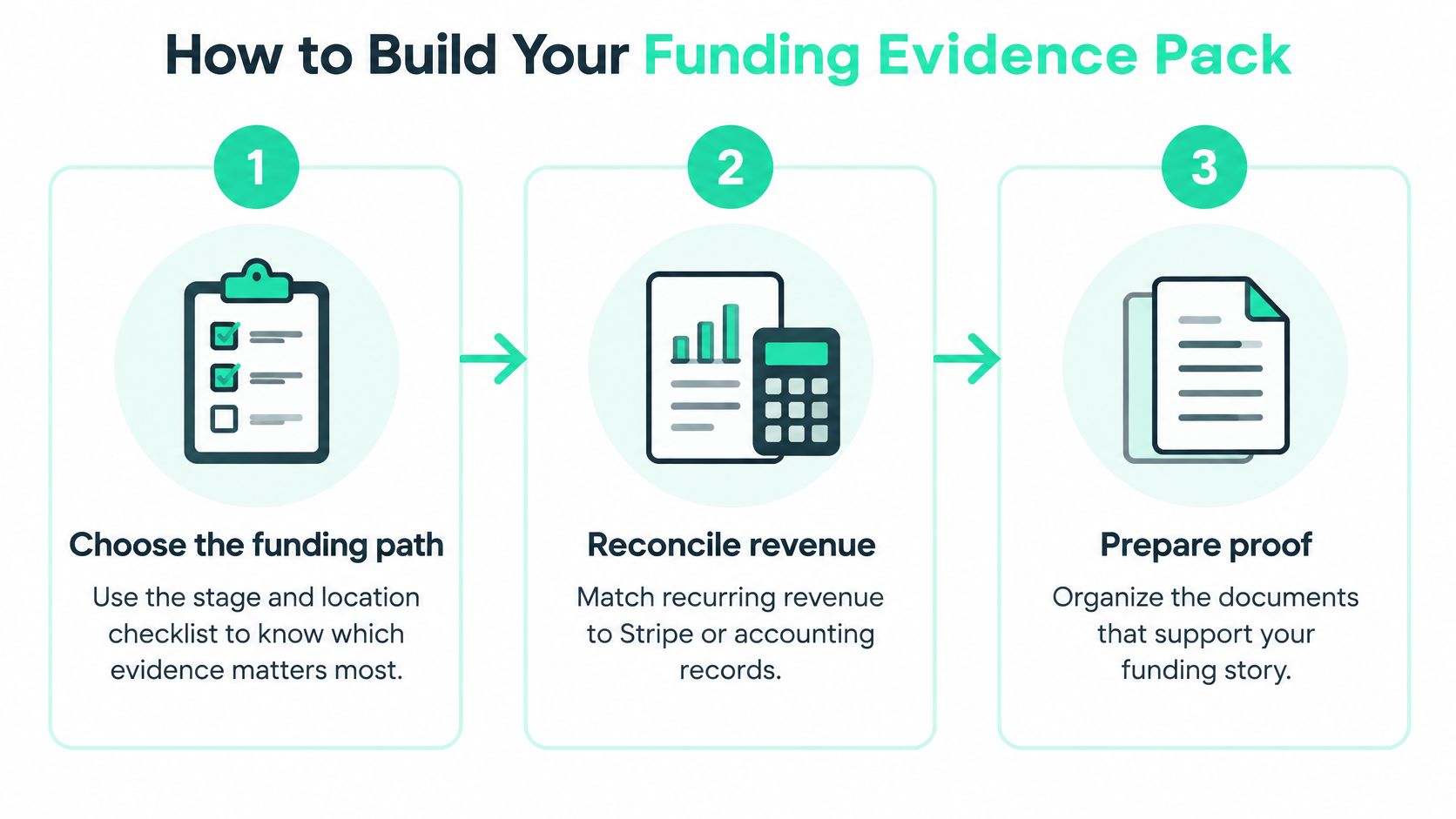
- Choose the funding path. Use your stage and location answers to decide whether you need research proof, revenue proof, or buyer proof. The common mistake is sending the same generic deck to every source.
- Reconcile revenue. Match recurring revenue to Stripe or accounting records, line by line. The common mistake is quoting booked, invoiced, or trial revenue as if cash had arrived. Practical guidance on how to show traction to investors can help you present those reconciled figures clearly.
- Define active users once. Write the definition down, such as a user who completed one core task in the period, and keep it fixed. The common mistake is counting signups, trial accounts, or duplicate seats as active users.
- Calculate gross margin after inference and API costs. Do it by customer segment and include retries and failed calls. The common mistake is treating gross revenue as if it were money available to spend.
- Document data and model rights. List data sources, licences, customer permissions, third-party models, and supplier dependencies. The common mistake is assuming that data you can access is data you're allowed to train on or resell.
- Write a twelve-month use-of-funds plan. Name the compute, data, hiring, and distribution spend the money covers. The common mistake is writing growth as a single vague line item. If part of the plan is founder-led outreach, examples of turning LinkedIn activity into sales conversations can help you turn that activity into pipeline evidence rather than vanity posts.
- Publish a shareable proof page. Use live metrics where possible, or a dated dashboard export for investors who need documents. The common mistake is sending undated screenshots with no definitions.
- Approach two or three matched sources first. Ask what evidence they found weak, fix that gap, then widen the list. The common mistake is blasting a long list before you know whether the pack answers basic questions.
Keep the pack short enough that a busy reviewer can verify it quickly. Put definitions beside metrics, dates beside exports, and source systems beside every number. If a figure can't be traced back to Stripe, accounting records, analytics, GitHub, or a signed customer document, label it as an estimate or remove it. Funders forgive early-stage uncertainty. They don't forgive numbers that change when checked.
Confirm Your Funding Path Before You Raise
Make three checks before you contact anyone. First, the funding source matches your stage, revenue pattern, team capacity, and location. Second, your evidence reconciles to payment, accounting, product, and code records. Third, your gross margin still holds after inference and API costs for the customers you plan to grow. If any check fails, fix that item before you ask for money. A weak margin won't become strong because a cheque arrives.
Choose one path for this month. Grant reviewers, angels, lenders, corporate partners, and crowdfunding backers ask for different proof, so pursuing everyone at once usually means you're prepared for no one. If the first two or three matched sources say no, treat the reasons as a revision list. Ask which figure they couldn't verify, which cost they didn't believe, or which milestone came too early. Then improve the pack and try the next matched source.
Your Checklist for This Week
- Pick one path. Select it from the options table using your stage and location answers.
- Export revenue. Pull the figures from Stripe or your accounting system and reconcile them to the number you'll quote.
- Record segment margin. Calculate gross margin after model and API costs for your largest customer segment.
- Draft the use-of-funds plan. Name the compute and data spend the funding will cover over twelve months.
If crowdfunding is the path that fits, creating a verified traction page on Fundl is free and doesn't require any backers. Setting up a project on Fundl takes about 5 minutes and involves setting the funding goal, campaign timeline, and core project details. Backers then contribute directly through Stripe Checkout after seeing the verified data, so your first conversation can start from proof rather than promises.
If your AI startup funding plan depends on showing real demand, Fundl lets you publish a verified traction page with live revenue, shipping, and audience metrics, then collect reward-based support through your own Stripe account without giving up equity. Build the evidence first, choose the funding path that fits your margin, and visit Fundl to create your page and share one credible link with backers.