
Approximately 42.1% of crowdfunding campaigns succeeded in a detailed global analysis of nearly 378,000 campaigns, but success depended on credible evidence, reachable audiences, and a deliverable plan, not ideas alone. Kickstarter facilitated roughly US$5 billion for more than 182,000 projects during the year examined in a 2020 academic study, proving that online fundraising can assemble serious capital without traditional lenders or investors. The study of creators and backers also makes the uncomfortable point clear: most campaigns still fail.
The popular advice is to choose the right platform, polish your story, and create urgency. That advice is incomplete. Skeptical backers don't fund presentation quality. They fund evidence that you can turn demand into delivery.
For an indie SaaS founder, open-source maintainer, educator, or AI builder, your strongest pitch may already exist in Stripe, GitHub, and product analytics. MRR, active users, shipping activity, retention signals, and public milestones tell a more convincing story than a glossy deck. The job is to make that proof easy to inspect, understand, and trust.
Table of Contents
- Rethinking the Search for Capital
- Choosing the Right Funding Channel
- Building Your Proof of Traction Page
- Setting the Ask and Designing Rewards
- Running the Campaign as a Communication Funnel
- Navigating Post-Funding Delivery Risks
- Your Campaign Checklist for Success
Rethinking the Search for Capital
Stop treating fundraising like a pitch contest. For solo builders and small software teams, that habit usually produces polished storytelling and weak trust. Traditional fundraising rewards a deck, a giant market slide, and a promise that value will show up later. Online support works better when you show people what is already working, what still needs to be built, and exactly what their money changes.
You are not asking strangers to buy a theory. You are asking them to back a concrete outcome. Reward-based fundraising changes the transaction from abstract future upside to a specific exchange, support this result and receive access, progress, or a defined benefit connected to it.
That shift matters because public funding does not run on investor theater. It runs on inspectable proof. Earlier research on crowdfunding already showed that plenty of campaigns get funded and plenty do not. The useful lesson is what separates the two. Backers respond when the offer is clear, the result is specific, and the creator gives enough evidence to judge delivery risk for themselves.
Ideas are cheap, proof is scarce
A mockup shows intent. A live product shows execution. A testimonial shows that one person liked what you built. A live revenue feed, usage trend, commit history, or waitlist with real activity shows whether demand is continuing.
That is the true advantage for digital products. You can often deliver value without factories, warehousing, or shipping logistics. A founder can offer early access, a product milestone, a course cohort, a support tier, or a community benefit. But vague rewards still fail. Backers need to see the path from today's proof to tomorrow's delivery.
The strongest online fundraising page doesn't ask backers to ignore uncertainty. It makes uncertainty visible and explains how the requested money reduces it.
Build your narrative like an operating dashboard. Show MRR if you have it. Show active users if they matter more. Show shipped releases, support load, retention signals, or public milestones if that is what proves momentum in your business. If you are working on tools for business users, bringing generative BI to non-technical teams is a useful example of how operational information can be turned into a clearer case for action. Your campaign needs the same discipline.
Forget the myth that online funding belongs to hardware brands, creators with huge audiences, or founders who know how to perform confidence. A developer can raise support around a maintained open-source tool. An educator can pre-sell a structured learning experience. A SaaS founder can fund a feature users already want. Every channel demands verifiable momentum paired with a credible use of funds.
Choosing the Right Funding Channel
The funding channel should match what your backers are buying. A channel becomes expensive when it forces you to explain a transaction your audience doesn't want.
| Channel | Best fit | Main trade-off |
|---|---|---|
| Reward-based crowdfunding | A defined product, feature, course, or milestone | You must fulfill the promised reward |
| Direct presales | A product with clear demand and a near-term delivery path | You take responsibility for customer expectations |
| Patronage or donations | Open-source work, public education, or community infrastructure | The value exchange can feel vague without a clear mission |
| Paid pilots or early access | B2B software and products solving an identifiable problem | Buyers expect useful access and responsive support |
| Equity crowdfunding | A company seeking investment rather than product support | Regulation, disclosure, and ownership dilution add complexity |
Reward-based crowdfunding sits in the practical middle. You don't give up equity, and you don't have to frame the request as charity. You offer a concrete benefit while showing why the contribution helps you ship.
Direct presales can work even better when the product is already understood. A buyer pays for access or delivery, and your campaign becomes a transparent launch mechanism. This option is less suitable when the scope remains undefined or fulfillment depends on untested infrastructure.
Patronage fits projects whose value is ongoing rather than transactional. Open-source maintainers and educators can ask for recurring support, but they still need to state what support enables. “Help me keep going” is weaker than a defined maintenance commitment, curriculum release, or community service.
Paid pilots and early access are strongest for software with a clear user problem. A small team can fund a specific integration or workflow by selling access to organizations that need it. The founder must avoid treating pilot revenue as permission to overpromise. A paid customer expects communication, working software, and a realistic implementation boundary.
Equity crowdfunding is a different category. In the United States, Regulation Crowdfunding took effect on May 16, 2016. From then through December 31, 2024, more than 8,400 offerings were initiated by more than 7,100 issuers, and reported proceeds totaled approximately US$1.3 billion, according to the SEC's Regulation Crowdfunding data. That history shows regulated online fundraising can mature, but it doesn't make equity the default choice for a creator who can offer useful product access instead.
Building Your Proof of Traction Page
Your proof page should answer one question before a backer asks it: what evidence shows that this project is alive, useful, and capable of delivery?
Start before launch. Connect the systems that already record your business activity, then decide which metrics a skeptical outsider can interpret without a private briefing.

Connect evidence, not decoration
Stripe can support a revenue view. Display MRR or another clearly defined revenue measure, explain what it includes, and distinguish recurring revenue from one-time payments. Don't show a large total without describing its period and meaning.
GitHub can show shipping behavior. Commit activity, release history, and issue movement can demonstrate that development is active. Commits alone don't prove product quality, so pair them with release notes, screenshots of working functionality, or links to public documentation.
Analytics can show audience use. Monthly Active Users can provide context for demand, but only if you define the metric and explain how it relates to the product. A large audience that never returns is not the same as sustained usage.
Source-linked data matters because static screenshots are easy to edit and quickly become stale. A live page doesn't eliminate risk, but it gives backers a way to evaluate the current state instead of relying on a founder's memory or a carefully selected image.
Make the page inspectable
Put the funding request beside the evidence. If you're asking for support to build an integration, show the users who need it, the current product boundary, the relevant repository activity, and the milestone the money will enable. If you're funding educational content, show the existing curriculum, audience behavior, and the delivery format.
Use a short explanation for every metric:
- Metric: What does it measure?
- Source: Where does the data come from?
- Meaning: Why does it matter to this project?
- Next milestone: What will change after funding?
A shareable page also helps supporters circulate something more useful than a promotional post. Tools for shared pages for knowledge sharing illustrate the practical value of giving different audiences one clear, updateable destination rather than sending them through scattered documents. For a deeper framework on connecting operational data to fundraising proof, use the data-driven fundraising guide.
Fundl is one option for publishing a reward-based campaign with live metrics connected from Stripe, GitHub, and analytics accounts. Its pages are designed to make revenue, development activity, and usage evidence visible to potential backers, while contributions are processed through the creator's Stripe account.
Proof standard: If a backer can't tell what a metric means, where it came from, and what decision it supports, the metric is decoration.
Setting the Ask and Designing Rewards
Set the ask from the work you can deliver, not from the valuation you hope to justify. A funding target should represent the minimum viable budget for a defined outcome, with enough room for operating, fulfillment, payment processing, and contingency costs.
Write the budget in plain language. List each cost, connect it to a milestone, and reduce scope if the total becomes difficult for your reachable audience to cover. A large request can signal ambition, but it also creates a larger proof burden.
Research on crowdfunding goal design found that smaller-budget projects were more likely to reach their targets. In one scientific-crowdfunding sample, 48% of projects succeeded compared with 36% on the general-purpose Kickstarter platform, showing why category and audience context matter. The research on crowdfunding success also links larger funding goals with lower success probability.
Build a deliverable budget
Use this order:
- Define the minimum launch. Identify the smallest version that creates the promised backer value.
- Price the work. Include development, support, infrastructure, content production, and fulfillment.
- Account for transaction costs. Don't spend the full gross amount in your plan.
- Add contingency. Explain what happens if delivery takes longer or operating costs rise.
- Tie money to milestones. Each budget line should correspond to a visible result.
Your live metrics should support the ask, not substitute for the budget. MRR can demonstrate that customers already pay. Active users can show that a feature serves a real audience. GitHub activity can support a claim that your team ships consistently. None of those metrics tells a backer how you will pay for support, infrastructure, or fulfillment.
Make rewards extensions of the product
Reward tiers should feel like fair exchanges, not arbitrary price points. Offer early access when the product is usable, a defined feature package when the scope is stable, or a structured course experience when the curriculum and delivery method are ready.
Avoid rewards that create operational chaos. A custom promise for every backer can turn a software campaign into a support queue. Standardize access, define delivery conditions, publish what isn't included, and state what happens if a milestone slips.
The best reward is often the next useful step for an existing audience. A current user may want the integration you're planning. An open-source contributor may want priority access to a hosted version. An educator's audience may want a focused cohort rather than a vague promise of future lessons.
Running the Campaign as a Communication Funnel
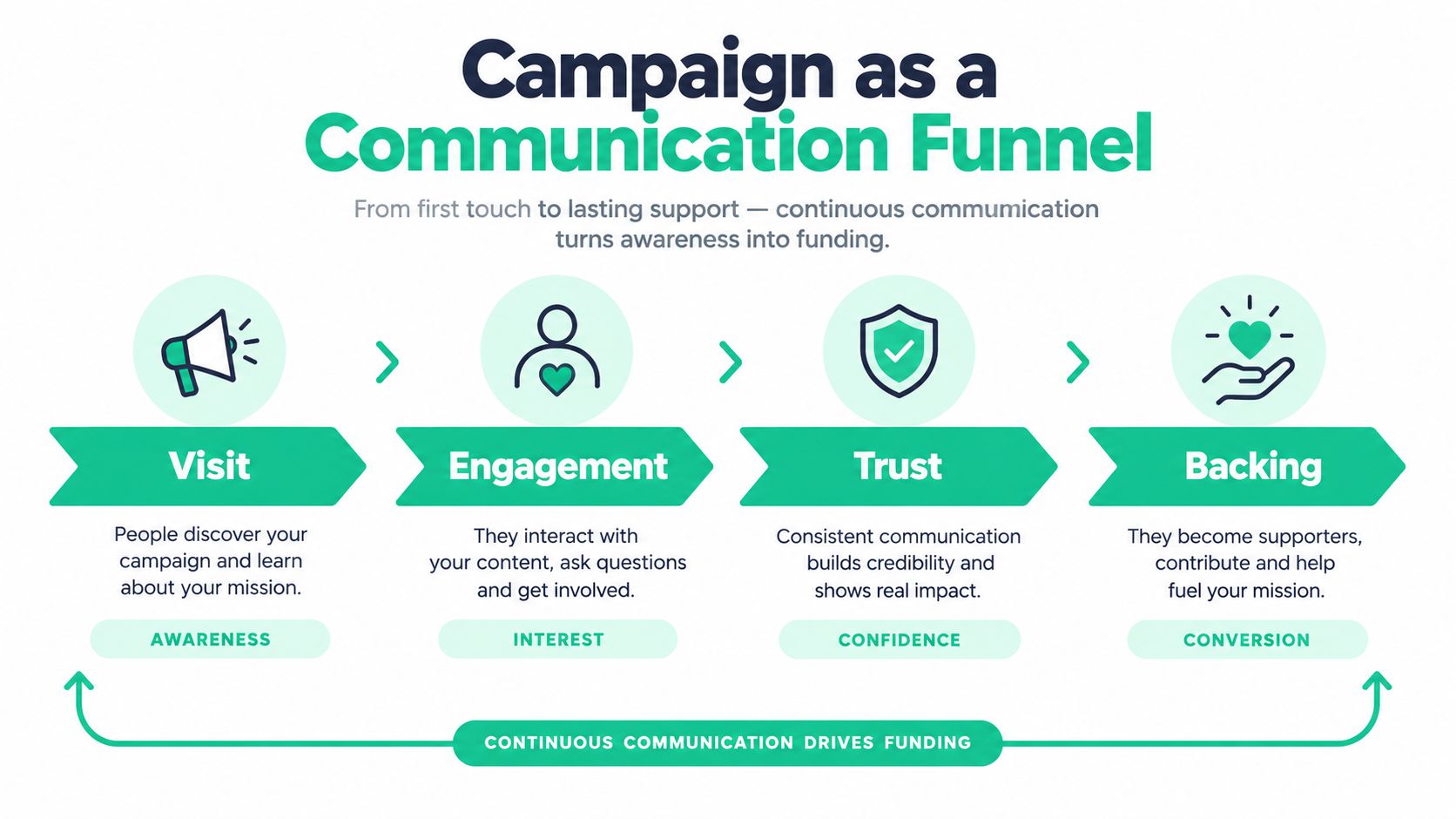
A campaign page is not a broadcast. It's a funnel that converts attention into understanding, then understanding into trust, then trust into a contribution.
Track the movement between those stages. Page views tell you whether distribution works. Engagement shows whether visitors inspect the evidence. Contributions reveal whether the ask and reward make sense. Repeat visits and update-driven traffic show whether communication keeps the project relevant.
Treat updates as operating reports
A good update answers four questions:
- What changed: Describe the shipped feature, new release, user signal, or setback.
- What proves it: Link to the relevant source, repository, product page, or metric.
- What happens next: Name the next milestone and its dependency.
- What should readers do: Ask for one action, such as contributing, sharing, testing, or replying.
Don't hide a decline in revenue or usage. Explain it. A temporary dip with a clear cause and response can build more trust than a campaign that shows only upward movement. Backers don't require perfection, but they do require evidence that you notice problems and manage them.
Operational research reports that approximately 50% of reward- or donation-based campaigns succeed, with frequent updates, network size, achievable goals, and clear information associated with stronger outcomes. The campaign research provides a broad benchmark, not a forecast for your project. It supports a practical conclusion: consistent communication beats a single promotional burst.
Segment the people you contact
Existing users need a reason to fund a milestone. Subscribers may need a concise explanation of what their support enables. Contributors deserve direct progress evidence. Relevant communities need context and a request that respects their rules.
Send different messages instead of copying one announcement everywhere. A founder's network can provide early attention, but a product community may provide the technical feedback that improves conversion. Measure each channel separately so you know where qualified interest originates.
Use the crowdfunding promotion guide for distribution ideas, then judge every tactic by contribution quality and follow-up engagement, not reach alone.
Operational rule: Every campaign update should leave a durable record of what happened, what the evidence shows, and what the next contribution enables.
Navigating Post-Funding Delivery Risks
Reaching the funding target is not the finish line. It creates a larger obligation to convert public support into a product, service, or milestone that matches the promise.
A 2025 study of crowdfunding challenges identified marketing and promotion as the most common difficulty at 62%, regulatory uncertainty at 55%, post-funding delivery problems at 50%, fraud or intellectual-property risk at 48%, and limited backer trust at 38%. Interviews in the same research indicated that about 40% of startups struggled with post-funding delivery, including timelines and backer communication. The study on crowdfunding challenges exposes the gap that launch-focused advice routinely ignores.
Fund capacity, not excitement
Before launch, calculate the support workload your rewards create. A software feature may require infrastructure, maintenance, documentation, and customer support. An education product needs content production, learner communication, and a delivery schedule. An open-source project needs maintainer time and a clear definition of what ongoing support includes.
Tie each promise to a capacity limit. State how many custom requests you'll accept, what response level contributors can expect, and which features won't be included in the funded milestone. Transparent constraints make the campaign more credible because they show that you understand the cost of success.
Prepare for slips
Your post-funding plan should include an update schedule before you collect contributions. If a timeline changes, tell backers what caused the change, what work is complete, what remains blocked, and what remedy is available. Don't replace a missed milestone with vague optimism.
Keep your live metrics current after funding. If MRR changes, explain the business context. If commits slow, show the revised plan. If usage declines, state whether you're correcting onboarding, prioritizing reliability, or reconsidering scope.
Refund policies and delivery terms should be readable before contribution. Backers need to know what they receive, when they receive it, and what happens if the project cannot deliver as described. The campaign earns trust through proof, but the post-funding period preserves it through accountable execution.
Your Campaign Checklist for Success
Use this checklist before you ask anyone to contribute:
- Verify every metric: Connect the original source and define what each number measures.
- Publish the proof page: Show revenue, users, shipping activity, or other evidence that relates directly to the project.
- Set the minimum budget: Fund a deliverable, not an aspirational valuation.
- Design bounded rewards: Match each tier to your actual product and support capacity.
- Secure early interest: Speak with reachable users and supporters before launch.
- Plan the update cadence: Commit to evidence-rich progress reports, including setbacks.
- Measure the funnel: Track visits, engagement, contributions, repeat visits, and channel quality.
- Prepare delivery terms: State milestones, limits, refund conditions, and remedies before funding.
- Keep proof live afterward: Update the evidence as the product and business change.
For a broader pre-launch workflow, adapt the product launch checklist to include proof verification, budget review, reward capacity, and post-funding communication.
The central advantage of a proof-first campaign is simple: you stop asking backers to finance a story and start giving them a clear view of a working system.
Fundl helps creators raise money online through reward-based campaigns built around live, source-connected traction from Stripe, GitHub, and analytics. Create a transparent funding page, set a deliverable-based goal, and invite skeptical backers to inspect what you're already building by visiting Fundl.