
Ask ten founders how to handle mrr vs arr and nine will give you the same answer: ARR is MRR times twelve, so lead with whichever one your audience prefers. That advice gets the arithmetic right and the reasoning wrong. Multiplying a single month by twelve turns one observation into a twelve-month claim, and most early subscription businesses don't have twelve months of stable pricing, stable usage, and stable customer mix standing behind that claim.
The result is a pile of numbers all called "ARR" that mean different things. Run-rate ARR is a projection from the current month. Contracted ARR is what customers have signed. Recognized revenue is what accounting records. Cash received is what hit the bank, prepayments included. On the same book of business those four can differ by a third or more, and the gap widens as usage pricing, annual prepay, and multi-year ramps enter the mix.
None of that makes the metrics broken. Each one answers a specific question, and the discipline is stating which question you're answering before you quote a figure.
Table of Contents
- What MRR and ARR Each Measure
- MRR and ARR Compared on the Same Criteria
- When ARR Is Not MRR Times 12
- Revenue That Must Stay Out of Both
- Reading the MRR Bridge Under the ARR
- Which Number to Lead With
What MRR and ARR Each Measure
Neither number is recognized revenue. Monthly recurring revenue is the normalized monthly value of active recurring subscriptions, and annual recurring revenue states that same base as a yearly run rate. Both are forward-looking operating metrics, which is why the SaaS metrics reference at Orm Tech places them closer to bookings or contracted recurring value than to anything an accountant would sign.
That distinction matters before any formula does. A founder who treats ARR as revenue will quote it in the same breath as cash collected, and the first backer who asks a follow-up question will expose the gap.
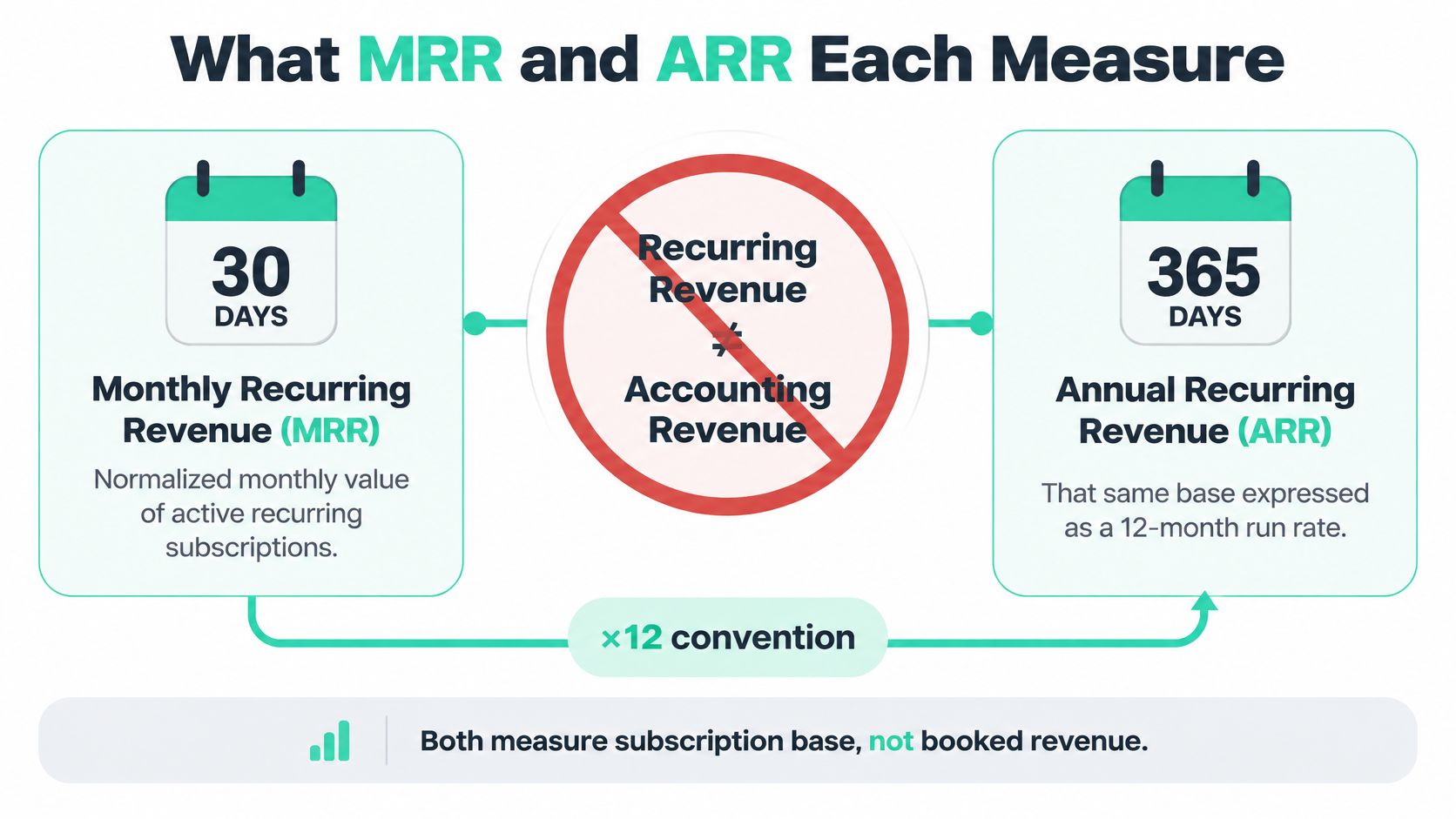
Under the simplest subscription model, ARR = MRR × 12. A business at $10,000 MRR reports $120,000 ARR, and a business at $50,000 MRR reports $600,000 ARR.
Why MRR Carries the Momentum
MRR moves in months, so it shows a trend while the trend is still fixable. A climb from $10,000 to $12,000 MRR is a $2,000 increase, or 20% monthly growth. The matching ARR move from $120,000 to $144,000 describes the same customers at annual scale, and it reads like a much larger story.
Anything with a monthly cost base compares cleanly against MRR: hosting, support, paid acquisition. Teams that buy pipeline on retainer can set Ever Outbound's retainer lead generation against the MRR it produces, month for month, which is a fairer test than weighing a monthly cost against an annualized revenue figure.
Normalization Is the Whole Trick
Every active subscription gets restated to a monthly value, whatever the billing cadence. A $12,000 annual subscription contributes $1,000 to MRR and $12,000 to ARR. A $36,000 three-year contract contributes $1,000 of monthly run rate and $12,000 of annualized run rate, not $36,000 of ARR.
One-time implementation fees, consulting revenue, and taxes stay out of both numbers, because none of them recur under the subscription terms.
Publish the pair. The monthly figure tells a backer whether the business improved this month. Its annual equivalent tells them how large the recurring base is. Both are conversions of the same clean base, and neither one forecasts booked revenue.
MRR and ARR Compared on the Same Criteria
Strip the definitions down and the two metrics differ on four things a founder uses: the horizon, the question answered, the arithmetic, and what each one hides. Everything else, including accounting status, is identical.
| Criterion | MRR | ARR |
|---|---|---|
| Primary question | Did the recurring base change this month? | How large is the recurring base as a yearly run rate? |
| Time horizon | One normalized month | Twelve-month run rate |
| Simple formula | Sum of each active subscription's monthly value | Period-end MRR × 12, or contracted annual recurring value |
| Billing example | A $12,000 annual plan counts as $1,000 | The same plan counts as $12,000 |
| Best for | Momentum, cohorts, expansion, and churn | Scale, cross-product comparison, and annual targets |
| Main blind spot | Understates the annual size of prepaid plans | Can hide a recent month of churn or contraction |
| Accounting status | Not a GAAP revenue line | Not a GAAP revenue line |
What Each Number Is Built to Answer
MRR answers a management question. Did new sales, expansion, contraction, and churn move the base this month? ARR answers a scale question. How big is the recurring base when stated as an annual run rate, for an investor, a product comparison, or an annual target?
The formula row is where confusion usually starts. MRR sums each active subscription at its monthly value. Run-rate ARR multiplies period-end MRR by 12, while contracted ARR counts only recurring commitments, often those with a term of at least 12 months. The same book of business produces a different annual number depending on which one you compute.
Billing frequency is a formatting detail, not a revenue event. A customer paying $1,200 once a year and a customer paying $100 a month both contribute $100 MRR and $1,200 ARR once normalized.
The Blind Spots Run Both Ways
MRR understates the annual size of a prepaid annual plan, which is why an annual-heavy business can look small on a monthly dashboard. ARR can keep looking healthy long after a rough month has damaged the base, because a twelve-month run rate absorbs one bad month more gracefully than the monthly figure does.
For external reference points on retention and growth alongside your own series, the SaaS metrics benchmarks collection is a reasonable cross-check.
Use this table as the lookup for which metric to compute. Any times-twelve number you publish is a claim about the next twelve months, and that claim needs a stated policy behind it before a backer will trust it twice.
When ARR Is Not MRR Times 12
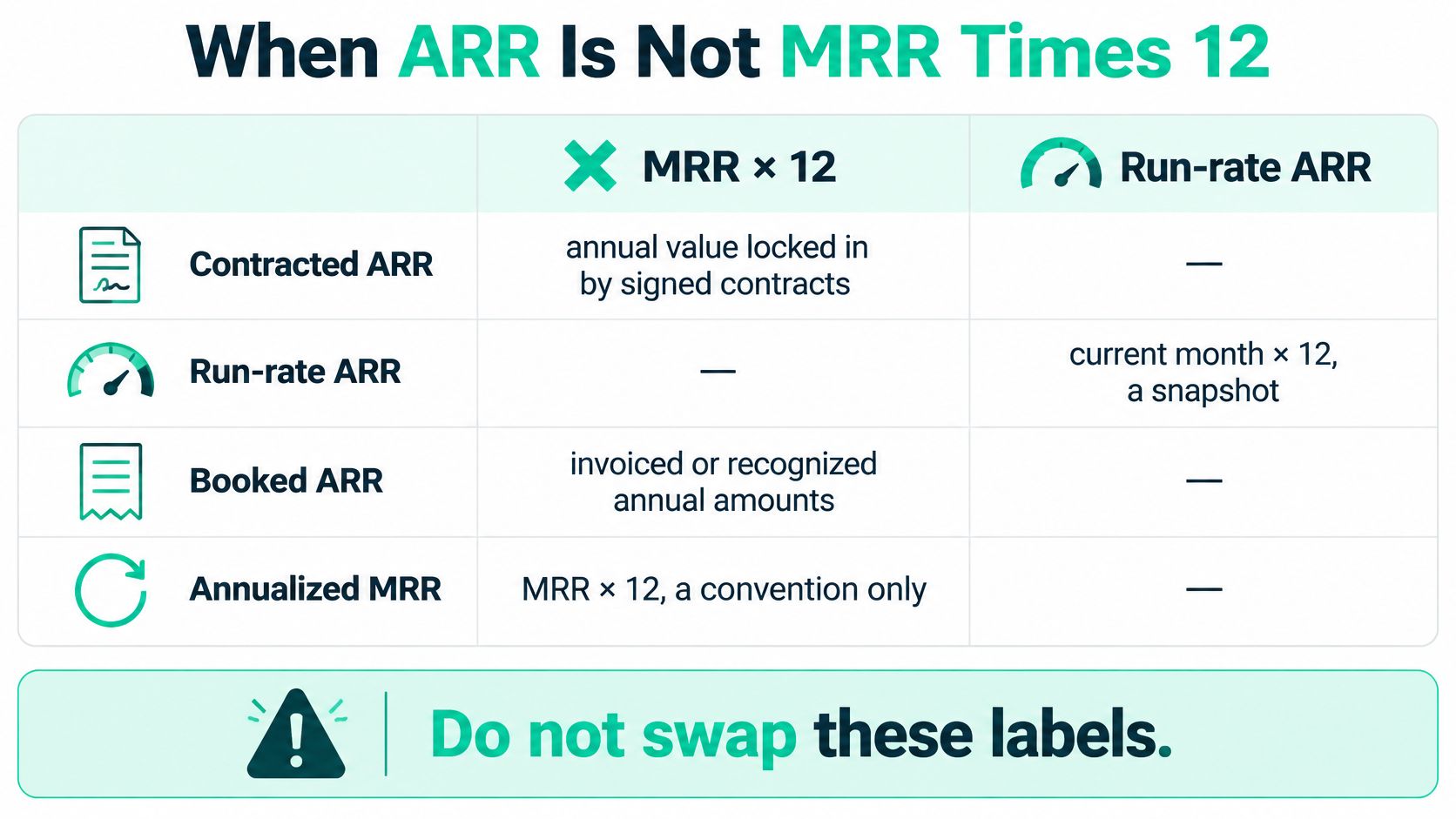
Times twelve is a convention, not an identity. It holds while pricing, customer mix, usage, foreign exchange, and churn all stay still, and it breaks the moment any of them move. The Digital Vantage SaaS metrics note calls the formula useful but not universally reliable without a clearly stated measurement policy. Work the cases with real arithmetic and the gap stops being theoretical.
| Case | What the month shows | MRR | ARR to report | Mistake to avoid |
|---|---|---|---|---|
| Stable subscriptions | $10,000 recurring | $10,000 | $120,000 | None if the base is truly recurring |
| Services mixed in | $20,000 including $8,000 one-time work | $12,000 | $144,000 | Quoting $240,000 ARR |
| Annual prepayment | $12,000 collected up front | $1,000 | $12,000 | Booking the cash month as MRR |
| Three-year contract | $36,000 total contract value | $1,000 | $12,000 | Treating the full term as ARR |
| Annual book, one invoice | $24,000 billed this month | $2,000 | $24,000 | Equating cash collected with MRR |
Four Labels That Are Not Interchangeable
- Run-rate ARR multiplies current MRR by 12, which makes it a snapshot of one month projected forward.
- Contracted ARR counts recurring commitments at their annual value, commonly only contracts of 12 months or longer.
- Recognized revenue is what accounting records for the period, governed by revenue recognition rules and audited.
- Cash received is what reached the bank, annual invoices and prepayments included.
Swap any two of those in the same conversation and you'll end up defending a number you can't reproduce.
Public filers don't settle on one definition either. Axon annualizes monthly recurring license, integration, warranty, and storage revenue to report ARR of $1.3 billion in 2025, up 41% year over year. Equasens annualized December monthly recurring revenue to report ARR of €108.0 million as of December 31, 2025, up 8.8% year over year. Research Solutions took a third route, defining ARR as contracted platform subscription recurring revenue normalized to one year, including monthly B2C subscriptions multiplied by 12.
If a walkthrough of the arithmetic helps, this short explainer covers the same ground visually.
There's no universal benchmark for committed MRR, because companies disagree on what "committed" means. Some count only countersigned contracts. Others include weighted pipeline, which turns a sales forecast into a revenue metric without saying so.
The policy every quoted figure needs: measurement date, source system, contract duration, billing basis, and the treatment of discounts, refunds, usage fees, and foreign exchange.
The practical milestone isn't hitting a particular ARR number. It's having a definition you can apply again next month and get a comparable answer.
Revenue That Must Stay Out of Both
One exclusion list governs both metrics. MRR and ARR are operating metrics for recurring subscription economics rather than GAAP revenue measures, and the ProfitWell subscription metrics reference applies the same exclusions to each.
- One-time setup fees: onboarding charges billed once at signing never recur under the subscription terms.
- Implementation and professional services: configuration, migration, and training work are project revenue even when they're inseparable from the sale.
- Consulting revenue: advisory hours billed alongside a subscription are services, not subscription.
- Taxes: sales tax and VAT are collected on behalf of an authority and were never yours.
- Non-recurring usage charges: overage and one-off consumption that won't repeat next month under the current terms.
The prepayment case shows why the rule matters. A customer who prepays $12,000 for a year spikes cash and the invoice in that month, while the recurring contribution stays $1,000 MRR and $12,000 ARR. Book the prepayment as MRR and you get a false spike followed by a false drop the next month, and anyone tracking the series will conclude the business collapsed when nothing changed.
The Source Rule for a Stripe-Based Build
- Pull active recurring contract terms or normalized subscription items as of the measurement date.
- Normalize each item to a monthly value, regardless of billing frequency.
- Exclude every one-time and non-recurring line before anything is summed.
- Compute ARR from period-end MRR, never from cash collected in the period.
Early SaaS and AI products often mix subscriptions with services, and that services revenue is real. It's also the wrong input for a recurring headline, which is why the two belong on separate lines of a traction update rather than blended into one impressive total.
Pass-fail check: if the dollar wouldn't repeat next month under the current subscription terms, it doesn't enter MRR or ARR, and every published pair states its measurement date plus whether it's contracted recurring value or recognized revenue.
Reading the MRR Bridge Under the ARR
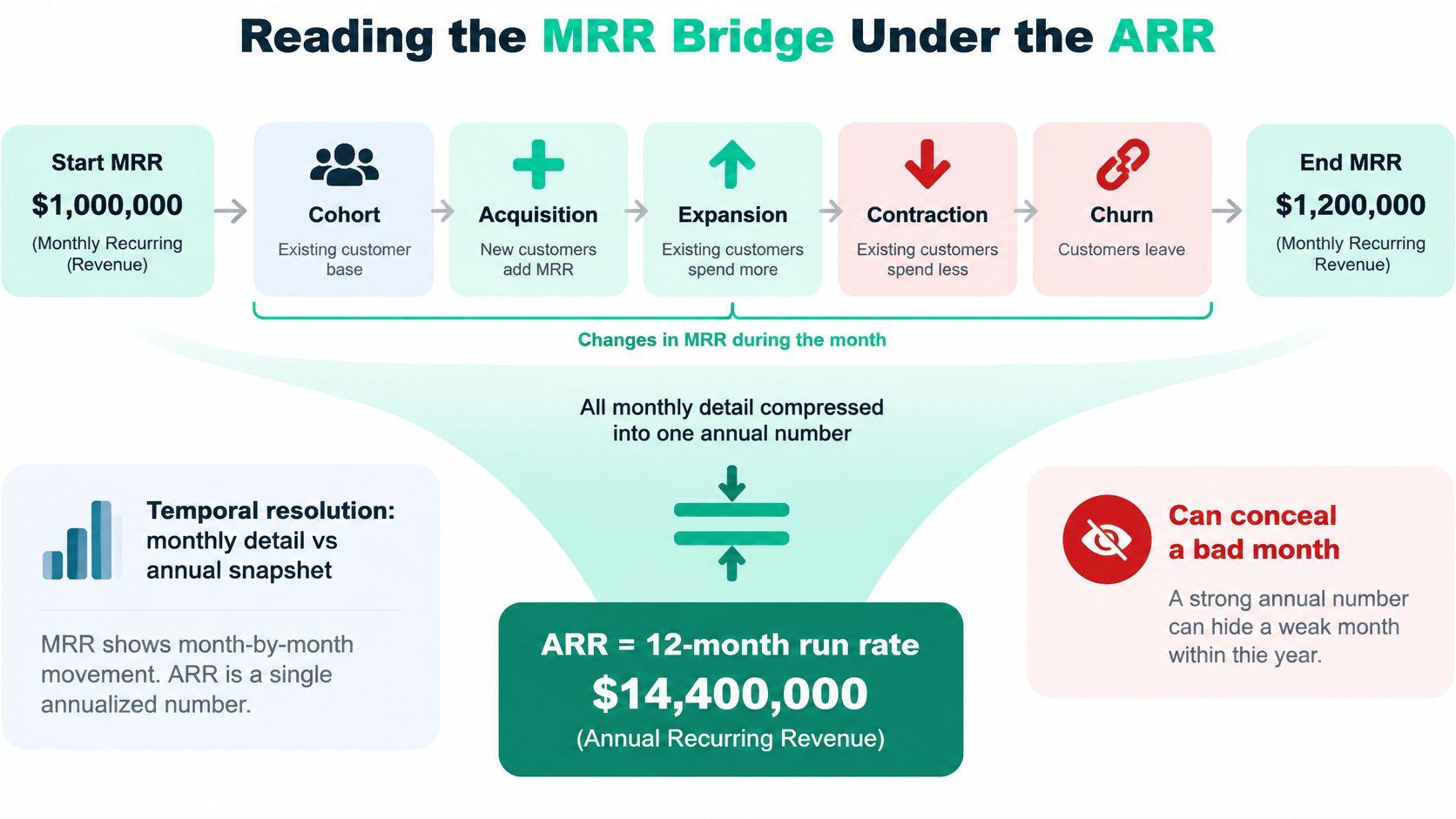
The most useful difference between the two metrics isn't size, it's resolution. MRR lets you split the base into cohorts, new acquisition, expansion, contraction, and churn. ARR compresses all of that into a single twelve-month run rate, and in doing so it can hide a bad month behind a large-looking headline.
The Sequence That Keeps the Numbers Honest
- Fix the measurement date. Take active recurring subscriptions as of that date, not a billing export for the calendar month.
- Normalize each subscription to a monthly value, whatever its cadence or term length.
- Split the change into its parts. Net New MRR equals New MRR plus Expansion MRR minus Contraction MRR minus Churned MRR.
- Compute ARR from period-end MRR, never by summing invoices.
- Report the change rate as ending MRR minus prior MRR, divided by prior MRR.
Why a Rising ARR Can Hide a Shrinking Base
Say a small SaaS closes the month at $40,000 MRR, up $500 from the prior month, which puts ARR at $480,000. The net half-thousand came from $3,000 of new business and $1,500 of expansion, offset by $4,000 of contraction and churn. Nothing in the ARR figure flags that. The bridge does, and at a base that size a handful of cancelled seats moves the percentage visibly.
Summing invoices fails for a simpler reason. An annual renewal that lands this month is cash timing, not a twelvefold jump in demand, and it will look like a collapse twelve months later when the same customer renews on schedule.
What to Publish
Current MRR, current ARR, and the MRR change rate, labeled as contracted recurring value or recognized revenue. Read together, those three tell a backer whether a higher ARR came from new and expansion revenue or from a base that's contracting. The SaaS growth metrics guide covers the retention and expansion signals worth showing alongside recurring revenue.
Which Number to Lead With
Lead with the metric your audience is judging, not the one that makes the base look biggest. That's the decision. Everything below is the lookup.
| Situation | Lead with | Also show | Why |
|---|---|---|---|
| Monthly operating review | MRR | The MRR bridge | Short-term movement is the decision |
| Backer or investor scale check | ARR | MRR and the monthly change rate | Scale without hiding a weak month |
| Mixed annual and monthly plans | Both | Whether ARR is run-rate or contracted | Billing cadence stops distorting the comparison |
| Pilots, promos, or usage pricing | MRR with exclusions | A warning not to headline ARR | A one-month spike may not be durable |
| Pricing or discount test | MRR | How discounts are treated | The monthly base moves immediately |
When Momentum Should Own the Headline
If the audience is judging whether last month got better, MRR leads and the bridge supports it. That covers monthly operating reviews, pilot-heavy products, promotional pricing, and any business where a fast MRR jump might be short-lived.
Pilot-heavy, promotional, and usage-priced products shouldn't headline ARR at all. A single strong month of pilots or volatile consumption annualizes into a number no contract supports, and the correction lands the following quarter.
For a pricing or discount test, watch MRR and state how the discount is treated. The monthly base moves right away, while the annualized figure just carries the same distortion forward twelve times.
When Scale Should Own It
An investor checking scale, or a founder comparing two products with different billing cadences, wants ARR. Show MRR and the monthly change rate next to it anyway. A large annualized figure with no monthly series behind it is exactly how a weak month slips through a board update unnoticed.
Mixed annual and monthly plans need both numbers plus the label. Billing cadence stops distorting the comparison once the page says whether the ARR is annualized MRR or contractually committed ARR.
What the Benchmark Actually Applies To
Scale context helps only when it describes you. Private SaaS companies in the 2024 KeyBanc Capital Markets and Sapphire Ventures survey recorded median ARR growth of 19 to 21 percent, across 104 companies with median ARR of $26 million. That describes businesses already at eight figures of recurring revenue. It isn't a target for a product at $8,000 MRR, and quoting it as one invites a comparison that won't flatter you.
Label before you quote: a recurring revenue figure with no measurement date attached isn't a metric, it's an anecdote with a dollar sign.
The Publish Set
Every traction update should carry four things: current MRR, current ARR, the month-over-month change rate, and a one-line definition with the measurement date. Fundl connects to Stripe for revenue, GitHub for commit activity, and analytics for audience signals, and refreshes the connected data automatically, so the numbers a backer sees stay current instead of aging into screenshots. For a worked structure for presenting that set, the guide to showing traction to investors walks through it.
The next step is administrative. Write the definition down, calculate period-end MRR, annualize only that recurring base, and label the pair before ARR appears in a pitch.
Fundl turns the definitions in this article into a shareable, source-verified traction page: Stripe supplies the revenue figure, GitHub and analytics supply the build and audience signals, and each project gets its own URL that updates as the underlying data changes. You state once whether the recurring figure is run-rate or contracted, and backers check the same number you quoted instead of taking it on trust. Visit Fundl to set up a page and raise on live metrics rather than promises.