
Your prototype works, a few customers are paying, and your savings won't last indefinitely. Hosting bills arrive whether you ship the next feature or not, and every subscription you buy competes with the money you need for groceries. The immediate question isn't whether investors would like your idea. It's which expense will help you reach the next paying customer without putting your finances at risk.
Bootstrapping a startup means making those decisions deliberately. Savings get you started, customers help finance continued work, and your spending choices determine how much time you have to build something people keep buying.
Table of Contents
- What Bootstrapping a Startup Really Means
- Bootstrapping Compared With Outside Funding
- Building Runway From Revenue
- Growing Through Pricing and Reinvested Revenue
- Setting Your Founder Salary as a Strategy
- Combining Non-Equity Funding Without Losing Control
- Early Warning Signs and How to Respond
- Decide Whether to Bootstrap Your Next Launch
What Bootstrapping a Startup Really Means
Say you have a working prototype, a handful of subscribers, and enough personal savings to cover six months of living expenses. You still need to pay for hosting, development tools, and a feature customers keep requesting. You could fund everything yourself, wait for customer payments, or reduce the feature's scope so you can ship it sooner.
That's bootstrapping in practice: financing development and growth through customer revenue, personal capital, and founder labor rather than selling equity to investors. Think of building a house room by room as cash arrives, instead of financing the entire blueprint before you've tested the foundation.
A useful starting point is to make every financial commitment visible.
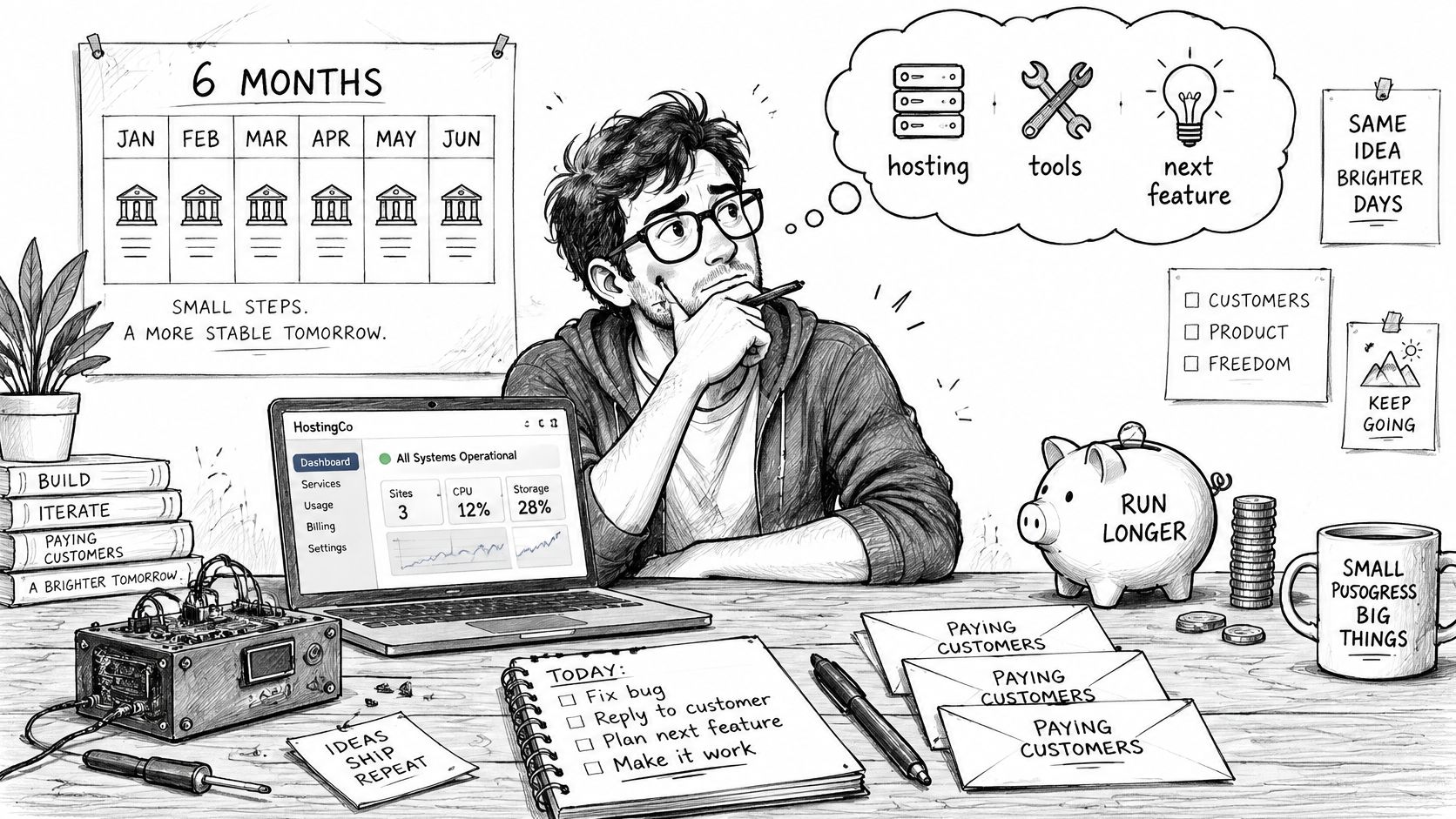
The cash inputs founders actually manage
Bootstrapping doesn't mean refusing all financing. Founders can use cards, personal credit, or small loans without selling ownership, although they still have to carry the repayment risk.
Your operating model has three connected inputs:
- Customer cash: Payments you can collect and use, not merely contracts signed or invoices issued.
- Business spending: Hosting, software, contractors, support, and other commitments.
- Founder time: Development, selling, and administration you perform without an immediate cash payment.
Unpaid work isn't free capacity. If you spend your afternoon answering support requests, you can't spend that same afternoon selling. For a founder serving trades businesses, Expressify AI's resource on speed to lead for home services offers a concrete workflow to examine: handling inquiries before buying more traffic.
Why evidence matters early
Young firms can't assume conventional credit will bridge every gap. The Federal Reserve's 2024 Report on Startup Firms found that startup employer firms, defined as operating for 0–2 years, were fully approved for financing at a 43% rate, compared with 54% for older employer firms.
Customer payments, retained usage, and consistent product delivery give potential supporters something concrete to evaluate. Bootstrapping is a sequence of funding decisions, not a permanent promise never to accept outside money.
Bootstrapping Compared With Outside Funding
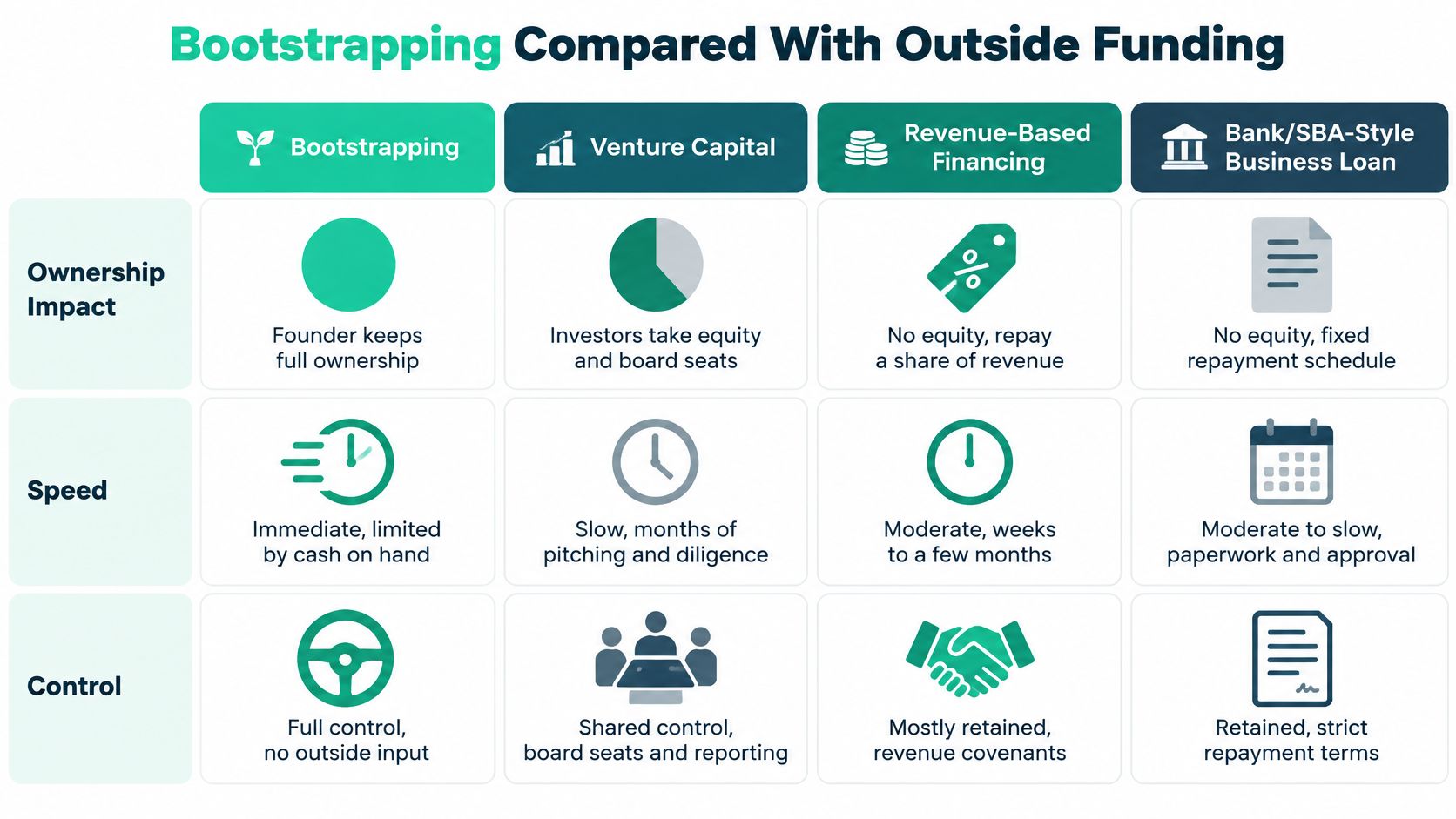
| Funding path | Ownership impact | Speed of capital | Founder control | Repayment obligation | Best fit |
|---|---|---|---|---|---|
| Bootstrapping with revenue and savings | Founder keeps existing ownership | Set by cash flow and available savings | Full, limited by cash | None to investors; cards create personal debt risk | Products with early paying customers |
| Venture capital | Dilution with each equity round | Fundraising takes time; capital can accelerate spending once secured | Shared through investor rights and board arrangements | No scheduled loan repayment; investors seek a large exit | Businesses pursuing rapid, large-scale expansion |
| Revenue-based financing | Founder keeps equity | Approval and amount tied to revenue | Retained, subject to financing terms | A share of revenue, subject to contract requirements | Predictable subscription income |
| Business loan | Founder keeps equity | Subject to lender underwriting and approval | Retained, subject to loan terms | Scheduled repayment, potentially with a personal guarantee | Stable margins and a specific use of funds |
Read each row as a trade-off, not a ranking. The relevant question is what the business can carry if growth disappoints.
Ownership isn't the only cost
Bootstrapping lets you choose your direction without negotiating with equity investors. But if you can't afford customer support or a necessary integration, keeping ownership can come with delayed sales and slower delivery. Available cash limits execution.
Venture capital can finance work before customer revenue covers it. In exchange, founders accept dilution and negotiate governance rights, reporting obligations, and expectations about future growth. A profitable specialist product can be attractive to its founder without matching an investor's desired outcome.
If you're considering an equity raise, Coto & Waddington, Attorneys at Law's guide to finding investors for Miami startups provides a location-specific starting point for investigating that route. Treat investor fit and deal terms as separate questions from whether you need cash.
The comparison below summarizes the financing paths.
Repayment changes the decision
Revenue-based financing connects payments to sales, but the contract still matters. Minimum payments, fees, repayment caps, and collection arrangements can make an apparently flexible advance less forgiving than its name suggests.
A business loan offers a defined repayment schedule. That can make planning easier, but customer cancellations don't cancel the payment, and a personal guarantee can expose assets outside the business.
Self-funding is hardly unusual. The U.S. Small Business Administration's 2024 finance summary reported that 80% of employer businesses and 76% of nonemployer businesses used personal savings for startup capital. Nonemployer businesses have no paid employees, making that distinction particularly relevant to solo operators.
Practical rule: Prefer commitments you can reduce, repay, or exit under a disappointing revenue forecast. Equity dilution generally isn't reversible, and debt doesn't disappear when demand slows.
Building Runway From Revenue
Runway = available business cash ÷ monthly net cash burn.
Net cash burn is cash paid out minus cash collected during the same period. Use actual collections rather than accounting revenue when payment timing differs, and exclude money already needed for taxes or other committed obligations from available cash.
For a hypothetical business with $60,000 available cash, monthly payments of $18,000, and customer collections of $8,000, net burn is $10,000. The calculation is $60,000 ÷ $10,000, giving six months of runway, assuming nothing changes.
Runway at different monthly net burn rates
These are alternative scenarios for that same hypothetical cash balance, not recommended spending targets.
| Monthly net burn | Runway in months | Decision signal |
|---|---|---|
| $5,000 | 12 | Room to test a paid acquisition channel with a capped budget |
| $8,000 | 7.5 | Keep commitments reversible while testing payback |
| $10,000 | 6 | Pause experiments that have no revenue target |
| $15,000 | 4 | Cut costs or evaluate price changes before the next billing cycle |
A runway calculation is a forecast, not permission to spend. Annual software renewals, refunds, delayed collections, and contractor deposits can cause cash to leave sooner than a monthly average suggests.
Monthly recurring revenue, or MRR, isn't the same as spendable cash. Separate recurring subscriptions from setup work and other one-off receipts. Our explanation of what recurring revenue means helps clarify which income you can reasonably build a continuing plan around.
Check what growth leaves behind
New customers extend runway only when their payments exceed the additional costs of serving and acquiring them within a useful period. Subtract hosting, processing, variable support, and acquisition spending before deciding what you can reinvest.
An Adlega benchmark compilation citing SaaS Capital's survey of more than 1,000 private B2B SaaS companies reports 20% median annual growth for bootstrapped firms, with 83% profitable or within two percentage points of breakeven. Those are benchmarks, not targets for a newly launched app.
Delegation belongs in the same calculation. Before buying administrative help, identify the work you'll hand over and the revenue-producing work you'll do instead; Approved Lux Personal Assistant's explanation of how Approved Lux supports busy founders is a resource for evaluating that option.
A growth expense is affordable when its expected cash payback fits inside your runway, not merely when the bank balance covers today's invoice.
If the business generates cash rather than burns it, don't divide by a negative burn figure. Monitor cash reserves and stress-test a weaker collection month instead.
Growing Through Pricing and Reinvested Revenue
Start with a narrow customer group whose problem you can describe without listing your product's features. Keep onboarding and support manual while you learn which requests recur, which customers activate, and what they're willing to buy. Automating an unclear process only makes it harder to change.
Test the offer before buying volume
Use pricing model validation to test the relationship between price, customer value, and willingness to pay. Don't confuse a higher price on your website with higher receipts across your existing subscriber base.
For example, suppose a hypothetical product earns $8,000 MRR. Repricing that entire revenue base 10% higher would add $800 monthly if every customer accepted and nothing else changed. Raising prices only for new signups would affect only their subscriptions, so it wouldn't immediately create that increase.
Put contribution cash to work deliberately
Suppose that same hypothetical product has an 80% gross margin. Its monthly gross profit would be $8,000 × 80% = $6,400, before operating expenses and any acquisition costs excluded from cost of revenue.
That isn't a free spending allowance. A $4,000 monthly campaign that returns less than $4,000 in incremental contribution cash during your decision window consumes reserves, even if total MRR rises.
Use a spending order that protects delivery:
- Protect a reserve first. Set aside contribution cash needed to maintain your minimum runway.
- Fund demonstrated acquisition. Expand the channel whose customers retain and repay acquisition costs.
- Remove the next constraint. Hire when capacity blocks profitable demand; build features when evidence supports their value.
Don't automatically hire before fixing a retention problem, or build features before improving onboarding. Compare each proposed commitment with the cash it leaves available under your weaker-sales forecast. Reinvestment should follow the constraint, not a fixed enthusiasm for growth.
Setting Your Founder Salary as a Strategy
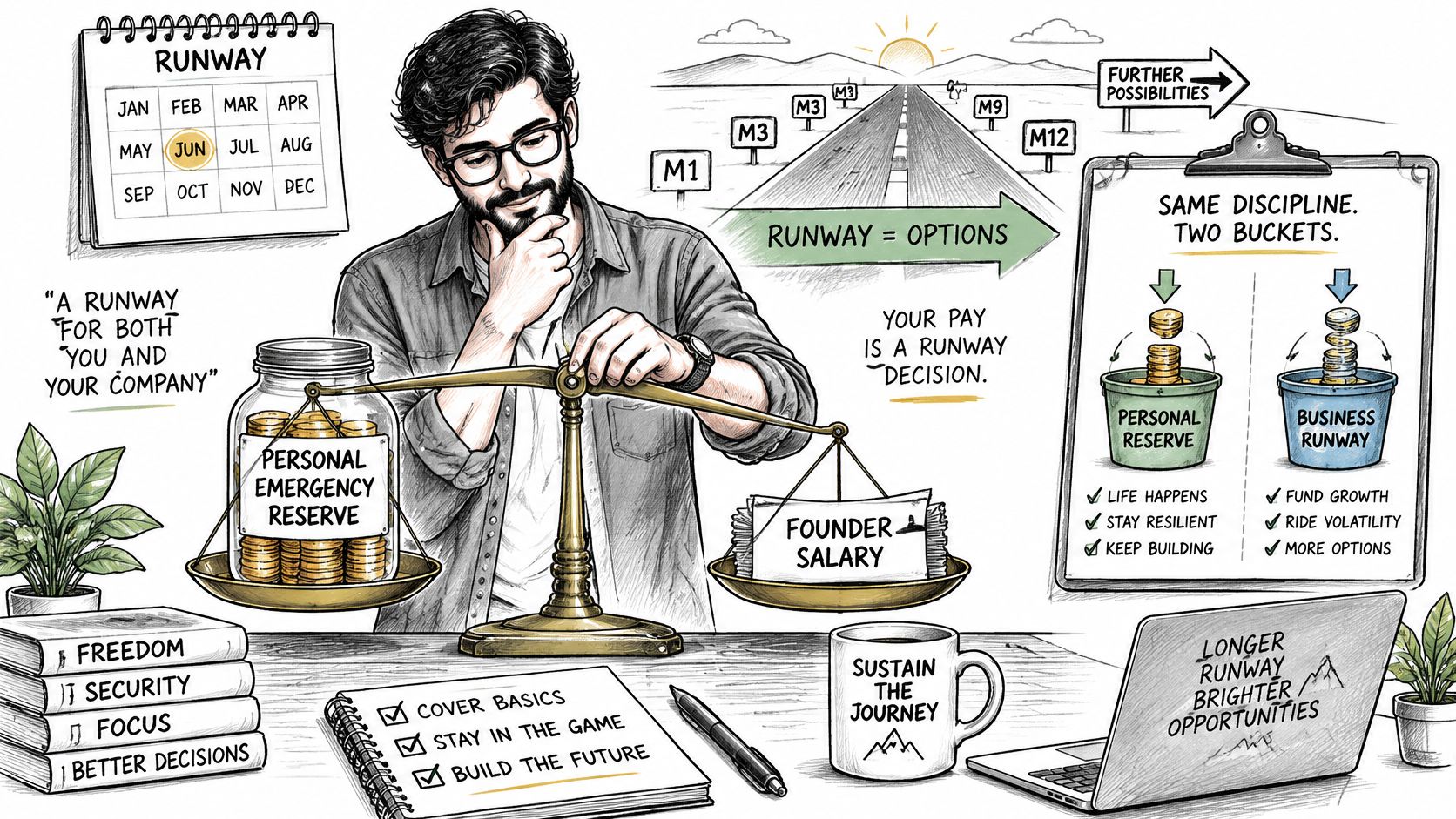
Keep personal emergency reserves separate from business runway. Your emergency fund protects your household when something goes wrong; company cash pays company obligations. Counting the same savings in both buckets gives you a false sense of safety.
The balance is easier to see when you treat founder pay as an explicit operating expense.
Set a salary floor the business can carry
- Calculate your personal monthly floor. Include housing, food, insurance, debt payments, taxes, and dependents, so the salary reflects necessary spending rather than an aspirational lifestyle.
- Use your actual location costs. Adjust the budget for where you live instead of copying another founder's salary.
- Test the company's total cash cost. Add applicable payroll costs and check whether compensation keeps projected burn within your chosen runway target.
If the business can't support that floor, name the shortfall. You may need consulting income, a narrower product scope, lower overhead, or a delayed full-time transition. Covering the difference with personal debt doesn't make the business sustainable.
In Pilot's 2025 survey of 1,844 companies, 67% of bootstrapped founders paid themselves between $1 and $100,000, while 10% of founders earning $100,000–$200,000 were bootstrapped. Those figures describe different groups: the latter isn't the proportion of bootstrapped founders earning that amount. They show an association between funding model and pay, not proof that low salaries cause successful bootstrapping.
Recognize the cost of underpayment
Watch for a founder who can't concentrate because household bills are overdue, postpones medical care, or answers support messages late into the night because there's no capacity left during the day. These aren't signs that the salary strategy is working. They're reasons to revise it.
Use the following video as a pause before reviewing your own compensation assumptions.
Compare discretionary growth spending with founder pay. Reinvesting everything becomes hard to justify when acquisition payback is unclear, churn remains unresolved, and underpayment threatens your ability to operate the company.
Pay yourself enough to keep the operating plan credible. Increase compensation when retained customer contribution can support it, rather than treating either deprivation or a market-rate salary as a universal rule.
Combining Non-Equity Funding Without Losing Control
Founders can combine retained revenue, limited personal capital, grants, loans, and reward-based support. The challenge is to choose obligations the business can meet, not to preserve a label.
A 2025 Mercury survey of 1,500 U.S. early-stage founders and executives, reported by 01net, found self-funding was the most common capital source at 61%, while 41% reported revenue-based financing. Funding categories weren't mutually exclusive, which makes a simple bootstrap-or-raise choice less useful.
Apply five checks before accepting money
- Revenue predictability: Do customers renew, and when do payments arrive?
- Gross margin: What remains after delivery costs?
- Repayment capacity: Can you meet obligations after essential operating expenses?
- Dilution: Are you transferring ownership or future economic rights?
- Reversibility: Can you repay early, reduce the commitment, or exit without a damaging penalty?
Our guide to non-dilutive funding for startups provides context for comparing options that don't require selling equity. Non-dilutive still doesn't mean cost-free: repayment, restrictions, application work, or reward delivery can consume resources.
Stress-test a revenue dip
Consider a hypothetical SaaS earning $8,000 MRR at an 80% gross margin. It has $6,400 monthly gross profit before operating expenses. Compare an advance repaid through a contractual share of collections with a personal loan carrying an unchanged monthly payment.
If sales fall for a couple of billing cycles, a genuine revenue-share payment falls with collections. That favors short-term repayment flexibility, provided the contract has no minimum that overrides the adjustment. But lower receipts also leave less cash after delivery costs, so flexibility alone doesn't prove affordability.
The personal loan's payment stays fixed. That can offer predictability when revenue is stable, but it transfers the sales risk to the borrower and may put household finances under pressure. Neither option wins the gross-margin check automatically, and neither necessarily allows an inexpensive early exit.
Waiting also has a cost. You might delay a support hire until customers leave, miss demand you could have served, or exhaust yourself handling work that someone else could do.
Add capital to expand a process customers already pay for. Don't borrow simply to postpone finding out why they won't buy.
Approve financing against a written use of funds, a weaker-sales forecast, and a delivery milestone you can verify.
Early Warning Signs and How to Respond
Suppose a founder spends $3,000 monthly on paid ads for three months, while MRR stays near $4,000 and the support inbox grows. In this hypothetical case, advertising has consumed $9,000 without increasing the recurring revenue base. That doesn't prove every acquired customer was unprofitable, but it demands a pause and a cohort-level review.
Early warning signs in a bootstrapped startup
| Symptom | Likely cause | Response |
|---|---|---|
| Revenue flat for three months while ad spend rises | Acquisition channel isn't converting into retained revenue | Pause paid spend and test a channel against a defined conversion goal |
| Founder working long hours as support queue grows | Insufficient support capacity | Automate repeat answers, then hire part-time once contribution margin supports the cost |
| Runway below a chosen three-month emergency threshold | Cash consumption is too high for available reserves | Cut costs, evaluate pricing, or assess affordable non-equity funding |
| Churn higher than new customer growth | Possible product-fit or customer-fit gap | Run a cohort experiment with a written hypothesis, primary metric, and decision threshold |
The time periods in this diagnostic table are working review triggers, not universal financial standards.
Respond in order of urgency
Check cash first. If your forecast crosses your emergency threshold, stop optional commitments before starting a lengthy experiment. A price change may help future collections, but it doesn't guarantee cash before the next bill falls due.
For the advertising example, pause the $3,000 monthly commitment and inspect customer-level acquisition, activation, and cancellation records. Move a smaller, capped test budget to a defined channel only after specifying the conversion event and stopping rule. Review the result after the next billing cycle rather than restarting the old campaign because traffic fell.
For the support queue, group requests by cause. Write reusable answers for repeated questions, repair confusing onboarding, and price part-time help against the contribution available to pay for it.
If customer losses exceed additions, talk to departing users and test a specific explanation. Stanford's examination of the Lean Startup method found that customer discovery helps teams converge on business ideas, while emphasizing that experimentation doesn't automatically produce learning.
Write down what result would make you keep, change, or stop the work. Fast feedback protects cash only when you act on it.
Decide Whether to Bootstrap Your Next Launch
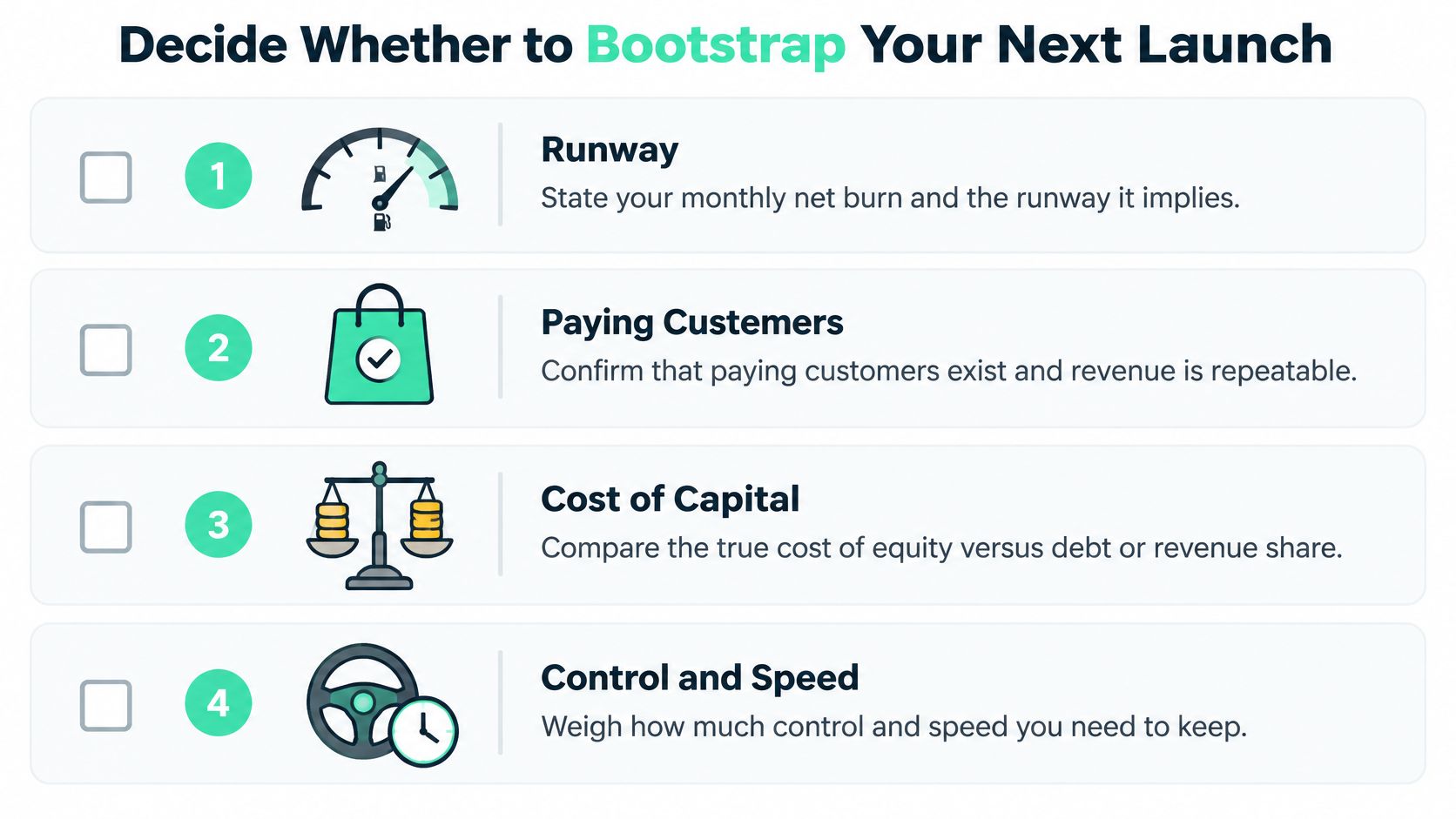
Bootstrapping a startup is a reasonable choice when the operating plan fits your resources, not just when you dislike pitching investors. Write down the conditions under which you'll continue, change direction, or seek additional capital.
Use these decision inputs before committing more money:
- Runway: State current monthly net cash burn and the time your available business cash supports.
- Paying customers: Confirm that customers buy and continue using the product before expanding the roadmap.
- Founder salary: Include the compensation you need, rather than relying on an unstated personal subsidy.
- Reversibility: Identify what happens to every contract and financing obligation if receipts decline.
Use this checklist to make the trade-offs visible.
Publish evidence before asking for support. At Fundl, creating a verified traction page is free and requires no backers. Project setup takes about 5 minutes, covering your funding goal, campaign timeline, and core details; every project displays live, source-verified data from connected platforms before backers contribute.
Our optional campaigns are reward-based, with no equity or financial returns. Connect your revenue data, set a measurable goal, and review your runway again after 30 days.
Fundl lets you show live, source-verified traction and seek reward-based support without selling equity. Create your traction page, connect the numbers behind your progress, and give potential backers a clear goal tied to what your business can afford to deliver.