
“Raise a seed round so you can build faster” is bad default advice. It assumes your company needs institutional money, that investors want the business you're building, and that faster expansion is worth giving up ownership. For a solo SaaS founder or a small software team, those assumptions deserve scrutiny.
Venture capital is not the only way to fund a company. You can fund development through customers, community support, grants, debt, or individual investors. Each route asks for different proof, and each creates different obligations.
Don't replace the fundraising question with “Which option avoids dilution?” Keeping your shares won't help much if loan repayments drain your operating account or prepaid customers expect more support than you can deliver.
Choose funding by the evidence you can show today and the obligation you can safely carry tomorrow.
The most useful alternatives to venture capital aren't interchangeable. A working prototype can support a pre-sale. Predictable subscription revenue can support financing. A popular repository can support sponsorship, but only if its users see a reason to contribute.
Start with the next deliverable, not the largest possible raise.
Table of Contents
- 1. Bootstrapping (Self-Funding)
- 2. Reward-Based Crowdfunding
- 3. Revenue-Based Financing
- 4. Customer Pre-Sales and Early Access
- 5. Open-Source Sponsorships and Donations
- 6. Grants for Software and Open-Source Projects
- 7. Small Business and Bank Loans (Including SBA Loans)
- 8. Angel Investing
- 9. Equity Crowdfunding
- How the nine alternatives compare on ownership, repayment, and best fit
- Matching Your Funding Path to Your Stage
1. Bootstrapping (Self-Funding)
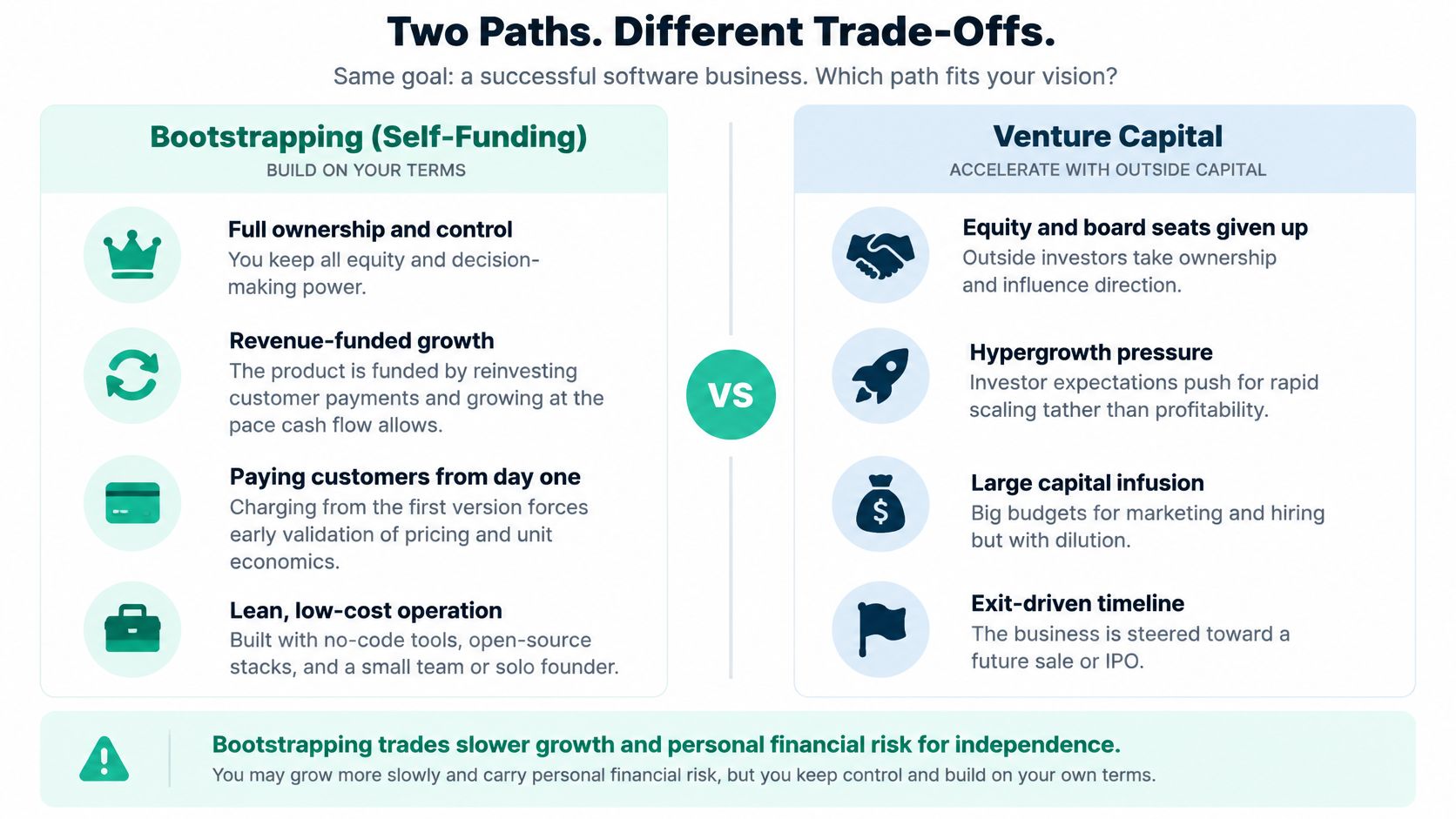
Bootstrapping means paying for the business with personal savings, operating revenue, or early customer payments. You keep ownership and decide what to build, whom to serve, and how quickly to expand.
Proof required: You don't need an investor's approval. You do need evidence that customers will pay before your available cash runs out.
Ownership and cash-flow cost: There's no outside equity dilution, but you absorb the losses yourself. Unpaid founder labor is a real cost, even when it doesn't appear in your accounting software.
Charge Before You Expand
Say you're building an appointment tool for independent tutors. Sell the scheduling workflow before adding invoicing, lesson planning, and a marketplace. A narrow product gives you a clearer test of willingness to pay.
Connect Stripe revenue to a cash-flow spreadsheet or accounting tool such as Xero. Track monthly recurring revenue, churn, available cash, and founder pay together. Revenue growth can hide a business that still can't support its owner.
- Protect personal runway: Set a firm limit on savings you'll contribute. Keep household emergency money separate.
- Use annual payments carefully: Prepayment improves cash availability, but you still owe customers ongoing service.
- Delay infrastructure upgrades: Buy capacity when usage requires it, not because a larger architecture looks more credible.
Bootstrapping works best when you can reach paying customers with a small, deliverable product. It's less suitable when substantial development or regulatory work must happen before anyone can buy.
2. Reward-Based Crowdfunding
A reward campaign turns a product promise into a public funding offer. Backers contribute for access, a finished product, or another non-monetary reward. They don't receive company shares.
Proof required: Show a credible demonstration, an identifiable audience, and a believable delivery plan. An email list helps only if subscribers are willing to back the offer.
Ownership and cash-flow cost: You avoid dilution, but you take on fulfillment obligations. Payment fees, support, production, and delivery reduce the amount available for development.
A systematic review published in 2025 synthesized 122 academic articles on reward-based crowdfunding, reinforcing the importance of campaign design and credibility signals. Treat those signals as operating evidence: show what works now and explain what still needs funding.
Sell a Deliverable Reward
For an education product, offer a defined workshop, course, or cohort rather than unlimited access to everything you might create. For software, specify the access period, supported features, and release status.
Keep reward tiers simple. Calculate delivery costs before setting the campaign goal, and include room for refunds and delays.
Practical rule: A campaign isn't profitable just because contributions exceed the funding goal. Subtract everything you've promised to deliver.
Our guide to reward-based crowdfunding explains the model in more detail. Kickstarter and Indiegogo are useful platforms to evaluate, but compare their collection rules and campaign requirements before choosing.
For a video introduction to the approach:
3. Revenue-Based Financing
Say your SaaS has retained customers and a paid acquisition channel that reliably brings in profitable subscriptions. You need cash to run that channel while subscription payments arrive gradually. Revenue-based financing may fit that timing gap.
Proof required: Expect to show verifiable revenue, retention, margins, and payment history. A forecast alone won't demonstrate repayment capacity.
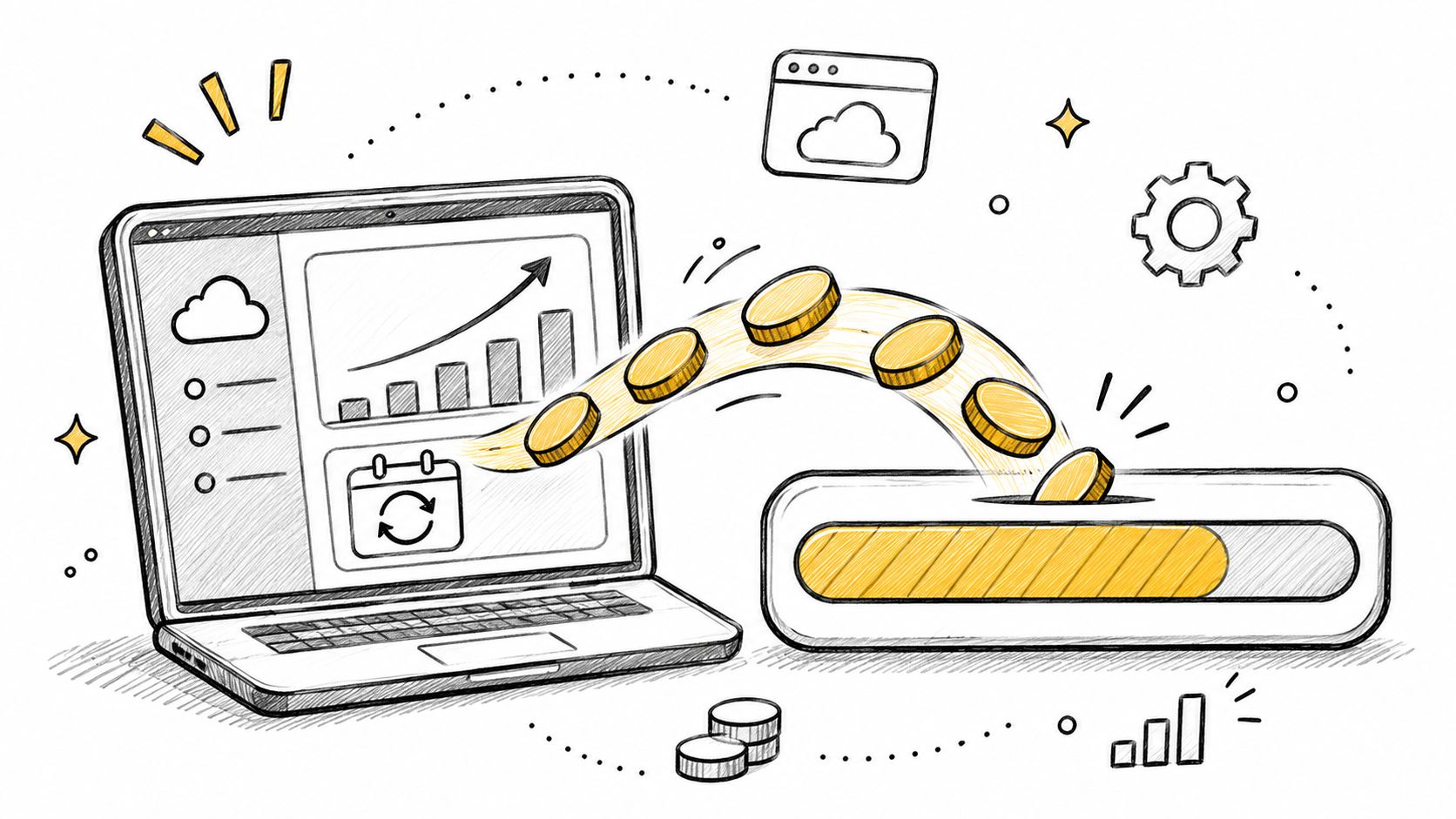
Ownership and cash-flow cost: You generally repay from revenue rather than issuing shares. That preserves ownership, but repayments reduce the cash available for hiring, infrastructure, and acquisition.
Underwrite the Repayment Yourself
A May 2025 survey covered by The Daily News surveyed 1,500 U.S. entrepreneurs running companies younger than six years and ranked venture capital behind self-funding, business loans, revenue-based financing, and friends-and-family capital. Availability, however, doesn't make a financing offer suitable for your business.
Lighter Capital is a provider to investigate. If you receive an offer through Stripe Capital or another sales-linked provider, read the actual agreement rather than assuming every product has the same repayment structure.
- Compare total repayment: Record the advance, fees, repayment cap, and expected payment timing.
- Stress-test weaker sales: Include churn, refunds, slower collections, and reduced acquisition efficiency.
- Inspect restrictions: Look for minimum payments, guarantees, liens, reporting duties, and limits on additional borrowing.
Use the money for a repeatable activity with measurable payback. Don't borrow against existing subscriptions to fund an unrelated product whose demand remains untested.
4. Customer Pre-Sales and Early Access
A customer payment is stronger evidence than a waitlist signup. Pre-sales let buyers fund a product before it's complete, usually through your own website, storefront, or direct sales process.
Proof required: Demonstrate a specific problem, a usable preview, and enough trust that customers will pay before full delivery. A clickable mockup may start a conversation, but it shouldn't be presented as finished software.
Ownership and cash-flow cost: There's no equity dilution. The cost comes through discounted pricing, refunds, support, and the work you still owe buyers.

Sell the Scope, Not the Roadmap
Say you're building a reporting app for Shopify merchants. Offer a paid founding-customer plan for a defined reporting workflow. Publish what customers can use immediately, what you're still building, and how cancellations work.
Steam Early Access and AppSumo are relevant channels to evaluate for games and software respectively. Selling directly through Stripe Checkout gives you another route, with direct responsibility for acquisition and customer communication.
- Separate promises from possibilities: Label committed features distinctly from ideas under consideration.
- Limit delivery exposure: Cap enrollment if onboarding or support requires substantial founder time.
- Avoid careless lifetime deals: A single payment can create ongoing hosting and support costs.
Pre-sales work when customers can evaluate a concrete benefit. They fail when founders sell broad future access to cover an undefined development budget.
Keep some proceeds available for delivery and refunds. Cash collected before launch isn't automatically cash you can spend freely.
5. Open-Source Sponsorships and Donations
A widely used repository doesn't automatically produce maintainer income. Users may value your work while assuming someone else pays for maintenance.
Sponsorship works when you make that maintenance visible and give individuals or companies a practical reason to support it. GitHub Sponsors, Open Collective, and Patreon are platforms to evaluate for collecting recurring support.
Proof required: Show adoption, release activity, useful documentation, and responsive maintenance. Commercial dependence can be more persuasive than a large star count.
Ownership and cash-flow cost: Sponsorship generally avoids dilution and loan repayments. The trade-off is uncertain income, sponsor concentration, and the time required to maintain relationships.
Ask the Organizations That Depend on You
Say your library handles authentication in commercial applications. Build a funding page that explains what sponsorship pays for: security review, compatibility updates, documentation, or release management.
Ask dependent companies directly. Give an engineering manager a clear explanation they can use to justify the expense internally.
- Show funded work: Publish a brief maintenance report with releases, resolved issues, and upcoming priorities.
- Keep perks bounded: Recognition and roadmap calls are easier to sustain than unlimited priority support.
- Separate sponsorship from services: If a company expects guaranteed response times, create a support contract.
Our guide to open-source project funding explores ways to structure community support.
Repository activity proves that you're maintaining software. It doesn't prove that sponsors will keep paying.
Use sponsorship as part of a funding mix until contributions are dependable. Don't hire against pledges that sponsors can withdraw before you've built a cash reserve.
6. Grants for Software and Open-Source Projects
A grant is not a softer customer contract. You get it by matching a published call, not by showing revenue or a star count.
Security improvements, technical research, accessibility, and shared infrastructure often fit that pattern. People rely on the result, but few will pay for it before it exists.
Proof required: Show eligibility, technical capability, and a direct fit with one funding call. The application has to name the work, who benefits, and how a reviewer will confirm you finished.
Ownership and cash-flow cost: You keep the equity, and you do not take on a loan payment. The bid itself is unpaid work. Spending is restricted, reporting is required, and reimbursement can land long after costs hit. Ownership stays intact. Cash flow does not.
Match the Project to the Program
Programs worth a close look include SBIR and STTR for eligible U.S. technology businesses, Sovereign Tech funding for digital infrastructure, and current Mozilla calls. Confirm the program is open and that this round covers your work before you draft anything.
Say your team maintains an encryption library. A proposal for one security audit and a remediation release is easier to budget and score than a general request to grow the project.
Build the application around three items:
- Deliverables: Name the code, documentation, testing, or research you will produce.
- Evidence: Explain how reviewers can verify that the work is complete.
- Budget: Connect personnel and supplier costs to those tasks.
Nonprofit discussions of typical grant amounts and award timing do not set the figures for SBIR, STTR, or open-source infrastructure calls. The live program documents govern eligibility, budget limits, and award timing for your application.
Do not count a submitted bid as runway. Keep a separate operating plan for a delayed decision, a rejection, and expenses the grant will not cover.
7. Small Business and Bank Loans (Including SBA Loans)
Debt fits a business that can repay from operations. It's a poor substitute for discovering whether customers want the product.
Bank term loans, business lines of credit, and U.S. SBA-backed lending offer different structures. A term loan can support a defined investment, while a credit line can help bridge the gap between paying expenses and collecting invoices.
Proof required: Prepare financial statements, bank records, tax documents, existing debt details, and a credible cash-flow forecast. New businesses may need to rely more heavily on projections and the founder's financial position.
Ownership and cash-flow cost: You keep equity, but interest and principal payments remain obligations. Collateral and personal guarantees can extend the downside beyond the business.
Borrow Against Repayment Capacity
An August 2025 survey summarized by EIX found that 57% of surveyed U.S. small-business owners said obtaining financing was challenging. Prepare your application before a cash emergency leaves you with little negotiating room.
Say your software consultancy collects enterprise invoices after completing the work. A credit line may cover payroll during that collection gap, provided customers reliably pay and your margins cover borrowing costs.
- Compare structures: Review bank, credit union, SBA-backed, and intermediary options where available.
- Read personal obligations: Understand guarantees, pledged assets, default provisions, and early repayment terms.
- Test delayed collections: Model what happens if a major customer pays late or disputes an invoice.
Borrowing to fulfill signed, profitable work is different from borrowing to keep an unvalidated app alive. Don't use the same repayment assumptions for both.
8. Angel Investing
Angel money is still outside equity capital. The difference is that an individual investor commits personal funds rather than investing through a conventional venture fund.
That can create room for a different company trajectory, but it doesn't guarantee patient terms. Some angels expect the same rapid growth and eventual exit as institutional investors.
Proof required: Show founder-market fit, a convincing product, customer evidence, and a credible growth opportunity. The importance of revenue versus prototype quality depends on the investor and the business.
Ownership and cash-flow cost: You give up equity now or accept potential future dilution through a convertible instrument. You also take on investor communication and possible governance obligations.
Choose the Investor's Expectations Carefully
Say you've built a developer tool with paying teams but need specialist engineering work before serving larger customers. An angel with relevant technical and commercial experience may offer useful introductions alongside capital.
Target individuals who understand your category. Use AngelList and founder networks for discovery, but investigate each investor's expectations directly.
- Define the milestone: Tie the raise to a release, customer segment, or commercial capability.
- Model dilution: Understand valuation caps, discounts, conversion mechanics, and follow-on rights.
- Discuss outcomes: Ask whether a profitable, modest-growth company would satisfy the investor.
A SAFE can simplify documentation, but it isn't free money or automatically founder-friendly. Have counsel review the terms and model how multiple instruments interact.
The distinction between crowdfunding and angel investing matters most when deciding what supporters receive. Rewards create delivery obligations; equity creates an ongoing financial relationship.
9. Equity Crowdfunding
Equity crowdfunding lets eligible businesses raise through regulated securities offerings. Unlike reward-based crowdfunding, backers receive shares or another financial instrument rather than only a product or perk.
Proof required: Prepare financial information, risk disclosures, a clear use of proceeds, and a persuasive business case. An existing customer community helps distribution, but enthusiasm doesn't replace compliance.
Ownership and cash-flow cost: Depending on the instrument, you accept dilution or other securities obligations. Legal preparation, platform costs, accounting, and ongoing reporting also require cash and attention.
Plan for More Than Campaign Launch
The SEC's Regulation Crowdfunding statistics recorded 8,492 offerings by December 31, 2024, with issuers collectively reporting approximately $1.34 billion in proceeds. Those figures establish a real financing channel, not a guarantee that an individual campaign will raise successfully.
Say your consumer app has paying users who actively recommend it. A securities campaign might let eligible supporters participate financially, provided you can explain the business risks and manage the resulting obligations.
Republic and Wefunder are platforms to evaluate for U.S. offerings. Engage securities counsel before promoting investment terms or accepting commitments.
- Confirm eligibility: Check issuer requirements, applicable limits, intermediary rules, and jurisdiction.
- Budget the process: Include preparation and post-offering administration, not just campaign marketing.
- Prepare investor communication: Establish who owns updates, disclosures, and questions after closing.
Don't confuse a large audience with investment demand. Customers may love your product without wanting an illiquid security, and investors need information that a product landing page doesn't provide.
How the nine alternatives compare on ownership, repayment, and best fit
| Item | Equity Given Up | Repayment Required | Traction Needed | Best For |
|---|---|---|---|---|
| Bootstrapping (Self-Funding) | None | None | Early paying customers or revenue | Founders prioritizing control and profitable growth |
| Reward-Based Crowdfunding | None | None; fulfill promised rewards | Demonstrable product and pre-launch audience | Products suited to pre-orders and community campaigns |
| Revenue-Based Financing | None | Revenue share until repayment cap is reached | Consistent recurring revenue | SaaS businesses seeking growth capital without dilution |
| Customer Pre-Sales and Early Access | None | None; deliver the product as promised | Clear offer and buyer interest | Founders validating demand before launch |
| Open-Source Sponsorships and Donations | None | None | Active users and supportive community | Open-source maintainers seeking ongoing support |
| Grants for Software and Open-Source Projects | None | Usually none | Eligible project and strong application | Software or open-source work matching grant priorities |
| Small Business and Bank Loans (Including SBA Loans) | None | Fixed payments with interest | Reliable cash flow and lender qualifications | Predictable businesses needing capital while retaining ownership |
| Angel Investing | Usually some equity | Usually none; terms may vary | Compelling early-stage opportunity | Founders seeking capital, mentorship, and connections |
| Equity Crowdfunding | Equity or equity-like securities | None | Investor community and campaign readiness | Companies raising from a broad investor base |
Matching Your Funding Path to Your Stage
Start with the proof you already have. Paying customers support bootstrapping and pre-sales. Predictable recurring revenue can support revenue-linked financing. A committed public audience may support rewards, while organizations that depend on your open-source software may support maintenance.
Match the obligation to your weakest plausible operating period, not your strongest forecast. If revenue falls, debt payments may remain due. If development slips, prepaid customers still expect delivery. If sponsors leave, payroll doesn't automatically shrink.
Build a Funding Sequence
For an unvalidated app, begin with customer conversations, a demonstrable workflow, and a tightly scoped paid offer. Use that evidence to decide whether to keep bootstrapping or launch a reward campaign. Avoid adding repayment obligations before you understand delivery costs and retention.
For a subscription business, improve collections and cash conversion before borrowing. Then compare a loan with revenue-based financing using the actual contracts. A flexible payment formula may still cost more than a conventional loan, and a lower headline cost may come with personal liability.
For technical infrastructure, separate public-benefit development from commercial services. Grants can support eligible project work, sponsors can support maintenance, and paid support can fund customer-specific obligations. Keep budgets distinct so you don't promise the same capacity to several funders.
Before accepting capital: Write down what happens if sales weaken, delivery slips, or the next funding round never arrives.
Choose the next milestone and calculate its full cost, including founder pay, support, fees, and a delivery reserve. Then prepare the evidence that matches the funding route:
- Customer-funded growth: Show purchases, retention, and a realistic delivery scope.
- Debt or revenue-linked funding: Show margins, collections, and repayment capacity.
- Community support: Show adoption, shipping activity, and specific rewards or maintenance work.
- Equity funding: Show the business opportunity, risks, ownership structure, and intended use of capital.
A shareable evidence page can make those conversations more concrete. At Fundl, we connect Stripe, GitHub, and audience analytics to display automatically refreshed, source-verified traction. Our reward-based campaigns don't offer equity or financial returns, and verified metrics aren't a guarantee of delivery.
The right funding path should help you complete a useful milestone without creating an obligation your business can't sustain. Preserve the option to change course as your evidence improves.
Create a free verified traction page with Fundl to show connected revenue, build activity, and audience signals in a shareable link. If reward-based funding fits your next milestone, use that evidence to invite support for clearly defined non-monetary rewards without giving up equity.