
MongoDB is rarely the wrong default for a new startup, but your schema boundaries, indexes, and tier choice matter more than the free M0 tier's 512 MB of storage and up to 100 operations per second. Choose it because your product fits a document-oriented model, not because the database looks free.
The popular advice is to start on Atlas and worry about scaling later. That's incomplete. You can postpone buying capacity, but you shouldn't postpone deciding which data belongs together, which data grows indefinitely, and what you're willing to spend when development turns into production.
My recommendation is straightforward: design the busiest read path before writing the schema, give ingestion its own storage boundaries, and define an upgrade trigger before launch. Those decisions matter more than a database feature checklist.
Table of Contents
- Why MongoDB Is the Default for Most New Startups
- How the Document Model Actually Works
- MongoDB vs Postgres vs a Key-Value Store
- Schema Patterns That Survive Contact With Real Users
- Atlas Pricing and the Hidden Cost Curve
- Scaling From Shared Cluster to Sharded Cluster
- The 10-Minute MongoDB Decision Checklist
Why MongoDB Is the Default for Most New Startups
MongoDB for startups makes sense when the product revolves around rich, self-contained entities. A project, workspace, creator profile, or customer configuration gives you a useful starting point. If your application usually loads an entity and displays its associated settings, a document-oriented model is worth considering.
That's different from choosing MongoDB because someone said it scales. Scalability doesn't tell you whether your application will require awkward queries, expensive writes, or a billing surprise.
Choose for the application you're building
I'd favor MongoDB when the team is still discovering the shape of its core entity. Keeping closely related configuration together makes the application model easier to reason about while features change. The useful question isn't whether you can add another field, but whether that field belongs to the same lifecycle and access pattern.
For a small team, I'd also favor managed infrastructure over taking responsibility for database operations without a compelling reason. But managed doesn't mean unattended. Someone still needs to own query behavior, data retention, recovery requirements, and spending.
Before committing, sketch the screens your customers will use:
- Entity detail pages: Identify the information that should arrive together.
- Administrative workflows: Look for updates that must remain consistent across otherwise independent entities.
- Reporting screens: Separate predictable product queries from open-ended analytical exploration.
If you're building around social data, use Captapi's analytics-ready social data schemas as a design-review resource. Compare your proposed entities with the questions your product needs to answer, rather than treating the incoming API payload as the final schema.
Know when to choose something else
I'd choose Postgres when the team already thinks clearly in relational models and the product requires frequent reconciliation across many entities. I'd also lean toward it when analytical questions are central to the product rather than an occasional export.
Don't make a SQL-fluent team relearn its modeling habits just to follow startup fashion.
Decision rule: Choose the database that makes your important workflows straightforward, not the one that makes the initial setup look impressive.
Before committing to MongoDB, name your schema boundary, your initial tier, and your capacity trigger. If you can't explain those choices, you haven't finished the database decision.
How the Document Model Actually Works
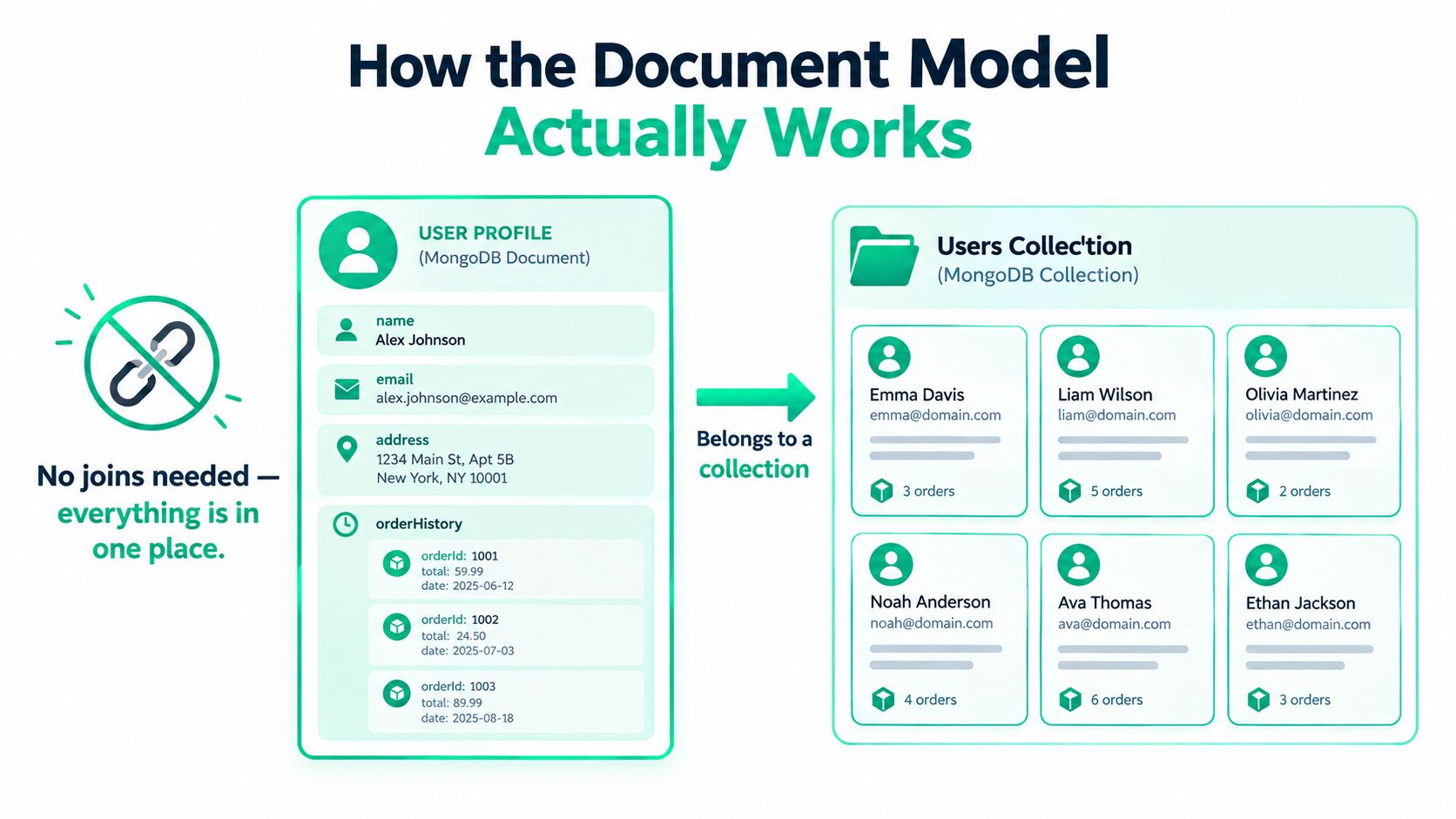
Think of a MongoDB document as the application's working view of an entity. A user profile might contain identity fields, preferences, and connected-account metadata as nested pieces of the same object. A collection groups documents representing the same kind of thing.
The useful analogy is a profile card that already contains the information needed to render the screen. You're designing the stored representation around an access pattern, rather than automatically splitting every nested object into a separate entity.
Start with a page, not an incoming payload
Consider a hypothetical traction application. Its public project page needs a title, creator configuration, connected-source status, metric definitions, and the latest refreshed snapshot. That gives you a sensible candidate for a project-oriented document.
Don't save whatever Stripe, GitHub, or an analytics connector returns. Instead, decide what the application means by a connection, a metric, and an observation. Provider-specific payloads shouldn't dictate your public page's structure.
A useful modeling exercise is to write the response object before the storage model:
- Identity: What makes this project recognizable?
- Configuration: Which settings belong to the project itself?
- Current state: What does the reader need to see now?
- History: What belongs in a separate, time-windowed query?
This is objects in, objects out as a design goal, not permission to copy every external object into production storage. The application should own the shape and meaning of its data.
The single-page analogy has a boundary
The infographic's no-joins shorthand describes an embedded read path, not a requirement to put everything in one document. A project's current configuration and its entire activity history are different storage problems.
Ask what happens when the project remains active indefinitely. If the document keeps acquiring observations, comments, or connector responses, the profile-card analogy has stopped being useful.
A better target is a document you can explain without referring to its age. Its size should follow the product's configuration limits, not the duration of the customer relationship. Keep the current view convenient, but give historical data an independent lifecycle.
MongoDB vs Postgres vs a Key-Value Store
Choose between these options by looking at the work your application performs repeatedly. Don't turn the decision into a contest over which database has the longest feature list.
The table below is a selection framework, not a benchmark. Redis and DynamoDB also deserve separate evaluations before implementation; grouping them as key-value options is useful only while discussing a lookup-oriented access pattern.
MongoDB vs Postgres vs Key-Value Stores for Early-Stage Products
| Criteria | MongoDB | Postgres | Key-Value Store |
|---|---|---|---|
| Iteration speed | Favor when changes stay within rich entity boundaries | Favor when the team already models relationships comfortably | Favor when the contract is a stable key and value |
| Query expressiveness | Evaluate using actual entity reads and comparisons | Prefer for relationship-heavy and exploratory requirements | Choose when lookup paths can be named in advance |
| Indexing | Budget indexes against ingestion work | Review indexes against both queries and updates | Check the chosen product's access-path constraints |
| Transactions | Prefer workflows contained within a document | My preference for consistency across many related entities | Verify the specific product against required atomic operations |
| Operational complexity | Include schema, retention, and tier ownership | Include migration, query, and capacity ownership | Don't confuse a simple lookup interface with simple operations |
Rich SaaS entities
For a SaaS built around configurable workspaces or projects, MongoDB is a strong candidate. I'd test whether the busiest screens can be served from a coherent entity representation without assembling unrelated records.
The deciding counterexample is usually an administrative workflow. If changing a subscription requires coordinated changes across customers, entitlements, invoices, and account balances, I'd take Postgres seriously before committing. Don't dismiss that workflow because the dashboard looks document-shaped.
Content and analytics products
For a content product, distinguish delivery from analysis. Serving a known content object and answering arbitrary questions about relationships are different jobs.
I'd lean toward Postgres when the product's value comes from repeatedly asking new cross-entity questions. For a system that publishes a current summary with separately retained observations, I'd evaluate MongoDB against that specific workload.
Write sample questions before selecting either one. Include the awkward ones: comparisons across customers, historical corrections, and changes to metric definitions. A database choice that handles the homepage but complicates every internal investigation isn't a good trade.
Thin, read-heavy APIs
If the API mostly retrieves a precomputed response by a stable key, evaluate a key-value store before adopting a richer model. Ask what additional queries the product needs, rather than what it might need someday.
My verdict is conditional but firm: MongoDB for rich entities, Postgres for relationship-heavy workflows, and a key-value store for deliberately constrained lookups. Team familiarity can outweigh an elegant theoretical fit. Shipping a model your team understands is better than maintaining one it keeps fighting.
Schema Patterns That Survive Contact With Real Users
The schema mistake I'd look for first is an entity document that doubles as a permanent event archive. It's convenient during development because everything is available in one place. It's a poor boundary once ingestion and interactive reads need different treatment.
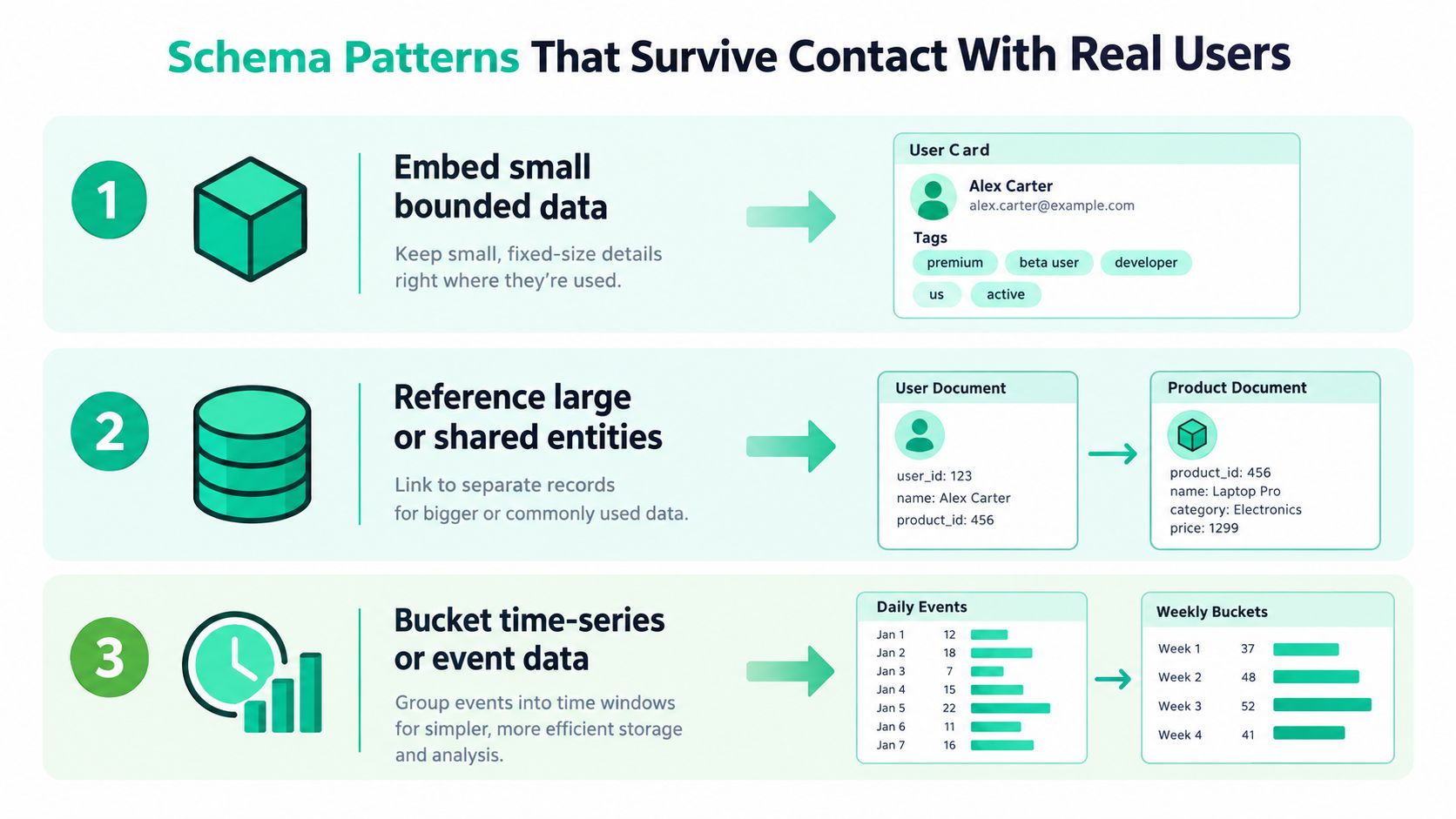
Use embedding, referencing, and time-bounded storage deliberately. Each solves a different ownership problem.
Embed the data you can bound
Embed configuration that belongs to the entity and has a clear size limit. For a user, that might be notification preferences. For a project, it might be Stripe and GitHub connection status, metric definitions, and the latest traction snapshot.
Define the bound in the product contract. A preferences object is naturally constrained; an activity array isn't constrained merely because it starts empty.
Reference independent ownership
I'd reference a project's owner rather than copying the owner's entire account into every project. Shared entities need an explicit source of truth, especially when their lifecycle differs from the document that points to them.
Keep copied display information intentional. If you store an owner's display name with a project, decide whether it represents current identity or a historical snapshot. Otherwise, someone will eventually have to guess which version is correct.
For a broader review, consult Up North Media's top 10 database design best practices. Use it to challenge ownership and lifecycle decisions, not to add abstraction for its own sake.
Keep observations outside the hot document
Store unbounded metric history separately, keyed by project and observation time. That lets you manage retention, archival, and time-window queries independently from the project's current presentation.
If you choose buckets for events, bound them by both the intended time window and their permitted growth. Don't replace an unbounded project array with an unbounded bucket. For modest ingestion, individual observation records may be the clearer starting point.
Treat data correctness as part of the schema review. This guide to improving data accuracy is a useful companion when deciding how to handle missing observations, corrections, and source provenance.
A transaction can protect a necessary workflow. It shouldn't excuse a document boundary you haven't thought through.
MongoDB's transaction and schema-design guidance supports embedded, denormalized models where appropriate, notes that multi-document transactions generally cost more than single-document writes, and explains that every additional index requires maintenance during inserts.
That maintenance is write amplification you must budget for. For recent project history, a candidate compound index is { projectId: 1, observedAt: -1 }. Validate its selectivity and ingestion overhead against realistic connector activity rather than adding indexes speculatively.
For every proposed index, write down the query it supports. Public-page reads, creator dashboards, and backer comparisons are legitimate reasons. A field existing in the document isn't.
Atlas Pricing and the Hidden Cost Curve
The free tier is a starting environment, not a financial forecast. Atlas lists M0 with 512 MB of storage and up to 100 operations per second; its pricing and deployment FAQ also explains that dedicated clusters are billed hourly, with costs depending on compute, storage, backups, and data transfer, and that development, test, and QA don't receive separate pricing tiers.
That's why I wouldn't give a founder a database budget based only on production document count. You need to price the workload and the environments you intend to keep running.
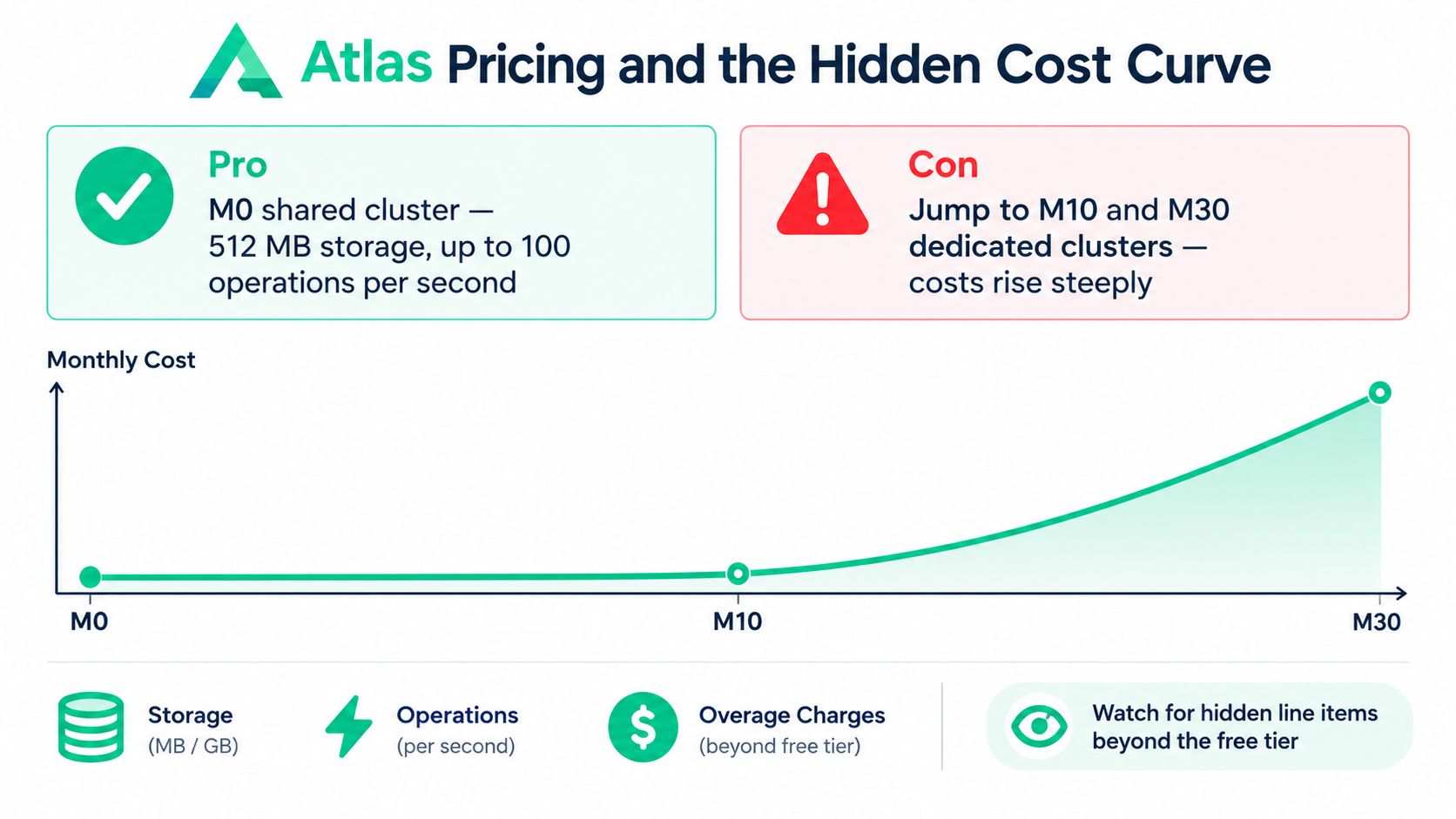
Treat the graphic as a conceptual warning, not a current price quotation or a guaranteed increase. Build the estimate from your proposed deployment configuration.
Budget by workload scenario
Prototype: List the data you'll retain, the connectors you'll exercise, and the environments you need. Keep disposable test history disposable. Don't import a large historical dataset merely because the integration makes it easy.
Early customer usage: Forecast document growth together with index overhead, backup retention, and staging requirements. Separate interactive reads from background ingestion. Customer count alone doesn't describe either workload.
High-variance launch: Estimate peak requests rather than averaging the launch across a quiet period. Public pages can receive bursty reads while connector jobs produce periodic write spikes. Model their overlap before deciding the starting tier is sufficient.
A useful budget worksheet should record:
- Compute assumptions: Which deployment will run continuously?
- Storage assumptions: What grows, and when is it deleted?
- Backup requirements: What recovery history does the business need?
- Environment inventory: Which resources are permanent versus disposable?
- Transfer expectations: Where will applications and consumers access the data?
Make cost controls operational
Set spending alerts and assign someone to act on them. Review nonproduction resources, pause eligible clusters when they aren't needed, and remove abandoned environments. Don't assume every deployment supports the same lifecycle controls.
Cap retention on collections that accumulate observations. Keep the history your product needs, then archive or delete according to a documented policy. Longer retention should be a product decision with an operating cost, not the accidental result of never writing a cleanup process.
Budget warning: A low headline price isn't a predictable bill when nobody owns environment sprawl and retention.
Before upgrading, identify what you're buying relief from. A bigger deployment can be justified, but it shouldn't substitute for understanding an inefficient read path or unnecessary ingestion work.
Scaling From Shared Cluster to Sharded Cluster
Scale because measurements justify it, not because your user count reached a milestone. The useful signals are resource pressure and customer-facing behavior under representative load.
Start with a deployment that fits the measured workload. Move toward dedicated capacity when persistent constraints remain after you've checked query plans, ingestion scheduling, and connection behavior.
Diagnose the constrained workload
A public page and a connector job should be visible as separate workloads. Track request patterns alongside background refresh activity so you can tell whether the database is struggling with interactive demand, ingestion, or their overlap.
Use an API usage metrics review to connect database pressure with application behavior. An aggregate request count won't tell you which endpoint or retry loop deserves attention.
Before changing topology:
- Reduce avoidable reads: Cache immutable or slowly changing project configuration at the application or CDN layer.
- Control ingestion: Batch metric upserts and schedule connector work deliberately.
- Make retries safe: Use an idempotency identity such as
(projectId, source, observedAt)to prevent duplicate observations.
These are workload controls, not promises that you'll never need more capacity.
Treat sharding as a partitioning decision
Consider sharding when measurements show that a single deployment can't meet the required capacity economically or operationally. Don't introduce it merely because growth is possible.
MongoDB's sharded-transaction guidance explains that shard-key selection affects performance, query isolation, and write capacity, and that single-shard transactions have replica-set-like performance while cross-shard transactions incur greater cost.
For a project-centric application, I'd investigate a partitioning strategy that keeps a project's normal reads and writes together. But project ID is a candidate, not an automatic answer. Test whether the proposed key distributes traffic as well as documents, particularly when some projects are far more active than others.
Document distribution can look balanced while demand isn't. Evaluate busy projects, bulk refreshes, and cross-project comparisons before committing.
My default recommendation is to stay with the simpler topology until there's a measured reason to leave it. You'll have enough product uncertainty without introducing distributed-data complexity ahead of demand.
The 10-Minute MongoDB Decision Checklist
Use this checklist before committing the application to its database model. Answer with concrete workflows, not preferences.
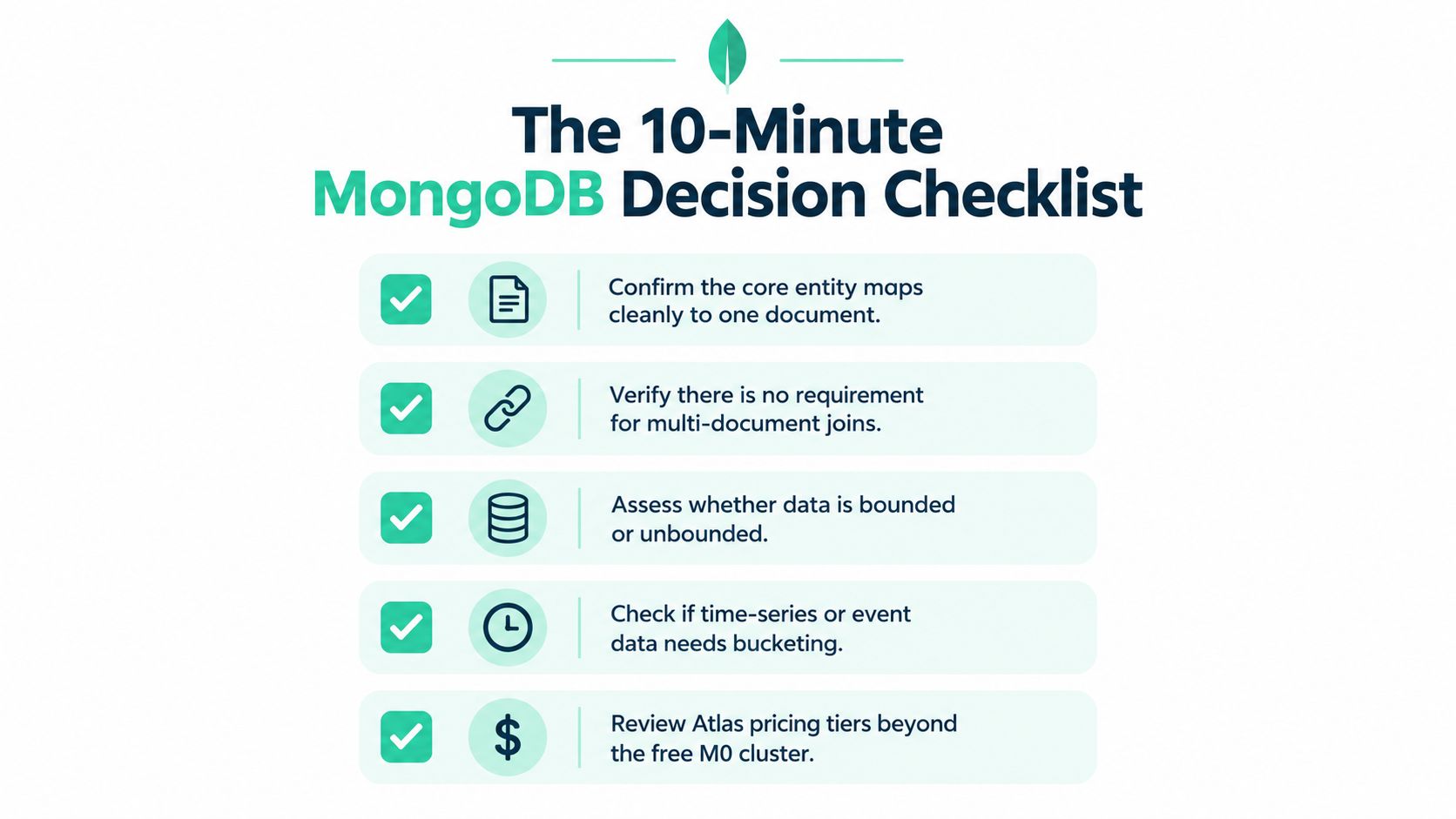
- Core entity: Can you describe the main document and its boundaries?
- Relationships: Are cross-entity workflows exceptional or central?
- Team fit: Does the team understand document modeling better than relational modeling?
- Growth: Have you identified unbounded collections and the working dataset?
- Operations: Are upgrade triggers, retention, and spending ownership explicit?
- Exit plan: Can you export clean records with stable identifiers and documented meaning?
Keep migration possible through disciplined data contracts, not a speculative database abstraction layer. If demand is still uncertain, prioritize validating your startup idea over engineering for hypothetical scale.
Choose MongoDB when it simplifies the product. Choose Postgres when you'd otherwise spend your time recreating relational workflows.
Fundl lets creators raise reward-based support through a shareable traction page connected to Stripe, GitHub, and analytics, using source-verified metrics instead of screenshots and promises. Put the same discipline into proving demand that you put into your database design: visit Fundl, connect your sources, and give backers evidence of what you're building.