
You've got a logo you like, a domain you paid for, and a handful of people who said they'd buy. What you don't have is spare cash to gamble on boxes of stock or proof that those friendly comments will turn into orders. That's the exact spot where brand on demand stops sounding like a merch trick and starts sounding like a safer way to launch.
Table of Contents
- The Founder's Dilemma Between Stockpiling and Launching Lean
- What Brand on Demand Actually Means
- The Four Mechanics That Make the Model Work
- Batch Production Versus Brand on Demand
- Why Reach Is Not the Same as Demand
- Three Founder Stories That Show the Model in Action
- A Fifteen-Minute Validation Checklist
- Turning Live Traction Into Your Real Brand
The Founder's Dilemma Between Stockpiling and Launching Lean
Most indie founders oscillate between two unhelpful extremes. You either bulk order shirts, books, planners, or packaged add-ons because the per-unit price looks attractive, or you wait until revenue feels solid enough to justify looking like a real brand. The first path ties up cash before you've learned which sizes, colors, messages, or formats people want. The second path protects cash, but it also delays the moment when strangers can buy, share, and test your idea in public.
Why Both Defaults Stall You
Stockpiling forces you to forecast before you have evidence. A SaaS founder might guess that conference attendees want hoodies, an educator might print workbooks for a cohort that hasn't enrolled, and a creator might order designs that looked great in a poll but flop at checkout. If you're wrong, you're not just out of money. You're storing proof of a bad guess.
Waiting creates a different problem. You keep refining the name, palette, and landing page copy while nobody can transact. Momentum fades because there's no order, no shipping confirmation, and no customer feedback to react to.
Practical rule: Don't ask whether you can afford inventory. Ask whether you have enough paid signal to deserve it.
Brand on demand offers a third path. You publish the offer, let a customer order first, and only then trigger the branded production or fulfillment step. You're not pretending demand exists. You're designing the business so demand reveals itself before you spend heavily. For small creators, educators, open-source maintainers, and software builders, that shift matters. It turns a logo and a hunch into a testable offer without betting rent money on speculative stock, and it gives you early orders you can learn from while the stakes are still manageable.
What Brand on Demand Actually Means
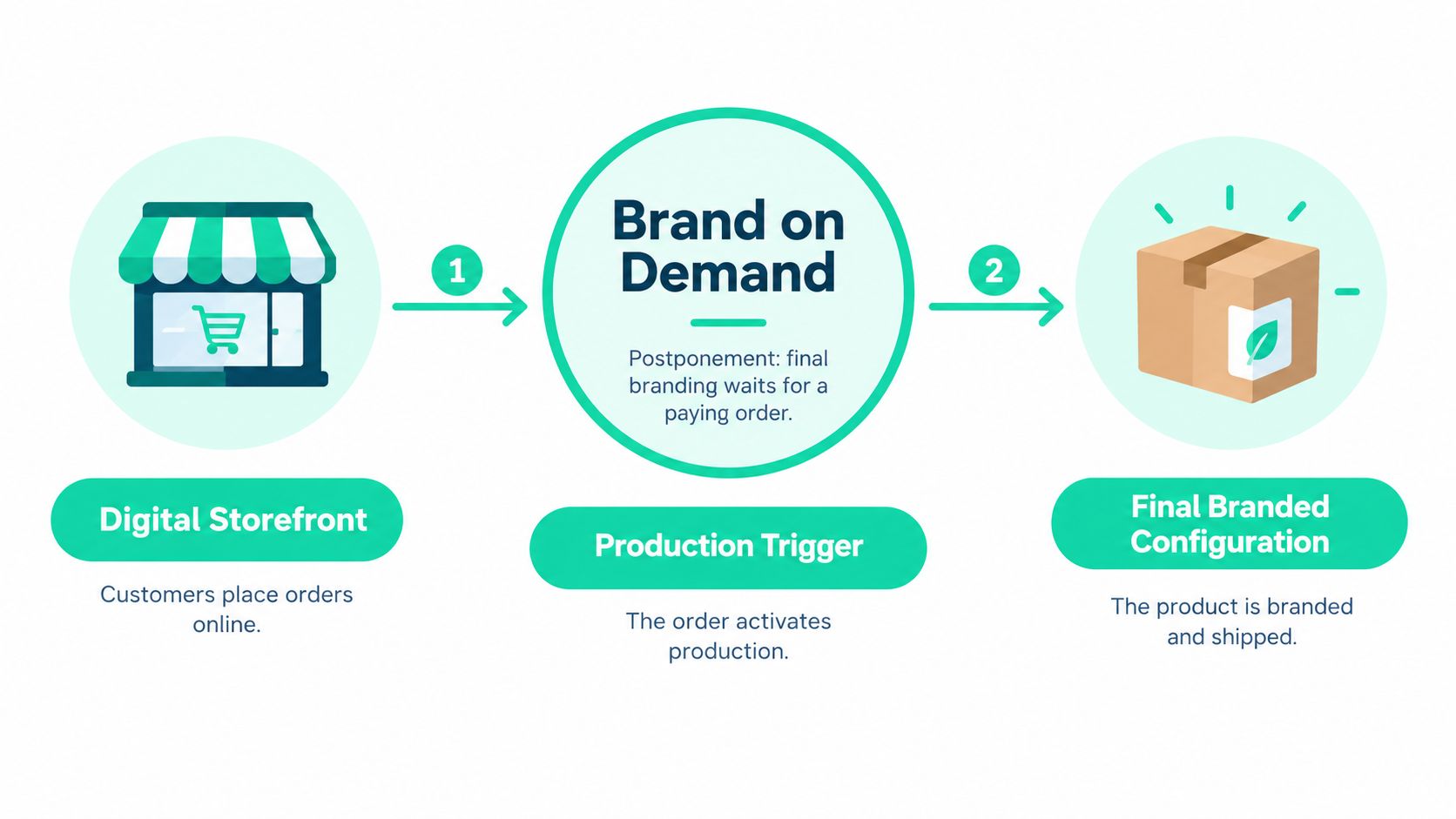
Brand on demand means you delay the final branded version of a product until someone has ordered it. The underlying item stays standardized for as long as possible. Only the demand-sensitive step, such as printing a design, applying a label, assembling a welcome kit, or personalizing packaging, waits for a paying customer. Operations people call this idea postponement.
Think of a coffee shop. The owner buys beans, cups, and milk in a fairly standard way. She doesn't pre-make hundreds of specific drinks at dawn and hope the right customers walk in. She grinds, pours, and adds the customer's name when an order arrives. Your brand works the same way when the blank product, print location, and quality checks are fixed in advance, but the final configuration happens after checkout.
The flow below maps that delay from storefront to delivery.
Brand Strategy Versus Operations
It's easy to confuse this model with generic print-on-demand. They're related, but they're not identical. If you want that broader production background, a guide for creators and enterprises can help you separate the printing method from the brand decisions around it.
- Brand strategy: Your audience, promise, design language, pricing, and reason to buy now.
- Operations: Your order trigger, supplier, production window, quality control, shipping, and returns handling.
Postponement isn't automatically cheaper. Research on postponement economics finds that its benefit depends on the balance between production costs, uncertainty costs, utilization variability, and backorder costs, and customization can erase the gain when it adds setup complexity or delays fulfillment. That's a useful warning. You're trading inventory risk for discipline. If every order requires a messy custom setup, slow approvals, or constant reprints, your lean model becomes an expensive bottleneck. Standardize everything upstream, and customize only the step customers value.
The Four Mechanics That Make the Model Work
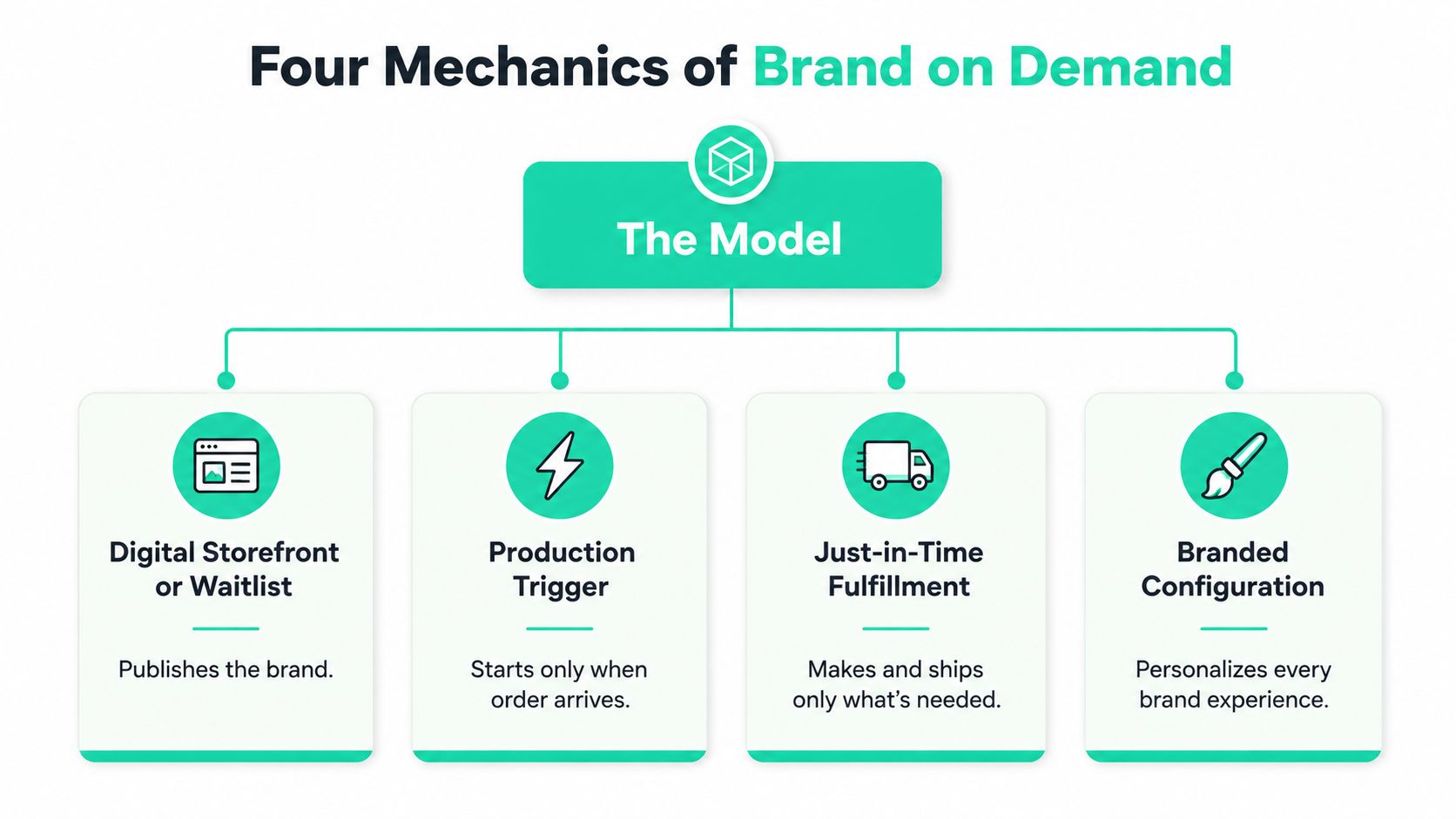
A working setup needs four connected mechanics, not just a supplier account. Miss one, and the model leaks money or trust.
The diagram below names those parts in the order a customer experiences them.
The Surface and the Trigger
First, you need a digital storefront or waitlist that makes the offer concrete. For a SaaS founder, that might be a pricing page that sells founding seats and shows current paid signups. For an educator, it might be a cohort page where enrollment activates printed workbooks and a completion kit. Vague interest doesn't count here. The page must let someone commit.
Second, you need a production trigger. Payment, a reached funding threshold, or a confirmed preorder starts the work. An open-source maintainer, for example, can send a shirt order to a printer only after a backer selects a size and pays. Nobody prints a speculative pile in the maintainer's apartment.
Fulfillment and Proof
Third, just-in-time fulfillment moves the finished item to the buyer, ideally without you repacking every unit by hand. You still own the experience, though. Track order-to-production time, dispatch time, defect or reprint rate, refund rate, and whether packages arrive when promised.
Those metrics matter because removing inventory doesn't remove risk. Evidence on print-on-demand operations shows the model reduces working-capital and obsolescence risk because units are made after actual orders, but it transfers risk toward variable unit costs, supplier capacity, and defect rates.
Fourth, and most often skipped, is the measurement layer. Record paid orders, repeat purchases, contribution margin after decoration, shipping, payment fees, refunds, and reprints, plus the service levels above. Without that layer, you can't tell whether you've built a brand or just opened a store that occasionally makes noise. The measurement layer turns each order into evidence for your next pricing, design, and supplier decision.
Batch Production Versus Brand on Demand
On-demand production doesn't always win. Batch production can be the smarter choice when demand is stable, sizing or format choices are predictable, and you need the lower per-unit cost to protect margin. Brand on demand shines when you're still learning what people want.
| Decision Factor | Batch Production | Brand on Demand |
|---|---|---|
| Working capital | High upfront spend before sales | Spend follows confirmed orders |
| Time to first dollar | Slower, production comes first | Faster, selling can start sooner |
| Dead stock exposure | High if forecasts miss | Low, units are made to order |
| Customization ceiling | Lower, variants multiply inventory | Higher, variants stay digital until ordered |
| Per-unit economics | Often stronger at volume | Often weaker, offset by lower risk |
Use a simple threshold this week. Does reduced inventory exposure outweigh the added per-unit customization and fulfillment cost? If yes, stay on demand. If a particular SKU sells predictably, has few variants, and suffers when delivery is slow, test a small batch for that SKU while keeping experimental designs on demand. Many founders end up with a hybrid, and that's fine.
Better forecasting can sharpen that call. A practical overview of demand forecasting methods for founders helps you separate stable repeat demand from a one-week spike. Apparel is a clear illustration, and this resource on how to start a tee brand without inventory shows why new designs usually belong on the on-demand side first.
Scale alone doesn't settle your decision, but market direction matters. Mordor Intelligence's print-on-demand market estimate puts global revenue at USD 15.19 billion in 2026 and forecasts USD 46.43 billion by 2031, implying a 25.05% CAGR over 2026 through 2031 as a projection. Supplier choice and fulfillment infrastructure are expanding, yet your own repeat orders should decide when a product graduates to batch.
Why Reach Is Not the Same as Demand
A large audience can make a weak brand look healthy for a while. Followers, impressions, and enthusiastic replies tell you people noticed. They don't tell you people will pay, stay, renew, or come back after the launch post fades.
The image below captures a common moment for creators who discover that visibility and income are different things.
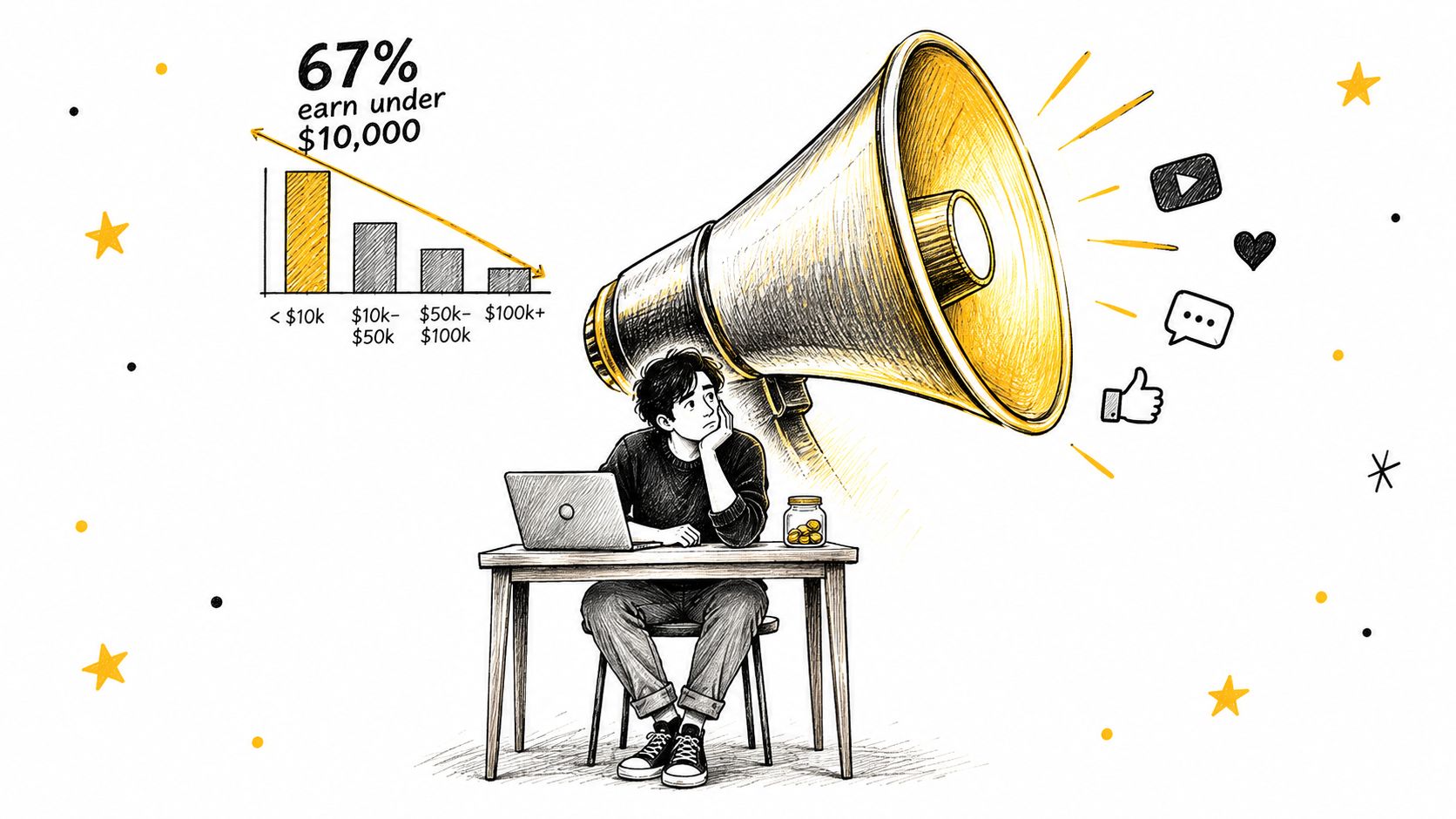
CreatorIQ's 2026 creator study found that 67% of surveyed creators earned less than $10,000 from content creation in the previous year, while fewer than 5% earned more than $100,000, with earnings tracking followers and views more closely than engagement. Read that carefully. Even reach is an uneven predictor, and engagement by itself is weaker still.
Treat Behavior as the Brand Asset
For a software founder, stronger proof looks like Monthly Recurring Revenue, Monthly Active Users, retention, and repeat purchases. For an educator, it might be paid enrollments, completion, and students who buy the next course. For an open-source project, consistent commits and recurring contributions say more than a clever tagline. These aren't just metrics for a dashboard. They're the substance strangers use to decide whether your brand deserves trust.
The video below is useful background on why audience size shouldn't be mistaken for a business model.
That doesn't mean launch presentation is irrelevant. Studying strong website launch campaign patterns can improve how clearly you present proof. But presentation shouldn't replace proof. Polished positioning built on weak signal creates a brand people admire briefly and trust slowly. Publish behavior that updates, and your branding becomes easier because customers can see delivery, not just promises.
Three Founder Stories That Show the Model in Action
A solo SaaS founder has a workflow tool, a small waitlist, and no desire to spend months building every feature. She sells a limited founding plan for the core workflow and shows live MRR, active users, and recent shipping activity on her public page. Early buyers aren't purchasing a fantasy roadmap. They're responding to a product that already works for a narrow job.
Her on-demand move is restraint. She builds the requested integration only after paid users cluster around the same need, and she prints onboarding kits for annual customers after payment clears. The lesson is simple. Let paid usage decide which branded extras and features deserve production.
An Educator and an Open-Source Maintainer
An educator takes a different route. Instead of recording an enormous course and printing materials in advance, he opens enrollment for a focused cohort with clear dates, outcomes, and a workbook reward. Contributions show whether the topic has pull before he commits to a larger production schedule. If enrollment reaches his threshold, he finalizes lessons around student questions and orders printed materials for confirmed learners.
That sequence protects both sides. Students see real enrollment momentum, and the educator avoids building a polished course for an empty room. His brand becomes associated with cohorts that run and finish.
An open-source maintainer uses merch to fund maintenance without turning his home into a warehouse. Backers choose a design and size, payment triggers printing, and the supplier ships directly. On the project page, supporters can also see ongoing commit activity, so the shirt isn't carrying the whole credibility burden.
A supporter buys the shirt once. Visible, steady development gives that supporter a reason to keep backing the project.
Across all three stories, the product differs, but the sequence doesn't. Commitment comes first, production follows, and visible proof makes the next commitment easier. That's brand on demand applied beyond a print shop.
A Fifteen-Minute Validation Checklist
You don't need a full identity system to run your first test. You need a small offer, a clear trigger, and one proof metric you won't hide from.
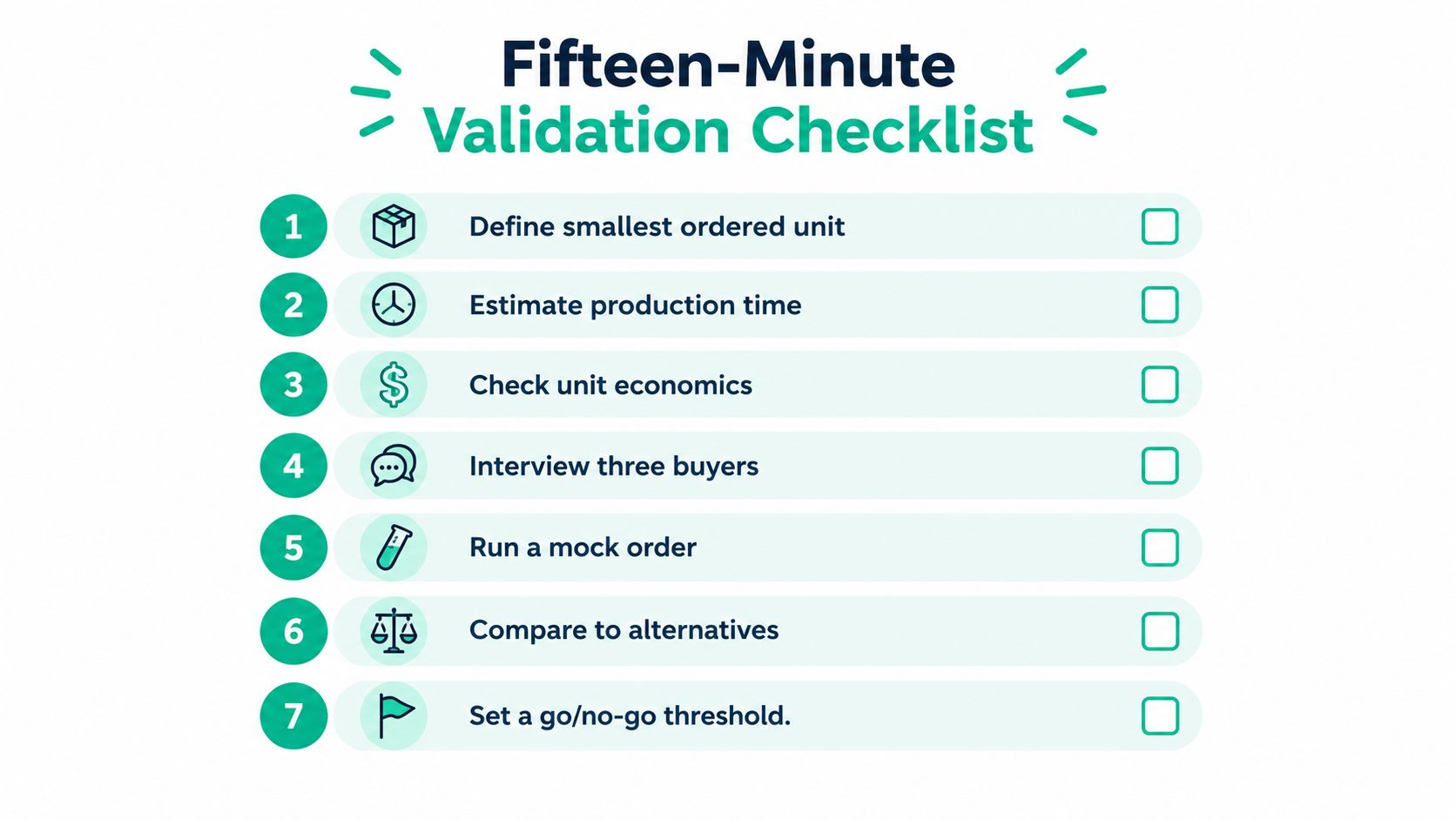
- Define the smallest ordered unit: Choose one seat, one cohort place, one shirt, or one kit.
- Pick the buying surface: Use a storefront, waitlist, or traction page where payment or a firm commitment can happen.
- Name the fulfillment path: Write down who produces, who ships, and what happens after a defect or refund request.
- Check contribution margin: Include production, decoration, shipping, payment fees, refunds, and likely reprints.
- Choose your proof metric: Select MRR, MAU, commits, paid orders, retention, or repeat purchases, then keep it current.
- Write three plain sentences: State who it's for, what changes for them, and why they should believe you.
- Set a go or no-go threshold: Decide in advance what paid signal justifies more designs, features, or a small batch.
If you need a structured way to run that experiment, follow a practical guide on how to test a product before scaling it. The wider production shift supports starting small. IMARC Group's print-on-demand market data estimates growth from USD 4.56 billion in 2020 to USD 11.38 billion in 2025, about 150% in five years, with a projection of USD 61.79 billion by 2034. Infrastructure is there. Your job is to supply a test worth running.
Turning Live Traction Into Your Real Brand
Your logo helps people recognize you. Your traction helps people believe you. That distinction should guide what you publish, what you produce, and what you postpone.
Start with three moves this week. Publish proof that updates from real systems, not screenshots you refresh when numbers look flattering. Defer production until a customer order or paid commitment triggers it. Measure service levels so a lean launch doesn't become a slow, defect-prone experience that damages the name you're trying to build.
What Belongs on Your Traction Page
- Commercial pull: MRR, paid orders, enrollments, or repeat purchases.
- Product use: MAU, retention, completed lessons, or another behavior tied to value.
- Delivery consistency: Commits, release activity, fulfillment reliability, or support responsiveness.
- A short narrative: Who you serve, what you're building next, and what customer behavior supports that choice.
Over time, those records become an identity system that's harder to copy than a color palette. Competitors can imitate your slogan by Friday. They can't instantly reproduce months of customers paying, using, returning, and watching you ship. Brand on demand, understood this way, isn't mainly about printing after checkout. It's about earning the right to scale a brand by showing demand as it happens.
Turn your live MRR, GitHub commits, and Monthly Active Users into a shareable traction page that proves demand while you keep production lean. Fundl lets you connect Stripe, GitHub, and analytics, publish source-verified metrics that auto-refresh, and receive reward-based contributions through your own Stripe account. Set up your page, share the clean URL, and let backers fund the brand your customers are already validating.