
The advice to bootstrap for control or raise venture capital for growth skips the most important question: what would additional money let your startup do that it can't do now? Without an answer, bootstrapping can become underinvestment, and fundraising can become an expensive substitute for proving demand.
A more useful approach treats funding methods as stages, not identities. Start with the capital your next milestone requires, identify the evidence that justifies it, and preserve the option to change course.
Table of Contents
- Bootstrapping vs Venture Capital at a Glance
- Ownership, Control and Dilution You Accept
- Growth Speed and Revenue Milestones Compared
- Metrics Each Path Requires You to Track
- Which Path Fits Your Startup Situation
- A Stage-Based Plan for Combining Funding
- Confirm Your Funding Path Before You Commit
Bootstrapping vs Venture Capital at a Glance
Bootstrapping means financing growth through customer revenue, founder savings, and operating discipline, with spending constrained by available cash. Venture capital means selling an ownership stake to outside investors to finance expansion, usually with expectations of rapid growth and a future liquidity event.
The bootstrapping vs venture capital decision is therefore less about ambition than about how your business converts money into progress. A founder who can sell a useful product before hiring a team faces a different financing problem from someone who needs substantial development before customers can buy.
Bootstrapping vs venture capital across key criteria
| Criterion | Bootstrapping | Venture Capital |
|---|---|---|
| Source of capital | Customer revenue, founder savings, operating cash flow | External equity from investors |
| Ownership | Founder keeps most or all equity | Investors take a stake; subsequent rounds dilute existing holders |
| Control | Founders retain decision authority, subject to existing agreements | Negotiated board seats and investor rights can shape major decisions |
| Growth pace | Limited by internally generated cash | Capital supports accelerated hiring, spending, and expansion |
| Investor expectation | Founder prioritizes sustainable profit and cash flow | Investors seek rapid scale and a future liquidity event |
| Typical time to $1M ARR | Usually slower, with meaningful exceptions among strong performers | Typically faster in the SaaS benchmark discussed below |
| Downside risk | Cash shortages can force gradual retrenchment or abrupt closure | Aggressive spending increases dependence on high-growth outcomes |
Scan the row that matters most to your decision. If control is nonnegotiable, a growth forecast alone won't settle the question. If customers require capabilities you can't afford to build, keeping every share may not compensate for missing the opportunity.
The immediate trade-offs
- Bootstrapping advantage: You can align spending with customer demand without negotiating an equity round.
- Bootstrapping drawback: A promising opportunity may exceed what operating cash can support.
- VC advantage: You can finance a coordinated expansion rather than adding capacity incrementally.
- VC drawback: You accept shared ownership and expectations that may conflict with running a smaller, profitable company.
Neither financing method establishes product-market fit. Treat capital as a resource for executing a credible plan, not as evidence that the plan is credible.
Ownership, Control and Dilution You Accept
Dilution compounds across rounds. When you sell new equity, your existing stake represents a smaller share of the company; another round reduces it again. Model the full ownership sequence, including employee equity, rather than judging an offer only by the valuation attached to it.
The choice involves both financial ownership and practical authority.
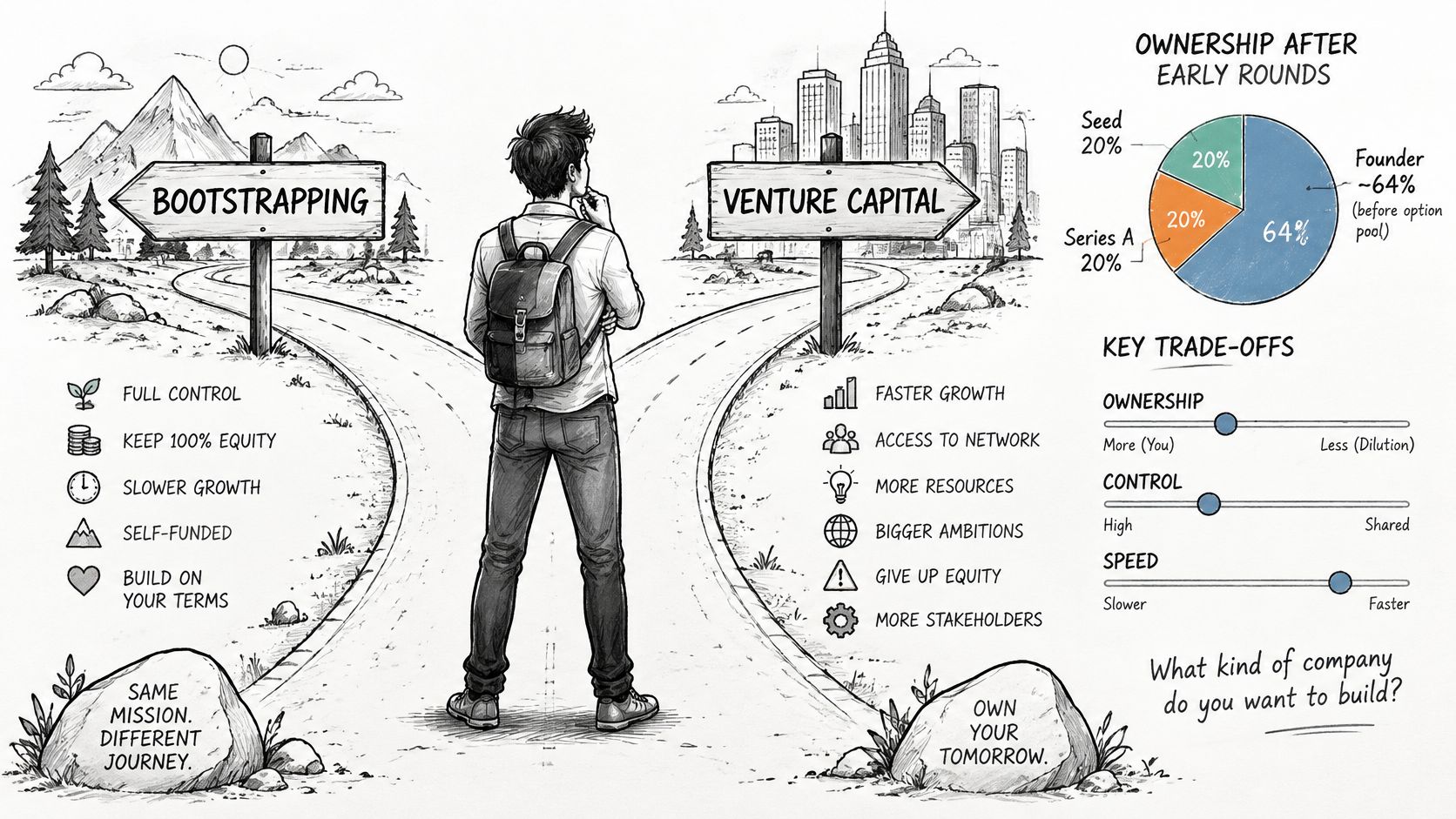
A percentage doesn't describe the whole deal
Review the rights attached to the investment with startup counsel. Board representation concerns who participates in governance. Protective provisions may require investor consent for specified actions, such as issuing securities or selling the company. Liquidation preferences affect how sale proceeds are distributed.
Translate each provision into a decision you might face. Could you accept an acquisition that suits your personal goals? Could you change direction, finance a new product, or keep operating without pursuing another round? The negotiated documents matter more than assumptions about what investors usually allow.
Bootstrapping preserves more discretion over pricing, roadmap, and hiring pace, but it doesn't remove constraints. Customers, contractual commitments, and available cash still limit your choices. Autonomy means choosing within those constraints rather than answering to an equity investor.
What you receive in exchange
The scale of external financing is substantial: in 2020, 10,862 U.S. venture-backed companies received approximately $164 billion, according to the National Venture Capital Association's annual market announcement. Those are capital-deployment figures, not evidence that funding guarantees success.
For a founder, the relevant benefit is the ability to coordinate engineering, sales, and distribution before operating revenue could finance them. That can be valuable when those investments reinforce each other. It's less persuasive when the proposed budget contains unrelated hires without a clear connection to customer acquisition or product delivery.
Use the accompanying video as a discussion prompt, then evaluate the actual financing terms.
Control test: Write down the decisions you're unwilling to share. Compare that list with the proposed governance rights before negotiating the headline valuation.
You aren't just selling a fraction of future proceeds. You're choosing who will help determine which future outcomes the company pursues.
Growth Speed and Revenue Milestones Compared
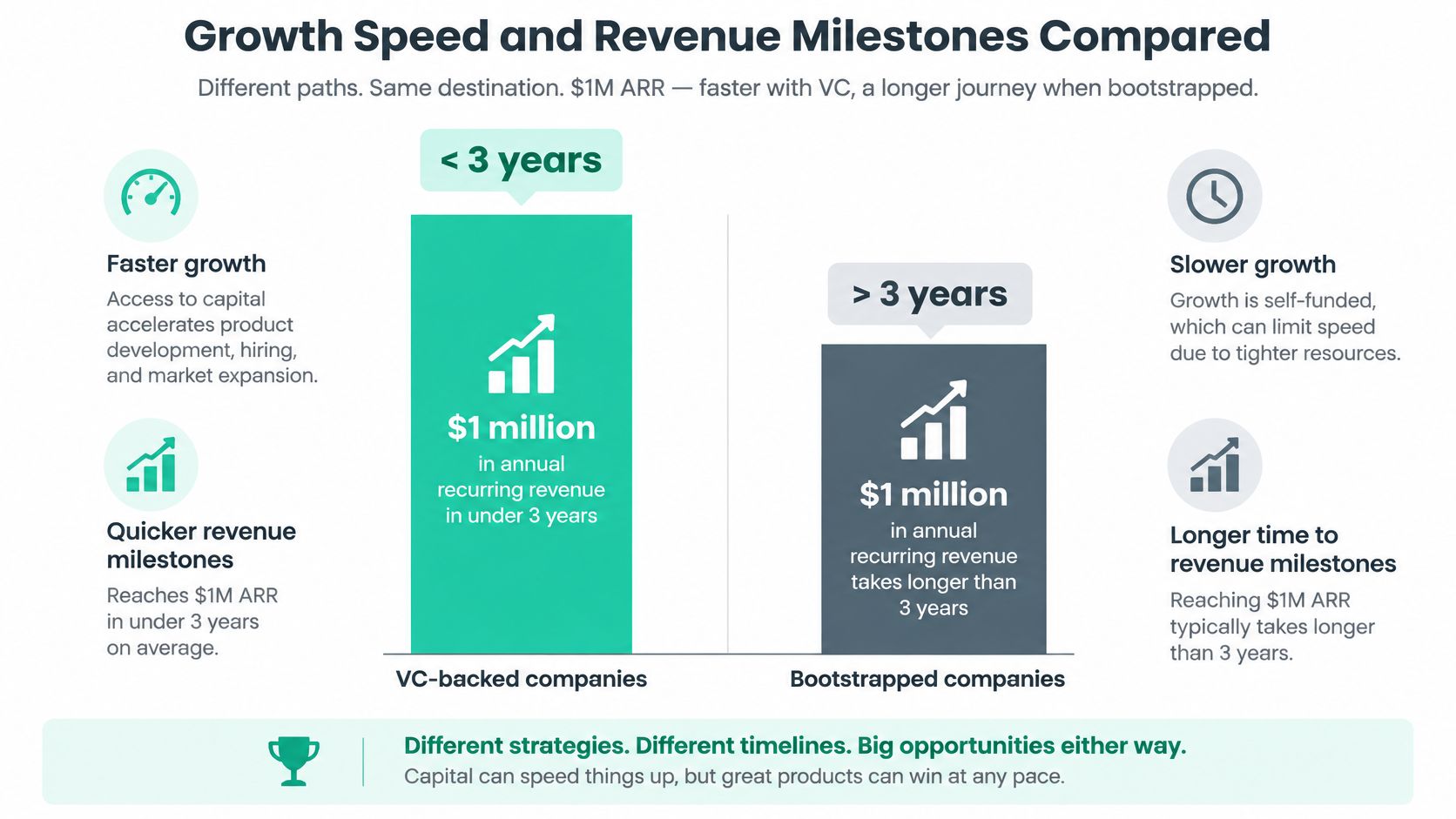
For SaaS companies, the benchmark favors VC on typical speed, but the strongest bootstrapped companies complicate the story. ChartMogul's 2024 SaaS growth report finds that VC-backed companies typically reach $1 million in annual recurring revenue in under three years, while bootstrapped companies take more than three years; top-quartile bootstrapped firms reach that milestone in approximately two years, only about four months slower than comparable VC-backed firms.
That distinction matters more than the average comparison alone. Funding status describes a group, not your company's probable result. These benchmarks don't establish that raising money causes an otherwise identical startup to grow faster.
The visual summarizes the typical milestone comparison.
Build competing forecasts, not competing beliefs
Create a reinvestment forecast using your current cash balance, customer collections, retention, and realistic hiring capacity. Then create a funded forecast that includes fundraising effort, recruitment lead times, onboarding, and the delay before new spending produces revenue.
Say a SaaS founder has repeatable sales but can't onboard customers quickly enough. Additional implementation capacity might accelerate recognized recurring revenue. By contrast, hiring salespeople before understanding why customers churn could increase acquisition spending without improving durable growth.
Use your actual monthly results to identify the constraint:
- Demand constraint: Customers aren't buying consistently. Investigate positioning, product value, and pricing before assuming acquisition spending will solve it.
- Capacity constraint: Customers want the product, but delivery or onboarding slows conversion. Estimate what removing that bottleneck would create.
- Distribution constraint: An established channel produces retained customers, but you can't fund its expansion. Test whether performance holds as spending increases.
Compare the shape of growth
The report characterizes bootstrapped growth as generally more linear and consistent across quartiles, with VC-backed growth more accelerated but less uniform. Don't interpret that as a promise of stability for your own business.
Instead, examine whether your forecast requires several uncertain changes to succeed simultaneously. A plan dependent on a new sales motion, an untested customer segment, and a major product release deserves more skepticism than one expanding a demonstrated process.
Capital is most defensible when you can identify the bottleneck, price its removal, and explain why removing it should change the milestone date.
Metrics Each Path Requires You to Track
A financing decision becomes manageable when your dashboard connects spending to customer outcomes. Start with operating measures that reveal whether the company can sustain itself, then add recurring-revenue measures that test whether expansion is becoming more efficient.
The evidence doesn't support treating bootstrapping as an automatic efficiency advantage. The bootstrapping-strategies paper describes positive growth associations among cash-flow-constrained or growth-oriented Belgian startups, but also summarizes a Kauffman Firm Survey-based finding of weaker profitability and revenue growth among firms at three years of age, with founder capabilities moderating outcomes.
Use consistent definitions
Operating and SaaS metrics for the funding decision
| Metric | Question it answers |
|---|---|
| Months of runway | Cash divided by monthly net burn: how long can we operate before cash runs out? |
| Contribution margin | Revenue less direct variable costs: does each sale leave money to cover overhead? |
| Revenue per employee | Revenue divided by headcount: how much revenue does the team produce per person? |
| Customer payback period | Acquisition cost divided by monthly customer gross profit: how long until acquisition spending is recovered? |
| Weekly shipping velocity | Completed, released improvements per week: how quickly are useful changes reaching users? |
| MRR growth rate | Change in monthly recurring revenue relative to the prior period: how quickly is recurring revenue compounding? |
| Net revenue retention | Existing-customer revenue after expansion, contraction, and churn: does the customer base expand or shrink? |
| Customer acquisition efficiency | New revenue relative to acquisition spending: what does each acquisition dollar produce? |
| Burn multiple | Net cash burn divided by net new ARR: how much cash finances each dollar of added recurring revenue? |
For a cash-generating company, runway based on net burn isn't the useful headline. Stress-test collections, customer losses, and committed expenses instead. Likewise, don't treat GitHub commits as interchangeable with useful releases.
Read trends before choosing capital
For bootstrapping, look for healthier contribution margins and improving payback across customer cohorts. For VC, ask whether extra spending can purchase scarce engineering, infrastructure, or distribution capacity without destroying those economics.
If reconciling Stripe receipts, payroll, and acquisition costs exceeds your capacity, HireAccountants' Hire Financial Analysts resource is a starting point for finding analytical support. Keep definitions and assumptions documented so someone else can reproduce the model.
Use our guide to showing traction to investors to organize the evidence behind your dashboard. Compare trends across successive quarters rather than letting an unusually strong month determine a long-term financing commitment.
Which Path Fits Your Startup Situation
Choose a starting path by examining how customers buy, what delivery costs, and which constraint prevents expansion. The recommendations below are decision rules, not claims that every company in a category should finance itself identically.
Starting path by startup situation
| Situation | Starting path | Evidence to check | Revisit when |
|---|---|---|---|
| Indie SaaS with recurring revenue | Bootstrap and reinvest revenue | MRR growth and retention | Growth needs capital faster than cash flow allows |
| Developer tool or open-source product | Community contributions plus revenue | Weekly commits and active users | Enterprise sales require upfront capital |
| Consumer app with network effects | Consider VC early if competitors raise | User growth and engagement | Speed matters to adoption and rivals are scaling |
| AI tool with heavy compute costs | Debt or VC after proven unit economics | Compute cost per user against margin | Cash flow no longer covers compute costs |
| Productized service or service business | Bootstrap | Contribution margin and customer payback | The service becomes a repeatable product |
Revenue-led software and developer products
An indie SaaS founder with retained, paying customers can test whether reinvested revenue supports the next useful hire. Separate customer expansion from new sales: apparent growth can conceal deterioration in the existing customer base. Revisit financing when a specific, affordable expansion opportunity exceeds internal cash capacity.
For a developer tool or open-source product, community activity and commercial demand are different signals. GitHub activity can demonstrate maintenance and delivery, while active use helps establish relevance. Before funding enterprise sales, investigate whether prospective buyers require security work, support commitments, or procurement capabilities that contributors alone won't finance.
Consumer apps and compute-heavy tools
A consumer app with network effects may justify earlier VC if users receive more value as relevant participants join. A competitor's financing announcement isn't sufficient evidence. Examine repeated engagement, user-to-user interaction, and whether adoption becomes more attractive within connected groups rather than merely increasing total registrations.
An AI tool needs a cost model that includes inference, storage, support, and usage variability. Test whether heavy users improve or damage contribution margin under the pricing model. Borrowing or selling equity can finance capacity, but neither fixes a product that loses more money as customers use it more.
Services and repeatable products
A productized service can begin with customer-funded delivery. Track whether standardized scope and reusable processes reduce fulfillment work, or whether every sale creates another bespoke engagement. Reconsider the capital structure when you can distinguish investment in a repeatable product from hiring more people to deliver services.
For a practical starting resource, Chicago Brandstarters offers a scrappy launch guide for Chicago founders. Pair launch tactics with our guide to non-dilutive funding for startups when evaluating ways to finance a defined milestone without issuing equity.
Don't copy the financing history of a successful company in another category. Copy the discipline of matching capital to an observable constraint.
A Stage-Based Plan for Combining Funding
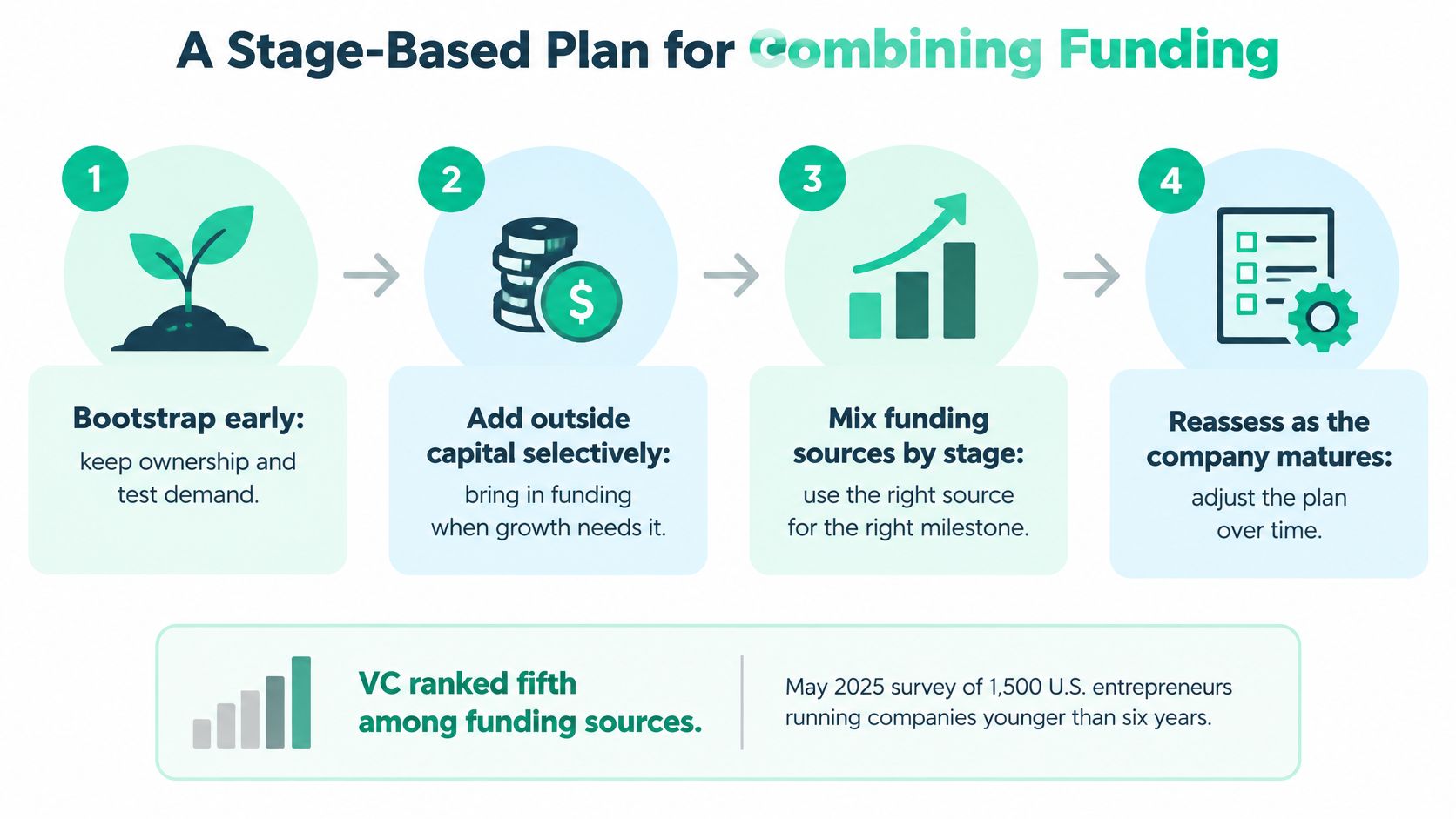
The binary framing overlooks how entrepreneurs assemble capital. A May 2025 survey of 1,500 U.S. entrepreneurs running companies younger than six years, described in Stacker's coverage of changing founder funding strategies, placed VC fifth behind self-funding, business loans, revenue-based financing, and friends and family; more than half reported never raising VC.
That doesn't establish which mix will work for your startup. It does support asking a broader question: which source fits the obligation you're prepared to accept at this stage?
The visual presents funding as an evolving process rather than a permanent affiliation.
Validate demand before financing expansion
Begin with customer revenue or community contributions when they can fund a meaningful test. Repeat paying use is a stronger transition signal than launch attention because it helps establish that customers continue to value the product.
Community support needs separate interpretation. Track whether contributions come from a broad group of users or a narrow circle of personal supporters, and include the cost of delivering promised rewards in your budget.
At Fundl, we offer an optional reward-based campaign alongside live, source-verified project data pulled from connected platforms. Backers can inspect those numbers before contributing through Stripe Checkout, with funds paid directly to the creator's own Stripe account. Contributions aren't investments and don't provide equity or financial returns.
Match predictable cash flow with repayment obligations
Consider debt or revenue-based financing when collections are predictable enough to support repayments. Model delayed receipts, customer cancellations, and a weaker sales period before committing.
Use the money for an identifiable purpose, such as delivering contracted demand or expanding a proven acquisition channel. Compare repayment obligations with the cash the investment is expected to generate, not merely with reported revenue.
Our guide to fundraising for startups can help organize that capital plan around milestones rather than an undifferentiated funding target.
Non-VC doesn't have to mean purely self-funded. Preserving ownership can involve combining customer revenue, community support, and carefully matched financing obligations.
Introduce equity when the opportunity requires it
Consider VC when the plan requires unusually rapid expansion, substantial research and development, or investment in network effects before operating cash can support it. The trigger should be a credible opportunity that the current financing structure cannot capture.
Prepare a capital map that connects each proposed expense to a milestone, its evidence, and the consequence of delay. Include recurring revenue, retention, shipping cadence, and contribution concentration where relevant.
These stages aren't mandatory gates. A research-intensive product may require equity before commercial validation, while a profitable software business may never need it. The sequence should follow the business's constraints, not a prescribed fundraising ladder.
Confirm Your Funding Path Before You Commit
A larger venture market doesn't necessarily mean broader access. CB Insights' 2025 venture trends report records $469 billion in global venture funding, up 47% year over year, while deal count fell 17% to 29,501.
The practical implication isn't that you should avoid VC. It's that your operating plan shouldn't assume investors will finance it on your preferred schedule. A promising pitch can still leave you exposed if customer work stops while you wait for a round.
Separate investor interest from an operating decision
Investor conversations can help you test whether your opportunity fits a fund's strategy. They aren't a substitute for determining whether customers want the product and whether you can deliver it economically.
For software, AI tools, open-source products, and creator businesses, independently verifiable traction can support continued operation while preserving a later financing option. It also gives prospective backers a basis for checking your claims. A transparent record reduces the need to rely on presentation alone, but it can't turn an unscalable model into a scalable one.
Before committing, answer these questions in writing:
- Milestone: What specific customer, product, or revenue outcome would this capital enable?
- Runway: How long can you operate under the current plan, including committed spending and realistic collections?
- Acceleration: Which activity becomes possible sooner, and what evidence supports the expected result?
- Control: Which ownership and governance concessions are acceptable for that acceleration?
- Fallback: What will you do if financing arrives late, costs more than expected, or doesn't arrive?
Set a decision date, not an indefinite fundraising period
Choose a review date tied to your cash position and operating commitments. Record the evidence that would justify continuing to bootstrap, adding repayment-based financing, or pursuing equity. This prevents a temporary financing preference from becoming an unquestioned strategy.
Creating a verified traction page on Fundl is free and doesn't require any backers. Project setup takes about 5 minutes and covers the funding goal, campaign timeline, and core project details. Use the page to make the evidence behind your financing decision inspectable, rather than relying on a static presentation.
Write down the milestone, the capital required, and the date when you'll reassess. Your best funding path is the one that can finance that next step on acceptable terms, not the one that sounds most impressive.
Fundl offers a free verified traction page and optional reward-based funding, so you can show evidence and seek support without offering equity. Visit Fundl to create your page, define the milestone you're funding, and put live traction behind your next capital decision.