
Referrals generated the largest volume of sales leads for 41% of small businesses, and 61% said customer or partner referrals produced at least one closed deal in the previous year, per a 2026 survey of 300 U.S. decision-makers at companies with 2 to 50 employees. Read that with your own pipeline in mind. Most first customers come from someone who already trusts someone, which means the job isn't finding strangers. It's asking the right people for a specific introduction and having something worth showing when they answer.
That's the half of how to get first customers that most guides skip. They hand you a list of places to post, then leave you alone with a Discord full of people who say "this looks cool" and never pay. What follows is the other half: a dated sequence with a stop rule at every stage, so you know what to do this week and when a channel has failed.
Table of Contents
- Why Finding Prospects Is Not Getting Customers
- The Sequence From First User to First Payment
- How to Validate Pain Before You Sell
- Price the First Offer Before Asking for Money
- How to Run a 100-Person Outreach Test
- Where to Show Up After Warm Demand Exists
- Convert Trials and Ask for the First Payment
Why Finding Prospects Is Not Getting Customers
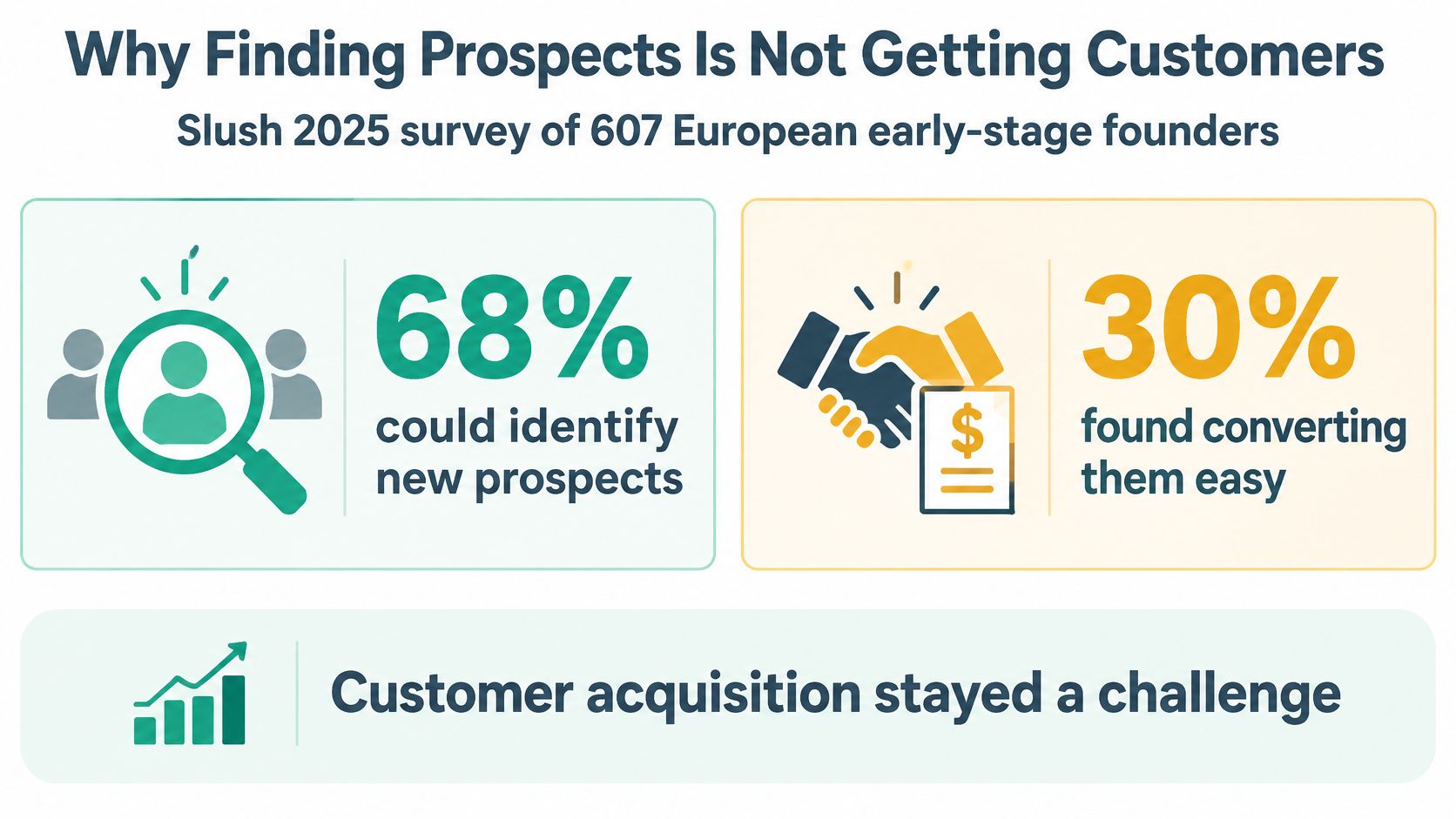
The Slush 2025 survey of 607 European early-stage founders put a number on something operators feel and rarely measure: 68% could identify new prospects, while only 30% found converting them easy, and customer acquisition stayed a challenge for just over half of those founders. Finding names isn't the bottleneck. Turning attention into a credible first purchase is.
Standard advice solves the wrong problem. Join the communities, post the content, send the cold messages. All of that fills a list. None of it tells a stranger why they should hand money to a founder they've never heard of. Buyers of SaaS, AI tools, open-source projects, and courses want proof of three things before they commit: the product is active, the founder ships consistently, and another user is getting a measurable result. Small numbers still work when they move over time. A flat line at 40 users is a warning sign. A line that climbs from 6 to 40 across eight weeks is a business.
If list building is your blocker, a comparison like CapyScout's guide to prospecting software will save you a week of tool shopping. For almost everyone reading this, it isn't the blocker. Conversion is.
So settle the vocabulary before anything else. A first customer is someone who pays, pre-orders, or makes a reward contribution. Not a signup. Not a compliment on the launch post. Not the interview subject who says they'd "definitely use this." Those are inputs, and treating them as customers is how founders spend a quarter feeling busy and end it with zero revenue.
The rest of this playbook runs three stages in strict order: warm validation with one narrow buyer, a payment from someone who came through the same source that produced your first users, then one independent channel you can repeat without exhausting your personal contacts. Before you read on, write a single sentence naming who has this problem this week and what they use instead right now. You'll need it in the next section.
The Sequence From First User to First Payment
Don't pick a channel first. Pick a sequence. An analysis of 462 documented startup journeys found that 68% of first customers came from the same source as the startup's first users, the median first sale was $20, the median delay between a first user and a first payment was zero days, and 70% of those startups began with free users before charging anything (Startup Founder Stories data insights). That's the order of operations, and it's short.
| Stage | Who you talk to | The ask | Advance when |
|---|---|---|---|
| Warm validation | People with the problem this week | Confirm pain, workaround, buying authority, price | The same pain recurs often enough to justify a paid pilot |
| Same-source sale | Users from the channel that created your first users | Pay, pre-order, or contribute | Two payments arrive from that source |
| Fast close | Activated free users | Charge the day the core outcome is obvious | Payment follows activation within days |
| Stay on that source | More people from the winning audience | Repeat the source instead of opening a new channel | Activation and payment hold steady across a second batch |
Why the zero-day median matters more than the $20. The typical first sale in that dataset closed the same day someone became a user, which means the payment ask belongs in the same conversation as the first useful outcome. Founders who wait for a polished launch to start charging are inventing a delay the data doesn't support. Your first buyer is usually an activated user who already understands the product, not a stranger reached by a campaign.
Log three numbers separately. Source, activation, and payment are different counts, kept apart on the same spreadsheet. A busy Discord with 300 members and zero payments isn't demand, it's attendance. When you collapse those counts into one "interest" number, you can't tell which channel to repeat.
Change channels only when the current source produces users who never activate or never pay. A new platform feeling fresher is not evidence.
That rule saves most solo founders a wasted month. The temptation to jump to Product Hunt, a newsletter sponsorship, or LinkedIn when a channel gets quiet is strong, and it's almost always premature. Staying on a source means more of the same people, not the same message blasted wider.
The mechanics of confirming the pain and running the outreach live in the next two sections. What matters here is that you never skip a row to reach the next one faster. Each row has an advance condition, and if you can't name the condition you've met, you haven't met it.
How to Validate Pain Before You Sell
Most founders lose six weeks at this stage by interviewing whoever will talk to them. Friends are polite. Former colleagues want to help. Neither produces a payment. The fix is a founder-led loop aimed at one narrow buyer, such as solo SaaS founders who already track revenue, or open-source maintainers who want community funding.
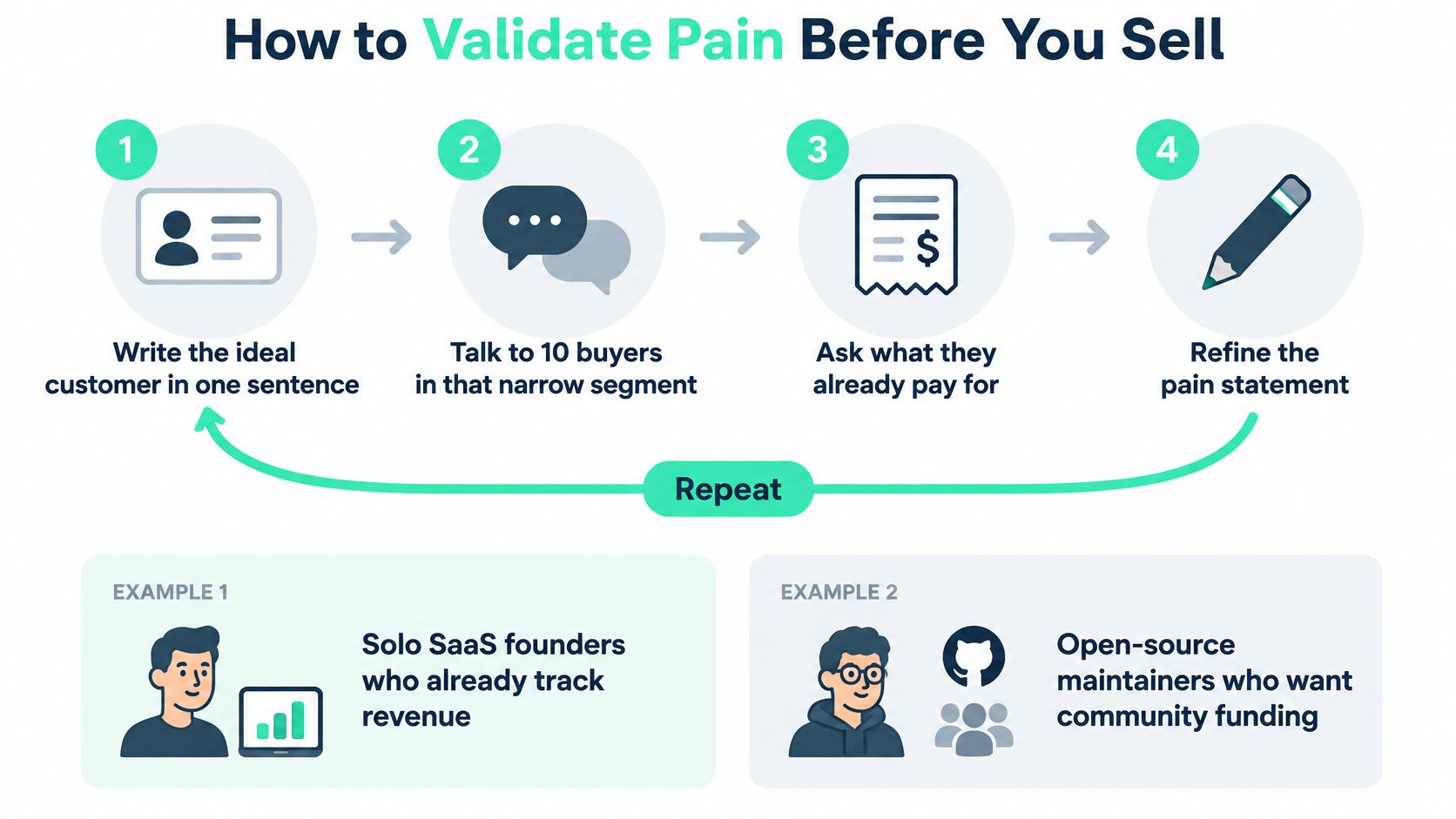
- Write the buyer in one sentence, including the workaround. "Solo SaaS founders who already publish MRR and currently prove traction with a Notion page and a screenshot." The workaround is the thing you're replacing, and if you can't name it, the buyer isn't defined yet.
- Book 20 to 30 structured interviews with people who have the problem now. Not people who might have it. Not people who admire the idea. Twenty calls is roughly two weeks of calendar work if you send 15 personal requests a day.
- Record the same five fields on every call. Pain, urgency, current workaround, buying authority, and the specific price they'd pay. Same fields every time or the tally at the end is worthless.
- Tally before you spend a dollar on acquisition. A threshold from startup KPI guidance puts problem confirmation at at least 60% of 30 or more interviews; below that, revise the segment or the problem hypothesis before investing in growth (validation KPI guidance). This is your first hard stop rule.
- Convert the five strongest interviewees into design partners. One narrowly scoped workflow, onboarded by you personally, in exchange for a paid pilot or contribution. Not "would you like to stay updated." Money or nothing.
- Measure activation separately from payment. Activation means reaching the core value event, such as connecting a data source and sharing the page. Payment and referral conversion are different numbers on different rows.
The whole loop is the front half of validating product-market fit, and the interview notes you collect become your outreach copy later. Write them down in the customer's exact words. "I look unserious next to founders with a dashboard," stolen verbatim from a call, outperforms any headline you'll write from scratch.
Watching a founder run one of these calls tells you more than another article on the topic. This walkthrough shows the structure in practice, including how to ask about price without leading the answer.
The pitfall to name out loud: interviews, signups, and compliments are not customers, and no universal early conversion rate exists to hide behind. Keep a baseline by source and by segment so you can tell whether a change in the numbers came from the message or the audience.
The pass rule: three people who agree to a paid pilot before any public launch. Not three people interested in a pilot. Three who've agreed to a number and a start date.
Price the First Offer Before Asking for Money
Set one price before you send a single outreach note, so every conversation asks for the same thing. The interviews handed you the raw material. Pull the specific figure each interviewee named and use the lowest of them as your floor, never the ceiling you wish existed.
For a solo SaaS founder, three options cover most situations. A one-month pilot at a discounted monthly rate, clearly labelled as an early price, works when the buyer wants to test without procurement. A fixed-price setup session plus the first month works when your time is the scarce ingredient and the buyer knows it. A reward-style pre-order with a dated delivery works when the product isn't finished and the buyer wants to be first in line rather than cheapest.
For open-source or community products, test two things only: a sponsored tier with a named perk and a one-time contribution with a visible outcome attached, such as priority on the roadmap or a support window.
Three rules keep this clean. First, never set the first price below the lowest figure interviewees named. Undercutting the number your own buyers supplied tells them the product is worth less than they thought. Second, if nobody names a number, the segment isn't confirmed yet, and you're back to the interview step rather than forward to the price list. Third, name what the payer gets and when it ships, and state the refund or cancellation rule in the same message. Ambiguity about delivery is what makes early buyers disappear at the payment page.
Keep payment counted by source, not in total. When you raise the price in six weeks, which you probably will, the only way to see whether the increase cost you conversions is a baseline that was already split by channel. This is the same discipline as pricing model validation: a price is a hypothesis with a number attached, and one cohort of five buyers is enough to test the first version.
How to Run a 100-Person Outreach Test
Once the niche is confirmed and one price exists, the pipeline becomes work you can schedule rather than a mood you're in. Build it as a dated 100-person experiment, with a stop rule at each stage.
- Days 1 and 2: build a list of 100 people who match the interview segment, and note one trigger for each: a recent launch, a public metric they posted, a support thread they started. The trigger is why this week and not last month. If you cannot find a trigger for someone, they do not belong on the list.
- Days 3 and 4: write two notes of under 120 words each. One leads with the workaround they're using, one leads with the outcome they described in interviews. Neither contains a feature list. Both end with one small ask.
- Day 5: send batch one to 50 people, and log reply, meeting, activation, and payment as four separate columns. Send batch two the following week only after the first note earns enough replies to keep it worth repeating.
- On a reply, run a diagnostic conversation. Show one outcome, then book a concrete next step with a date, such as a paid pilot starting Monday. If they will not accept a dated next step, mark it interest and move on.
- Give the test the full 100 sends before you judge it. Nearly every solo founder quits early at this stage, and early silence reads worse than it is.
The reason for that patience is the length of the cycle. Salesforce benchmark research cited by TechCrunch found an average 84-day lead-to-opportunity cycle, only 13% of leads becoming opportunities, and fewer than 1% of total leads becoming customers. Read the 84 days again before you conclude a channel is dead in week two.
Treat the first three rows below as judgment calls for your own cohorts. The last two are the benchmarked figures.
| Funnel stage | Directional range | Use it as |
|---|---|---|
| Visitor to signup | No universal range | A check for qualified traffic reaching a clear page |
| Signup to activation | No universal range | Compare against your own cohorts by source |
| Trial to paid, no card taken | No universal range | Judge only after 20 or more trials |
| Lead to opportunity, B2B | 13 percent of leads | Salesforce research cited by TechCrunch |
| Lead to customer, B2B | Under 1 percent of leads | Expect long cycles; average lead-to-opportunity is 84 days |
Two operational details decide whether this is a test or a bad reputation. Personalize the first line with the trigger you found, and before sending batch one, send a test email to confirm your domain lands in the inbox rather than the promotions tab. A hundred careful messages that never arrive look exactly like a failed channel.
If replies stay near zero after both messages across 100 people, the trigger is wrong. Rewrite the trigger and resend to a new 50 before you add a third channel.
The kill rule exists because "try more channels" is the most expensive advice in early sales. Clicks, opens, and upvotes can move while the business stays still. Activated users and payments are the only two columns that decide whether the test passed. And if you find yourself accepting unqualified signups to keep the numbers moving, stop. A list of 40 wrong-fit trials will teach you less than five right-fit ones.
Where to Show Up After Warm Demand Exists
Public channels come after warm users activate and at least one of them pays. Not before. Opening a community presence, a content engine, and a launch simultaneously is how a solo founder ends up with three half-finished experiments and no money.
The trade-off is real, and it's where most channel lists fall apart. Supabase's 2025 State of Startups reports that 37% of startup professionals and founders said AI lowered customer-acquisition cost, while data quality and availability remained a reported implementation challenge for 17%. Efficiency gains don't remove the trust work. They just make the drafting faster.
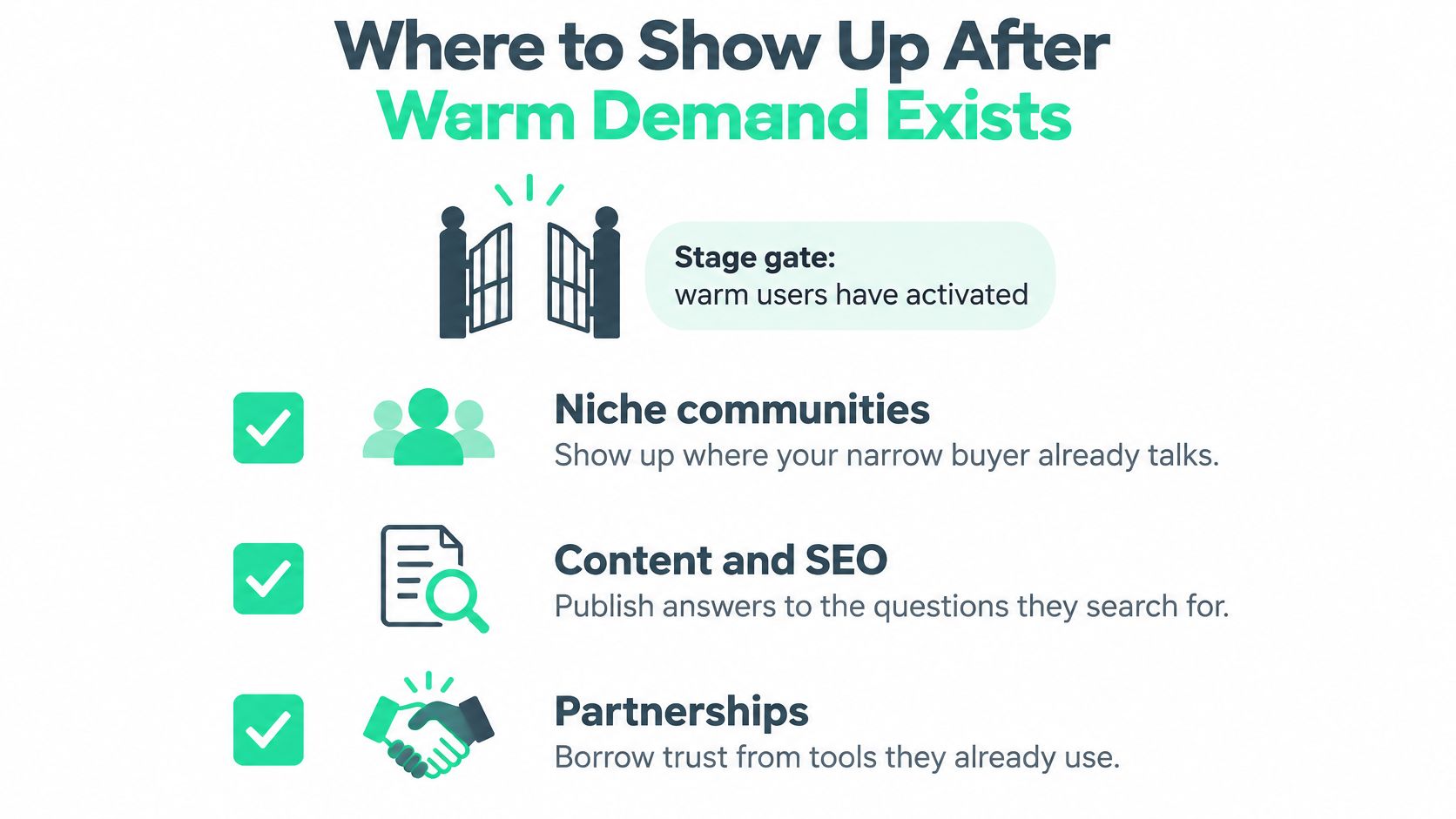
Pick one, and pick it for this week. Niche communities where your buyer already asks for help: answer ten existing threads with a specific fix before you post anything of your own. Open-source distribution through a useful repo, a README that shows the outcome, and real issue replies: ship a small release each week and write what changed. Early-adopter launch platforms get one announcement once a workflow works, with a clear ask and a link to proof rather than a waitlist.
The trap in all three is the same. Network buyers may pay because they know you, and community members may cheer without ever paying. Track source, activation, retention, referral behaviour, and minutes spent per customer. That last number is the one founders ignore, and it's the one that tells you whether a channel is affordable for one person.
The decision rule: before you repeat a channel, one person who doesn't know you has to pay through it.
Most small businesses do run several channels at once, and the data explains why the advice doesn't transfer. In 2025, 91% of small businesses used multiple sales channels, including social media at 54% and their own websites at 53%, per the SBE Council survey. They have staff and an existing customer base. You have a calendar with one name on it.
Referrals deserve their own slot in that schedule rather than a mention. Customer referrals were named the best source for acquiring customers by 65% of small businesses in 2024, rising to 75% among businesses with 10 or fewer full-time employees, according to LocaliQ's marketing trends report. Give introductions a weekly quota the way you'd give any channel one.
Time-box each public channel to two weeks. Keep it only if activation appears from people you didn't already know. AI can draft your replies, and it can summarize threads, but the activity trail on your project page is what persuades a stranger, not the eloquence of the reply.
Convert Trials and Ask for the First Payment
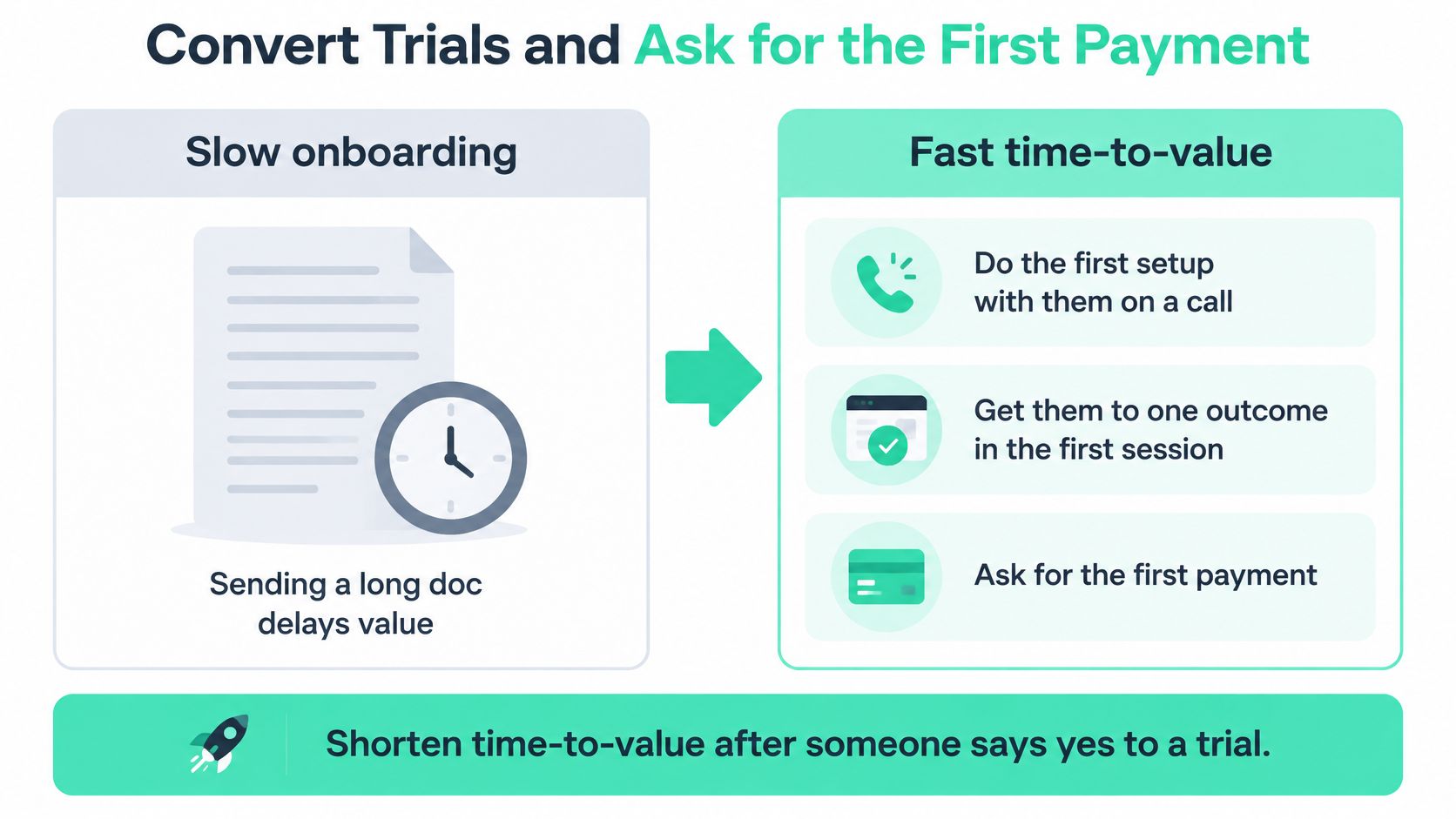
The gap between a yes to a trial and an actual payment is usually a week of your own delay. Close it deliberately.
- Do the first setup with them on a call. Screenshare, take control, finish the connection yourself. A setup document longer than one page is a deferral.
- Get them to one outcome in that first session. A working workflow, a shared proof page, a first export. One, not three.
- Put checkable evidence beside the ask. Match the proof to your product type, using the table below. A stranger wants to see activity, not adjectives.
- Show imperfect numbers as a trend. A four-week line that climbs from 3 paying users to 9 is more convincing than a cropped screenshot of a single good day, and it survives scrutiny.
- Ask for payment in the same week the outcome lands. Name what the payer gets, the date it ships, and the refund rule in the same message.
- Ask every payer for two introductions to people with the same problem. A referral carries trust that no cold message reproduces.
The proof that belongs beside each ask
| Product type | Proof to show | How to show a small number | Ask beside the proof |
|---|---|---|---|
| SaaS or AI tool | Live usage or revenue | A week-by-week trend, not a one-day spike | Paid pilot or first subscription |
| Developer or open-source tool | Releases, commits, and issues closed | A shipping cadence with dates | Sponsored tier or paid support |
| Education product or course | Completion or a learner outcome | How many finished, even if the cohort is tiny | Pre-order or first paid seat |
| Consumer app | Usage plus a clear refund and support path | Current activity and how to get help | First purchase or reward contribution |
Put one proof link in the ask itself, not a folder of screenshots you'll forget to update. On Fundl, a project page displays live, source-verified data pulled from connected platforms so backers can inspect the numbers before they contribute, creating one is free and needs no backers, and setup takes about 5 minutes.
The honest number beats the big number. Buyers can tell when a metric was refreshed last quarter, and they price that doubt into the offer.
Shortening time to value is also the most impactful thing you can do to improve conversion rates, because a trial that never reaches the core outcome can't convert no matter how good the pitch was. Concierge setup, prebuilt metric mappings, and one shareable page do more than a redesigned landing page.
Here's the stop check. If people reach the outcome and still won't pay, the problem is the offer or the price, not distribution. Fix that before you launch anywhere new. Reaching activation and refusing to pay is a message, and it's a louder one than silence.
Fundl is built for the moment when you have real activity to show and no polished pitch to wrap around it. Connect Stripe, GitHub, or an analytics source, publish a traction page that refreshes itself, and let the numbers do the persuading while you keep asking for the payment. Visit Fundl to set up your first verified page and put it in front of the next five people you ask.