
Most funding advice starts with the wrong question: How much money can you raise? The better question is, what will this money make you give up? A larger angel round can accelerate hiring and product development, but it can also introduce negotiated ownership, reporting expectations, investor influence, and a relationship you'll manage long after the wire arrives.
Crowdfunding and angel investing are not just two ways to fill the same bank account. They solve different founder problems. Reward-based crowdfunding can help you prove demand without selling equity. Angel investing can provide concentrated capital and experienced support, but usually in exchange for ownership and a more involved financing relationship.
| Decision factor | Crowdfunding | Angel investing |
|---|---|---|
| Primary exchange | Rewards, pre-orders, or investment depending on the model | Equity or a convertible instrument for capital |
| Backer structure | Many smaller supporters | One investor or a small syndicate |
| Main founder benefit | Validation, distribution, and potential ownership preservation | Larger concentrated capital and strategic guidance |
| Main hidden cost | Campaign work, fulfillment, and ongoing backer communication | Dilution, negotiation, and governance expectations |
| Best fit | A product with an audience that can show demand | A company that needs capital and hands-on support to scale |
Table of Contents
- Why the Crowdfunding and Angel Question Is Often Misunderstood
- How Crowdfunding and Angel Investing Actually Work
- Capital Structure, Dilution, and Regulatory Differences
- Performance, Validation, and Long-Term Founder Value
- Real-World Scenarios That Determine the Better Choice
- How to Decide Between Crowdfunding and Angel Investing
- Key Takeaways for Founders Choosing Their Funding Path
Why the Crowdfunding and Angel Question Is Often Misunderstood
The popular advice says equity is the “serious” option and crowdfunding is what founders use before they're ready for real investors. That framing is outdated and often harmful. For a traction-first founder, selling ownership before proving demand can create a permanent governance cost for a problem that a well-run reward campaign could have solved.
A reward-based campaign can give you more than cash. It can test whether people will commit money to a product, create a group of early customers, and generate public evidence that your idea has an audience. You still have to deliver what you promised, but you haven't automatically added a shareholder who expects influence over future decisions.

Capital has a carrying cost
Angel money can be valuable when an investor brings relevant operating experience, customer introductions, recruiting help, or follow-on support. It can also become expensive if you accept capital from someone who wants regular access, strategic influence, or approval rights without doing useful work.
Crowdfunding has a different burden. Instead of managing one concentrated relationship, you may need to communicate with many backers, answer questions publicly, handle delivery expectations, and protect trust when plans change. That workload matters, especially for a solo founder who is also building the product.
Practical rule: Choose the funding model whose obligations match the way you already operate. Don't accept a governance-heavy relationship merely because the cheque is larger.
The United States illustrates why crowdfunding deserves more respect as a financing channel. Investment crowdfunding grew from fewer than 100,000 investments per year in its early years to roughly 200,000 in 2019, then nearly doubled again in the following two years. By 2021, nearly 1,500 offerings raised about $440 million in a single year, and from 2016 through 2021 more than 4,000 companies raised over $1 billion from more than 1.3 million investors in the U.S. crowdfunding market.
That scale doesn't make crowdfunding automatically better. It does show that distributed participation can fund real businesses. The choice comes down to whether your next milestone requires public proof and autonomy or concentrated capital and experienced intervention.
How Crowdfunding and Angel Investing Actually Work
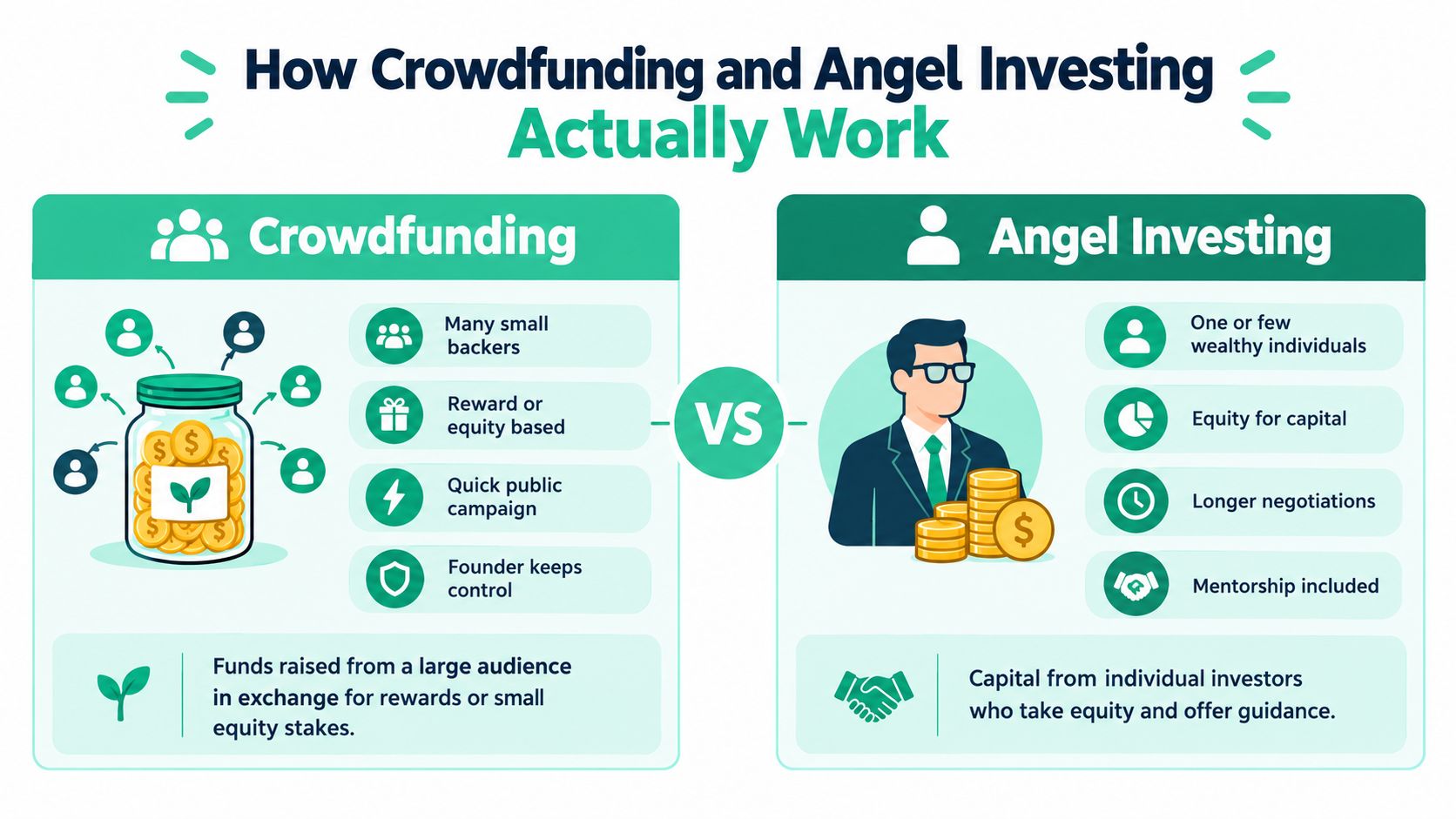
Crowdfunding is an umbrella term, so start by identifying the exchange. In reward-based crowdfunding, people contribute money in return for a product, early access, a service, or another benefit. They aren't buying part of your company. That makes the model particularly useful for founders who need to finance production or test demand without giving away ownership.
Equity crowdfunding works differently. Backers invest for an ownership stake or another financial instrument, and the company takes on disclosure and compliance obligations. Debt crowdfunding creates a repayment relationship. For this article's traction-first use case, reward-based crowdfunding is the clearest comparison with angel investing because it can provide a demand signal without creating an investor cap table.
Angel investing is concentrated by design. One individual or a small syndicate provides capital in exchange for negotiated equity, a convertible note, or another instrument that can create ownership later. The investor may also offer introductions, advice, recruiting support, and scrutiny. Those benefits can materially help a company, but they also create an ongoing relationship that needs clear boundaries.
The practical difference for founders
A campaign asks you to persuade a broad audience. Your landing page, demo, pricing, proof of demand, and updates all contribute to the result. The audience may include customers, fans, developers, or people who want the product to exist.
An angel round asks you to persuade a smaller number of people through private conversations and diligence. The investor evaluates the market, team, traction, terms, and potential return. You may close faster once a committed investor appears, but reaching that point often involves repeated meetings and negotiation.
| Operating question | Reward-based crowdfunding | Angel round |
|---|---|---|
| Who validates the idea? | Prospective customers and community members | An investor or investment group |
| What does success signal? | People are willing to support or pre-order the offer | An investor believes the company can produce a financial return |
| What happens after funding? | Fulfillment, updates, and customer support | Reporting, investor communication, and agreed rights |
| What does the founder protect? | Usually ownership, subject to campaign obligations | Potentially speed and expertise, in exchange for equity |
A campaign can therefore function as marketing and financing at the same time. An angel round is primarily a capital transaction, even when the investor is helpful. Founders comparing platforms can also review how a SaaS crowdfunding platform works before deciding whether their product is suited to public validation.
The important distinction isn't “many investors versus one investor” by itself. It's whether you want your funding process to generate customers and public evidence or to establish a private capital and advisory relationship.
Capital Structure, Dilution, and Regulatory Differences
The cheapest capital can create the most work. Reward-based crowdfunding may preserve your ownership, but it turns funding into a public operating promise. Angel money can move faster once conviction is established, yet it introduces investors, documents, reporting, and possible limits on how you run the company.
A reward campaign usually raises non-dilutive funding through pre-orders or community contributions. You keep your shares and voting control, while accepting responsibility for delivery, updates, refunds, and customer support. If production slips, backers do not disappear because they do not own equity. They may still demand answers, post criticism, or ask for their money back.
Angel investing creates a negotiated ownership relationship. The instrument may be priced equity, a convertible note, or a SAFE-style arrangement. The document matters more than the label “angel.” It determines future dilution, conversion terms, decision rights, information rights, investor access, and the complexity of your cap table. Accepting money from several angels can also create a coordination burden that a single lead investor would not.
Why angel money is concentrated
Angel investing remains a larger and more concentrated source of early-stage capital than crowdfunding in major markets. One U.S. analysis recorded about $22 billion deployed by angels in 2011 across roughly 66,000 companies, while a later Kauffman study reported 8,900 firms receiving angel investment in 2014 in the cited U.S. analysis.
Angel checks commonly fall between $25,000 and $100,000, and the median U.S. angel deal has stayed around $250,000 over the past decade. An average angel round of about $339,390, a typical valuation near $3.5 million, and a 24.2% yield rate in 2023 illustrate how selective the process can be. Treat those figures as market context, not a forecast for your company.
You do not submit a product and wait for a crowd. You build conviction with a limited number of investors who may expect regular updates, access to information, and a meaningful relationship. That relationship can provide useful judgment, but it can also slow decisions if governance terms are broad or several investors must be consulted.
Regulation changes the workload
In the United States, Regulation Crowdfunding permits eligible offerings of up to $5 million per year, subject to its rules and use of an appropriate registered intermediary under the Regulation Crowdfunding framework. Non-accredited participants can invest through registered portals, subject to investment limits and other requirements described in this overview of angel investing access.
Public fundraising still requires preparation. A securities campaign can involve disclosures, financial information, portal coordination, legal review, and ongoing reporting. Reward-based crowdfunding avoids an equity transaction, but replaces much of that legal work with campaign execution, manufacturing, fulfillment, support, and reputation risk.
Founder test: Before comparing headline amounts, list the obligations attached to every dollar. Dilution, reporting, investor access, delivery, refunds, and decision rights are part of the price.
European angel markets also show that funding may arrive through many smaller rounds rather than a few large transactions. For a founder, the practical lesson is simple: a modest angel round can still create a lasting ownership and governance relationship. If autonomy and speed matter more than investor guidance, keep the structure simple and raise only what the operating plan requires.
Founders assessing non-equity options can start with this guide to what non-dilutive funding means.
Performance, Validation, and Long-Term Founder Value
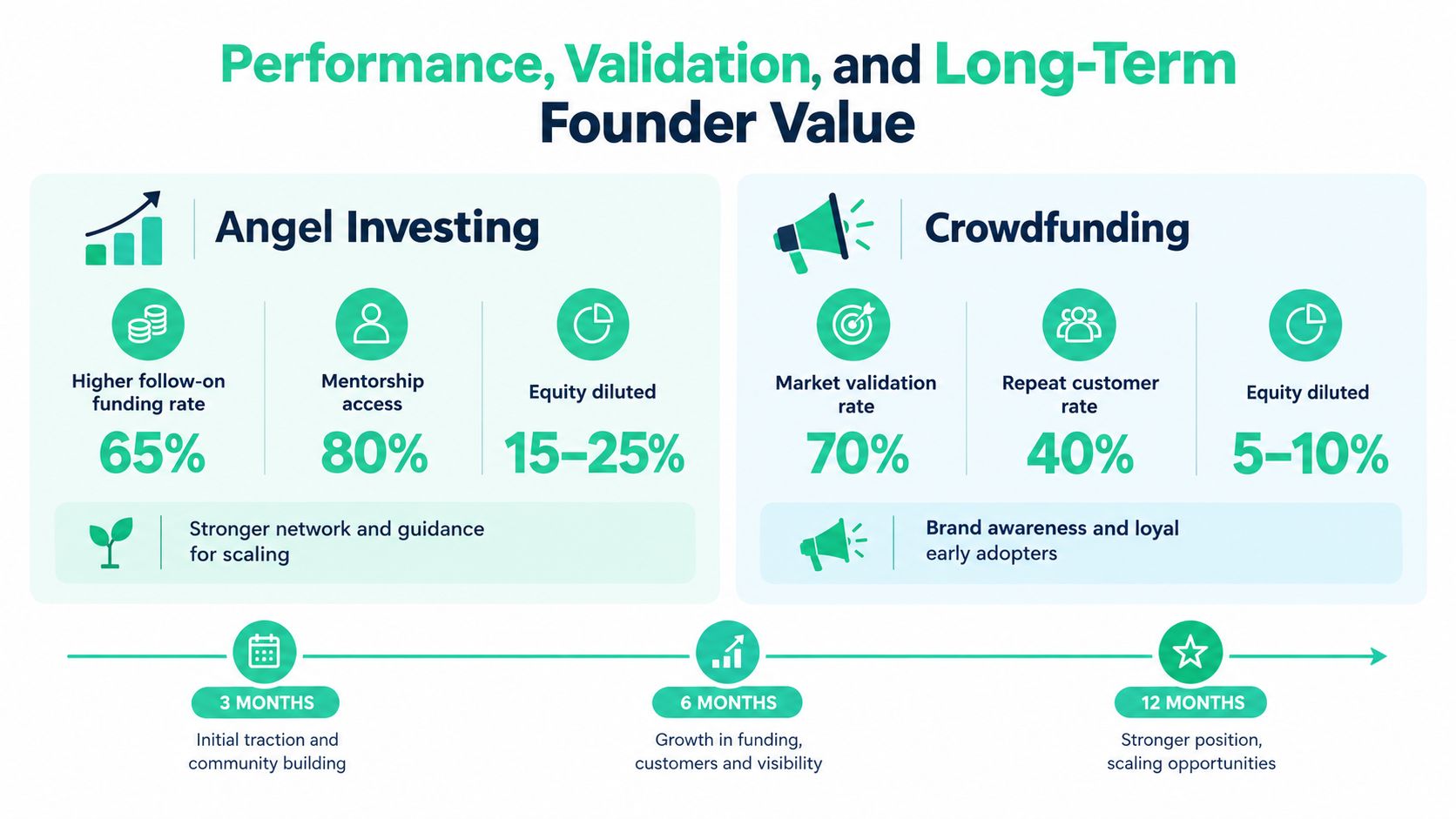
A funding model can create value without producing the same kind of return. Angels usually assess a company as an investment. Reward backers assess a product as customers or supporters. Those audiences produce different signals, and founders make mistakes when they treat a successful campaign as equivalent to an investor-grade return benchmark.
Angel investing has stronger historical performance evidence. A review of private-market studies cited by Crowdwise found average historical angel-investing IRRs of about 26.6%, with study results ranging from 17.6% to 37.6%. The same review found Reg D equity-crowdfunding datasets with a wider, thinner-sampled range of roughly 17.4% to 41% in the cited private-market review.
That comparison doesn't tell you whether your campaign or round will succeed. It tells you what each model is generally designed to measure. Angels want a path to financial return across a portfolio. Crowdfunding often earns its keep through demand validation, community distribution, and access to capital.
Validation is not the same as mentorship
An angel can challenge your pricing, introduce a buyer, help recruit an executive, or prepare you for a later financing conversation. That support is concentrated, so you know who owns the relationship and who is accountable for helping.
A crowd can validate a different set of questions. Will people pay before the product is complete? Does the offer make sense without a private explanation? Can you turn attention into orders, feedback, and repeat usage? Those answers can improve your product and strengthen later investor conversations, but they don't replace operating expertise.
Crowdfunding also creates a public record of your ability to communicate. A campaign gives potential customers a reason to share your product, while an angel pitch is usually private. For an indie hacker, that distribution may be more valuable than advice that arrives in occasional investor calls.
Measure the signal you actually need
Don't call every contribution traction. Separate:
- Interest, such as sign-ups, comments, or social engagement.
- Commitment, such as a paid pre-order or contribution.
- Delivery, meaning you shipped what supporters paid for.
- Durability, shown by continued use, renewals, referrals, or repeat purchases.
If you need to explain progress to future investors, use a clear traction framework rather than relying on a campaign total. The more precisely you connect funding to customer behavior, the more useful the signal becomes.
The long-term value question is therefore not “Which model has the better return?” It's “What evidence and support will help this company reach its next milestone without creating a bigger operating problem?” An angel may be the right answer for a complex enterprise sale or a capital-intensive build. A reward campaign may be the better answer for a founder who needs customers to prove the product before accepting ownership terms.
Real-World Scenarios That Determine the Better Choice
A solo founder building a small SaaS product usually doesn't need an investor who wants to debate every roadmap decision. They need enough evidence that customers will pay, a way to finance focused development, and the freedom to change direction quickly. A reward-based campaign can fit that situation when the founder already has a clear offer and an audience willing to act.
An angel becomes more attractive when the company needs a relationship, not just money. Suppose the product requires enterprise introductions, regulated-market expertise, or a senior hire the founder can't make alone. A well-chosen angel can shorten those paths. The wrong angel, however, adds meetings and opinions without opening the doors the founder expected.
Four founder profiles
The traction-first indie hacker. Choose reward-based crowdfunding when the product is usable, the audience understands the problem, and early supporters can contribute before a major build-out. The campaign should fund a defined milestone, not an indefinite promise.
The open-source builder. Crowdfunding can turn an existing user community into financial support without forcing the project into a venture-scale growth story. The founder must be explicit about what contributions fund, what supporters receive, and how product decisions remain independent.
The consumer product founder. Public funding can work when a physical or digital product is easy to demonstrate and backers can understand the offer quickly. Fulfillment is the hard part. If manufacturing, support, and delivery aren't under control, public enthusiasm can become a customer-service crisis.
The ambitious enterprise startup. Angel investing may be the stronger route when the company needs concentrated capital, high-touch introductions, and experienced guidance through a long sales cycle. The founder should choose an angel for specific capabilities, not for status.
My recommendation: If you can prove demand with customers, do that before selling ownership. If you need a particular investor's access or judgment to reach the next milestone, negotiate for that value explicitly.
The best sequence can also combine approaches. A founder might use reward-based support to validate a product, deliver to early customers, and then approach angels with evidence rather than a concept. That doesn't guarantee investment, but it gives the founder a stronger negotiating position and a clearer view of what the company needs.
How to Decide Between Crowdfunding and Angel Investing
Start with the milestone, not the funding label. Write one sentence describing what the money must accomplish. “Finish the product” is too vague. “Deliver the first customer-ready version, test paid demand, and reach a repeatable onboarding process” gives you something to fund and measure.
Then score each option against five constraints.
Control: How much authority do you want to retain over product, pricing, hiring, and timing? Reward-based funding generally preserves ownership, while angel financing introduces negotiated rights and expectations.
Speed: Are you able to launch a public campaign now, or do you need private conversations to secure a larger concentrated round? Campaign preparation takes work. Angel fundraising takes meetings, diligence, and negotiation.
Proof: Do you need customers to validate the offer, or do you need capital and specialist judgment to build it? Don't use an angel round to answer a customer question that a paid test could answer.
Governance: Who will contact you after funding? For a crowd, define update cadence, delivery commitments, and support boundaries. For an angel, define introductions, reporting, decision rights, and the specific help you expect.
Future flexibility: Model what happens if you change pricing, pivot the product, or raise again. A funding choice that works today can restrict tomorrow's options if it creates expensive obligations or complicated ownership.
Match the model to the evidence
Choose crowdfunding when you can show the product clearly, reach a relevant community, and turn contributions into a defined delivery plan. For a live-traction campaign, a platform such as Fundl can connect creator data sources including Stripe and GitHub to a shareable page with refreshed metrics, while contributions remain reward-based and are processed through the creator's Stripe account.
Choose angel investing when the company has a capital need that customers can't solve through pre-orders or support, and when a particular investor can contribute more than money. Ask what they will do in the first month, not just what they did for another company.
If neither option fits, keep the company smaller, pursue revenue, or look for grants and other non-dilutive sources. The right answer may be to delay fundraising until the company has a sharper use for capital.
Key Takeaways for Founders Choosing Their Funding Path
Crowdfunding is the stronger choice when your priority is demand validation, community support, and ownership preservation. Angel investing is the stronger choice when you need concentrated capital, strategic access, and hands-on guidance. Neither model is automatically faster or cheaper, because each creates a different operating workload after the money arrives.
Make the decision around your next milestone. If customers can prove the idea, earn that proof before selling equity. If a specific angel can remove a serious execution barrier, negotiate the relationship as carefully as the valuation.
Fundl helps founders raise reward-based support around live traction, with shareable pages that connect evidence such as Stripe and GitHub data to the campaign. Visit Fundl to turn your metrics into a transparent funding page and start asking backers for support on terms you control.