
In the third quarter of 2025, global startup funding totaled $97 billion, and AI companies received 46% of that money, according to Crunchbase. The headline looks like a boom. For a first-time founder outside that cluster, it is closer to a crowded on-ramp with a few very wide lanes.
Fundraising for startups is a decision under concentrated capital. First decide whether a round is even the right move. Then size a smaller check that reaches one milestone, pick a source that matches how much control you can give up, and publish evidence a stranger can verify. The gap before the next round is often long. A tidy pitch deck does not keep you alive through it. Comparable numbers do.
Table of Contents
- Fundraising Stages and Typical Round Sizes
- Deciding Whether to Raise at All
- Sizing Your Round Without Overpromising
- Funding Sources Compared by Dilution and Control
- How to Build Your Pitch Materials
- Metrics Investors Check Before the First Meeting
- Round Instruments and the Timeline to Close
- Confirm Your 30-Day Fundraising Plan
Fundraising Stages and Typical Round Sizes
Match your current stage to the round and the investor type in the table. The stage is set by evidence, not by ambition.
| Stage | Typical round size | Usual lead investors | Traction investors expect |
|---|---|---|---|
| Pre-seed | $250,000 to $1 million | Founders, friends and family, angels, pre-seed funds | Working prototype, first users, a clear problem |
| Seed | $1M to $4M | Seed funds, angels, micro-VCs | Repeatable acquisition signal, early revenue or strong usage |
| Series A | $8M to $20M | Venture firms | Consistent monthly revenue growth, retention data, a proven channel |
| Series B | $25M to $60M | Growth-stage VCs | Scalable unit economics, expansion into new segments or markets |
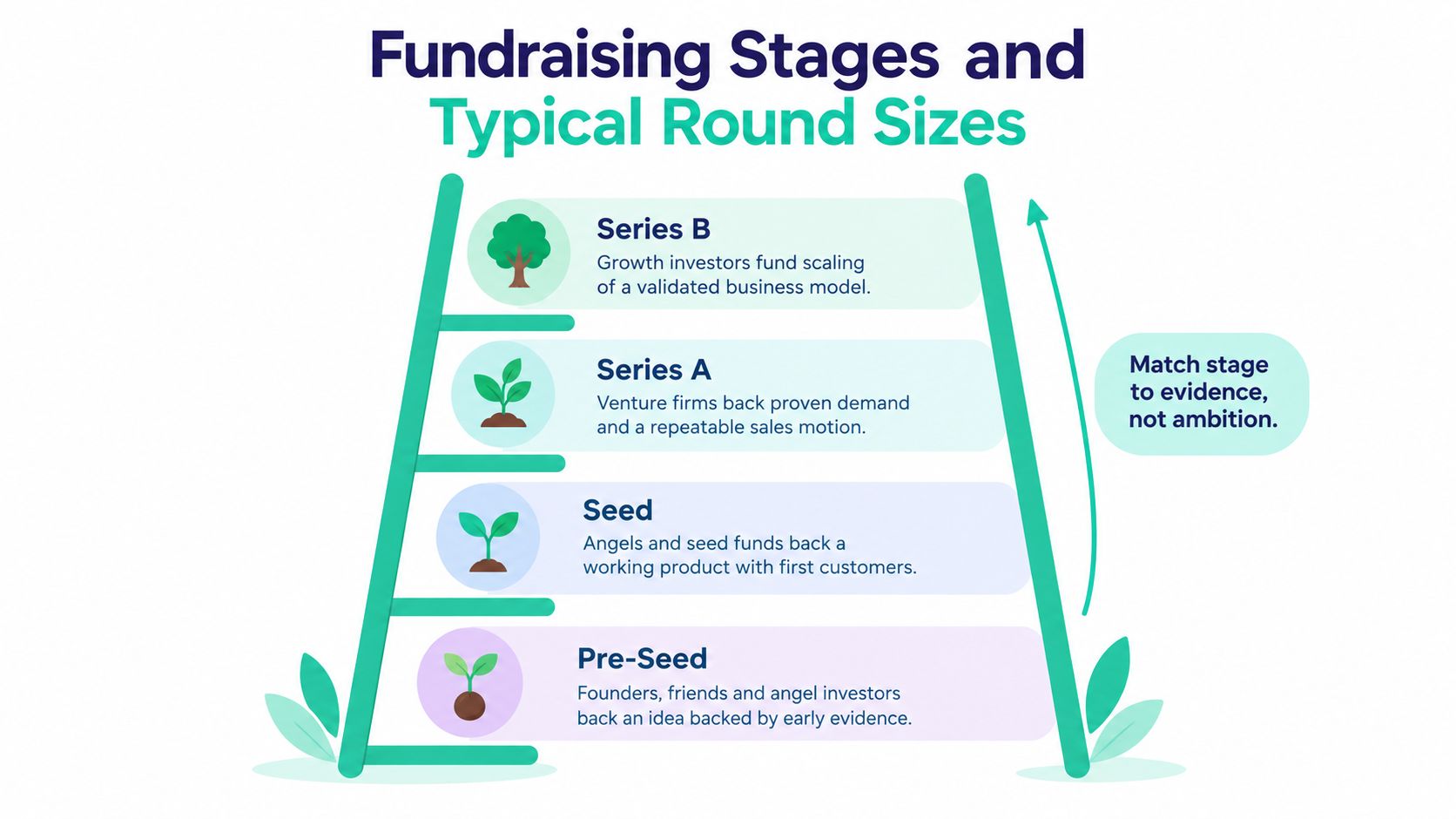
Think of the stages as rungs on a ladder. You don't skip a rung because the view from the top looks better.
What each rung asks you to prove
Pre-seed is the seedling. Founders, friends, angels, and small pre-seed funds back an idea that already has a prototype and a few users. If you are still shaping that first check, our guide to pre-seed funding walks through what that earliest rung usually includes.
Seed asks for a working product and a repeatable way to find customers, plus early revenue or heavy usage. Series A asks venture firms for consistent monthly revenue growth, retention, and one channel you can describe without hand-waving. Series B is for growth investors who want unit economics that still work as you enter a new segment.
These ranges are approximate for U.S. deals. A deep-tech company and a consumer app will not see the same check at the same rung.
Why the headline total misleads a small team
KPMG reported that global VC investment increased from $349.4 billion across 43,320 deals in 2023 to $368.3 billion across 35,684 deals in 2024. Dollars rose 5.4%, while the deal count fell about 17.7% to a seven-year low, and the implied average deal moved from roughly $8.1 million to about $10.3 million.
Bigger checks are landing on fewer, more proven companies. Timing and evidence matter more than the yearly total.
Self-check: Name your stage, write the one proof point that stage expects, and stop. Don't open a raise for the rung above the one you can actually stand on.
Deciding Whether to Raise at All
Should this company raise at all? Run four checks before you book a single meeting.
- Odds. Dollars can rise while the number of companies that close a round falls. A J.P. Morgan startup briefing found that only 18% of surveyed European founders said raising money would currently be easy, while 57% disagreed. Treat a hot headline as someone else's market until your segment shows the same pattern.
- Revenue. If customers already pay you, test bootstrapping or revenue-based financing before you sell shares. Neither path adds dilution.
- Segment. If you are outside AI or outside the United States, ignore the global pile and count only the capital that closes in your niche.
- The gap. Plenty of seed companies never reach a Series A, and the wait is long enough that a short runway becomes the biggest risk.
The rule is simple. Raise when the next milestone needs more cash than revenue can fund, and you can keep the company alive for up to about two years. Otherwise plan for revenue-funded survival, a smaller target, and lower burn.
Write the decision down with the date. Revisit it each quarter against the same metrics you put in your monthly note. A blunt read from CEO peer groups often catches a raise that is really a delay in cutting burn.
Sizing Your Round Without Overpromising
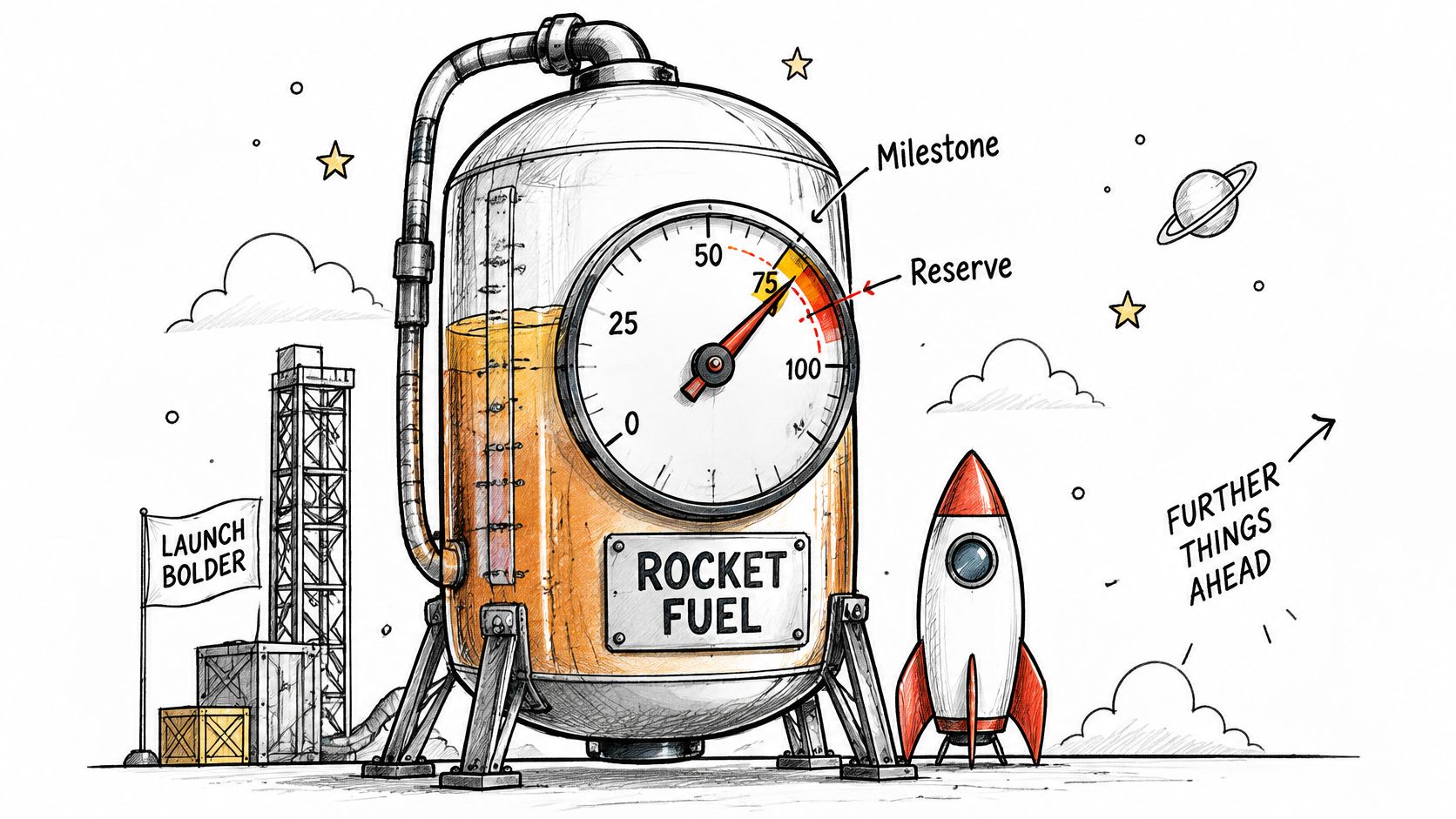
Treat the round like a fuel tank. Fill it to the next milestone, plus a reserve for delays. Don't fill it to the brim because a bigger number sounds serious.
A worked tank
Say net burn is $60,000 a month and the milestone is 18 months out. Eighteen times $60,000 is $1.08 million. A raise itself can take three to six months, and shipping slips, so add a three-month buffer of $180,000. The need is about $1.26 million, which you can round to $1.25 million for the ask.
Then price the equity. A $1.25 million raise at a $6 million post-money valuation sells about 20.8% of the company. That is $1.25 million divided by $6 million. If that slice feels too large, the fix is a smaller burn or a nearer milestone, not a fantasy valuation.
Subtract cash already in the bank and revenue you have contracted. If you hold $200,000 and a signed customer will pay $50,000 during the window, the outside need drops by $250,000. Then check the answer against the milestone. If the money runs out before that proof exists, the round is too small. If it funds two milestones you have not earned yet, it is too big.
Reward targets stay narrow
On a reward or community campaign, tie the goal to one deliverable: infrastructure, a compliance step, or a named release. An analysis of more than 4,200 reward-crowdfunding campaigns found that larger funding targets were associated with lower probabilities of rapid success, while campaigns with more pledges had higher success hazards, as summarized in this campaign-design study. Backer count and average contribution also tracked with success, and the target amount worked the other way.
Raising far above need adds dilution and a story you must keep beating. Raising far below need forces another round before the milestone lands.
A short walk-through of how founders talk about round size with investors is worth fifteen minutes before you lock the number.
Funding Sources Compared by Dilution and Control
Each source is a different fuel. The price is equity, control, or time.
| Source | Dilution | Control given up | Time to cash | Best fit |
|---|---|---|---|---|
| Bootstrapping from customer revenue | None | None | Ongoing, limited by revenue | Products already earning money |
| Friends and family | Equity or SAFE | Low to medium | 2 to 6 weeks | Early teams with personal backing |
| Angel investors | Usually 10% to 20% per round | Low, sometimes advisory | 1 to 3 months | Pre-seed and seed, strong founder |
| Seed venture capital | Usually 15% to 25% per round | High, board seat and reporting | 3 to 6 months | Fast growth in a large market |
| Accelerators | Usually 5% to 10% for a small check | Medium, program dates | Fixed program calendar | Founders who need a network |
| Grants | None | Low, reporting duties | 3 to 12 months | Research or public-benefit work |
| Revenue-based financing | None | Low, repay from revenue | Weeks | Predictable recurring revenue |
| Reward-based crowdfunding | None | Low, rewards must ship | Often 30 to 60 days | A visible audience and real perks |
Reward contributions are not investments. They carry no equity, ownership, debt, or financial return. You owe the promised perks, and nothing more. If dilution is the constraint, start with non-dilutive funding for startups and only then look at priced equity.
Crunchbase data shows annual global startup investment roughly doubled from 2014 to about $300 billion in 2024. That year, AI companies attracted more than $100 billion, and U.S.-based startups received 56% of global venture capital. Don't treat that pile as money sitting in your segment.
Match the source to revenue quality, growth rate, and how much control you can realistically give away.
How to Build Your Pitch Materials
Investors read before they meet you. Each document has to stand alone, because the person who opens the folder may never hear your voiceover.
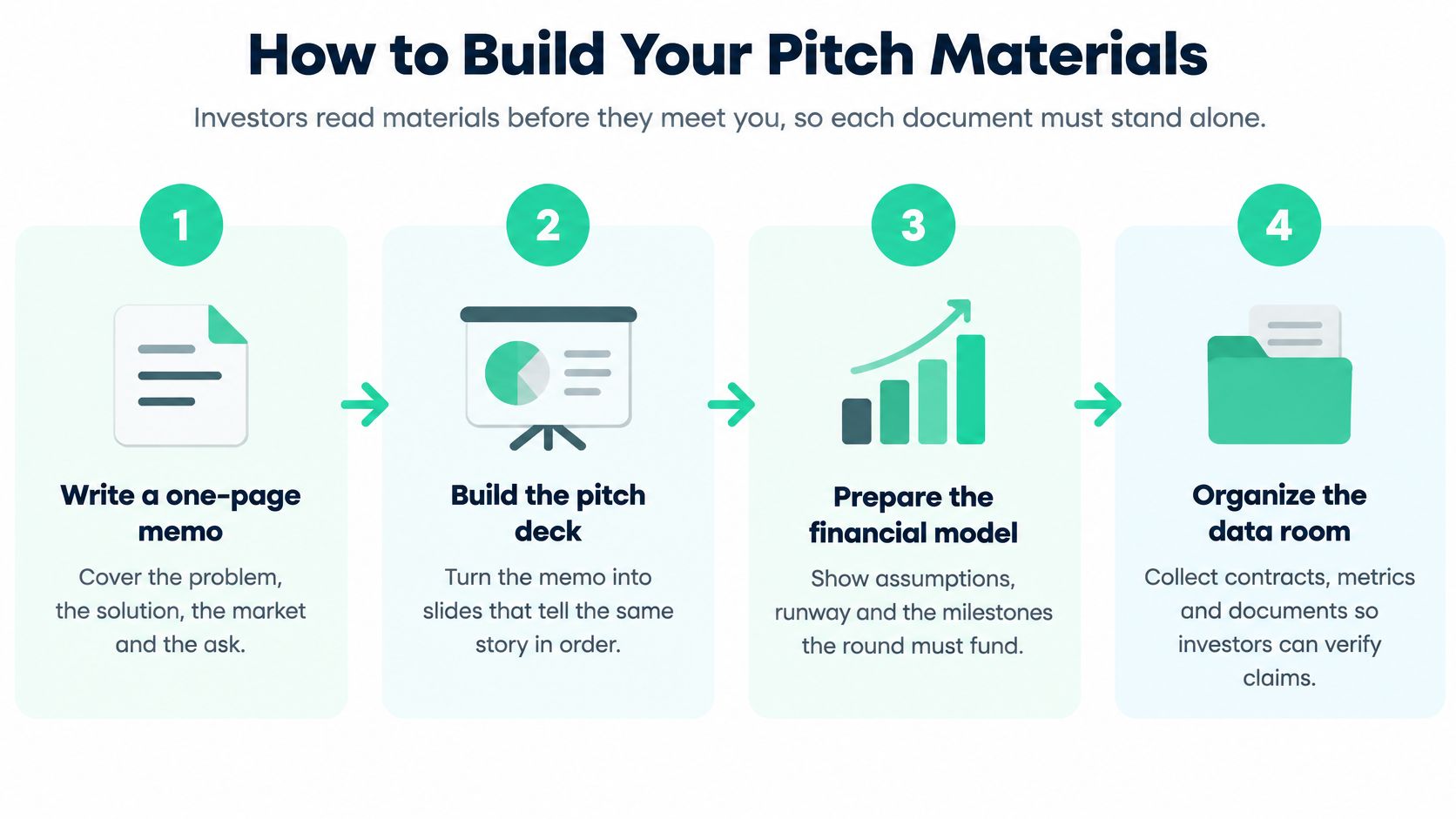
- Write a one-page memo. Cover the problem, the solution, current traction, the round size, and the use of funds, and keep it under 600 words. The common miss is a memo that reads like a slogan and never states the ask.
- Build a 10 to 12 slide deck in this order: problem, solution, market, product, traction, business model, competition, team, ask, and use of funds. The usual hole is a deck with no traction slide, so the story never touches the ground.
- Build an 18 to 36 month model with a base case and a downside case, and tie every hire to a revenue milestone. A fractional partner who lives in startup cash flow and financial forecasting will catch a model that grows revenue without showing what that growth costs.
- Prepare the cap table and a draft of the round, with post-money ownership for each scenario you could realistically sign. Forgetting the option pool is how founders discover they sold more than they thought.
- Assemble a data room: incorporation documents, IP assignments, key customer contracts, and a metrics export that includes definitions. A screenshot folder is not a data room.
- Write a two-minute spoken summary and a three-line investor email, then test both on someone who has never seen the product. If they can't repeat the problem, the lines are still about you.
- List the twenty hardest questions, including the weakest part of the business, and draft honest answers. Dodging the weak spot in writing is how it ambushes you in the room.
Metrics Investors Check Before the First Meeting
Investors and backers want numbers they can recompute. A single impressive screenshot does not survive a second look.
| Metric | How to define it | Rough early-stage benchmark | What it signals |
|---|---|---|---|
| Monthly recurring revenue and growth | Recurring revenue per month and month-over-month change | Consistent growth of 10% to 20% a month is strong at seed | Demand is real and compounding |
| Gross margin | (Revenue minus cost of revenue) divided by revenue | Above 70% once software costs dominate | Pricing can support scale |
| Net revenue retention | Revenue from existing customers, including expansion, divided by starting revenue | Above 100% | Customers stay and spend more |
| Logo churn | Share of customers lost in a month | Under 3% to 5% a month for small-business products | The product fits an ongoing need |
| CAC payback | Months of gross margin needed to recover acquisition cost | Under 12 months | Growth can pay for itself |
| LTV to CAC | Customer lifetime value divided by acquisition cost | 3 to 1 or higher | Acquisition spend creates value |
| Burn multiple | Net burn divided by net new annual recurring revenue | Under 2x is good, under 1x is excellent | Growth is efficient with cash |
| Runway | Months of cash remaining at current net burn | 18 months or more before you start a raise | Time to run a process without panic |
These benchmarks are rough guides for early-stage SaaS. A marketplace, a services product, and an infrastructure tool will not share the same healthy range. Say which business you are before you quote a target.
Definitions that don't move
A study of 21,270 Kickstarter campaigns posted from July 2019 through July 2020 found funding success tied to multimedia, extensive disclosure, team participation, third-party recognition, prior successful funding, risk disclosure, and transparent execution detail. The practical translation is source-linked revenue, a stated active-user window, known risks, and an explicit split of how funds will be used.
Timestamp every metric. Separate monthly active users from registered accounts. Say whether revenue is gross, net, or recurring. A changed definition reads as a flattering rewrite, even when the business improved. For a fuller pass on what to publish, see how to show traction to investors.
Publish a short monthly note that explains what moved, what shipped, what fell, and which experiment failed. Updates that only celebrate are less trusted than updates that stay comparable.
Round Instruments and the Timeline to Close
Most early rounds use a standard instrument. The choice mainly decides who absorbs dilution when later money arrives.
| Instrument | How it converts | Who bears later dilution | Typical use |
|---|---|---|---|
| Pre-money SAFE | Ownership is calculated before other SAFEs convert | Earlier SAFE holders and existing holders share it | Pre-seed and seed with simple terms |
| Post-money SAFE | Ownership is fixed against a cap that includes all SAFEs | Founders absorb it | The most common pre-seed and seed instrument |
| Convertible note | Debt converts at a discount or a cap, with interest and a maturity date | Existing holders take the extra shares set by the cap and discount | Bridge rounds between milestones |
| Priced seed round | New shares sell at a set price, with full documents | All holders share pro rata | Seed with a lead investor and a board seat |
If you want a plain tour of how these structures show up in real rounds, explore startup funding rounds before you negotiate the cap.
A realistic calendar
Plan two to four weeks to finish materials. Spend the next four to six weeks building a list of thirty to fifty investors who write checks at your stage. First meetings, follow-ups, and diligence then run for several more months. Verbal yeses that stall in diligence are normal. Keep the data room current, and keep a backup list so one slow partner doesn't freeze the round.
Duet Partners, summarizing Carta cohort data, reports that only 15.4% of U.S. startups progressed from seed to Series A on the latest measure, versus 30.6% for the 2018 cohort. The median time from seed to Series A reached roughly 774 days, compared with 420 days at the 2021 peak. Start the next raise with 18 to 24 months of runway, not six.
Before you sign, read the conversion math and the cap. The headline valuation is the least important line on the page.
Confirm Your 30-Day Fundraising Plan
If you can name your stage, your round size, and your source, you can start. If one of those three is still a guess, another week of outreach will not fix it.
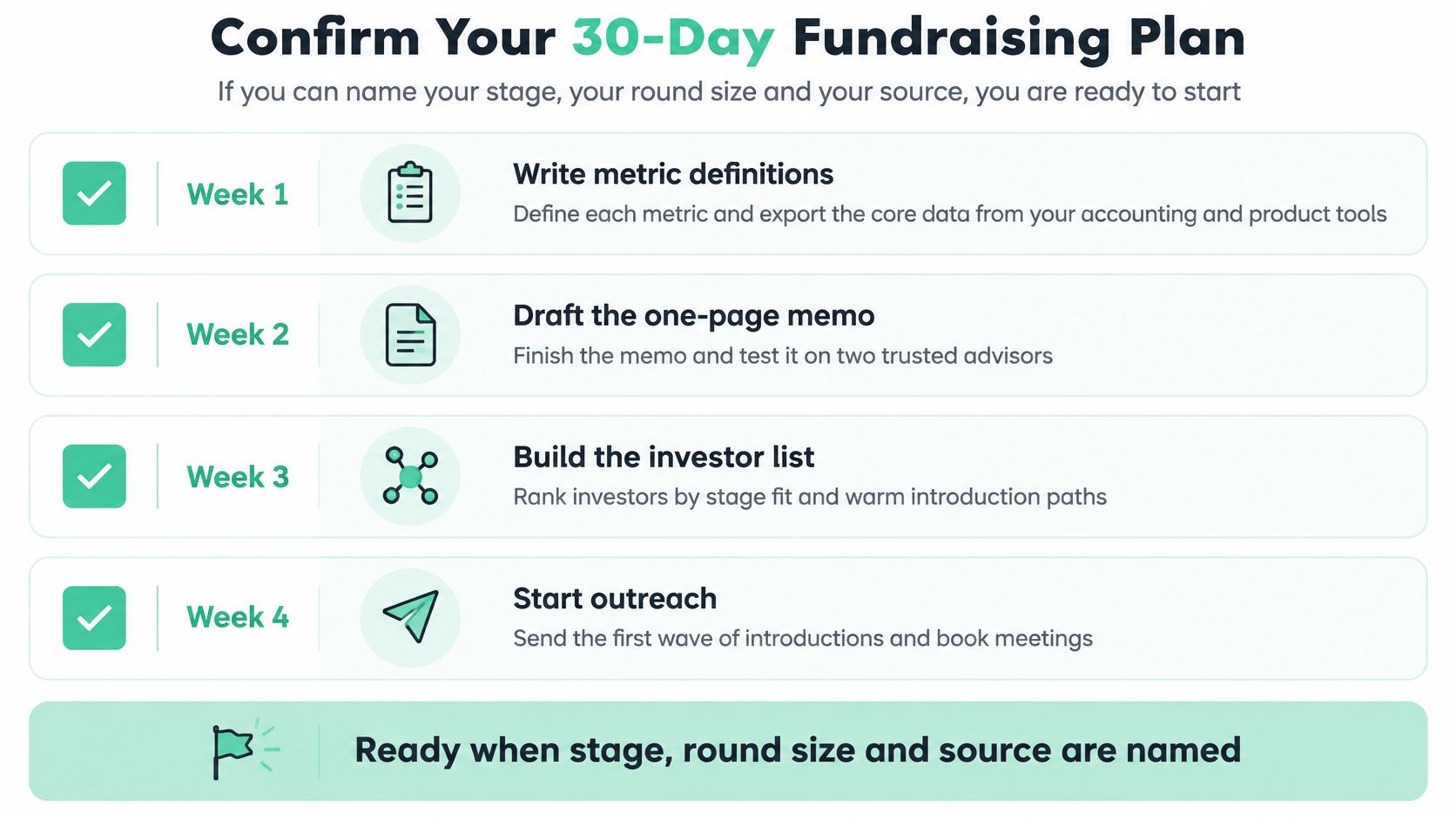
- Week one: Write the metric definitions and export the last twelve months with timestamps. A number without a definition will get challenged in the first call.
- Week two: Draft the one-page memo and the first six slides. Stop when a reader who doesn't know you can repeat the ask.
- Week three: Build the runway math and the cap table scenarios for the round you intend to raise.
- Week four: Pick the source that matches your revenue quality and your control limits. List twenty investors or backers, each with a reason they fit.
A reward path when you already have an audience
If the product has people who would pay for a perk rather than a share, a verified traction page on Fundl is free to create and does not require any backers first. It can show live metrics from connected sources such as Stripe. Backers contribute through Stripe Checkout after they see that data, and you need a Stripe account connected before any contribution can land. A reward-based contribution is not an investment and carries no equity.
The test for the next step is blunt. If the metrics would still persuade a stranger who only has one link, the traction is ready to show.
Fundl lets creators raise reward-based support around live, source-verified traction instead of a static pitch. If you are sizing a smaller, evidence-backed round and want backers to see revenue, shipping, and audience signals before they contribute, set up a page and share one link. Visit Fundl when you are ready to put the numbers in front of people.