
The biggest audience doesn't automatically make a crowdfunding platform the best choice. A generalist site may offer discovery, but it can still be a poor fit if your project needs recurring support, niche expertise, verified traction, predictable payouts, or help with fulfillment. Before choosing, compare one-time versus recurring funding, generalist versus specialist reach, all-or-nothing rules, payment handling, evidence of demand, and the work you'll owe backers after funding.
This list ranks the best crowdfunding platforms by project fit rather than popularity alone. It covers Fundl for traction-led software campaigns, Kickstarter and Indiegogo for time-boxed reward launches, Patreon for memberships, Open Collective and GitHub Sponsors for community-funded work, and Crowd Supply for vetted open hardware. For a broader starting list of crowdfunding options, PledgeBox's crowdfunding platform guide offers additional context. Fundl earns the featured position because it puts live, source-verified metrics at the center of the pitch instead of treating traction as an optional slide.
Table of Contents
- 1. Fundl
- 2. Kickstarter
- 3. Indiegogo
- 4. Patreon
- 5. Open Collective
- 6. GitHub Sponsors
- 7. Crowd Supply
- Top 7 Crowdfunding Platforms Comparison
- Choose the Funding Model You Can Sustain
1. Fundl
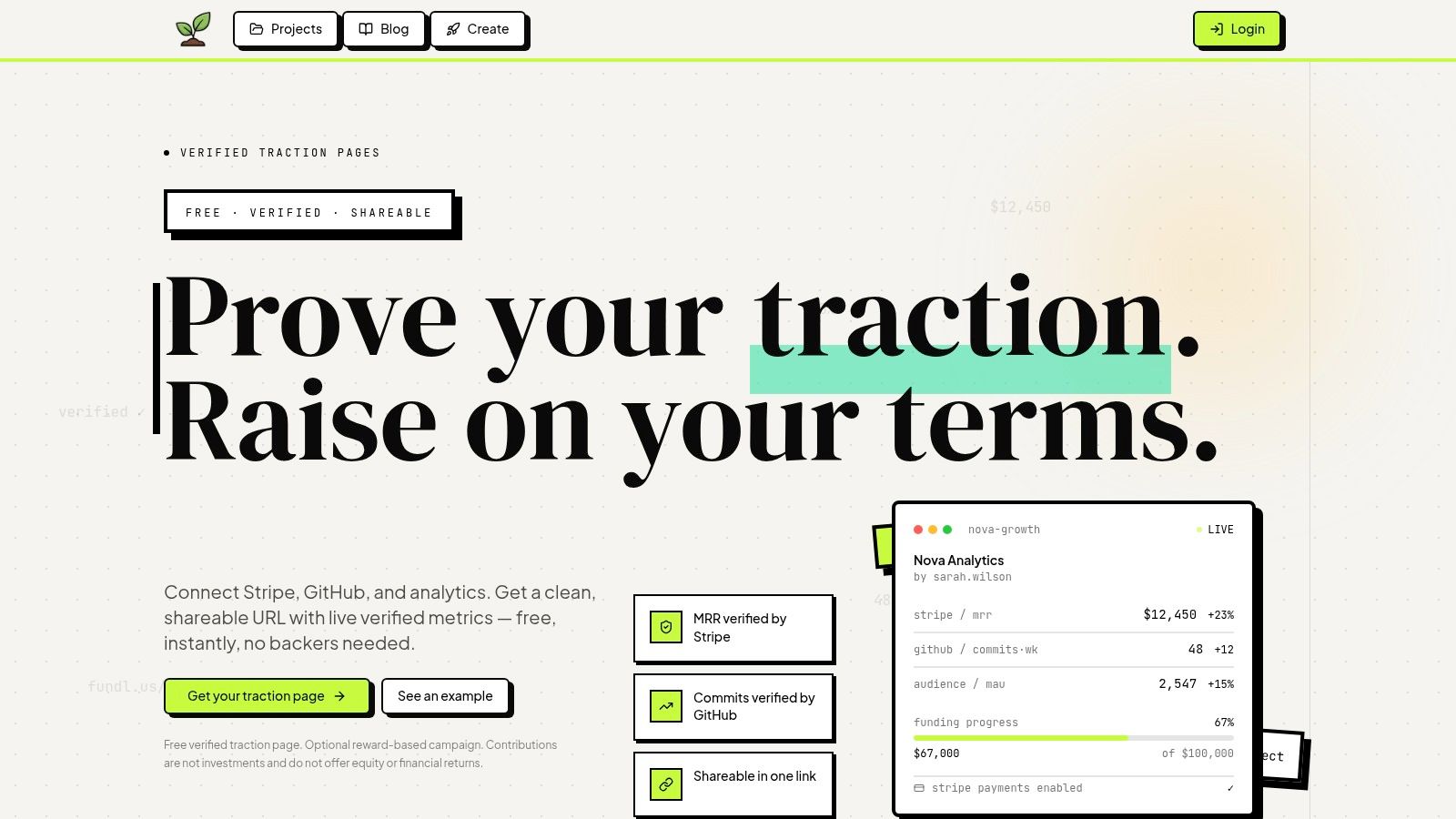
Fundl is the strongest fit when existing traction is your main credibility asset. It's designed for makers and founders who can connect real operating data, not just describe an idea. Creators can link Stripe, GitHub, and analytics accounts to publish a clean, shareable traction page with source-verified metrics such as Monthly Recurring Revenue, weekly commits, and Monthly Active Users.
That changes the backer's evaluation process. Instead of relying on screenshots, polished projections, or manually updated campaign claims, supporters can compare revenue, shipping activity, and audience signals in one standardized view. Metrics auto-refresh, so the page can continue reflecting the project after launch.
Setup is intentionally lightweight. A creator sets a goal, connects data sources, shares the page, and receives reward-based contributions directly through their own Stripe account. Fundl says the setup takes about 15 minutes, which makes it practical for indie hackers, SaaS founders, AI-tool builders, education creators, open-source developers, and no-code makers who already have something working.
Why verified traction changes the pitch
Fundl's central advantage isn't a larger general-purpose discovery feed. It's the evidence layer. A backer can see whether a software project has revenue, whether an open-source maintainer is shipping consistently, and whether an audience is active before deciding to contribute.
Practical rule: If your project has measurable activity, make that activity easier to verify than your competitors' promises.
The trade-off is equally important. Fundl is reward-based only, so contributors don't receive equity or financial returns. It also doesn't hold money in platform escrow. Contributions go directly through the creator's Stripe account, which keeps the payment path simple but provides less platform-mediated protection than a marketplace that controls the transaction.
Fundl is therefore a poor choice for an idea with no connectable traction signals. It's a particularly strong choice for founders who want to prove demand, show consistent shipping, and let live metrics carry more of the argument than a conventional pitch deck. Visit Fundl to see how its verified traction pages work.
2. Kickstarter
Kickstarter remains the best fit for a polished, time-boxed reward campaign that benefits from broad discovery. Its categories cover design, technology, games, art, publishing, and other creative work, giving projects a chance to reach backers who are already accustomed to evaluating campaign pages and reward tiers.
The platform's all-or-nothing model creates clear discipline. A creator sets a goal and deadline, and the campaign must reach that target for funding to proceed. That structure can reassure backers because it reduces the risk of a creator receiving partial funding that can't support the promised production plan.
Kickstarter also supplies discovery surfaces such as staff picks, category pages, and newsletters, alongside tools for updates, backer messaging, and analytics. Those features matter most when the campaign has a strong visual presentation, a clear reward structure, and enough pre-launch interest to generate early movement.
Kickstarter's scale is substantial. The platform is described as having funded more than 570,000 campaigns with total funding above $6 billion, an average of about $10,500 per campaign, according to the market overview of crowdfunding growth and Kickstarter activity. That history gives backers a familiar environment and gives creators a large archive of comparable campaign formats.
For a product launch, however, audience access isn't the same as automatic demand. Categories can be crowded, and creators still need strong preparation, external promotion, compelling rewards, and a credible delivery plan. Kickstarter also limits eligibility to supported countries, with identity and banking requirements that must be checked before launch.
A practical example is the need to treat campaign design as part of product strategy. The discussion of using Kickstarter for a 3D printer launch illustrates why a technically strong product still needs a clear promise, visual proof, and a reward structure that ordinary backers can understand.
Choose Kickstarter when you're launching one defined product or creative project, can work within all-or-nothing funding, and want the strongest generalist reward-campaign environment in this list.
3. Indiegogo
Indiegogo is a strong match for technology, hardware, design, and film campaigns aimed at early adopters. Its audience tends to be comfortable with new products, prototypes, and projects that need more explanation than a conventional consumer purchase.
The platform now standardizes Fixed Funding, which means campaigns use an all-or-nothing structure. That matters because older comparisons often describe Indiegogo mainly through flexible funding. Creators shouldn't select it expecting to keep partial funds under a former campaign model. The current structure requires a realistic target and a launch plan capable of reaching it.
Indiegogo's most useful distinction is what happens after the campaign closes. Late Pledge can keep collecting orders after the main campaign, allowing a creator to extend demand capture while production and fulfillment continue. For hardware teams, that creates a bridge between campaign momentum and a longer pre-order or post-campaign sales process.
Where Indiegogo earns its place
The platform also provides creator education, planning resources, and campaign checklists. Those tools can help a first-time founder turn a prototype into a more complete launch plan, but they won't replace customer acquisition. Discovery can be inconsistent, so creators should treat their own audience, press outreach, partnerships, email list, and community activity as core distribution channels.
The payment and campaign rules deserve close attention before publishing a page. Indiegogo's current fixed-funding approach means that a creator who needs partial capital should reconsider the funding model rather than assume the platform will preserve a shortfall. The same constraint can improve backer confidence, but it also raises the stakes for the campaign target.
Indiegogo works best when the project has a tangible demonstration, a technically interested audience, and a reason for supporters to keep watching after launch. It's less compelling for a software product that needs recurring revenue or a community project that mainly needs transparent expense reporting.
Select Indiegogo for a tech-oriented campaign that can benefit from a specialist audience and continued ordering through Late Pledge, while accepting that external marketing remains essential.
4. Patreon
Patreon is not a conventional launch platform. It's the better choice when funding depends on ongoing participation, regular publishing, or a community that wants continued access to a creator's work.
Creators can organize membership tiers around private posts, gated benefits, messaging, and other recurring perks. Depending on regional availability, Patreon also supports paid posts and one-time digital sales. That combination lets educators, podcasters, toolmakers, artists, and software creators mix predictable membership income with individual purchases.
The core trade-off is operational rather than promotional. A one-time campaign creates a defined promise with a delivery endpoint. Patreon creates a continuing relationship. Every tier needs a benefit that members understand, and the creator needs a sustainable process for publishing, responding, tracking benefits, and retaining patrons.
New creators who join from August 4, 2025 default to a 10% platform fee, while legacy plans have different fee arrangements, according to Patreon's stated plan structure. Creators should verify the current terms directly before setting prices because platform plans and regional payment rules can change. Payment handling also deserves planning, especially if a creator combines memberships with one-time products. This guide to crowdfunding payment processing explains why the route from supporter payment to creator payout belongs in the platform decision.
A recurring model only works when the creator can sustain the promise after the launch excitement fades.
Patreon suits an educator releasing lessons, a developer maintaining a tool with regular updates, or a creator building a private community around frequent content. It's a poor fit for a single product that needs a one-time manufacturing budget and no continuing member benefit.
Choose Patreon when your audience is more likely to support an ongoing rhythm of content, access, or product development than a single campaign deadline.
5. Open Collective
Open Collective is built for projects where financial transparency is part of the product. It fits open-source maintainers, community groups, meetups, and collaborative initiatives that need supporters to see not only how much money came in, but also how that money was used.
Public budgets, receipts, and expense records give contributors a view into the project's finances. That visibility is especially valuable when a collective asks a community to fund infrastructure, events, maintainers, or shared resources. Instead of treating accounting as a private back-office activity, Open Collective makes it part of the trust mechanism.
Fiscal hosting adds another useful layer. A project without its own legal entity can work with a host that manages invoicing, payouts, compliance, accounting, tax documentation, and vendor payments. That can remove a significant administrative burden for volunteer-led initiatives, although it introduces host-specific rules and costs.
Transparency versus control
Independent Collectives can use core platform features for free under the platform's stated model, while fiscal hosting creates additional charges. Open Collective says hosts pay the platform a 15% platform share of host fees, and the final economics can vary by host and organizational setup. Review the current host terms rather than assuming every collective has the same cost structure.
This model is distinct from a product pre-sale. Backers may care less about receiving a packaged reward and more about seeing a public record of responsible spending. The creator's ongoing responsibility is therefore financial stewardship, timely receipts, clear budgets, and honest explanations when priorities change.
Open Collective is strongest when transparency itself helps convert support. It's less suitable for a private SaaS founder who wants to present live revenue metrics, or for a consumer hardware team that needs manufacturing and logistics support.
Use Open Collective when your project is community-owned or open-source oriented and supporters need a visible, accountable funding trail.
6. GitHub Sponsors
GitHub Sponsors is the most direct option here for ongoing developer support. It places sponsorship beside the work itself, through GitHub profiles and repositories, so maintainers can ask for support where users already inspect code, file issues, and follow releases.
Sponsors can choose custom tiers and benefits, while maintainers can use profile and README badges to make the funding request visible without sending supporters to a separate campaign narrative. Organization-level sponsorship and invoicing options also make the program relevant to companies that want to support maintainers or open-source infrastructure.
The platform's economics depend on the source of the sponsorship. GitHub states that sponsorships from personal accounts carry no GitHub fee, so the developer or organization receives the full sponsorship amount in that case. Organization-originated sponsorships can include fees of up to 6%, made up of card and service components, while invoicing may change the card-fee treatment. Check the current terms for the specific sponsor relationship.
That distinction matters because GitHub Sponsors isn't a timed campaign. It doesn't give a maintainer the same launch moment, reward catalogue, or deadline structure as Kickstarter. Its strength is continuity. A developer can connect support to maintenance, releases, documentation, issue triage, or infrastructure work over time.
The best sponsorship request is close to the work it funds. Put the ask beside the repository, release process, or maintainer profile supporters already trust.
GitHub Sponsors works well for a library maintainer, developer tool author, or open-source team with an established user base. It's less suitable for a new consumer product that needs a concentrated pre-order push.
The practical value of sponsorship for open-source teams is explored in this guide to open-source project funding. Choose GitHub Sponsors when the project's value is delivered continuously through code and maintenance.
7. Crowd Supply
Crowd Supply is the best fit for open hardware and developer-focused products that need more than a campaign page. Its audience is aligned with boards, devices, maker tools, and technical products, so a well-documented hardware project can reach people who understand specifications, prototypes, and development constraints.
The platform uses project vetting and coaching, alongside all-or-nothing campaigns. That selection process can make the platform less accessible than a generalist site, but it can also improve fit between the project and its audience. A technical founder may gain more from informed review and operational guidance than from broad exposure to backers who aren't familiar with the product category.
Crowd Supply also provides fulfillment and logistics support. That's a major distinction for hardware because successful funding creates obligations beyond collecting money. Creators must manage manufacturing, inventory, shipping, customer communication, returns, and changes to the production schedule. Integrated support can reduce the operational risk for a first-time hardware founder, although the service is reflected in the platform's item-fee structure and overall commercial terms.
Why operational support can outweigh reach
Crowd Supply typically takes more than a generalist reward platform, and project selection is competitive. Those costs can still make sense when the alternative is handling fulfillment alone without the systems or experience to manage a technical product launch.
The platform is not a natural home for pure SaaS, digital memberships, or a software project whose primary proof is recurring revenue. Its advantage comes from category alignment and delivery support. A hardware founder should compare the total operational burden, not just the visible platform fee.
Select Crowd Supply when you're building open hardware or a developer device and want vetting, a technically relevant audience, and help with logistics after funding.
Top 7 Crowdfunding Platforms Comparison
| Platform | 🔄 Implementation complexity | ⚡ Resource requirements | 📊 Expected outcomes | 💡 Ideal use cases | ⭐ Key advantages |
|---|---|---|---|---|---|
| Fundl | Low, fast setup (~15 min) but requires data-source links (Stripe/GitHub/analytics) | Needs connected Stripe, GitHub, analytics and basic promo | Transparent, verified traction leads to reward contributions; limited built-in discovery | SaaS, AI tools, open‑source, no‑code makers with measurable metrics | Live, source‑verified metrics; direct payouts; quick credibility |
| Kickstarter | Medium, campaign planning, creative assets, deadline management | Significant marketing, polished prototype, fulfillment plan | High visibility and potential large funding if well marketed (all‑or‑nothing) | Time‑boxed product launches across design, games, tech, publishing | Largest reward audience; strong discovery and credibility |
| Indiegogo | Medium, campaign prep; checkout and campaign setup | Marketing, prototypes; post‑campaign Late Pledge ops if used | Good traction with tech/hardware backers; post‑campaign order capture | Hardware, design, film, tech gadgets targeting early adopters | Tech‑leaning audience; Late Pledge for continued sales |
| Patreon | Low–Medium, ongoing content delivery and membership setup | Consistent content/perks, community management, tier maintenance | Predictable recurring revenue and steady support; retention dependent on delivery | Creators, educators, toolmakers, SaaS with frequent updates | Recurring income; membership tools and CRM‑style benefits |
| Open Collective | Low, simple setup for collectives; fiscal hosting adds steps | Community donations; optional host fees and accounting processes | Transparent budgets and sustained community funding; administrative clarity | Open‑source projects, meetups, communities needing fiscal transparency | Public ledgers; fiscal hosting reduces administrative burden |
| GitHub Sponsors | Low, enable sponsorships on repos/profiles | Active GitHub presence; minimal overhead to accept funds | Ongoing sponsorships from developer community; modest but steady income | OSS maintainers and developer‑focused projects | Native GitHub audience; low/no fees for personal accounts |
| Crowd Supply | Medium–High, vetting, campaign prep, and logistics coordination | Working hardware prototypes, fulfillment planning; higher platform fees | Higher success for technical hardware plus integrated fulfillment and shipping support | Open hardware, developer boards, maker tools with complex logistics | Vetting and coaching; integrated fulfillment reduces operational risk |
Choose the Funding Model You Can Sustain
Start with the promise your project can keep. Choose Fundl when verified live traction is the main credibility asset and you can connect Stripe, GitHub, or analytics data. Its reward-based model, direct Stripe payouts, and auto-refreshing metrics suit SaaS, AI tools, open-source projects, education products, and other software-led work that already has measurable activity.
Choose Kickstarter for a polished, time-boxed reward launch where broad discovery, category visibility, and an all-or-nothing goal support a defined product or creative project. Choose Indiegogo for a technology-oriented campaign that can use Fixed Funding and extend sales through Late Pledge. Both require substantial campaign preparation and external promotion, even when their built-in discovery tools are useful.
Choose Patreon when your audience wants recurring access, content, or benefits and you can maintain that relationship after the initial sign-up. Choose Open Collective when supporters need public budgets, receipts, and a clear explanation of how community funds are spent. Choose GitHub Sponsors when the value comes from ongoing code maintenance, releases, documentation, or developer infrastructure rather than a single launch.
Choose Crowd Supply for vetted open hardware and developer products that need fulfillment guidance as well as funding. Its niche audience and logistics support can be more valuable than general reach when manufacturing and shipping are the largest execution risks.
The wider market makes this fit-based approach more important. The global crowdfunding market grew from about $13.9 billion in 2019 to roughly $120 billion in 2024, implying growth near 29% annually over that span, according to the published crowdfunding market analysis. Other forecasts disagree on the market's future size and regional leadership, but they consistently describe a large, active, geographically diverse industry. One market report identifies more than 1,500 platforms across 100 countries, while another independent estimate counts more than 6,500 active platforms worldwide, showing why a popularity-only ranking is inadequate.
Before committing, compare eligibility, fees, payout handling, audience fit, verification requirements, and the work required after funding. A platform that converts well for someone else's category can still create unnecessary risk for your project if its funding model, trust mechanism, or delivery expectations don't match the way you operate.
Fundl gives traction-led founders a shareable page built from live, source-verified Stripe, GitHub, and analytics data, with reward-based contributions routed directly through the creator's Stripe account. If your project has real revenue, shipping activity, or audience signals to prove, visit Fundl and put that evidence at the center of your crowdfunding campaign.