
Most launch advice still treats launch day as a verdict. Finish the code, polish the landing page, schedule the announcement, and hope attention turns into customers. That model is especially weak for indie founders, because a polished release can hide a broken activation path, unclear value, or users who never return.
A software product launch should produce evidence, not just noise. Before the public rollout, you need signals that real people can discover the product, reach first value, use it again, and understand what they're paying for. The announcement matters, but it's only one event in a longer process of proving demand.
Table of Contents
- Rethinking Launch Readiness Beyond Feature Completeness
- Building a Metrics-Backed Pitch with Live Traction
- Structuring Pricing and Reward Offers for Early Adopters
- The Technical and Operational Pre-Launch Checklist
- Targeting Launch Channels with Validation Signals
- Measuring Post-Launch Growth and Iteration Cycles
Rethinking Launch Readiness Beyond Feature Completeness
A finished codebase is a technical milestone, not a launch decision. The product may compile, deploy, and pass its test suite while still failing to explain its value, guide new users, or create a reason to return. Founders who build in secret until everything feels complete often discover these problems only after spending their launch audience.
The historical numbers are sobering. The Standish Group's CHAOS data for the 2020–2024 cycle classified only 31% of software projects as fully successful, while 50% were challenged and 19% failed outright, as summarized by this software product launch process guide. Those categories aren't a direct forecast for your SaaS, but they show why delivery completion can't stand in for outcome validation.
A related launch pattern appears after release. A 2021 Marketing Letters study found a 25% failure rate after the first year and a 40% failure rate by the end of the second year, based on SKU-level tracking, according to this review of product launch statistics. The practical lesson is clear. A launch can attract initial attention and still lose momentum when repeat usage, distribution, and retention become harder than announcement-driven acquisition.
Replace the green light with proof
Modern AI development makes this distinction more urgent. Teams can produce features, integrations, and polished demos quickly, but their testing and proof mechanisms may not keep pace. Recent coverage describes this as an “AI Validation Gap”, while launch guidance increasingly points to skipped beta programs, weak rollout planning, and missing activation funnels as reasons products miss their targets.
The question shouldn't be, “Have we built enough?” Ask instead:
- Activation: Can a new user complete the first meaningful task without founder assistance?
- Time to value: How long does it take before the product solves the problem promised on the landing page?
- Repeat usage: Do users return because the workflow matters, or only because they're curious?
- Retention evidence: Can you identify a cohort that continues using the product after the initial experience?
A beta path exposes these issues while the product team can still respond. Invite a narrow group, define the first valuable action, observe where users stop, and fix the path before broad promotion. Don't confuse a waitlist with validation. A waitlist demonstrates interest in a message. Product usage demonstrates that the experience delivers on it.
Practical rule: Treat feature completeness as an input to launch readiness. Treat activation and retention evidence as the decision criteria.
This principle also applies to operational products that help teams publish, coordinate, or distribute content. If your product includes social workflows, study how white label social publishing for apps packages those capabilities for other brands, then validate whether users can complete the core publishing task before promoting the broader feature set.
Build for the rollout, not the announcement
A credible launch has stages. First, validate the problem and the activation path. Next, release to a controlled beta group. Then expand access while monitoring errors, support requests, and usage quality. The public announcement should accelerate a working loop, not create the first opportunity to find out whether the loop exists.
That approach may feel slower than a dramatic launch push, but it protects your scarce resource, user attention. A founder with a small audience can't afford to send everyone into an onboarding flow that doesn't work. Ship fewer claims, expose more evidence, and let real usage determine which features deserve the spotlight.
Building a Metrics-Backed Pitch with Live Traction
Screenshots are easy to curate. A live traction page is harder to fake because it connects the story to current product activity. For a SaaS launch, the strongest pitch doesn't only say what the product does. It shows whether the team is shipping, whether people are using the product, and whether customers are paying.
Start by deciding which signals answer the buyer's or backer's main doubts. A developer may care about repository activity and release cadence. A SaaS customer may care about active usage and product reliability. A supporter evaluating a reward-based campaign may want revenue, audience activity, and a clear explanation of what funding provides.
Connect evidence to the story
A practical setup uses source systems rather than manually maintained slides:
- Connect billing data. Link Stripe or your payment provider so recurring revenue and payment activity come from the system that processes transactions.
- Connect shipping activity. Use GitHub to show commits, releases, or other public indicators of sustained development. Don't present commit volume as proof of customer value. It shows activity, not usefulness.
- Connect product analytics. Define the event that represents activation, then track active users, returning users, and the key workflow that creates value.
- Explain each metric. A number without a definition invites confusion. State what counts as an active user, which revenue period you show, and how often the data refreshes.
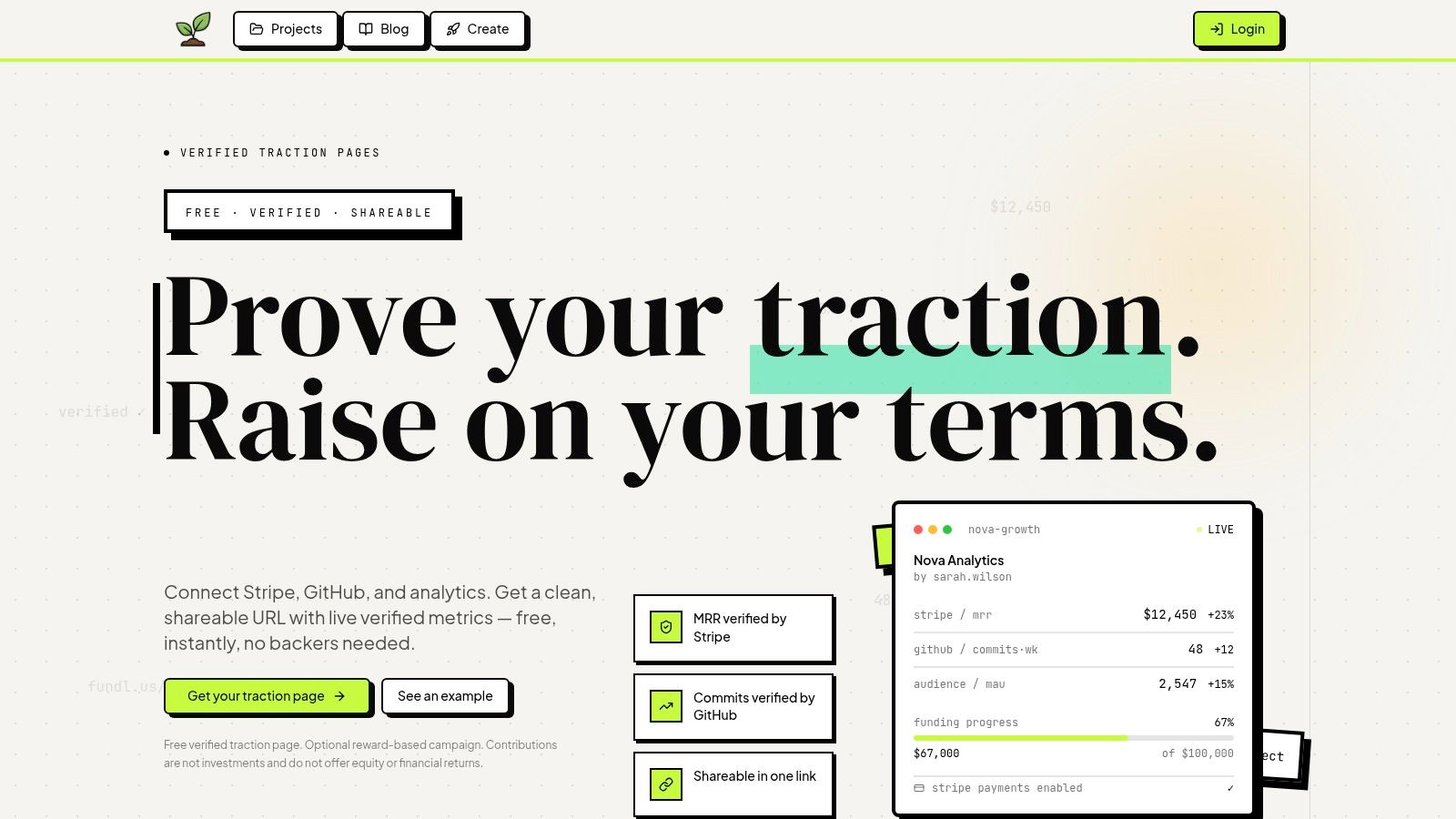
- Publish one shareable page. Put the product description, audience, traction signals, funding or purchase offer, and risks in one place. Your launch post should send qualified visitors there instead of forcing them to assemble the story across multiple links.
A public page works best when the metrics have context. If active usage rises but paid conversion remains weak, say that the product has engagement evidence but still needs pricing validation. If GitHub activity is strong while usage is flat, don't imply that shipping pace equals demand. Transparency makes the pitch more credible because it shows where the evidence is strong and where the work remains.
For teams designing the dashboard itself, a data driven design guide can help turn raw events into a clearer interface. The same principle applies to the product and the pitch page. Show the decisions users make, not a wall of decorative charts.
Fundl is one option for publishing a shareable traction page that connects Stripe, GitHub, and analytics sources, with metrics such as Monthly Recurring Revenue, weekly commits, and Monthly Active Users refreshing from those sources. Its reward-based model processes contributions through the creator's own Stripe account rather than platform-held escrow. Founders should still verify that each displayed metric is defined accurately and reflects the audience's actual decision criteria.
You can also treat the public page as a community asset, not only a fundraising document. A useful community engagement strategy gives supporters a reason to return, comment, share feedback, or follow progress after the initial announcement.
Make the pitch falsifiable
Your launch pitch should contain claims that someone can verify. “Built for modern teams” is positioning. “Users complete the export workflow and return to manage another project” is a testable product hypothesis, provided you define the relevant events and cohort.
Include the current state, the next milestone, and the evidence you'll use to judge progress. Avoid selecting only the most flattering chart. A flat metric can be useful if it reveals a bottleneck that your launch plan addresses. The goal isn't to look finished. It's to make the product's trajectory understandable.
Use the video later in the page or campaign, after visitors have seen the evidence and understand what they're evaluating.
Structuring Pricing and Reward Offers for Early Adopters
Early adopters don't all buy for the same reason. Some want immediate access to a useful workflow. Others want to support a founder they trust. A few are testing whether your product can become part of their operating stack. Your offer should make the exchange explicit rather than hiding behind a vague “limited launch deal.”
Use live traction to decide what you can credibly promise. If users are activating but paid retention is still uncertain, an early-access plan with direct feedback may be more honest than a lifetime deal. If recurring revenue is already visible and support costs are understood, a discounted annual plan may align better with the business you're trying to build.
Match the offer to the evidence
| Traction Signal | Offer Structure | Target Audience |
|---|---|---|
| Waitlist interest and completed beta interviews | Paid pilot or founder-supported early access | Problem-aware users willing to provide feedback |
| Repeated activation in a focused workflow | Early-bird subscription with a clear product scope | Early adopters seeking immediate utility |
| Active users with visible recurring payments | Annual plan or defined reward tier | Customers who want continuity and predictable access |
| Strong shipping activity but unproven retention | Time-bound beta access with transparent limitations | Technical users comfortable evaluating an evolving product |
| Community support without established revenue | Reward-based contribution tiers tied to concrete deliverables | Backers who want to support development without equity |
The table isn't a formula. It prevents a common mistake, offering the most aggressive price before you understand the cost of serving customers. A lifetime deal can generate cash and attention, but it can also create permanent support obligations and reduce future subscription revenue. A low early-bird price can remove purchase friction, but it may anchor customers to a price that won't sustain the product.
Make scarcity factual
Scarcity should come from a real constraint. You might limit founder-led onboarding, cap the number of beta accounts you can support well, or set a clear date for an early-access price to end. Don't invent a countdown that resets whenever the campaign needs another push.
Reward tiers need equally concrete boundaries. State what contributors receive, when access begins, which features are included, and what happens if development changes direction. If a milestone depends on community funding, describe the dependency without promising an outcome you can't control.
A strong campaign page connects the offer to evidence. Show active usage, revenue where relevant, release activity, and the specific work the offer supports. Readers evaluating a campaign can use guidance on effective crowdfunding pages to compare how clearly the page explains its audience, proof, rewards, and next steps.
Don't set a revenue target because it sounds impressive. Set a target tied to a defined operating need, such as completing a product milestone, covering a development phase, or supporting a known customer workflow. The more directly the offer maps money to work, the easier it is for early adopters to judge the trade-off.
The Technical and Operational Pre-Launch Checklist
A metrics-backed pitch creates an expectation that the product can deliver. Launch traffic then tests every weak dependency at once, including authentication, databases, queues, email, payment processing, and support. Solo founders don't need enterprise complexity, but they do need a tested failure path.
Test the path users will take
Don't load-test only the homepage. Trace the complete route from campaign link to account creation, onboarding, core action, confirmation email, and payment. A fast landing page doesn't help if the first authenticated request exhausts database connections.
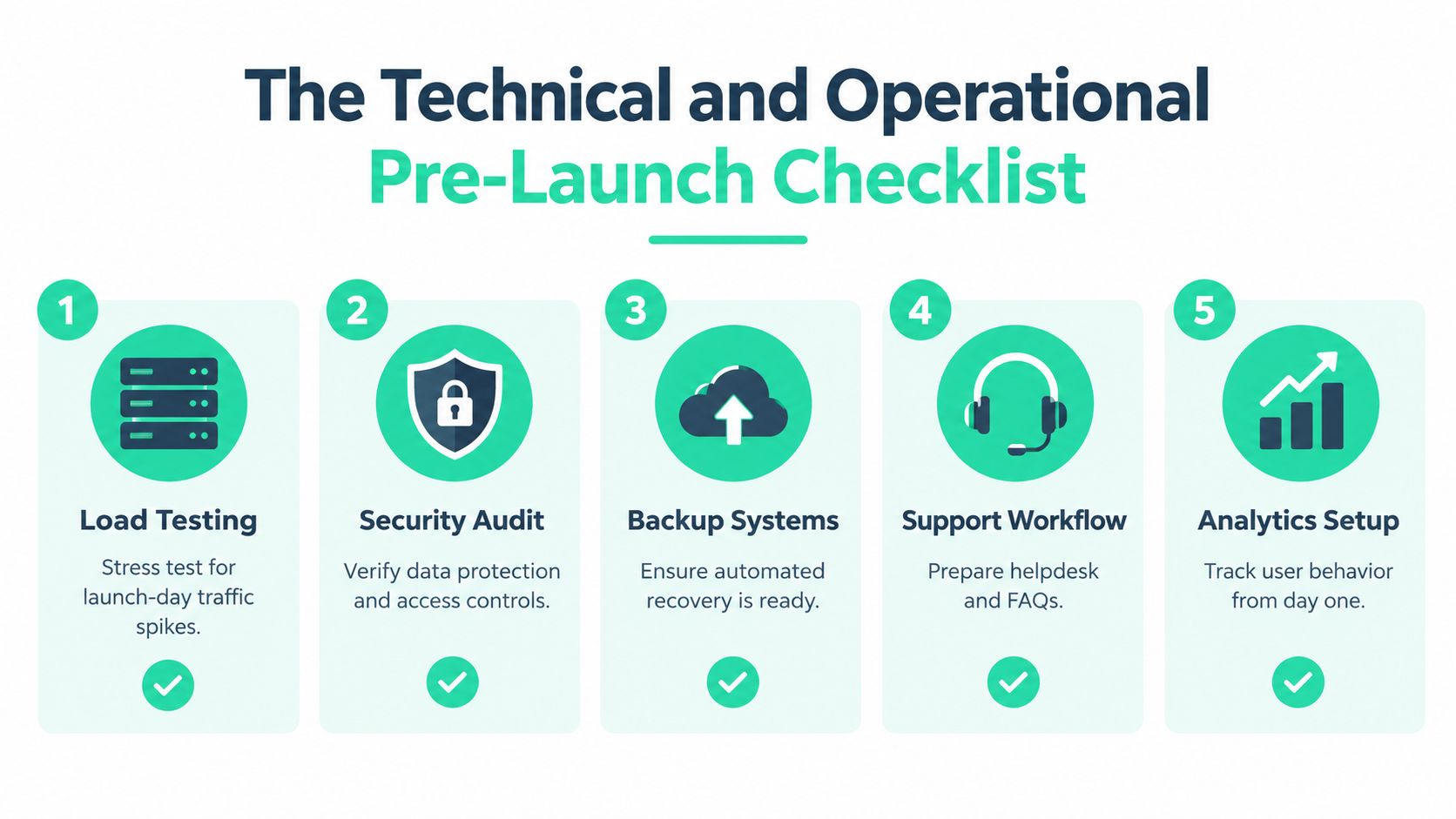
- Load testing: Simulate the workflows most likely to receive concentrated demand. Watch response times, connection pools, queue depth, and third-party rate limits.
- Payment verification: Run successful, failed, refunded, and interrupted payment scenarios. Confirm that Stripe webhooks update account status safely and idempotently.
- Recovery readiness: Test backups by restoring them, not by admiring a dashboard that says backups completed. Document who can restore data and how users will be informed.
- Security review: Check authorization boundaries, secret handling, dependency alerts, and access to customer data. Payment-related software should account for the security of payment data and functionality, an area addressed by the PCI Secure Software Standard.
- Analytics validation: Trigger every activation, engagement, retention, and revenue event manually in a production-like environment. Confirm that duplicate events, blocked scripts, and timezone differences don't corrupt the funnel.
Prepare the human systems
Support failures can damage trust faster than a minor interface bug. Write answers for setup, billing, cancellations, data export, and known limitations. Give users a visible support route and a fallback channel in case your helpdesk or email provider fails.
Create an incident document with the first actions for common failures. It should identify how to disable a broken feature, pause a campaign, communicate an outage, and issue a refund. If you're the only operator, write the instructions while calm, then follow them during a rehearsal.
Operational test: Ask a fresh user to complete the product's core task while you observe silently. Every question they ask is evidence that the activation path needs clearer guidance.
Keep launch-day observability simple. You need error tracking, uptime monitoring, payment event visibility, and a dashboard that shows whether users reach the promised first value. Don't add a dozen tools because a checklist recommends them. Add only what helps you detect, diagnose, or communicate a failure.
Targeting Launch Channels with Validation Signals
A launch channel should match the evidence you have, not the channel you happen to like. A developer product with visible repository activity has a different credibility story from a consumer app with strong repeat usage. Sending both to the same broad audience wastes attention and makes your strongest signal less visible.
Start with a simple channel map. Identify the behavior your product solves, the people who already discuss that behavior, and the proof that matters to them. Then write the launch message around that proof.
Match signals to audiences
GitHub activity can support a developer-focused story when the repository is relevant, readable, and connected to the product. Share the implementation problem, the working demo, and the workflow someone can test. Don't flood communities with commit screenshots. Developers care more about whether the tool fits their environment than whether the founder shipped frequently.
Active usage is more persuasive for niche newsletters, operators, and potential customers who want to know whether the workflow works beyond a demo. Show the core action, explain what an active user means, and link to the live evidence. If your audience includes data-conscious backers, give them enough context to distinguish product activity from vanity traffic.
Payment activity belongs in a commercial message, but it needs boundaries. Explain whether the figure represents recurring subscriptions, one-time purchases, or campaign contributions. Revenue can establish that someone paid, but it doesn't explain why they paid or whether the product will retain them.
Customer language often beats polished positioning. Pull recurring phrases from support requests, onboarding calls, and beta feedback, then use those phrases in channel-specific copy. A developer community may respond to a technical limitation and workaround. A founder newsletter may respond to the operating problem and the proof that the workflow is now repeatable.
Demonstrate the product honestly
A demo should show the shortest path from problem to useful result. Remove setup steps that don't help the viewer understand the product, but don't conceal manual work that customers will encounter. The guide to creating product demos that convert is useful for thinking about structure, pacing, and the relationship between demonstration and action.
Use different calls to action by channel. A technical audience might be asked to test an integration. A prospective customer might be asked to start a trial. A backer might be asked to review the traction page and choose a reward. One generic “launch now” link makes it difficult to learn which audience and message produced meaningful behavior.
Don't optimize for the biggest possible reach. Optimize for qualified visits that produce activation, feedback, or a purchase. A smaller audience that understands the problem can give you better evidence than a large audience attracted by an exaggerated feature claim.
Before posting, check that the destination page loads, analytics events fire, the product can accept new accounts, and support is staffed. Distribution only matters when the receiving system can turn attention into a useful next action.
Measuring Post-Launch Growth and Iteration Cycles
Launch day tells you what people did when the announcement was fresh. It doesn't tell you whether the product earned a place in their routine. The post-launch review should therefore follow cohorts through a defined funnel, from acquisition to activation, engagement, retention, and revenue.
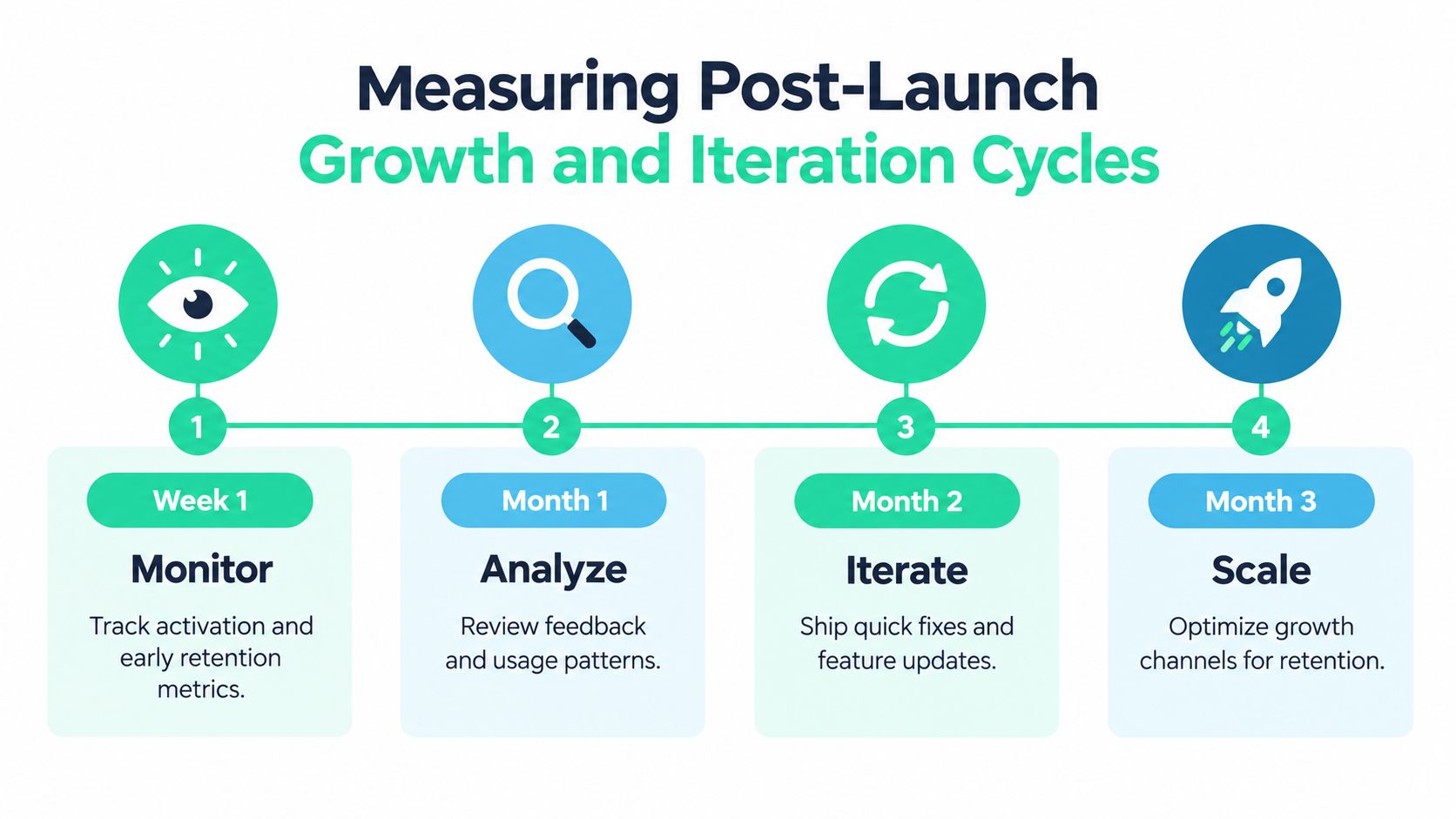
A practical methodology is to review the funnel at 7, 30, and 90 days, as recommended in this product launch analytics framework. Each checkpoint answers a different question, and each prevents a different kind of self-deception.
The 7-day review
At seven days, focus on acquisition quality and activation. Track signups by source, waitlist conversion if the campaign used one, completion of onboarding, the core activation event, and time to first value. Break the results down by channel and user type. An overall activation rate can hide a strong segment and a completely broken one.
Read support conversations alongside the numbers. If users sign up but ask what to do next, the problem may be onboarding. If they reach the first action but fail to complete it, inspect permissions, defaults, integrations, and error messages. Fix the earliest repeatable obstacle before adding another feature.
The 30-day review
At thirty days, look for engagement quality and emerging retention. The relevant question is whether users return to complete the workflow that justified the purchase or signup. Review usage frequency, completed core actions, feature adoption, cancellations, refunds, and qualitative feedback from active and inactive users.
Don't treat every feature request as a roadmap vote. Compare requests with actual behavior. A rarely used feature may deserve removal or simplification, while a small interaction that appears in successful user paths may deserve investment.
The 90-day review
At ninety days, evaluate retention and commercial durability. Review week-2 and week-4 retention, longer-term cohort behavior, trial-to-paid conversion, expansion or downgrade patterns, and the revenue contribution of each acquisition source. These are the checkpoints that distinguish launch attention from a product people continue to value.
Use the results to choose one iteration cycle. You might improve activation, repair retention, revise pricing, narrow the target audience, or double down on a channel that brings qualified users. Avoid changing all five at once, because you won't know which decision changed the outcome.
Decision rule: Keep the metric definitions stable long enough to compare cohorts, but change the product quickly when repeated user behavior exposes friction.
A conversion problem often sits between intent and completion. Review ways to improve conversion rates with the actual funnel beside you, then test the smallest change that addresses the observed barrier. Don't rewrite the entire launch story because one channel underperformed. Find out whether the channel attracted the wrong audience, the page made the wrong promise, or the product failed to deliver the first value.
Software product launches work when the team keeps learning after the announcement. Your final report should include what users did, where they stopped, what you changed, and what the next cohort needs to prove. That record becomes more valuable than a temporary spike in attention because it guides the product toward repeatable demand.
Fundl lets creators publish a shareable traction page by connecting live Stripe, GitHub, and analytics data, so supporters can evaluate current revenue, shipping activity, and user engagement instead of stale screenshots. Visit Fundl to set up your project metrics, define a reward-based offer, and give early adopters verifiable evidence before they contribute.