
You've got a product half-built, a few users who keep asking for access, maybe a Stripe account with the first trickle of revenue, and a GitHub graph that proves you've been shipping nights and weekends. You're wondering whether crowdfunding could fund the next stretch without giving up equity or spending months in investor meetings.
That's a sensible question. It's also the point where many software founders get bad advice.
Most crowdfunding content still talks like you're making a watch, a gadget, or a board game. Software works differently. You're not paying for molds, containers, and warehouse slots. You're paying for continued shipping. Your backers aren't just buying a finished thing. They're betting that you can keep building, supporting, and improving something that changes every week.
That difference matters. It changes how you set rewards, how you write your page, what proof people need, and even whether crowdfunding is the right move at all.
Table of Contents
- Introduction to Crowdfunding for Software Startups
- How Crowdfunding Works When Your Product Is Software
- Reward vs Equity Models and Which Fits Software Startups
- Why Traction Proof and Reward Design Determine Success
- Building a Campaign That Converts for SaaS AI and Dev Tools
- Legal Fulfillment and Trust Considerations for Software Campaigns
- Your Launch Checklist and Next Steps to Raise on Traction
Introduction to Crowdfunding for Software Startups
A first-time SaaS founder has a product that works well enough for demos, a handful of active users, and maybe a few paid accounts. She looks at crowdfunding and expects something close to a $50,000 angel check, just with a public page instead of a pitch meeting. So she spends her energy on the video, the headline, and launch-day buzz.
For software, that framing usually leads founders in the wrong direction.
Crowdfunding works better as a traction-verification system.
That means the campaign is doing more than collecting money. It is testing a simple question in public: will people who do not know you trust your product progress enough to pay now for continued development, access, support, or a better price later? For software, that answer often matters more than the dollars raised, because it tells you whether your product story survives contact with strangers.
Kickstarter reported 35,512 projects launched in 2024, and the company notes it has operated since 2009. Those numbers help explain why crowdfunding now sits in the category of established launch channels rather than novelty, including for software-adjacent products such as apps, games, and developer tools (Kickstarter's 2024 Creative Download).
The useful founder questions are usually more practical than broad:
- Can this campaign confirm real demand before I spend months building features nobody asked for?
- Can I bring in cash without giving up ownership yet?
- Will backers pay for software that is improving quickly but still incomplete?
- What convinces someone to fund digital access instead of waiting for a finished product?
Those questions point to the job of a campaign. You are not only asking for belief. You are measuring trust.
Software makes that measurement unusually clear because the signals are live. A backer can look for signs of movement the same way a customer checks whether a restaurant is busy before walking in. They look for active users, visible updates, shipped features, believable scope, and rewards that do not create delivery headaches. A polished page can help, but polish cannot hide weak traction for long.
That is why software crowdfunding often rewards teams with visible shipping velocity more than teams with the strongest pitch deck. A small developer tool with paying users, release notes, and a sensible lifetime deal can be easier to fund than a bigger idea with attractive mockups and no proof that anyone uses it.
Analysts at CoinLaw compiled market data showing that US investment crowdfunding across Regulation Crowdfunding and Regulation A+ reached $924.8 million in 2025, up 58% from 2024. The same summary says startups are projected to make up 35.4% of the crowdfunding tool market in 2025, and reward-based crowdfunding holds the largest funding-model share at 42.5% (crowdfunding market statistics compiled by CoinLaw).
The takeaway is straightforward. Crowdfunding is established enough to evaluate seriously, but software founders get the most value from it when they treat it as a live proof system. The campaign should answer one concrete question: does the market trust this team to keep shipping?
How Crowdfunding Works When Your Product Is Software
A founder launches a crowdfunding page for a new developer tool. The page looks sharp, the mockups are polished, and the copy sounds confident. Backers still hesitate. They are not asking one quiet question, which is whether the page is attractive. They are asking a practical one: will this team keep shipping after the campaign ends?
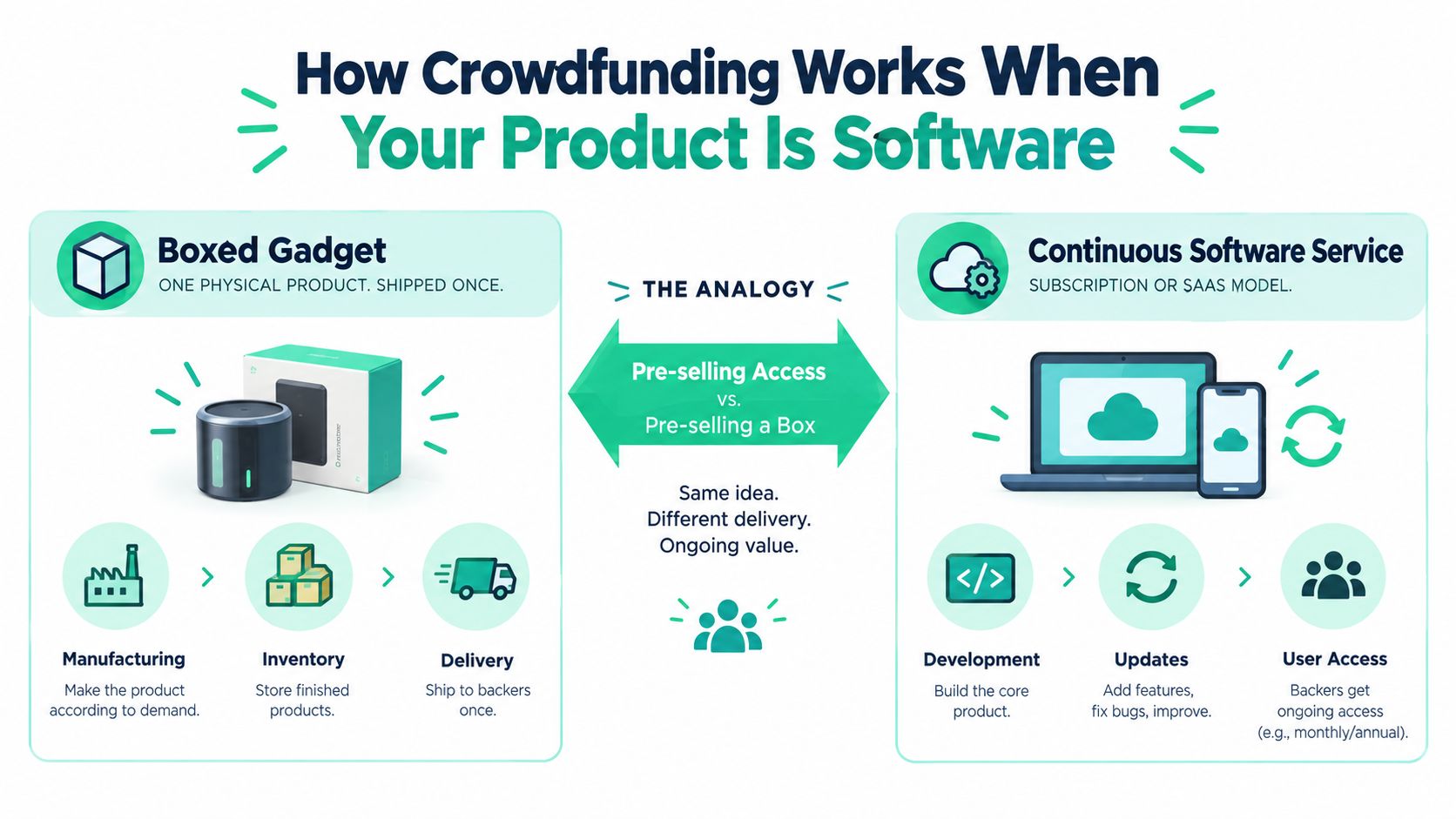
That is how crowdfunding works for software. The campaign is a live test of execution, and the funding is one output of that test.
Backers in software campaigns usually act like early customers with a slightly higher tolerance for rough edges. They are paying for some mix of:
- early access
- discounted access
- premium support
- influence over product direction
- community status
- implementation help or training
The important shift is this: a software backer is often buying future responsiveness as much as present functionality. If the reward is a year of access, they want to know what that year will feel like. Will bugs get fixed? Will requests get answered? Will updates arrive on a believable schedule?
A useful way to frame it is to treat the campaign like a public checkout page for your next phase of product work. People are not only buying software. They are buying evidence that your team can turn weeks of work into visible releases.
A simple model for software campaigns
| Product type | What the backer is buying | What the founder must prove |
|---|---|---|
| Physical product | A finished item delivered once | The team can manufacture, package, and ship units reliably |
| Software product | Access to an improving product over time | The team can ship weekly or monthly updates, support users, and keep scope realistic |
That second row is where software founders often get tripped up.
If you offer “12 months of Pro access,” the reward sounds easy because there is nothing to manufacture. But the promise is larger. You are committing to bug fixes, onboarding, uptime, support replies, and enough product progress that a backer still feels good six months later. Low marginal delivery cost helps software campaigns, but only if the ongoing service load stays believable.
For a narrower version of this idea, this guide to crowdfunding an app shows how software rewards need to match what users expect after they pay.
What backers look for in software
Software backers cannot inspect a box on a shelf, so they look for operating signals instead. Common examples include:
- a working demo or usable beta
- release notes or recent shipped features
- signs of active users or pilot customers
- clear reward limits and support boundaries
- a roadmap with near-term milestones, not a grand vision with vague timing
Research on crowdfunding motivations has found that backers often respond to a mix of product value, participation, and community belonging, not pure altruism alone (overview of backer motivations in crowdfunding research). That maps well to software. A backer may want the tool, the price advantage, and a say in what gets built next.
One sentence matters here. Crowdfunding for software is a traction-verification system.
If you already have users, updates, and a reward that is easy to deliver digitally, your campaign can convert that proof into funding. If you have only concept art and broad promises, the campaign exposes that gap quickly. In that sense, crowdfunding works a lot like a public trial run of your go-to-market motion. It shows whether real users trust your pace of shipping enough to pay now, before the product is fully mature.
Reward vs Equity Models and Which Fits Software Startups
A software founder can run two very different kinds of crowdfunding campaign and call both of them a "raise." The mechanics may look similar on the surface, but the test being run is different.
Reward crowdfunding asks, "Will users pay now for access, support, or early use?" Equity crowdfunding asks, "Will investors buy into the company and its future upside?" For software, that distinction matters because one model verifies customer demand directly, while the other tests your investment case.
Side-by-side comparison
| Criteria | Reward Based | Equity Based |
|---|---|---|
| What people receive | Access, perks, support, early use, services | Ownership stake or investment security |
| Founder gives up ownership | No | Yes, or ownership-linked rights depending on the structure |
| Main audience | Early users, community members, product fans | Investors looking for upside |
| Best fit for software stage | Early product, beta, first users, initial monetization | Company with a stronger financing case and readiness for investor scrutiny |
| Best fit for offer type | SaaS, AI tools, dev tools, education products, open-source support layers | Startups seeking larger capital formation or signaling for later financing |
| Core promise | “We will ship and deliver these rewards” | “We are building a company you can invest in” |
| Complexity | Lower operational complexity, but high fulfillment pressure | Higher legal and compliance complexity |
Reward crowdfunding usually fits software earlier
Software works especially well with reward campaigns because the reward can often be delivered digitally. Early access, a lifetime tier, onboarding help, office hours, or premium support do not create the same cost structure as boxes, inventory, and shipping labels.
That changes the role of the campaign.
A reward campaign works like a live checkout page for your go-to-market motion. If people buy, you learn that your offer, price, and timing are credible. If they hesitate, the problem is often not your video quality. It is usually weaker proof of value, unclear reward design, or uncertainty about whether you will keep shipping.
If you are comparing options, this guide to choosing a crowdfunding platform for startups can help you match the platform to your stage and offer type.
Equity crowdfunding fits a different question
Equity crowdfunding is closer to a public angel round. You are asking people to underwrite the company, not prepay for product access.
That can fit a software startup with a clearer financing plan, stronger reporting habits, and a founder team ready for investor updates, legal review, and compliance work. The audience is also different. A reward backer asks, "Will this tool help me soon?" An equity investor asks, "Can this company grow in value over time?"
Those are related questions, but they are not the same.
A simple way to choose
Use reward crowdfunding if your campaign is strongest when someone can try the product, understand the use case quickly, and say yes to a digital offer.
Use equity crowdfunding if your campaign depends more on the company story, market size, long-term upside, and investor belief in the business beyond immediate product usage.
Another way to frame it is simple. Reward crowdfunding verifies traction. Equity crowdfunding finances the company.
A practical matching test for software founders
Reward-based is usually the better fit if:
- You have something people can access now. A beta, usable prototype, or narrow version of the product.
- Your reward is cheap to deliver repeatedly. Software access, support, setup help, training, or community.
- You want fast market feedback. The campaign itself becomes evidence of demand.
- You want to avoid dilution. You are raising through sales-like commitments rather than ownership.
Equity may fit better if:
- Your raise is larger and more company-focused.
- Your story relies on future scale more than current user adoption.
- You are prepared for investor scrutiny, legal process, and ongoing communications.
For first-time software founders, reward campaigns often teach more because they force a hard question early: are people excited enough about what you have already built, and how fast you ship, to pay before the product is fully mature? That makes reward crowdfunding more than a funding channel. It becomes a traction-verification system with money attached.
Why Traction Proof and Reward Design Determine Success
A software founder launches a campaign with a polished video, a long roadmap, and five reward tiers. Backers come in fast. Two weeks later, support emails pile up, the team is promising onboarding calls they cannot staff, and the product work slows down because fulfillment has become the full-time job.
That pattern is common in software crowdfunding because backers are not only judging the idea. They are testing whether your team can keep shipping once real customers show up and expectations become public.
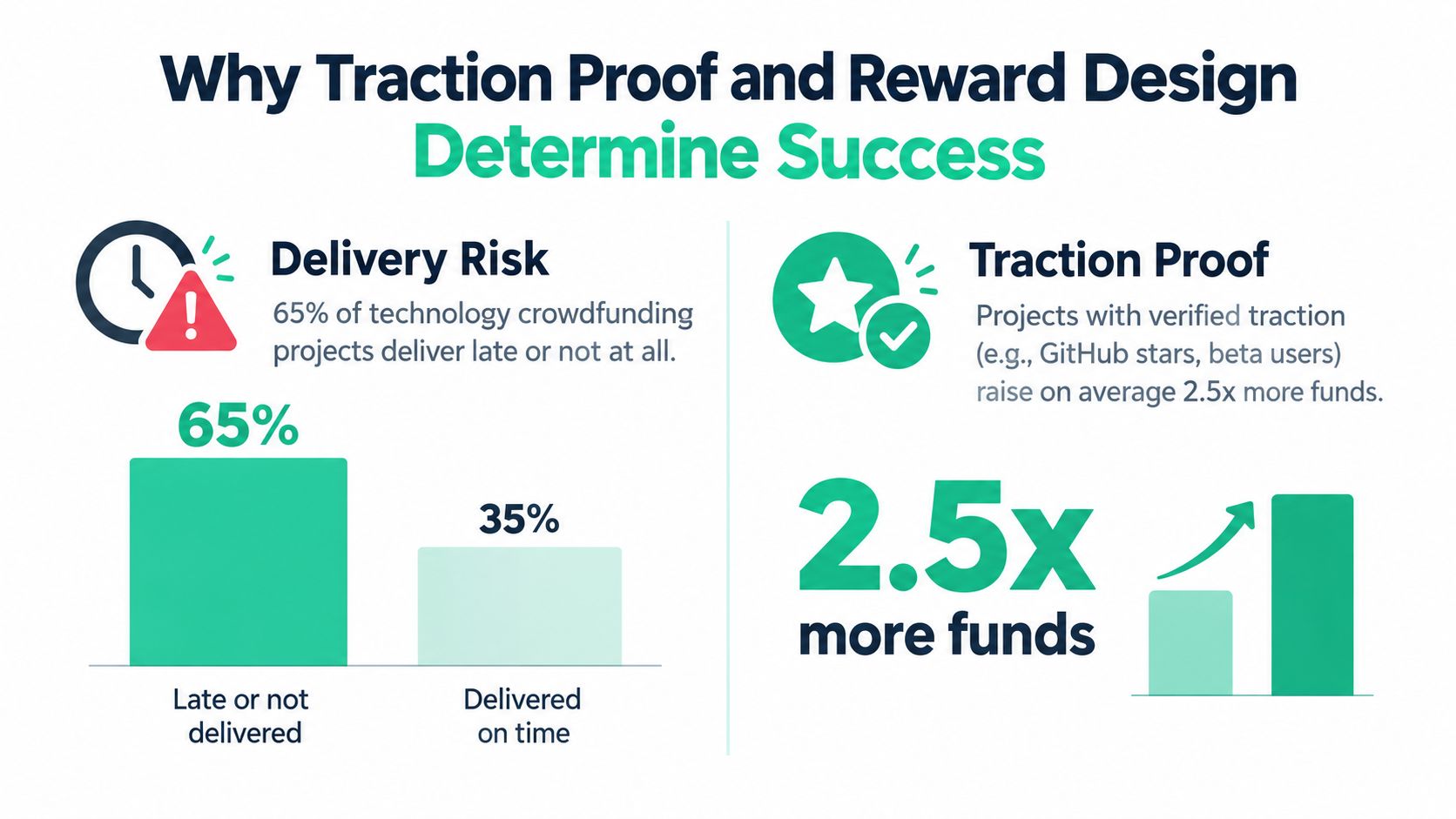
A review of Kickstarter fulfillment found that delays and non-delivery are common enough to shape how cautious backers should be, especially in technical categories (fulfillment analysis of Kickstarter projects). For software founders, the lesson is practical. A campaign succeeds or fails long before the deadline page says "funded." It succeeds when the offer brings in support without breaking your ability to deliver.
Backers are pricing your execution risk
For software, a reward tier works like a small contract. Each one sets a price, a promise, and a hidden workload.
A $29 early-access tier may be easy to fulfill if it only grants beta access and a private changelog. A $199 lifetime tier can still work if you already know your hosting, support, and onboarding costs. A $499 team bundle capped at 20 can be smart if it includes a defined number of seats and one setup session, not unlimited hand-holding.
That is the framework many first-time founders miss. Reward design is not decoration around the campaign. It is unit economics plus delivery capacity, exposed in public.
Use a simple test for every tier:
- What exactly does the backer get?
- What does it cost you to deliver after payment fees and support time?
- How many can you fulfill without slowing product shipping?
- What new obligation does this create 30 days from now?
If you cannot answer those four questions in plain language, the tier is probably too complicated.
Good reward tiers fit software economics
Software has one big advantage in crowdfunding. Extra copies usually cost far less to deliver than physical goods. That makes digital rewards attractive, but only if you keep support load under control.
The safest tiers usually share three traits:
- Low marginal cost. Beta access, annual plans, templates, private community access.
- Clear boundaries. Limited support hours, fixed setup scope, capped team seats.
- Fast time to value. The backer can log in, test something useful, and understand what they paid for.
By contrast, risky tiers often bundle too many promises together. Founders add swag, custom onboarding, roadmap influence, office hours, and concierge setup because the package sounds generous. In practice, each extra promise acts like another tab left open in your browser. One is fine. Twenty will slow the whole machine.
Later in the campaign, trust often grows through repeated contact, not one launch-day spike. A clear update rhythm and a plan for ongoing replies matter, especially for technical products. This guide to community engagement strategies for creator campaigns is useful if you need a simple way to structure that follow-through.
Here's a useful framing before you watch the video below.
Reward design changes conversion and delivery at the same time
Researchers who studied reward-based crowdfunding at scale showed that tier structure can be examined systematically rather than treated as creative guesswork, as noted earlier in the article. For software founders, that matters because the best-performing offer is rarely the one with the fanciest naming or the longest feature list. It is usually the one that is easiest to understand and easiest to fulfill.
Start narrow.
Offer a small number of tiers. Give each one a clear buyer type. Cap any reward that requires your team's time. Remove anything that creates shipping, inventory, or vendor coordination unless it directly helps adoption of the software.
Build rewards for the week when your team is tired, bugs are live, and backers still expect answers.
A funded campaign is not the finish line. For software, it is a live verification system. It shows whether your pricing makes sense, whether users want the product badly enough to pay early, and whether your team can turn demand into steady delivery without creating a support mess that stalls the roadmap.
Building a Campaign That Converts for SaaS AI and Dev Tools
A founder launches a polished campaign page for an AI tool, gets praise on the visuals, and still struggles to convert visitors into backers. Another founder shows a plain page with active users, recent product updates, and a reward people can understand in seconds. The second campaign usually has the stronger shot because software crowdfunding works like a live checkout test for demand, not a pitch contest.
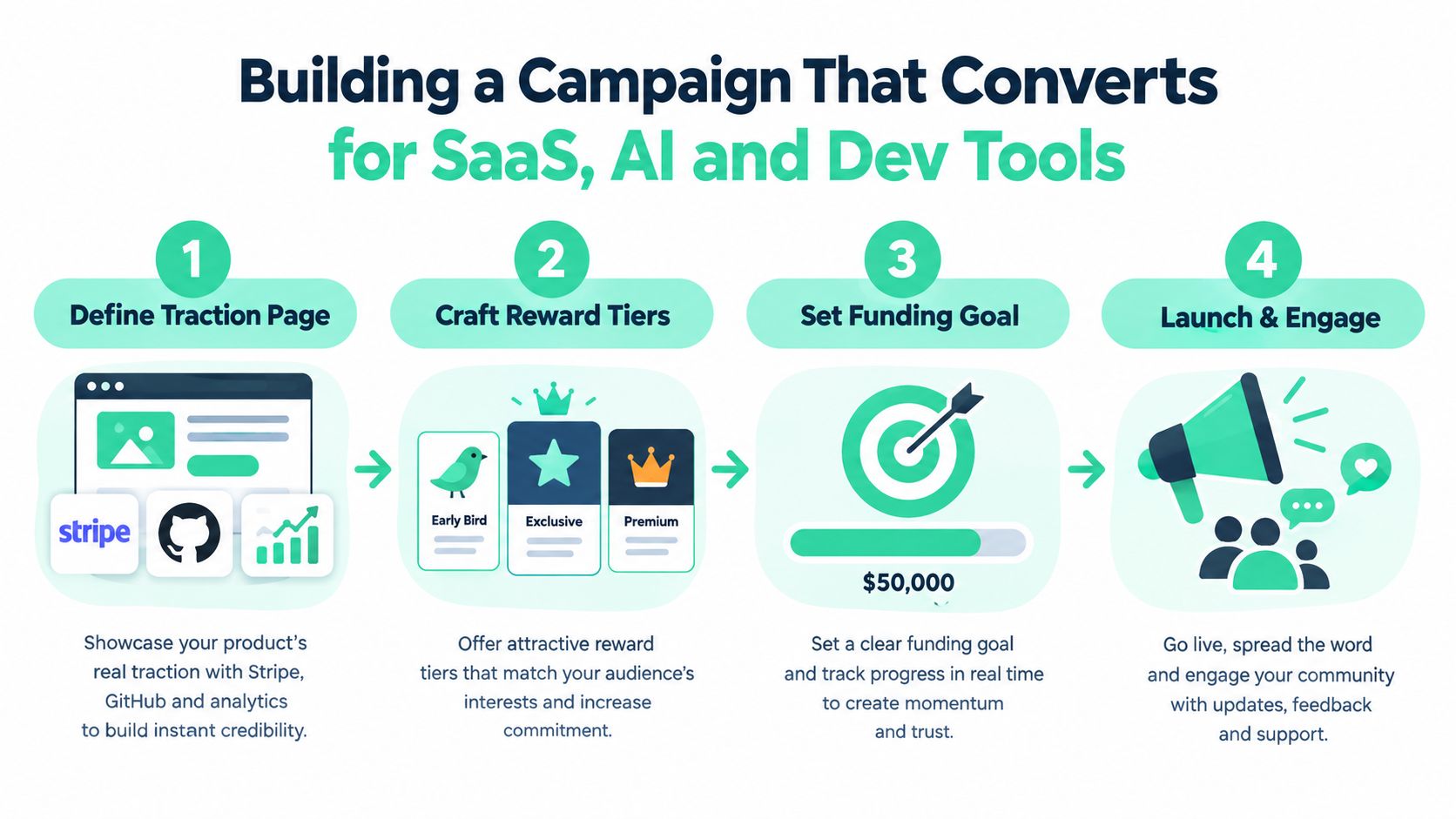
Start with a traction page
For SaaS, AI, and dev tools, buyers want proof that the product is already moving. They are asking simple questions. Is anyone using this? Is the team shipping? If I pay now, will this still exist in a few months?
A traction page answers those questions in one place. It works like a storefront window. Instead of arranging products behind the glass, you arrange signals that reduce doubt.
Useful inputs often include:
- Stripe for paid signups, revenue, or active customers
- GitHub for commits, releases, and visible build progress
- Product analytics for activation, usage patterns, or retained users
- Email or waitlist tools for signup intent and launch interest
What matters is the translation, not the raw feed. A visitor should be able to scan the page and understand what the product does, who is already using it, and whether the team has momentum.
Fundl is one option for this setup. It lets creators connect Stripe, GitHub, and analytics to publish a shareable traction page with auto-refreshing metrics and reward-based support through the creator's own Stripe account. For software products, that format fits the job of the campaign. It verifies demand in public while people are deciding whether to buy early access.
Build rewards around software economics
Rewards should match how software scales. A digital product can serve more users without creating boxes, shipping delays, or inventory problems, but founder time does not scale the same way. That is where many campaigns get into trouble.
Start with offers that are clear, low-friction, and cheap to deliver:
- Private beta access for early testers
- Discounted annual or lifetime plans for early supporters
- Team bundles for small companies or dev shops
- Limited founder support tiers with onboarding or office hours
- Contributor recognition for community-led or open-source products
Avoid rewards that create operational drag:
- physical merch
- uncapped consulting
- custom feature promises for a single backer
- broad tiers with fuzzy scope
A good reward menu should read like a pricing page with fewer choices and stronger reasons to buy now. If a backer cannot tell which tier fits them in a few seconds, conversion drops.
Turn metrics into a story people can trust
Numbers alone do not persuade. They need context.
A simple campaign narrative often works best for software founders:
- Name the painful workflow. Show the task that feels slow, expensive, or frustrating today.
- Show present-day proof. Point to usage, revenue, shipped releases, or active testing.
- Explain what this campaign funds. Be specific about the next build stage, not a distant vision.
- Connect each reward to delivery. Make it obvious why the team can fulfill what it is selling.
Many first-time founders get confused. They assume the story is about ambition. For software, the stronger story is execution under observation. Backers are watching whether your metrics are alive, whether your offer matches buyer behavior, and whether your release pace supports the promises on the page.
If you want cleaner input before launch, study how teams collect and sort recurring requests. This comparison of open source product feedback tools is useful because software campaigns convert better when founders can separate repeated pain points from random suggestions.
Warm up the right audience before launch
Software campaigns rarely convert from broad awareness alone. They perform better when the first visitors already know the problem and have seen signs that the team can ship.
That audience might come from a narrow developer community, an email list, GitHub discussions, Product Hunt followers, a Slack group, or founders you have helped in public. The size matters less than the fit. A small group of people who recognize the pain and trust your shipping speed is worth more than a large feed of casual clicks.
For SaaS, AI, and dev tools, crowdfunding works best when the campaign page confirms what the audience already suspects. The product is real. The demand is real. The team can keep shipping.
Legal Fulfillment and Trust Considerations for Software Campaigns
A software campaign feels lighter than a hardware campaign, but it still creates real obligations. The cleaner your operating setup, the more credible your campaign becomes.
Trust is part of the product
One underserved question in software crowdfunding is whether open-source projects have an advantage over closed products. Recent academic work on financing open-source software suggests backers are more likely to support open-source projects because they perceive them as more trustworthy, and the paper argues that trust, not just novelty, plays a central role (academic paper on financing open-source software).
That doesn't mean closed SaaS can't crowdfund. It means software founders should think more carefully about trust signals.
For open-source, trust signals might include:
- public roadmap discussion
- visible maintainers
- contribution guidelines
- governance clarity
- realistic maintenance commitments
For closed SaaS, trust often comes from:
- transparent delivery scope
- clear support expectations
- documented privacy and data handling
- consistent update cadence
- explicit refund and cancellation terms
Fulfillment risk is mostly self-inflicted
The easiest way to reduce campaign risk is to avoid promises that drag you into work unrelated to the product. Physical fulfillment, custom side work, and unclear access terms all create friction.
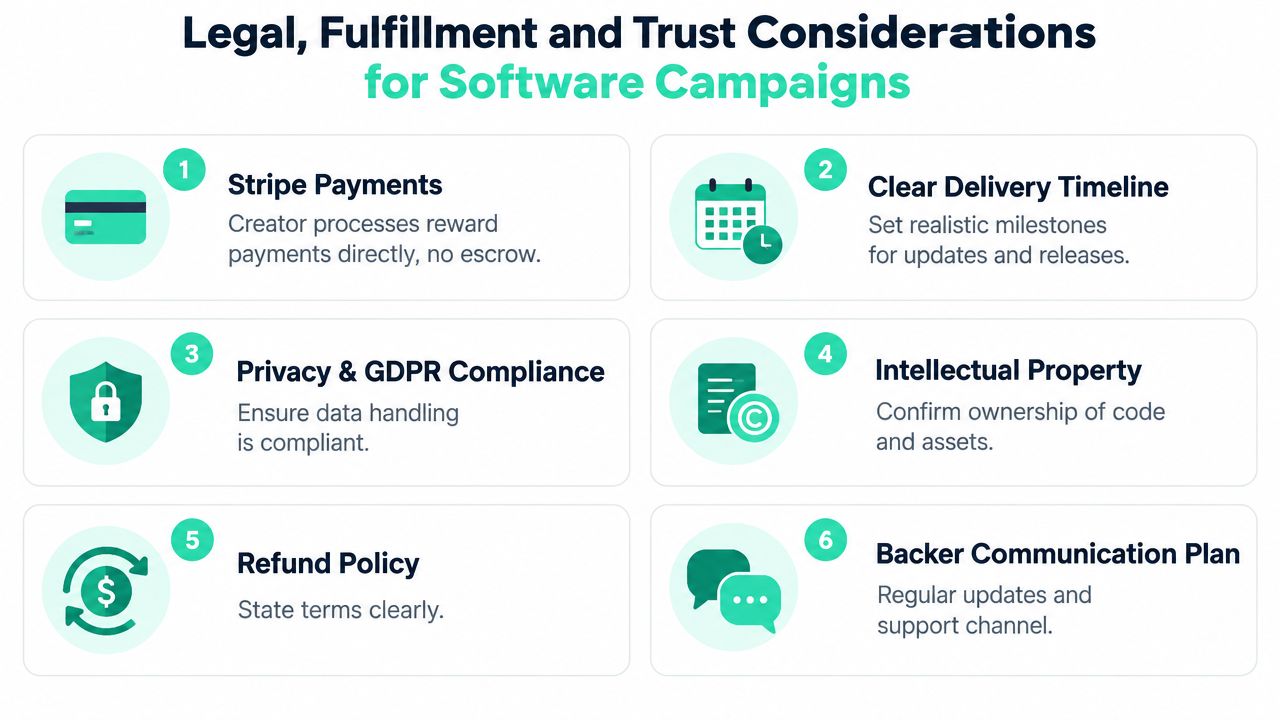
A simple readiness checklist helps.
- Payment flow: Know how contributions are processed and when funds reach you.
- Reward definition: Write each tier so a stranger can understand exactly what they get.
- Timeline realism: Promise milestones you can defend, not aspirations you hope to hit.
- Code ownership: Make sure you control the IP behind what you're offering.
- Privacy posture: If users will share data, say how you'll handle it.
- Update plan: Decide where and how often backers will hear from you.
Software founders often think trust comes from sounding confident. In practice, trust comes from narrowing promises and keeping them visible.
When crowdfunding validates demand and when it only amplifies
Crowdfunding isn't automatically discovery. Sometimes it's just amplification.
Broader market coverage says the crowdfunding market in 2026 is estimated in a range of about $23.82B to $27.93B, with long-term CAGR projections between 9.5% and 17.1%, yet independent Reg CF reporting cited in the same market context shows concentration in outcomes. In November 2025, just two platforms drove over half of investor commitments, and 2025 annual Reg CF activity totaled only $18.36M across 477 companies (crowdfunding market report coverage).
The practical lesson for software founders is simple. A campaign doesn't manufacture trust from nothing. It works best when you already have a small but real base of attention, usage, or community credibility that the campaign can organize and convert.
Your Launch Checklist and Next Steps to Raise on Traction
If you strip away the launch videos, clever tier names, and startup theater, crowdfunding for software startups comes down to four things: proof, pricing, scope, and cadence.
Proof means showing that users already care. Pricing means your rewards don't trap you in low-margin busywork. Scope means promising only what your current team can deliver. Cadence means backers can see that you keep shipping after the campaign starts.
A clean pre-launch checklist
Use this as a working draft before you publish anything.
- Proof layer ready: Your revenue, usage, commit history, or customer activity is organized into something a stranger can verify quickly.
- Reward menu trimmed: Every tier is digital or tightly bounded, and none of them commits you to open-ended labor.
- Milestones defined: Funding directs specific product steps, not fuzzy aspirations.
- Page copy grounded: You explain the problem, current traction, and next build targets in plain language.
- Audience list prepared: You know exactly who hears about the launch first.
- Update rhythm chosen: Backers will know when to expect progress notes and what those notes will include.
Measure success beyond dollars raised
A software campaign can succeed even if the most useful result isn't the total amount collected.
Watch for signs like:
- better quality conversations with users
- clearer pricing insight
- stronger retention among early adopters
- improved roadmap confidence
- more repeatable messaging
- stronger public trust signals for future fundraising
Those signals often matter more than a vanity headline. They tell you whether the market believes your product is worth following, paying for, and waiting for.
If you want a sanity check on founder-facing policy language before launch, tools like an AI legal assistant for business owners can help you think through terms, promises, and operating questions in plain English before you publish.
The mindset that keeps campaigns healthy
Treat your campaign like a live test of your product system, not a one-time event. If the campaign reveals weak trust, muddy pricing, or unrealistic delivery plans, that's useful information. It's cheaper to learn that during crowdfunding than after hiring, raising, or building six months of features nobody wanted.
The strongest software campaigns don't win because the founder wrote better hype. They win because the backer can see a believable machine already running: users arriving, code shipping, and rewards that fit the reality of the product.
That's the standard worth aiming for.
If you want to raise this way, Fundl gives software founders a reward-based crowdfunding workflow built around verified traction instead of static promises. You can connect live product signals, publish a shareable traction page, and let supporters fund progress through your own Stripe account. See how it works at Fundl.