
Open source software is often treated as if it comes with a single monetization playbook: release the code, build a community, then charge enterprises for premium features. That advice is popular because it's simple. It's also incomplete.
Open source is a distribution and trust advantage, not a revenue model by itself. The right business depends on who pays, what value they receive beyond the code, how much operational capacity your team has, and whether revenue arrives through recurring subscriptions, project work, licensing, or community support. A maintainer who sells uptime is running a different business from one who sells commercial usage rights. A developer educator sells expertise, while a marketplace operator sells access to an ecosystem.
The economic scale of open source makes this distinction important. A 2024 report from Linux Foundation Research, GitHub, and Harvard University estimates that organizations contribute about $7.7 billion annually to open source software worldwide, with 86% of that value coming from employee and contractor labor rather than direct cash spending. That means the biggest pool of value usually sits in maintenance, engineering, operations, and support, not in donations alone.
The ten models below organize open source monetization around the value being sold: rights, convenience, expertise, ecosystem access, or validated demand. Each model includes its operational cost, its risk to community trust, and the live traction signals that can make a Fundl funding page more credible.
Table of Contents
- 1. Dual Licensing Open Source and Commercial
- 2. Sponsored Development and Grants
- 3. SaaS Wrappers and Hosted Services
- 4. Premium Plugins Themes and Marketplace Extensions
- 5. Enterprise Support and Professional Services
- 6. Crowdfunding and Community Fundraising
- 7. Advertising and Sponsorship Placement
- 8. Educational Content and Courses
- 9. Managed Infrastructure and DevOps Services
- 10. Bounties Bug Fixes and Feature Development
- Open Source Monetization: 10-Strategy Comparison
- Choose the Revenue Engine Your Community Can Sustain
1. Dual Licensing Open Source and Commercial
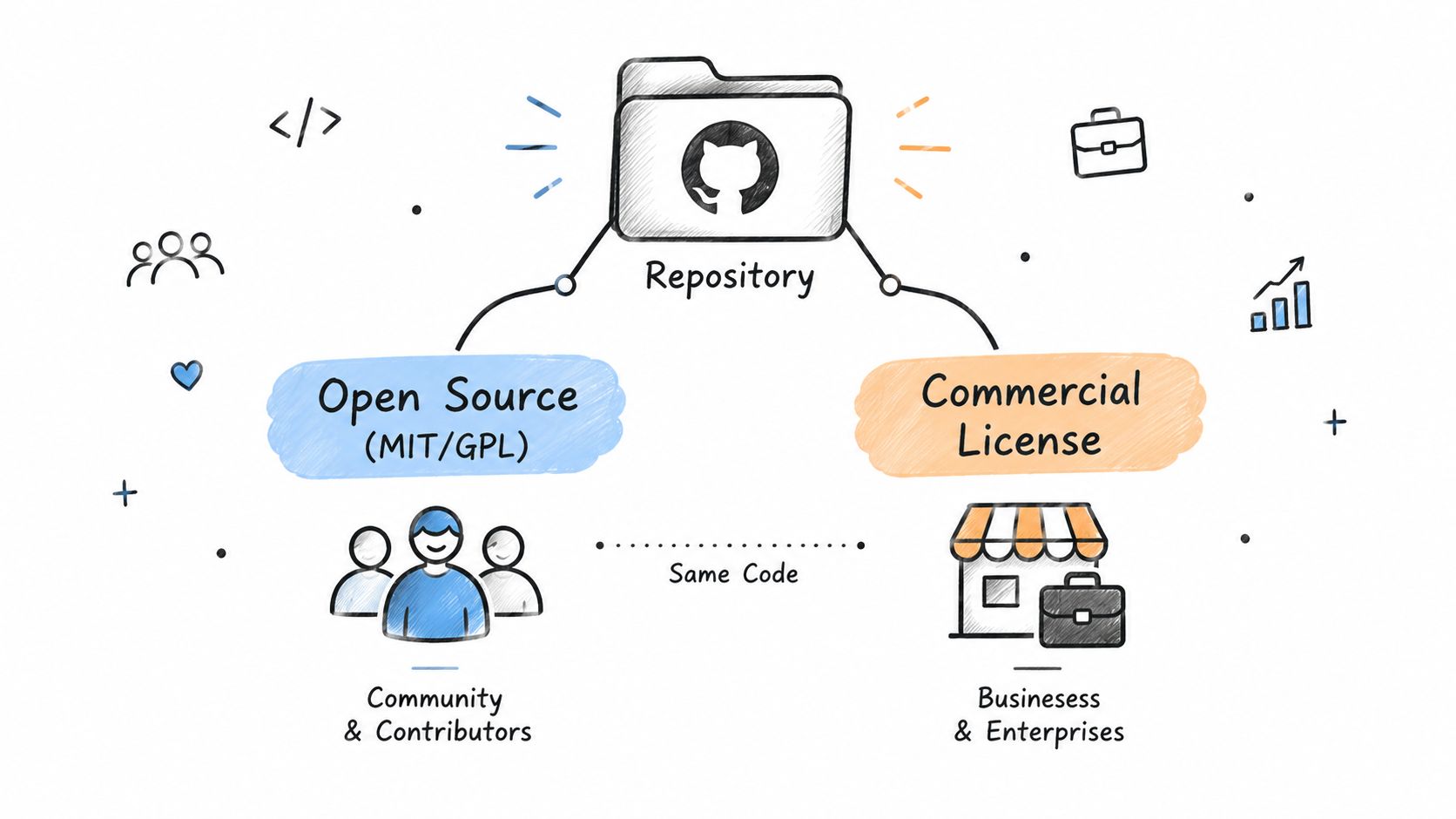
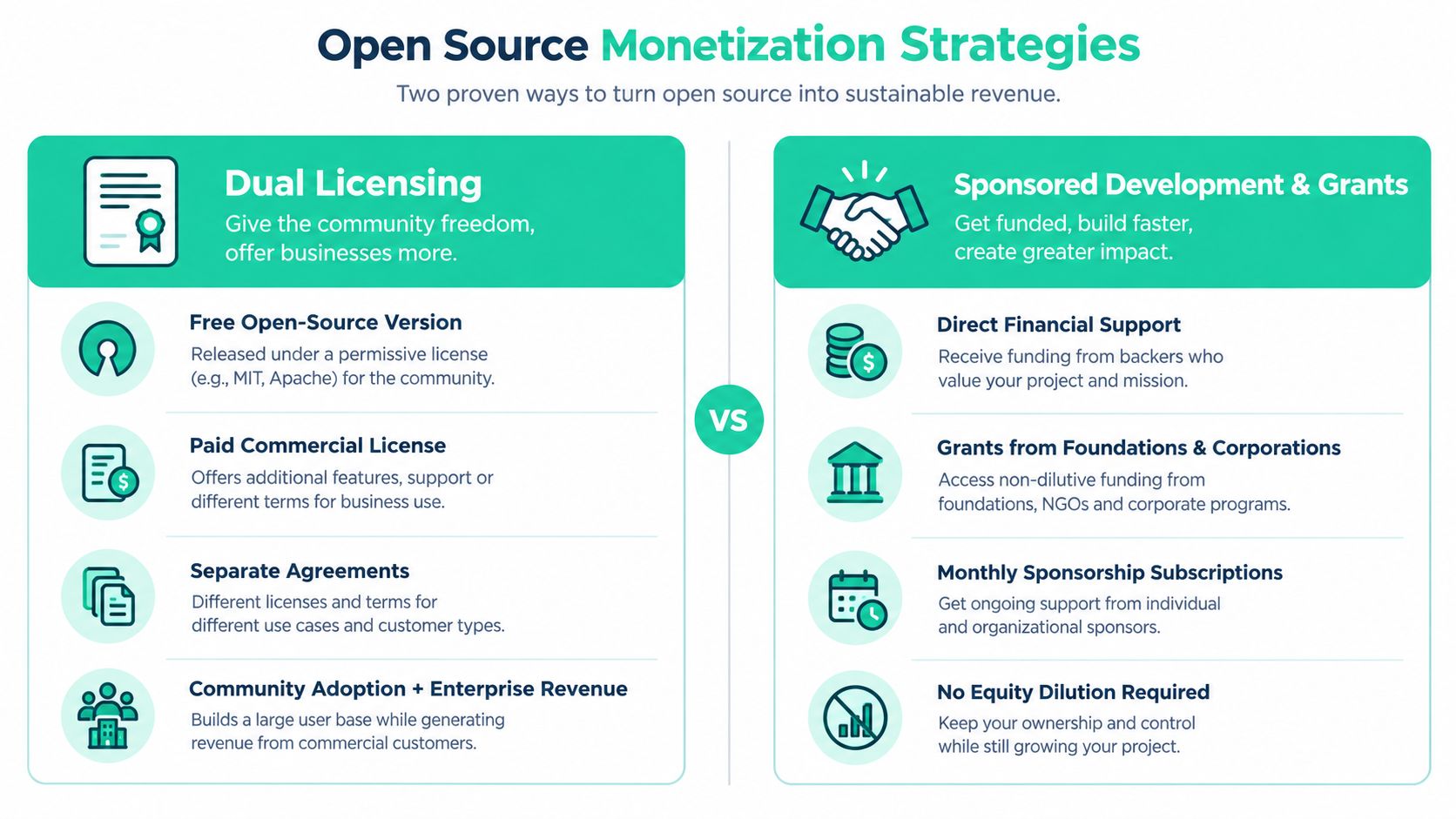
Dual licensing sells rights. The same codebase is available under an open source license for community use and under a commercial license for customers who need different legal permissions, distribution terms, or proprietary usage rights.
This model fits software that companies want to embed, redistribute, or incorporate into closed products. A developer may use the open source edition under its stated obligations, while a commercial customer pays for terms that better match its procurement, distribution, or compliance requirements. Qt is a well-known example of this structure. MongoDB, Nextcloud, and Elastic have also used licensing strategies that separate community access from commercial offerings, although their precise license arrangements differ and should never be copied without legal review.
The model doesn't work if the license boundary is vague. Publish the exact license files, explain which use cases require commercial terms, and provide a plain-English decision guide. Customers shouldn't need a lawyer to discover whether their intended deployment is permitted, even if they ultimately need counsel before signing.
Where the model earns its keep
Commercial licensing can produce high-value contracts without forcing self-hosted users into a hosted product. The trade-off is that licensing sales require legal documentation, contract negotiation, compliance review, and someone who can explain the difference between the community and commercial rights.
Track active installations, commercial inquiries, adoption by organizations, commits, release cadence, and issue resolution. On Fundl, connect those signals to a clear funding purpose, such as maintaining the licensing infrastructure, funding security work, or hiring engineers. Backers should see why commercial rights support the project rather than just seeing a payment button.
2. Sponsored Development and Grants
Sponsored development sells continued project capacity. Individuals, companies, foundations, and public programs fund work because they depend on the software, want a roadmap delivered, or want critical maintenance to continue.
This model works best when you can describe the work in terms a sponsor can evaluate. “Support the project” is weaker than “fund security updates, documentation, release engineering, or compatibility work.” Sponsorship tiers can offer recognition, roadmap briefings, contributor events, or governance participation, but they shouldn't turn essential project decisions into a pay-to-control system.
Large foundation-backed projects such as Kubernetes and Docker demonstrate how corporate sponsorship can support shared infrastructure. Smaller projects can use GitHub Sponsors, Patreon, or Open Collective, while individual maintainers may pursue grants from foundations or technology companies. The commercial logic is indirect. Sponsors aren't necessarily buying exclusive software rights. They're funding reliable labor around software they already use.
Make funded work visible
The Fundl guide to open source project funding emphasizes the value of combining funding requests with verified project activity. That approach is useful because a sponsor can compare the ask with visible evidence: recent releases, issue activity, contributor participation, security maintenance, or a published roadmap.
The 2024 Open Source Software Funding Report estimates that organizations invest about $7.7 billion annually into the ecosystem, while 86% of that value comes from employee or contractor labor and 14% from direct financial contribution. The practical lesson is clear. Sponsorship should fund the labor that keeps the project dependable, not just add a badge to a website.
Publish sponsor goals, show progress, maintain a public sponsor list when appropriate, and report what the money enabled. Useful Fundl signals include recurring sponsor revenue, GitHub activity, release consistency, open issue trends, and the proportion of the roadmap funded.
Practical rule: Ask sponsors to fund specific maintenance outcomes, while keeping technical governance transparent and open to the wider community.
3. SaaS Wrappers and Hosted Services
Hosted services sell convenience. The open source software remains available for self-hosting, while customers pay you to handle deployment, upgrades, backups, monitoring, security operations, and support.
Discourse offers open source forum software alongside hosted services. Gitea, Metabase, Supabase, Cal.com, and Plausible Analytics show variations on the same principle. The customer isn't paying because the source code is inaccessible. They're paying because running production software consumes time and introduces operational risk.
A credible hosted model keeps the self-hosted version useful. If you deliberately make the community edition unreliable or remove basic capabilities only to create upgrade pressure, users may conclude that the hosted service is a toll booth rather than a service. The paid value should come from operational excellence, managed infrastructure, collaboration, security, backups, and a smoother path from evaluation to production.
Price the burden you remove
Hosted services create recurring revenue, but they also create recurring obligations. You need reliable infrastructure, incident response, customer support, billing, tenancy controls, data protection, and a process for handling migrations between hosted and self-managed deployments. Small teams often underestimate the cost of being responsible for customer data and uptime.
Track active hosted accounts, recurring revenue, retention, deployment volume, support requests, infrastructure incidents, and self-hosted-to-hosted conversion. A Fundl traction page can show recurring revenue and product activity, but it should also explain the operational work behind the offer.
This video can sit alongside the written explanation as an additional product walkthrough.
A simple comparison page should answer three questions: what can users run themselves, what does the hosted service remove, and what happens if a customer leaves? Transparent answers reduce licensing anxiety and make convenience feel like a fair exchange.
4. Premium Plugins Themes and Marketplace Extensions
Marketplaces sell ecosystem access. The core application stays open and useful, while developers or the project team offer paid plugins, themes, integrations, templates, and extensions.
WordPress built a vast commercial layer around plugins and themes. VS Code uses an extension ecosystem, while Figma, Ghost, and Shopify show how platforms can create economic opportunities for third-party creators. The open source project may earn through listing fees, revenue sharing, premium first-party extensions, hosting, or services that help buyers discover and trust what they install.
The key requirement is extensibility. A monolithic tool with no clear plugin boundary shouldn't force a marketplace into existence. The product needs stable interfaces, documentation, version compatibility, and enough users for creators to believe that building an extension is worth their time.
The marketplace operator owns the quality problem
Marketplace revenue can scale beyond the core team's own engineering hours, but it shifts the burden toward governance. You need submission guidelines, security review, moderation, payment handling, refund policies, creator support, and a response process for abandoned or malicious extensions.
A marketplace can also fail through poor discovery. If buyers can't find reliable extensions, and creators can't reach buyers, both sides leave. Curated collections, compatibility labels, creator profiles, audit results, and clear reviews can improve trust without pretending every extension is equally safe.
Useful Fundl signals include installed extensions, active creators, marketplace transaction activity, repeat purchases, extension retention, and security review completion. Don't present plugin count as proof of health by itself. A smaller ecosystem with maintained, trusted extensions may be more valuable than a larger catalog full of abandoned projects.
A marketplace becomes a business when it reduces the risk and effort of choosing extensions, not merely when it lists them.
5. Enterprise Support and Professional Services
Professional services sell expertise. Customers pay for implementation, migration, training, custom development, performance work, incident response, or a support contract around software they could otherwise download and run themselves.
Red Hat and Canonical demonstrate the support-led model around Linux distributions. Acquia built services around Drupal, while companies working with Kafka and Elasticsearch commonly combine software, enterprise capabilities, and technical assistance. These businesses convert open source adoption into a pipeline of customers who need help operating a consequential system.
This is often the most direct route to early revenue because you can sell knowledge before building a large hosted platform. A maintainer who understands the architecture can help a customer deploy faster, diagnose a difficult issue, or avoid an expensive migration mistake. The drawback is equally direct: services revenue is tied to people and time.
Productize the work before it consumes the team
Create clear support tiers. Community support can remain public, professional support can define response expectations, and enterprise support can include dedicated contacts, escalation paths, and service-level commitments. Keep the boundaries visible so paying customers know what they receive and community users know what isn't promised for free.
Consulting should produce reusable assets whenever possible. Turn recurring deployment questions into documentation, create migration playbooks, automate diagnostics, and convert common training requests into courses or certification. Without that discipline, every customer creates a new custom project and maintainers lose time for the core product.
Track support revenue, paying customers, response performance, delivered projects, repeat engagements, and the share of service work converted into reusable product improvements. A Fundl page can connect those signals to a funding request for additional maintainers, documentation, or support coverage.
6. Crowdfunding and Community Fundraising
Crowdfunding sells validated demand and community-backed development. Backers contribute because they want a feature, release, hardware product, documentation effort, or project milestone to exist, and they want to help fund it before completion.
This model works when the project has a community that can understand the proposed outcome. A campaign needs a specific promise, a delivery sequence, an owner, and a way to report progress. “Help us build the future” is not a funding plan. “Fund a maintained database adapter, publish the work under the project license, and provide milestone updates” gives backers something concrete to evaluate.
Platforms such as Kickstarter have supported open hardware and software campaigns. Pine64 and elementary OS show how community-oriented products can use direct support to fund development. Crowdfunding can also test whether stated enthusiasm becomes actual payment, which is a more useful signal than attention alone.
Turn the campaign into a public operating record
The Fundl guide to SaaS crowdfunding is relevant to open source teams because a campaign can combine a funding target with live evidence. Connect GitHub activity, Stripe data, and analytics where applicable. Show what has shipped, what remains, and which signals indicate that users are still engaged.
Reward tiers should be simple to fulfill. Early access, project recognition, training, merchandise, voting on clearly bounded priorities, or access to a community session may be manageable. Avoid rewards that create a second business requiring inventory, logistics, or individual customization unless you have the capacity.
Track contribution volume, recurring support, active users, GitHub activity, milestone completion, and campaign conversion. Keep communicating after funding closes. Backers don't just fund the launch. They judge whether the project honors its reporting and delivery commitments.
7. Advertising and Sponsorship Placement
Advertising sells attention and association. An open source project can place relevant sponsor links, logos, or messages in documentation, package pages, newsletters, community spaces, or release communications without charging users for access to the software.
This model is strongest when the audience is well defined and the sponsor is relevant. A developer infrastructure company may value visibility among maintainers who evaluate tools. A security provider may want to support documentation used by engineering teams. The placement should help fund the project without turning README files or error messages into cluttered advertising surfaces.
npm package documentation, GitHub sponsorship badges, PyPI listings, developer communities, and foundation sponsorship programs all offer different forms of visibility. The commercial value depends on audience quality, context, engagement, and trust. A small but focused technical audience can be more useful to a sponsor than broad, unfocused traffic.
Protect the project's credibility
Set rules before accepting money. Decide where sponsor marks can appear, which categories are excluded, whether maintainers can reject a sponsor, and how you will disclose the relationship. Don't let a sponsor influence security disclosures, technical recommendations, or project governance in exchange for placement.
Offer sponsorship packages based on defined benefits such as logo placement, a project update, a community event, or a documentation acknowledgment. Avoid promising impressions or conversions you can't measure. Fundl can display sponsor count, sponsorship revenue, GitHub activity, and audience signals on a shareable traction page, giving sponsors a clearer view of what their support reaches.
The main cost is reputational. Poorly matched ads can make an independent project look captured by vendors. Keep placements minimal, contextual, and easy to distinguish from maintainer guidance.
8. Educational Content and Courses
Education sells expertise packaged for transfer. Maintainers and experienced contributors can create courses, tutorials, workshops, certifications, bootcamps, reference material, or paid community programs around an open source technology.
The free software creates a natural learning environment, but it doesn't automatically create a good curriculum. Students pay for structure, sequencing, practical exercises, feedback, and confidence. A course should help someone move from installation to a real workflow, not just repeat the project's documentation in video form.
Wes Bos and Kent C. Dodds have built education businesses around JavaScript ecosystems. FreeCodeCamp combines free learning content with broader training initiatives, while Linux-focused training providers show how education can support an ecosystem without closing the underlying software.
Build around a recurring learning problem
Start with one audience and one outcome. A course for contributors should teach repository navigation, issue selection, testing, and review etiquette. A course for operators should focus on deployment, monitoring, upgrades, and incident handling. A course for business users should explain workflows and governance rather than implementation details.
Free content can serve as discovery, but premium material should offer a meaningful improvement in learning speed or support. Keep lessons current as the software changes. Version labels, update notes, practical labs, and a visible support policy prevent students from buying an outdated path.
The Fundl guide to launching a course provides a useful framework for connecting an education offer to audience evidence. Track enrollment, completion, repeat purchases, learner questions, cohort participation, and course update activity. Fundl can help present those signals alongside a funding goal for curriculum development or maintainer education work.
Education doesn't need to compete with the open source community. Free documentation can remain broad, while paid instruction provides depth, feedback, and a more guided experience.
9. Managed Infrastructure and DevOps Services
Managed infrastructure sells operational convenience at the system level. Instead of hosting only the application, the provider manages databases, deployment pipelines, containers, storage, networking, observability, or other infrastructure required to run an open source stack.
Supabase offers managed PostgreSQL alongside an open source development model. PlanetScale, Railway, Render, Vercel, and Heroku represent different approaches to managed databases, application deployment, and platform services. The common customer problem is not access to source code. It's the difficulty of keeping production systems secure, available, updated, and understandable.
This model can be more demanding than a basic SaaS wrapper because customers may depend on several infrastructure components at once. A small provider should begin with one clear operational problem, such as managed PostgreSQL or deployment for a specific framework, rather than promise to manage an entire cloud.
Sell reduced operational burden
Publish a transparent pricing method and a cost estimator. Explain what happens when usage grows, what backups include, how data can be exported, and which security responsibilities remain with the customer. Buyers need to understand their exposure before they place a production workload on the platform.
The service also needs strong onboarding. Documentation should cover the first deployment, environment configuration, monitoring, rollback, migration, and account recovery. If a customer can't understand how to leave, they may hesitate to start.
Track active deployments, recurring revenue, retention, support volume, deployment failures, incident response, resource utilization, and successful migrations. Fundl can make those signals visible to backers who are evaluating whether the team can operate the service responsibly.
Managed infrastructure works when the provider's operational skill is part of the product. It fails when the team treats hosting as a thin wrapper around a free project without budgeting for security, reliability, and customer support.
10. Bounties Bug Fixes and Feature Development
Bounties sell validated demand for specific work. Users, companies, or community groups fund a bug fix, integration, feature, documentation improvement, or security task, and developers earn payment when they meet the published acceptance criteria.
This model creates a direct connection between demand and development. Instead of asking contributors to guess which issues might be valuable, a sponsor attaches a budget to a defined problem. Gitcoin, Bountysource, IssueHunt, and other bounty platforms have used variations of this approach for open source work.
A bounty is only useful when the request is specific. “Improve performance” is not an actionable task. A good issue describes the affected workflow, expected behavior, constraints, test requirements, documentation needs, and who decides whether the work is complete.
Make completion enforceable
Use a clear workflow from funding to acceptance. The issue should show the budget, scope, deadline if relevant, maintainer contact, review process, and payment conditions. Integrate the process with GitHub issues so contributors discover the work where they already collaborate.
Reputation and skill matching can reduce wasted effort. A contributor who understands the project's architecture is more likely to deliver than someone attracted only by the bounty amount. Automated payment after maintainer approval can reduce administrative work, but it can't replace human review.
Track active bounties, total committed value, completion rate, time to acceptance, repeat funders, contributor participation, and the number of completed tasks that become maintained project code. Fundl can display those signals beside GitHub activity and a funding goal.
Bounties are not a substitute for core maintenance funding. They work well for discrete, sponsor-valued tasks. They work poorly when a project uses them to avoid paying for the unglamorous work of releases, triage, governance, and long-term stewardship.
Open Source Monetization: 10-Strategy Comparison
| Strategy | Implementation Complexity 🔄 | Resources & Ops ⚡ | Expected Outcomes ⭐📊 | Ideal Use Cases | Key Advantages 💡 |
|---|---|---|---|---|---|
| Dual Licensing (Open Source + Commercial) | Legal and enforcement complexity; clear license boundaries required 🔄 | Moderate, legal, compliance, license audits | Enterprise revenue + broad community adoption; predictable upgrades ⭐⭐📊 | Projects with clear commercial demand and active community | Monetizes same codebase while keeping OSS community; clear upgrade path 💡 |
| Sponsored Development & Grants | Low legal complexity; high outreach and grantwriting effort 🔄 | Low-to-moderate, fundraising, community relations, reporting ⚡ | Unrestricted funding but unpredictable; strengthens community ties ⭐📊 | Public goods, widely used tooling, projects aligned with funders | No equity dilution; aligns with OSS values; flexible funding streams 💡 |
| SaaS Wrapper & Hosted Services | High, requires ops, billing, and support systems; ongoing maintenance 🔄 | High, infrastructure, SRE, customer success, scaling costs ⚡ | Recurring MRR/ARR; scalable and predictable revenue if product-market fit achieved ⭐⭐⭐📊 | User-facing tooling where convenience outweighs self-hosting | Predictable subscriptions; low friction for non-technical users; strong business signals 💡 |
| Premium Plugins, Themes & Marketplace Extensions | Moderate, platform, curation, and quality control needed 🔄 | Moderate, marketplace platform, payments, discoverability efforts ⚡ | Diverse revenue streams; passive transaction fees; ecosystem growth ⭐⭐📊 | Extensible platforms with large user bases (CMS, IDEs) | Scales via third-party creators; encourages community contributions 💡 |
| Enterprise Support & Professional Services | Moderate, sales, SLAs, and hiring expert staff 🔄 | High, talented engineers, support org, sales/BD teams ⚡ | High-margin but capacity-limited revenue; strong customer retention ⭐⭐📊 | Complex deployments, enterprise customers needing SLAs | Builds deep customer relationships; premium ARPU; defensible expertise 💡 |
| Crowdfunding & Community Fundraising | Medium, campaign planning, marketing, and fulfillment 🔄 | Low-to-moderate, campaign ops, comms, reward fulfillment ⚡ | Fast upfront funding and market validation; variable predictability ⭐📊 | Early-stage projects seeking capital and community validation | Builds engaged community, no equity dilution, marketing boost 💡 |
| Advertising & Sponsorship Placement | Low, technical setup simple; curation and brand safety required 🔄 | Low, sponsor relations, audience metrics, placement ops ⚡ | Revenue scales with audience; risk of community backlash if mismanaged ⭐📊 | Large docs/sites, community hubs, widely used tooling pages | Non-intrusive monetization; easy to implement and test revenue streams 💡 |
| Educational Content & Courses | Medium, content creation, updates, and platform management 🔄 | Moderate, production, marketing, platform hosting, instructor time ⚡ | High-margin scalable revenue; depends on marketing and freshness ⭐⭐📊 | Popular technologies with training demand and certification needs | Leverages expertise to build authority and recurring student revenue 💡 |
| Managed Infrastructure & DevOps Services | Very high, complex infra, SLAs, and operational maturity required 🔄 | Very high, cloud costs, SRE teams, monitoring, compliance ⚡ | Strong recurring revenue and retention if reliable; high scaling potential ⭐⭐⭐📊 | Infrastructure tools and enterprise workloads needing managed offerings | Creates switching costs, strong unit economics at scale, enterprise fit 💡 |
| Bounties, Bug Fixes & Feature Development | Medium, marketplace, payments, and moderation systems 🔄 | Moderate, escrow/payments, dispute resolution, integration with repo ⚡ | Faster issue resolution and community-funded features; variable volume ⭐📊 | Projects needing targeted feature funding or external contributors | Aligns incentives; transparent funding for specific work; flexible contributor model 💡 |
Choose the Revenue Engine Your Community Can Sustain
The best open source monetization model matches the value a buyer receives with the work your team can reliably deliver. Don't choose a model because another project uses it. Choose it because you understand the buyer, the operational burden, the license implications, and the evidence that demand already exists.
Choose dual licensing when commercial customers need different rights and you can explain those rights precisely. Choose enterprise support and professional services when customers need expert implementation, migration help, or response commitments around a complex system. These approaches can suit commercial buyers who want self-hosting, control, and a direct relationship with the maintainers.
Choose hosted services when users value convenience more than operating the software themselves. Choose managed infrastructure and DevOps services when the hard part is not the application but the production environment around it. Both models can produce recurring revenue, but both require serious operational capacity. Hosting isn't passive income. It creates obligations around security, incidents, data, billing, and support.
Choose premium plugins and marketplaces when your product has stable extension points and enough ecosystem activity to support both buyers and creators. Marketplaces can expand the value of the core project, but they also create moderation, security, discovery, and compatibility work. Don't launch one before you can explain how you'll protect users from abandoned or unsafe extensions.
Choose education when your advantage is practical expertise and users need a guided path through a complicated technology. Courses, workshops, and certification can complement an open source project without restricting access to the code. They need continuous updating, clear audiences, and real learning outcomes.
Choose sponsorships, grants, crowdfunding, or bounties when the community wants to fund development directly. These models are especially useful for maintainers who want to keep the project open while making specific work visible. They can also validate demand, but they shouldn't hide the cost of ongoing labor. A CMU study of GitHub repositories found that only 25,885 of 77,934,441 repositories, or 0.04%, asked for donations, and only 10% of projects in the larger corpus received at least $1,000 per month. The observed payout distribution had a median of $55, which shows why donations alone rarely provide a durable operating model. See the CMU study of donations in open source for the underlying findings.
A sustainable strategy usually starts with one primary revenue engine and one complementary stream. A hosted product might add support. A services-led project might add training. A community-funded maintainer might add bounties for specific work. Keep the combination understandable. If backers, contributors, and customers can't tell what they're paying for, the model will create confusion before it creates revenue.
Write down the value exchanged. State what remains open, what is paid, who receives the money, and how maintenance is funded. Publish licensing terms, support boundaries, reward conditions, and commercial policies before users have to ask. Transparency is not a marketing layer. It is part of the product contract.
Then track a small set of verifiable signals. Depending on the model, that could include recurring revenue, active deployments, GitHub activity, releases, contributors, support demand, course enrollment, marketplace activity, or bounty completion. Don't publish every metric you have. Publish the metrics that connect directly to the value you're asking people to fund.
The maintainer labor problem deserves direct attention. Recent research and coverage summarized by the Linux Foundation indicate that many maintainers remain unpaid while maintenance demands rise, which means a project can appear commercially successful while the people doing the work remain underfunded. Allocate revenue deliberately across maintenance, security, governance, contributor incentives, infrastructure, and growth. If all revenue goes toward acquisition, the project may grow faster while becoming less sustainable.
For a practical funding process, set a specific goal, connect Stripe, GitHub, and analytics where they apply, and publish a shareable traction page through Fundl. Let backers see live evidence of revenue, build activity, and audience engagement instead of relying on screenshots or promises. Fundl uses reward-based contributions without equity or debt, and contributions are processed through each creator's own Stripe account. The result should be a clear request backed by current project activity, not a vague appeal for goodwill.
Start small enough to deliver. Fund one maintenance milestone, sell one support package, launch one course, or test one hosted workflow. Learn which value people will fund, report what happened, and expand only after the project can sustain the promise.
Fundl gives open source teams a shareable crowdfunding page built around verified traction from sources such as Stripe, GitHub, and analytics. Visit Fundl to set a funding goal, connect your project data, and invite community support with live evidence at the center.