
The broadest market isn't automatically the best opportunity. A large audience can hide weak demand, expensive competition, and a product that tries to satisfy too many workflows at once. The strongest niche market business ideas usually start with a specific customer, an acute operational problem, and a proof loop that shows whether the solution creates value.
This list evaluates eight opportunities through the same founder-sized filter: customer specificity, MVP feasibility, monetization, measurable traction, and validation path. For each idea, the useful question isn't whether the category sounds fashionable. It's whether a small team can identify the buyer, ship a deliberately narrow first version, measure behavior through signals such as MRR, MAU, commits, or email signups, and decide what to build next.
A live Fundl traction page can support that process by publishing source-verified data connected from Stripe, GitHub, and analytics tools. The page doesn't replace customer research or a working product. It gives founders a way to show connected evidence rather than relying only on screenshots, projections, or promises.
Table of Contents
- 1. Micro-SaaS for Vertical Markets
- 2. AI-Powered No-Code Automation Workflows
- 3. Educational AI Tools and Courses
- 4. Open-Source Software Monetization and Sponsorships
- 5. Productized Services and Service Automation
- 6. Creator Economy and Personal Brand Monetization Platforms
- 7. Data-Driven Analytics and Insights Tools for Niche Markets
- 8. AI-Assisted Content Creation and Curation Tools
- 8-Item Niche Market Ideas Comparison
- Turn One Narrow Idea Into Proof
1. Micro-SaaS for Vertical Markets
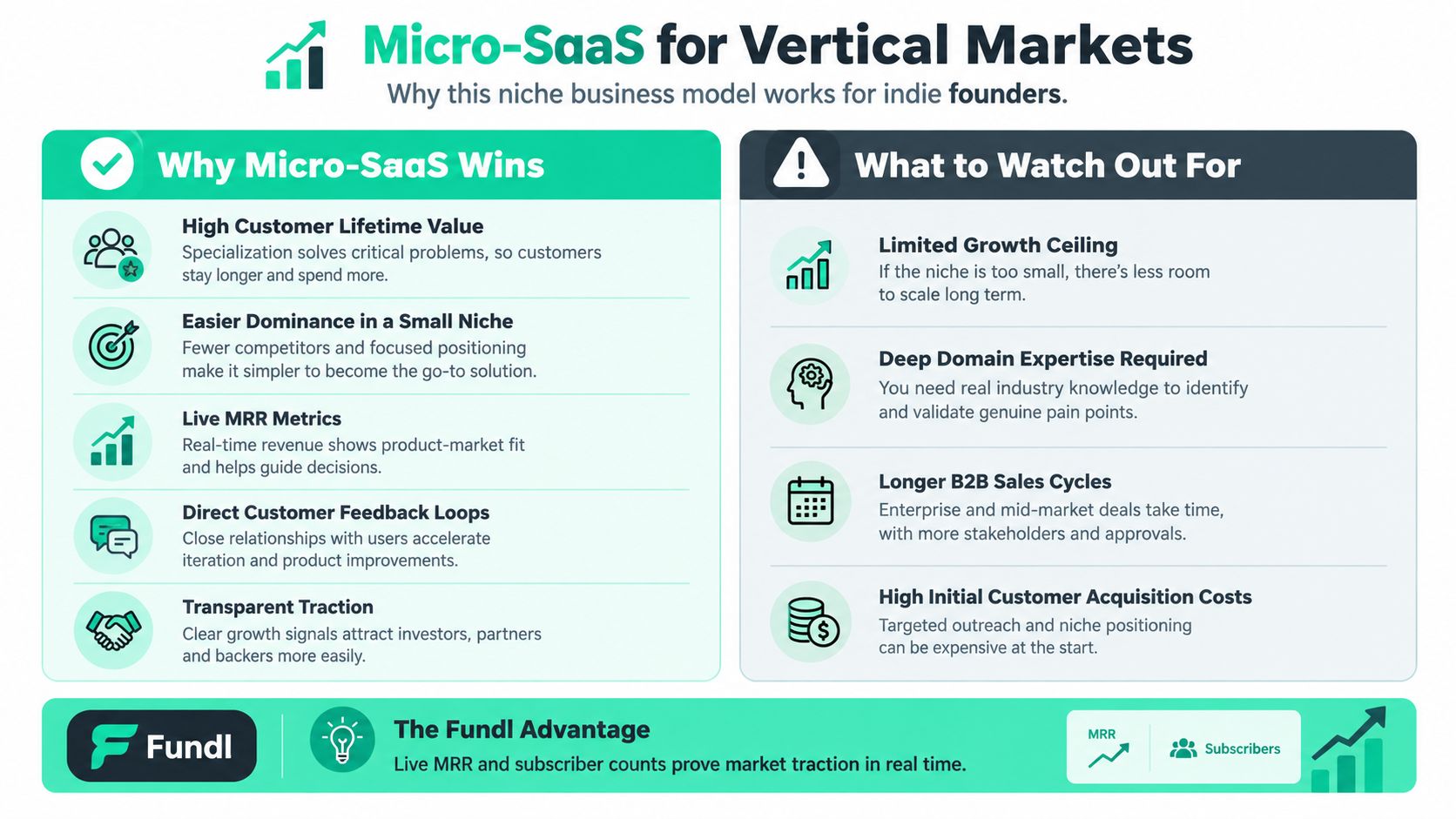
A micro-SaaS product becomes attractive when it handles one recurring job for one clearly defined professional group. A dental practice may need a workflow that general appointment software handles poorly. A freelance bookkeeper may need client follow-up, document collection, or reporting built around the way independent firms work. An appliance manufacturer may need digital tools for home appliance makers rather than another generic project-management platform.
The opportunity is strongest where the buyer already spends time and money managing the problem manually. Specialized software can earn attention by fitting an existing workflow more closely than a broad platform, but founders shouldn't assume that a narrow audience automatically means easy distribution. Access to communities, professional associations, and practitioners matters as much as the feature set.
A deliberately small first product
The MVP should complete one high-value task from intake to outcome. For example, a bookkeeping tool might collect missing client documents, send reminders, and show what remains outstanding. A niche e-commerce product might solve one catalog, fulfillment, or reporting problem for a tightly bounded merchant group.
Avoid building an industry-wide operating system. Start with a workflow users can describe in concrete terms, then measure whether they return to it.
Practical rule: Charge for the job being completed, not for a long list of features.
Recurring billing can make this model easier to reason about. Fundl's explanation of recurring revenue is useful when deciding whether the product's value appears repeatedly enough to support a subscription.
Evidence that can support the next decision
Connect Stripe to display MRR, GitHub to show ongoing commits, and an analytics source to show active usage. The most useful metrics depend on the workflow:
- Revenue signal: MRR, paid accounts, and failed-payment recovery.
- Usage signal: MAU, completed workflows, and repeat sessions.
- Shipping signal: commits tied to customer-requested improvements.
- Demand signal: qualified email signups from the target profession.
Validate the idea by interviewing practitioners, reviewing complaints in relevant Reddit, Discord, or Slack communities, and manually delivering the workflow before automating it. A Fundl traction page becomes meaningful once those connected metrics reflect real customer activity.
2. AI-Powered No-Code Automation Workflows
AI automation is most defensible when it removes a specific repetitive decision from a known workflow. A small retailer may need incoming support messages routed correctly. A recruiting firm may need documents classified before a human reviews them. A specialist agency may need data moved between a form, CRM, and reporting system without maintaining custom code.
The weak version of this idea is “Zapier for an industry.” The stronger version automates one painful task and makes the result easy to verify. Narrow scope also limits the risk of building an interface that promises flexibility but leaves users responsible for configuring every edge case.
Build trust into the MVP
The first product might accept one document type, classify it, and send the result to one destination. Or it might watch one inbox, recognize a small set of request types, and route them to the right queue. Human approval should remain visible wherever an incorrect action could create financial, legal, or customer-service consequences.
The product needs logs, exception handling, and a clear way to undo or correct an action. These aren't decorative features. They let a buyer judge whether automation is safe enough to place inside a real operation.
A useful discovery route is a POD niche discovery tool, but keyword or trend interest is only an initial signal. Founders still need conversations with the people doing the work.
Measure completed value, not novelty
Track the number of active users, automations executed, successful runs, human overrides, and repeat usage. An expanding automation count can indicate activity, but successful completion and continued use are stronger evidence than raw task volume.
A free tier can reduce adoption friction if its limits lead naturally to a paid workflow. Fundl can display MAU, automation activity, and GitHub commits from connected sources, giving a backer a view of both usage and development. Validate with a concierge version first. Run the workflow manually, record exceptions, and only automate the steps that recur often enough to justify product work.
3. Educational AI Tools and Courses
Educational products become more compelling when they target a measurable skill rather than a broad subject. A course for all business owners is difficult to position. A tool that helps a defined group complete a particular task, practice a specific technical concept, or move through a bounded curriculum has a clearer promise.
This category can combine structured lessons with AI assistance, such as adaptive explanations, practice feedback, question generation, or instructor support. The AI shouldn't become the product's only differentiator. Learners pay for progress, clarity, accountability, and a path through material that would otherwise feel difficult to organize.
Start with a cohort, not a platform
A small pilot can reveal whether learners finish activities, ask for help, and apply the skill outside the lesson. The initial MVP might contain a short curriculum, one practice loop, a lightweight discussion space, and a way for an instructor or expert to review difficult cases.
Don't begin by building a full learning management system. Use existing tools for communication, payments, and content delivery while you learn which parts of the experience create progress. A free introductory module can demonstrate instructional quality without giving away the complete outcome.
Track MAU, lesson completion, practice attempts, return sessions, and time to a defined skill outcome. Avoid claiming a completion rate or learning lift unless your own connected data supports it.
Validation that distinguishes interest from learning
Email signups show curiosity. Pre-enrollments show a stronger willingness to commit, while completed exercises and repeat participation show whether the experience works. Collect direct feedback after each learning activity, then compare what students say with what they do.
Fundl can provide a place to present pre-enrollment evidence and, after launch, connected activity metrics. Student comments may add context, but they shouldn't substitute for behavioral data. A credible funding story explains which learning problem the product solves, what the pilot tested, and which metric will determine the next curriculum or feature decision.
The opportunity is particularly suitable for founders who already have access to a professional community. Distribution through an existing audience reduces the need to build both the educational product and a discovery channel at the same time.
4. Open-Source Software Monetization and Sponsorships
Open-source funding is a real niche infrastructure opportunity, not merely a request for donations. The 2024 Open Source Software Funding Report estimated that organizations worldwide invest $7.7 billion per year in open source, with much of that value represented by labor rather than direct cash contributions. The report drew on responses from 501 organizations globally, which makes the signal relevant across major software ecosystems.
That funding base creates room for focused products that help maintainers demonstrate execution, explain funding needs, manage sponsorships, or sell support around freely available software. A project doesn't need to become a broad developer platform to create value. It may only need to make one funding or accountability task easier for a defined maintainer community.
Choose the economic layer carefully
Possible MVPs include a sponsorship page tied to project milestones, transparent fund allocation reports, premium support intake, or a hosted feature that complements a free package. The founder should define what remains open, what contributors receive, and what paying users actually buy.
A sponsorship request is more credible when it connects contributions to specific work. Maintainers can publish planned improvements, link progress to commits, and report usage or contributor activity without overstating what those metrics mean.
For guidance on structuring the ask, founders can consult this sample sponsorship proposal. The proposal should explain the project, the funding purpose, the delivery evidence, and the update rhythm.
Evidence beats enthusiasm when a maintainer asks a community to fund ongoing work.
Metrics for an open-source traction page
GitHub commits and contributor activity can show active development. Downloads, package usage, documentation visits, issue resolution, and recurring sponsorships can add context. Each metric answers a different question, so don't combine them into a single unsupported claim about project health.
Fundl is relevant here because connected GitHub data can show shipping activity on a live page. Validation starts with conversations among maintainers, review of existing sponsorship workflows, and a small funding experiment tied to a clearly described deliverable. If contributors and users can't explain why the proposed funding mechanism is better than current options, the product needs sharper positioning.
5. Productized Services and Service Automation
A productized service turns expertise into a defined package. Instead of selling an open-ended promise such as “we'll improve your marketing,” the founder offers a fixed deliverable, a known process, and a clear completion point. Examples include a technical SEO audit, a design sprint for a specific type of startup, or a recurring content package for one professional audience.
This model suits small teams because the founder can sell before building software. The first version may rely on templates, checklists, automation, and manual expertise. That makes customer conversations immediate and exposes which steps can eventually become reusable assets or software.
Standardize the promise
A strong package names the customer, the input required, the work performed, and the output delivered. An SEO audit for local medical practices should not look identical to an audit for a software company. The more specific the workflow, the easier it is to identify qualified prospects and spot repeatable work.
Track monthly active customers, completed projects, turnaround time, rework, referrals, and renewal behavior. If the service includes a recurring component, MRR can show whether customers continue paying. Don't publish an outcome percentage or client performance claim unless the client has approved the evidence and the underlying data can support it.
Turn delivery into an operating system
Start by completing the work yourself and documenting every recurring action. Then automate administrative steps such as intake, scheduling, reminders, reporting, and handoffs. Tools such as Airtable, Notion, Stripe, and lightweight AI assistants can support the process, but automation should follow a proven service sequence rather than lead it.
- Customer access: Reach prospects through communities where the problem is discussed in specific language.
- MVP offer: Sell one package with a fixed scope and a defined delivery window.
- Traction proof: Show paid projects, repeat customers, completion activity, and documented process improvements.
- Funding use: Explain whether contributions will support templates, software, or contractor capacity.
A Fundl traction page can help a service founder publish verified revenue and operating signals when connected data exists. Validation should begin with paid pilots, not a polished agency website.
6. Creator Economy and Personal Brand Monetization Platforms
Creator infrastructure is often a better niche than content creation itself. Writers, educators, designers, musicians, and specialist commentators may already know how to produce work, but they still need tools for memberships, payments, private access, community management, analytics, and direct audience relationships.
The broad creator platform market is crowded. A founder-sized opportunity usually comes from serving one creator vertical with a distinct economic or workflow problem. A membership product for science communicators might prioritize structured supporter benefits and research updates. A platform for independent educators might emphasize cohort access, resource libraries, and recurring billing.
Solve for the creator's business model
An MVP should support one monetization path well. It might collect payments, deliver gated resources, and manage member access. Or it might help a creator package a recurring community experience without depending on advertising or an external recommendation algorithm.
The product's economics need to be easy to understand. Creators want to know what they pay, what their members receive, how payouts work, and how they can export or control their audience relationship. These questions should appear in the product before advanced community features.
A focused creator community can provide early distribution. Interview people who already sell memberships, courses, or digital products, then observe where they lose time or revenue during a typical publishing cycle.
Show both sides of the marketplace
Track MAU for creators, paying members, retention, member activity, and revenue processed or distributed where the connected data supports those metrics. Creator adoption alone doesn't prove that members find value. A healthy evidence set links creator activity to audience participation and recurring payments.
Fundl can support a campaign around product development by publishing connected Stripe and analytics signals. Founders considering sponsorship should also understand how to get a sponsor, then present a specific funding use rather than a general request to “support creators.”
Validation can begin with a small group of creators using a manual membership workflow. Their repeated requests will reveal whether the opportunity lies in payments, access control, analytics, or community operations.
7. Data-Driven Analytics and Insights Tools for Niche Markets
Small operators often have data but lack a useful interpretation layer. A general analytics platform can expose dashboards, events, and reports without answering the practical question a specialist asks each week. A niche analytics product earns its place by translating a narrow data set into a decision.
For a small software company, that might mean subscription health and customer activity. For a local operator, it might mean job profitability, scheduling efficiency, or repeat demand. The product should connect to the sources the buyer already uses, then present only the indicators relevant to the workflow.
One dashboard, one decision
The MVP could connect Stripe and an analytics platform, normalize the data, and deliver a weekly report with clear actions. It doesn't need a warehouse, complex permissions, or a universal chart library at launch. Products such as Metabase, Plausible Analytics, Mixpanel, and ChartMogul demonstrate different approaches to analytics, but a new founder shouldn't imitate their breadth.
A dashboard earns retention when it changes a decision, not when it contains more charts.
Choose a primary metric that reflects value. It may be active users, reports reviewed, data points analyzed, dashboards created, or decisions completed from the report. The right measure depends on the target customer and the job the product performs.
Build a proof layer into the product
A founder can use Fundl to publish connected evidence from Stripe, Google Analytics, or another supported analytics source. This makes the traction page an extension of the product's evidence model, especially if buyers themselves care about transparent reporting.
Validate by asking prospects to send anonymized exports or walk through their current reporting process. Build the first report manually and deliver it on a regular schedule. If users open it but never act on it, the problem may be presentation rather than demand. If they repeatedly request the same decision support, the product has a stronger basis for automation and paid expansion.
8. AI-Assisted Content Creation and Curation Tools
AI content products face a clear positioning problem. A general writing assistant or image generator enters a crowded field, while a tool designed for one creator type can optimize its prompts, templates, review process, and distribution workflow around a real publishing context.
The strongest version doesn't merely generate more text or images. It helps a defined user produce acceptable work faster, maintain a consistent voice, handle a repeatable format, or curate material for a particular audience. A tool for newsletter writers may combine research capture, outline generation, editing, and publishing preparation. A product for children's book authors may prioritize age-appropriate structure, illustration continuity, and review checkpoints.
Quality control is part of the product
The MVP should serve one content format and one publishing workflow. Include editable outputs, saved preferences, source handling, and a review step. Users need control because raw generation isn't the same as publishable work.
A free tier can let prospective users judge output quality before paying, but the upgrade path should correspond to a real limitation, such as volume, collaboration, saved workflows, or distribution support. Community galleries and feedback loops can provide discovery, but they shouldn't distract from the core job.
Measure publishing behavior
Track MAU, content pieces generated, drafts accepted, publishing volume, repeat sessions, and paid conversion. Generated content is an activity metric, not proof of quality. Retained usage and completed publishing workflows offer a more useful picture of whether the tool fits the creator's process.
Fundl can help a founder present these signals through a live traction page when the data comes from connected analytics or payment sources. Validation should involve a narrow creator cohort, manual review of outputs, and a landing page that asks for a concrete signup or pre-enrollment. The founder should be able to explain which creator problem is being solved, why existing tools don't fit, and what evidence will justify the next model or feature investment.
8-Item Niche Market Ideas Comparison
| Item | Implementation Complexity 🔄 | Resource Requirements ⚡ | Expected Outcomes 📊 | Ideal Use Cases 💡 | Key Advantages ⭐ |
|---|---|---|---|---|---|
| Micro-SaaS for Vertical Markets | Medium, focused domain knowledge, modest integrations | Low–Medium dev + deep industry expertise, Stripe/community | Predictable MRR, high LTV, tight PMF signals | Niche industry tools (dental, bookkeeping, appliance makers) | Easier niche dominance, premium pricing, strong feedback loops |
| AI-Powered No-Code Automation Workflows | Medium–High, many integrations and AI logic | Significant engineering, API/AI costs, integration partners | High MAU potential, usage-based revenue, measurable automations | SMB workflow automation, support routing, e‑commerce ops | Broad market reach, clear ROI for automation |
| Educational AI Tools and Courses | Medium, content creation + adaptive learning systems | Content creators, instructional design, platform/AI costs | Recurring subscriptions, completion/skill metrics, strong retention | Cohort courses, personalized tutoring, skill bootcamps | High perceived value, scalable delivery, measurable outcomes |
| Open-Source Monetization & Sponsorships | Low–Medium, platform + community processes, licensing nuance | Community management, GitHub integration, legal/IP support | Recurring sponsorships, public project metrics, transparent goals | OSS maintainers, developer tools, ecosystem funding | Trust-driven funding, verifiable public metrics, strong community ties |
| Productized Services & Service Automation | Low–Medium, repeatable processes and delivery templates | Operator expertise, templates, automation/no-code tools | Predictable revenue, clear deliverables, lower churn than ad hoc work | Done-for-you content, audits, design sprints, growth packages | Fast to launch, scalable via process, demonstrable client outcomes |
| Creator Economy & Personal Brand Platforms | Medium, payments, content delivery, community features | Platform infra, payment processing, creator support tools | Recurring creator income, MAU, member growth metrics | Memberships, newsletters, paid communities, exclusive content | Strong creator-fan engagement, multiple revenue streams |
| Data-Driven Analytics & Insights Tools (Niche) | Medium–High, ETL, dashboards, data hygiene, compliance | Engineering for integrations, analytics UI, data security | Usage-based revenue, actionable KPIs, high retention if useful | Niche dashboards (SaaS metrics, creator analytics, e‑commerce) | High demand for insights, measurable business impact |
| AI-Assisted Content Creation & Curation Tools | Medium, model integration, output quality control | AI models/compute, editorial oversight, collaboration features | High content throughput, subscription revenue, engagement metrics | Marketers, creators, agencies needing scalable content | Productivity gains, scalable content output, network effects |
Turn One Narrow Idea Into Proof
Eight ideas can create useful options, but they can also create a familiar founder mistake: treating research as progress. A list isn't a portfolio to build all at once. Choose the opportunity where you have the best combination of customer access, problem urgency, MVP speed, monetization clarity, and evidence quality.
Start by ranking each idea against those factors. Customer access comes first because a perfect product can't compensate for an unreachable buyer. Urgency matters because a painful workflow creates stronger motivation than a mild preference. MVP speed matters because early learning is more valuable than a large untested build. Monetization clarity matters because a business needs a credible path from usage to revenue. Evidence quality matters because some ideas naturally produce observable signals, while others depend heavily on subjective feedback.
A practical sequence looks like this:
- Observe the niche: Join the communities, professional groups, or working environments where the problem appears. Ask users to show the current workflow instead of asking whether they like your idea.
- Write a narrow promise: Describe one customer, one job, and one useful outcome. Remove every feature that doesn't support that promise.
- Publish a focused landing page: Explain the problem, the proposed workflow, and the next step. Track qualified email signups, replies, pre-enrollments, or requests for a pilot.
- Sell or pilot before scaling: A paid pilot provides stronger evidence than general approval. For education, that may be a pre-enrolled cohort. For services, it may be a fixed-scope project. For software, it may be a manually delivered workflow.
- Ship the smallest useful version: Build only the part that users repeatedly need. Keep human review in place when automation could create costly mistakes.
- Choose one value metric: MRR measures recurring revenue. MAU measures active use. Commits show shipping activity. Workflow completions, member participation, or published outputs may better represent value in other models.
- Publish substantiated traction: When connected data can support the story, create a live Fundl traction page. Link the funding request to a specific product milestone, operating need, or deliverable.
Different ideas produce different evidence. A micro-SaaS product may show MRR and completed workflows. An open-source project may rely more on commits, contributors, downloads, and sponsorship activity. An educational product needs learner participation and progress signals. A productized service should show paid customers, repeat work, and delivery consistency. Don't force every business into the same dashboard.
The strongest niche founders also separate signals from assumptions. A waiting list is evidence of interest, not proof of willingness to pay. A high number of generated outputs doesn't prove quality. GitHub activity shows development work, but not necessarily customer value. Revenue is powerful evidence, but it needs context about retention and the workflow that produces it.
Fundl fits this evidence-first process because creators can connect Stripe, GitHub, and analytics data to publish a shareable traction page. The information can auto-refresh, allowing backers to see current signals instead of relying on stale screenshots. Funding is reward-based rather than equity-based, and contributions are processed through the creator's own Stripe account, according to the publisher's product information.
The next build decision should come from what customers do, not from which category sounds most exciting. Interview the niche, test the promise, collect a measurable response, and let the evidence determine whether you deepen the workflow, change the audience, or stop.
Fundl lets founders publish a live traction page using connected Stripe, GitHub, and analytics data, including evidence such as MRR, commits, and MAU where available. If you're validating one of these niche market business ideas and want backers to see substantiated progress, visit Fundl and turn your verified metrics into a clear funding page.