
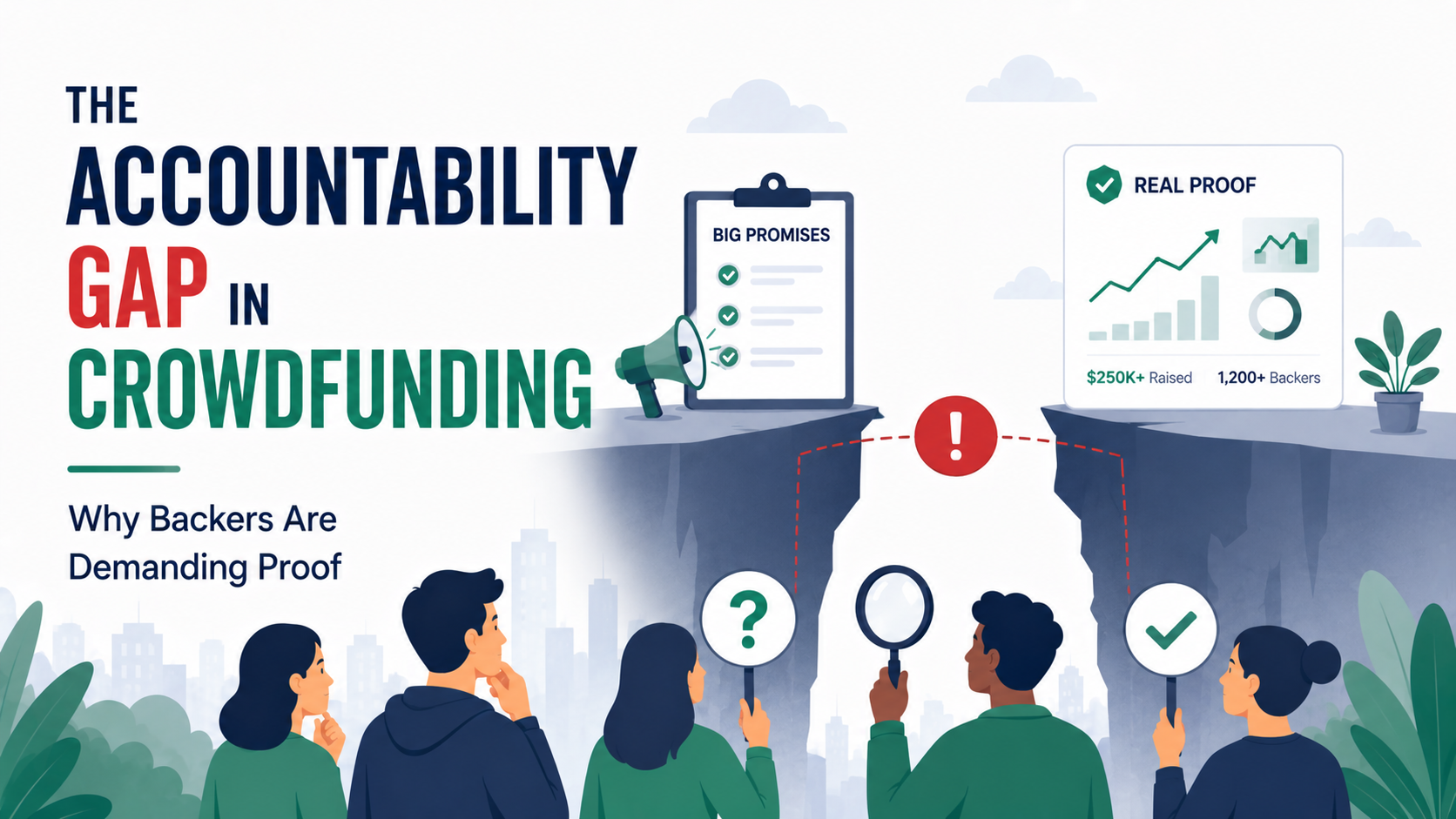
The Accountability Gap in Crowdfunding: Why Backers Are Demanding Proof
Crowdfunding has been around long enough to accumulate a reputation — and not entirely a good one.
The pitch video is slick. The prototype looks polished. The founder is articulate and the campaign page is beautifully designed. A backer clicks "support," enters their card details, and waits. Months pass. Updates become sparse. Delivery dates slip. Eventually, a short post appears explaining that the project encountered "unexpected challenges" and won't be fulfilling orders.
This is not a fringe story. It is a pattern — one that has quietly eroded backer confidence across the entire crowdfunding industry. And it is driving a significant shift in what backers expect from a startup crowdfunding platform before they commit a single dollar.
Table of Contents
- The Numbers Behind Crowdfunding's Trust Problem
- Why "Just Trust Me" No Longer Works
- What Real Traction Actually Looks Like
- How Accountability-First Platforms Are Responding
- What This Means for Creators in 2026
The Numbers Behind Crowdfunding's Trust Problem
The figures are not flattering for the industry.
An independent analysis conducted by the Wharton School of Business at the University of Pennsylvania found that roughly 9% of successfully funded Kickstarter projects — campaigns that raised their full goal — still failed to deliver the rewards promised to backers. Source: Kickstarter Fulfillment Report. That figure accounts only for outright non-delivery; delayed or partial deliveries tell a grimmer story still, with separate research suggesting fewer than 30% of campaigns deliver on time and without issues. Source: ResearchGate, Measuring Project Success
Zoom out further, and the picture worsens. Across the broader crowdfunding market, approximately 85% of campaigns fail to reach their funding goals at all. Source: LaunchPad Agency
None of this means crowdfunding is broken. Tens of thousands of projects have successfully delivered, and the model remains one of the few paths available to early-stage creators who want to fund work without giving up equity or taking on debt. But the failures have consequences. Each unfulfilled campaign trains backers to be more skeptical, more selective, and less willing to extend good faith to the next creator who shows up with a polished pitch and no evidence.
Why "Just Trust Me" No Longer Works
In the early days of reward-based crowdfunding, a compelling idea and a credible-looking page were often enough. Backers were novelty-seekers, early adopters who understood they were taking a risk and accepted it.
That cohort still exists, but the mainstream backer population has changed. Many have been burned directly, or they know someone who has. Social media has made high-profile crowdfunding failures more visible than ever. News cycles pick up the stories of campaigns that raised millions and vanished, and those stories travel.
The result is a trust deficit that individual creators cannot simply talk their way out of.
A founder can write a compelling narrative about their roadmap, their passion, and their product vision. But narrative, on its own, does not tell a backer whether the team is actively building. It does not confirm that anyone is already paying for the product. It does not distinguish a serious operator from someone who is good at writing a campaign page.
What backers increasingly want is not a better pitch. They want evidence.
What Real Traction Actually Looks Like
The challenge is that "evidence of traction" has historically been self-reported. Creators share revenue screenshots, GitHub activity screenshots, or customer testimonials — all of which are easy to fabricate and difficult to verify.
Two data sources, however, are hard to fake when connected directly to a campaign:
GitHub commit history. For software products — apps, developer tools, SaaS platforms, indie games — an active, sustained commit history signals that real development work is happening. Commits are timestamped, attributable, and impossible to retroactively manufacture at scale. A creator with 200 commits across the last 60 days is building. One with a repository last touched eight months ago probably is not.
Stripe revenue data. For products that already have paying customers, live Stripe revenue is the most direct signal of market validation available. It answers the question every serious backer wants answered: "Is anyone actually paying for this?" A campaign page that shows $4,200 in monthly recurring revenue, pulled in real time from Stripe, tells a backer something that no amount of pitch copy can replicate.
These are not vanity metrics. They are operational signals — the equivalent of a due diligence data room, made accessible to backers who are not VCs and do not have time to request spreadsheets.
How Accountability-First Platforms Are Responding
Traditional crowdfunding platforms were built around discovery and payment processing. They created the infrastructure for campaigns to go live and collect money, but they largely left the question of creator credibility up to backers to assess on their own.
A newer generation of startup crowdfunding platforms is treating accountability as a core product feature — not an afterthought.
The approach varies. Some platforms require creators to pass a vetting process before their campaigns are approved. Others use community-based review systems. The most direct approach connects campaigns to live, third-party data sources so that what backers see is not curated by the creator.
Fundl, for example, builds this connection into the campaign itself. Creators link their GitHub repository and Stripe account during setup, and those data sources populate directly on the campaign page — active commit frequency, current revenue figures, and development cadence all visible to any backer considering whether to support the project. The creator does not upload screenshots or write their own progress reports. The data speaks independently.
This model does not eliminate risk for backers. Products can still fail to ship for legitimate reasons. But it removes the information asymmetry that has historically allowed underprepared or disingenuous campaigns to raise money they cannot deploy effectively.
What This Means for Creators in 2026
If you are a founder preparing to run a crowdfunding campaign this year, the shift toward accountability has a direct implication: showing your work is now a competitive advantage.
Backers who land on your campaign page are comparing you to every other campaign they have encountered — including the ones that burned them. The campaigns that convert best in 2026 are not necessarily the ones with the most cinematic video or the most elaborate perk tiers. They are the ones where backers can see real activity, real customers, and a creator who does not seem to be hiding anything.
Concretely, this means a few things before you launch:
Build before you raise. A campaign launched with zero commits and no customers is a request for pure faith. Spend time building a minimum version of your product and acquiring even a handful of paying users before going public. The numbers do not need to be large — they need to be real.
Document your process publicly. A public GitHub repository with a consistent commit history is visible proof of momentum. Writing short public updates about what you built each week, even before your campaign exists, establishes credibility that no campaign copy can replicate retroactively.
Choose a platform that verifies, not just hosts. Where you run your campaign signals something about how seriously you take your backers' trust. A platform that surfaces verified metrics by default tells backers you have nothing to hide — and that matters in a market where skepticism is the default.
Conclusion: Accountability Is the New Differentiator
The crowdfunding market is not shrinking. For software and indie dev projects specifically, the opportunity is significant and growing. But the backers who fund those projects are more cautious than they were five years ago, and with good reason.
The creators and platforms that understand this are not treating accountability as a compliance burden. They are treating it as a feature — a way to attract backers who are serious, informed, and ready to commit because they can see that the project is real.
If you are building something and considering crowdfunding as a path to funding it, the question worth asking is not just "can I raise money here?" but "can backers actually verify that I am worth backing?"
A platform like Fundl is designed around that second question. Worth exploring if you want your traction to do the talking.