
Description
Verified crowdfunding shows backers live GitHub commit history and Stripe revenue before they pledge. This guide explains what it is, how it works on Fundl, and why it is a better model for both backers and founders.
What Is Verified Crowdfunding? How Backers See Real Data Before They Pledge
Most crowdfunding platforms ask backers to make financial decisions based on a pitch. The creator writes a compelling description, posts a product video, and lists a set of features that will exist someday. Backers evaluate the pitch and decide whether to trust it. That is the entire accountability mechanism.
The problem: there is no way to independently verify most of what a crowdfunding pitch claims. Is the product actually being built? Is anyone paying for it? The answers to those questions determine whether a campaign is a real project or wishful thinking — and traditional platforms provide no way to tell the difference.
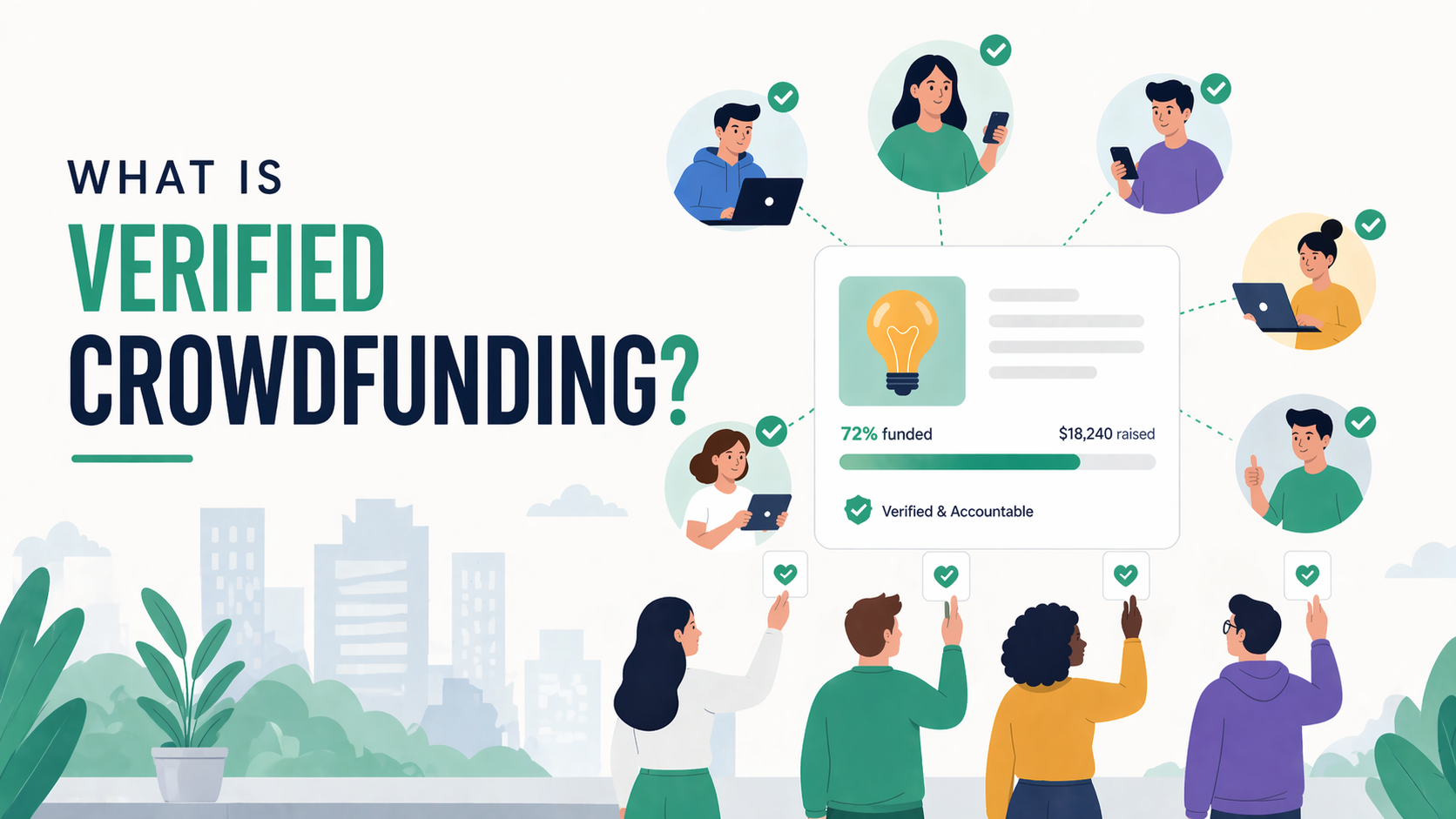
Verified crowdfunding is a model that addresses this directly. Rather than relying on creator claims, verified platforms connect live third-party data sources to the campaign page. Backers see real GitHub commits and real Stripe revenue alongside the pitch. The decision to back is grounded in evidence.
This guide explains how verified crowdfunding works, what data it exposes, how Fundl implements it, and what backers and founders should know before they participate.
Table of Contents
- Description
- What Is Verified Crowdfunding? How Backers See Real Data Before They Pledge
- Table of Contents
- TLDR
- The Accountability Problem in Traditional Crowdfunding
- What Is Verified Crowdfunding?
- How GitHub Verification Works
- How Stripe Revenue Verification Works
- What Backers See on a Fundl Campaign Page
- Verified Crowdfunding vs. Traditional Crowdfunding
- For Founders: How to Get Ready for Verified Crowdfunding
- For Backers: How to Read Verified Metrics
- The Bottom Line
TLDR
- Traditional crowdfunding requires backers to fund based on unverifiable claims. Nearly 1 in 10 Kickstarter campaigns fails to deliver.
- Verified crowdfunding connects live GitHub commits and Stripe revenue to the campaign page. Backers see real data — not self-reported updates.
- Fundl is a verified crowdfunding platform built for startups and indie devs. All payments run through Stripe; funds go directly to creators.
- GitHub verification shows build activity: commit frequency, recency, and contributor count.
- Stripe verification shows financial traction: real revenue from real paying customers.
- Together, these two signals let backers evaluate a project the way an investor would — with evidence.
The Accountability Problem in Traditional Crowdfunding
In 2024, the global crowdfunding market processed billions in pledges across Kickstarter, Indiegogo, and hundreds of niche platforms. A significant portion of that capital funded projects that never delivered.
Research cited by DTU Science Park estimates that hardware crowdfunding projects alone have cost backers $26 million in failed deliveries. Entrepreneur reports that nearly 1 in 10 Kickstarter projects fails to deliver rewards. And those are only the documented failures — projects that miss delivery entirely. The number of campaigns that deliver a diminished version of what was promised is substantially higher.
The accountability gap is structural:
- No verification requirement. Any creator can claim any metric. Platforms do not fact-check pitch content.
- No ongoing visibility. After a campaign closes, backers rely on creator-authored updates. There is no independent data feed.
- No recourse. Kickstarter's documentation states explicitly that it cannot guarantee project delivery. Once funds move, backers have limited options.
This is not a failure of individual creators. It is a design flaw: the platform model optimizes for campaign volume, not backer outcomes. Verified crowdfunding was built to fix the design flaw.
What Is Verified Crowdfunding?
Verified crowdfunding is a fundraising model where the platform connects real, third-party data sources to each campaign page — so backers evaluate actual project activity alongside the creator's pitch.
On Fundl, this means two specific integrations:
- GitHub — the platform connects to the creator's repository and surfaces live commit activity.
- Stripe — the platform connects to the creator's Stripe account and surfaces live revenue data.
These metrics are not self-reported. They are pulled via authenticated API connections directly from GitHub and Stripe and displayed in real time on the campaign page. A creator cannot manually edit these numbers. The data is live, continuous, and comes from the same source that GitHub and Stripe themselves use.
The result: every Fundl campaign page contains both a human pitch (what the creator says about their project) and a data layer (what the third-party integrations say about the project's activity and revenue). Backers can evaluate both before deciding.
How GitHub Verification Works
GitHub is the dominant platform for software version control and collaboration. Nearly all software projects — from solo indie apps to large open-source codebases — maintain a GitHub repository. Commit history on GitHub is a real-time, tamper-resistant record of development activity.
Fundl connects to a creator's GitHub repository via the GitHub API during campaign setup. Once connected, the campaign page displays:
Commit frequency. How often is code being pushed to the repository? A project with consistent commits over months signals active, sustained development. A project with no commits in the past 30 days raises questions.
Recency. When was the last commit? A repository last updated two years ago is a different signal than one updated this week.
Contributor count. Is this a solo developer or a team? Multiple contributors indicate broader project investment and reduce the risk of abandonment if one person disengages.
Branch activity. Are there active feature branches, pull requests, and code reviews? This level of activity signals a structured development process.
For a backer evaluating a software startup campaign, GitHub data answers the most important question in crowdfunding: is this person actually building?
A founder can write a pitch describing a product that does not yet exist. They cannot fake six months of consistent GitHub commits.
How Stripe Revenue Verification Works
Stripe is the payment infrastructure behind millions of software businesses worldwide. If a software product has paying customers, there is a high probability those payments flow through Stripe.
Fundl connects to a creator's Stripe account during campaign setup. The integration uses Stripe's API to surface revenue data directly on the campaign page. Backers see:
Monthly recurring revenue (MRR). For subscription products, MRR shows the baseline of predictable revenue the product is already generating.
Total revenue. For one-time purchase products, cumulative Stripe revenue gives backers a sense of market validation.
Revenue trend. Is revenue growing, flat, or declining? A month-over-month growth trend is one of the strongest signals of product-market fit available to early-stage companies.
Like GitHub data, Stripe revenue figures are pulled directly from the source. A creator does not enter these numbers — Stripe does. The figures a backer sees on a Fundl campaign page reflect what Stripe's records actually show, not what the creator claims to have earned.
This matters because revenue is the single most objective indicator of whether a product has genuine demand. A $2,000 MRR product has already convinced real people to pay real money. That evidence is worth more than any pitch deck section titled "Market Opportunity."
What Backers See on a Fundl Campaign Page
A Fundl campaign page combines the creator's own content with the live verified metrics layer:
Creator content:
- Project description and pitch
- Funding goal and timeline
- Team background
- What the capital will fund
Verified metrics (live, third-party):
- GitHub commit count and last commit date
- GitHub contributor count
- Stripe MRR or total revenue
- Revenue trend (if applicable)
Both sections appear on the same page. Backers can assess the pitch and then cross-reference it against the live data. If a creator says "we have strong developer traction," the GitHub data confirms or contradicts it. If a creator says "customers are already paying for this," the Stripe revenue confirms or contradicts it.
This combination shifts the backer's evaluation from "do I believe this person?" to "does the data support this claim?" — a fundamentally more reliable basis for a funding decision.
Verified Crowdfunding vs. Traditional Crowdfunding
| Feature | Kickstarter / Indiegogo | Fundl (Verified Crowdfunding) |
|---|---|---|
| Metric verification | None | Live GitHub + Stripe |
| Revenue visibility | Creator-reported | Stripe API (real-time) |
| Development visibility | Creator updates | GitHub commit history |
| Payment processing | Proprietary | Stripe |
| Fund disbursement | After campaign closes | Direct to creator |
| Equity required | No | No |
| Platform focus | General | Startups and indie devs |
| Backer recourse | Platform discretion | Informed decision pre-pledge |
The critical difference is when the accountability mechanism activates. Traditional platforms create accountability — weakly — after funds are committed. Verified crowdfunding creates accountability before the pledge, when it actually influences backer decisions.
For Founders: How to Get Ready for Verified Crowdfunding
Verified crowdfunding rewards founders who are already building. Before you launch a Fundl campaign, make sure:
Your GitHub repository is active. If the last commit was three months ago, start building again before you go live. Backers can see the commit history, and a stale repository undermines your pitch before you make it.
You have Stripe connected to your product. Even early revenue is a powerful signal. If your product does not yet have a payment flow, consider setting one up — even a minimal one — before launching. The difference between "$0 revenue" and "$200 MRR" is significant to a backer evaluating your campaign.
Your pitch references the data. Do not let the verified metrics speak for themselves — connect them to your story. "We have shipped 400 commits over six months and converted our first 15 paying customers to $1,200 MRR" is a narrative backed by live data. That is a different conversation than a features list.
You understand what you are asking for. Backers who can see your real metrics will evaluate your funding ask in that context. "We need $20,000 to reach $5,000 MRR" is specific and credible. "We need $20,000 to build the product" is vague against a backdrop of live data.
For Backers: How to Read Verified Metrics
The verified metrics on a Fundl campaign page give you a factual basis for evaluation, but knowing what to look for matters.
GitHub commits:
- Look for consistent commit history over at least 2-3 months. A burst of commits in the week before a campaign launch is less meaningful than steady activity over time.
- Check the last commit date. A product with no commits in 60+ days is not under active development, regardless of what the pitch says.
- Multiple contributors are a positive signal. A solo developer is higher-risk for abandonment.
Stripe revenue:
- Any revenue is better than zero. A small but growing MRR shows that the market has validated the product enough for people to pay.
- Look at the trend. Growing revenue is more meaningful than a static number.
- Understand the product type. A one-time purchase product will show total revenue differently than a subscription SaaS. Read the creator's description alongside the numbers.
The pitch vs. the data:
- If the pitch makes specific claims about traction, check them against the metrics. They should align. Significant discrepancies between what the creator claims and what the data shows are a red flag.
- If the pitch is aspirational ("we will build X with this capital"), the metrics tell you whether the team has the execution history to back the ambition.
The Bottom Line
Crowdfunding has always had a trust problem. The model asks backers to make financial decisions based on claims they cannot verify, about products that do not yet exist, made by people they have never met. The historical result is a meaningful rate of failed deliveries and lost capital.
Verified crowdfunding does not eliminate risk — no fundraising model does. What it does is move the accountability mechanism to the right place: before the pledge, not after it. When backers can see live GitHub commits and live Stripe revenue alongside a pitch, they can make an informed decision rather than a speculative one.
For founders, the implications run in the other direction: the same verified metrics that give backers confidence are the most credible way to demonstrate that you are serious about what you are building. If your metrics are strong, show them. If they are not strong yet, build until they are, and then raise.