
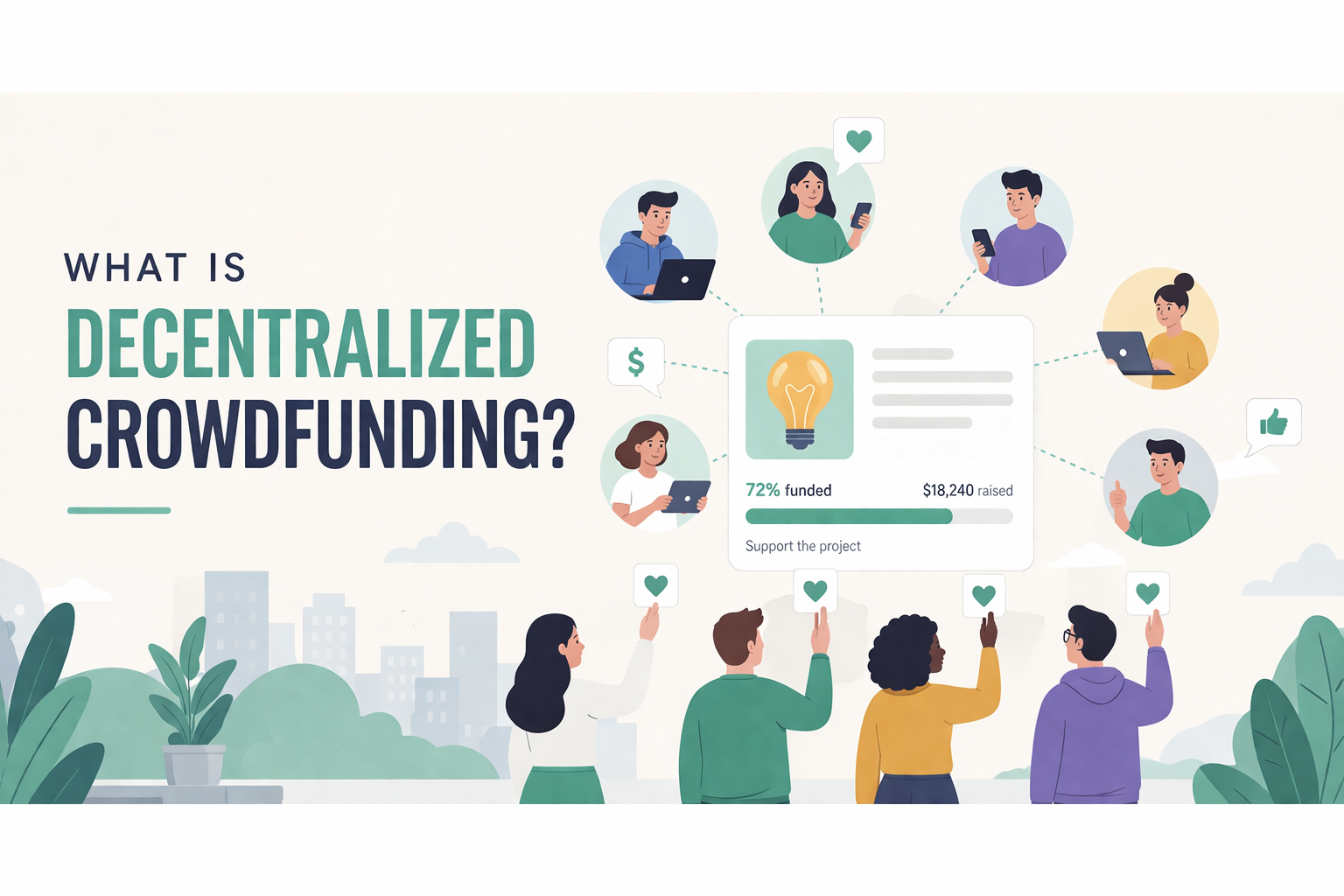
Decentralized crowdfunding moves capital directly between backers and creators through blockchain-based smart contracts, with no platform, bank, or middleman controlling the money. Unlike Kickstarter or Indiegogo, where a company holds all pledged funds and decides when to release them, a decentralized platform runs on code.
Table of Contents
- TLDR
- What is Decentralized Crowdfunding?
- How Traditional Crowdfunding Works, and Why it Fails
- How Decentralized Crowdfunding Works
- How Smart Contracts Protect Backers
- Benefits of Decentralized Crowdfunding
- Risks to Know Before You Back a Project
- Decentralized Crowdfunding vs. Traditional Crowdfunding
- How to Get Started
- The Bottom Line
TLDR
- Decentralized crowdfunding uses blockchain and smart contracts to fund projects without a central authority.
- Smart contracts hold funds and release them over time, not in a lump sum to the creator.
- Backers get real-time transparency, democratic refund rights, and on-chain proof of progress.
- The global crowdfunding market is projected to hit $18.5 billion by 2026. (Qubit Capital)
- Platforms like Fundl connect live Stripe and GitHub metrics to each campaign so backers see real revenue and code activity before they commit.
What is Decentralized Crowdfunding?
Decentralized crowdfunding moves capital directly between backers and creators through blockchain-based smart contracts, with no platform, bank, or middleman controlling the money.
The campaign rules, from funding goal to refund triggers, are written into a smart contract and enforced automatically. Backers know exactly where their money is and what conditions govern its release. Creators get funded without handing control to a third party. Neither side has to trust the platform itself.
How Traditional Crowdfunding Works, and Why it Fails
Platforms like Kickstarter and Indiegogo follow a simple model: creators pitch, backers contribute, and the platform takes a 5-8% fee before releasing funds to the creator in one lump sum.
Once that money moves, backers have no leverage. According to a University of Pennsylvania study cited by Entrepreneur, nearly 1 in 10 Kickstarter projects fails to deliver rewards. Creators can post vague updates, miss deadlines, or go silent with no real consequences.
The accountability failures run deeper than individual bad actors:
- Lump-sum payouts. Creators receive all funds upfront, with no accountability for how they spend them.
- No verification. Backers fund based on pitch decks.
- No refund mechanism. Once a campaign closes, most platforms offer no path to recover funds.
- Platform dependency. One company controls every transaction.
How Decentralized Crowdfunding Works
Decentralized crowdfunding replaces the platform middleman with smart contracts on a public blockchain. The flow:
1. A creator sets up a campaign. They define a funding goal, timeline, and the conditions under which funds release. All of this gets encoded in a smart contract, publicly visible and immutable.
2. Backers contribute funds. Contributors send stablecoins or tokens directly to the smart contract. The funds sit in escrow on-chain.
3. Funds stream over time. Many decentralized platforms release funds linearly, a fixed amount per day, as long as the creator continues to make progress.
4. Progress records on-chain. Advanced platforms like Fundl pull live data from connected tools like Stripe and GitHub, so backers verify real progress without taking the creator's word for it.
5. Backers can vote for refunds. If a project goes off the rails, backers vote to trigger a refund mechanism. Funds not yet streamed to the creator return to contributors.
How Smart Contracts Protect Backers
A smart contract is a self-executing digital agreement stored on a blockchain. According to IBM, smart contracts encode "if/when... then..." logic directly into code and execute it automatically when conditions are met.
For crowdfunding, that translates to:
- If the funding goal is reached, then the fund stream begins.
- If backers vote above a refund threshold, then remaining funds return automatically.
- If a creator disconnects their verification integrations, then the platform flags the campaign as unverified.
No human is in the loop. No platform admin needs to approve anything. The contract runs.
Traditional crowdfunding enforces every rule at the platform's discretion. Smart contracts remove that discretion entirely.
Benefits of Decentralized Crowdfunding
1. Full Transparency
Every transaction records on a public blockchain. Anyone can audit where funds came from, how much reached the creator, and how much remains in escrow. No company dashboard filters the data.
2. No Lump-Sum Risk
Linear fund streaming means creators earn their funding over time. With streaming, backers avoid the full risk of a creator taking all the money on day one and disappearing.
3. Democratic Refund Rights
Backers vote collectively on refunds. If a project goes quiet or misses milestones, the community decides what happens next. This replaces the toothless "contact support" approach of Web2 platforms.
4. Global Access
Crypto-based crowdfunding has no geographic limits. A backer in Singapore can fund a creator in Brazil with no currency conversion fees or wire delays. As Bold Awards notes, cross-border payments in crypto avoid foreign exchange fees.
5. Verified Metrics Replace Hype
The best decentralized platforms verify real business activity on top of holding funds on-chain. Platforms like Fundl display live Stripe revenue, GitHub commit counts, and active user metrics on each project page. Backers make decisions based on data.
6. Lower Platform Fees
Traditional crowdfunding platforms charge 5-8% of all funds raised plus payment processing fees. Smart contract-based platforms run on blockchain infrastructure with lower overhead, passing the savings to creators.
Risks to Know Before You Back a Project
Decentralized crowdfunding solves many problems of traditional platforms but introduces new ones. The FBI reports that US citizens lost $9.3 billion to crypto scams in 2024 alone. (Elliptic)
Token Volatility
If a project raises funds in a volatile token rather than a stablecoin, the treasury value can collapse before the project ships. Look for campaigns that raise and hold USDC or similar stablecoins.
Rug Pulls
A "rug pull" happens when a creator collects funds and abandons the project. Platforms with smart contract-enforced streaming and democratic refund voting make this much harder, but no system is fully immune.
Smart Contract Bugs
Smart contracts are code, and code has bugs. Flaws in a contract can expose funds to exploits. Look for platforms that publish audited contracts.
Lack of Regulatory Clarity
The regulatory environment around crypto crowdfunding varies by jurisdiction and continues to evolve. Research the legal status of crypto-based fundraising in your country before participating.
How to reduce your risk:
- Choose platforms that raise in stablecoins (USDC, USDT).
- Choose platforms with on-chain fund streaming.
- Look for verified third-party metrics.
- Check that smart contracts have been audited.
Decentralized Crowdfunding vs. Traditional Crowdfunding
| Feature | Traditional Crowdfunding | Decentralized Crowdfunding |
|---|---|---|
| Fund custody | Platform holds funds | Smart contract holds funds |
| Fund release | Lump sum | Linear streaming |
| Transparency | Dashboard updates | On-chain, public ledger |
| Progress verification | Self-reported | Third-party integrations |
| Refund mechanism | Platform discretion | Backer vote |
| Platform fee | 5-8% | Lower (blockchain gas fees) |
| Geographic access | Often restricted | Global by default |
| Creator accountability | Low | High |
How to Get Started
For Creators
- Connect your platforms. Link your Stripe account and GitHub repository before you launch. Verified metrics are your strongest pitch.
- Set a realistic goal and timeline. Smart contract-based campaigns encode your goal and end date into the contract. You cannot change them after launch.
- Choose a stablecoin denomination. Raising in USDC protects your treasury from token price swings.
- Launch on a platform with backer protections. Platforms like Fundl combine fund streaming with live metric verification and democratic refund voting.
For Backers
- Verify the metrics. Don't fund a campaign based on a pitch alone. Look for live Stripe revenue data and active GitHub commits.
- Read the smart contract terms. Understand the refund threshold and streaming rate before you contribute.
- Use a hardware wallet. Never keep large amounts of stablecoins in a hot wallet connected to a browser.
- Diversify. Treat it like early-stage investing. Commit only what you can afford to lose.
The Bottom Line
Decentralized crowdfunding fixes the core failure of platforms like Kickstarter: the moment backers hand over money, they lose all leverage. Smart contracts change that by holding funds in escrow and releasing them incrementally, with backers holding democratic power throughout.
The global crowdfunding market is growing from $1.45 billion in 2024 to a projected $5.43 billion by 2033, and a meaningful share of that will run on blockchain rails. (GECA)
Creators get credibility from verified traction. Backers get leverage over their money. Platforms like Fundl add live metric verification so every campaign shows data you can check yourself.