
Description
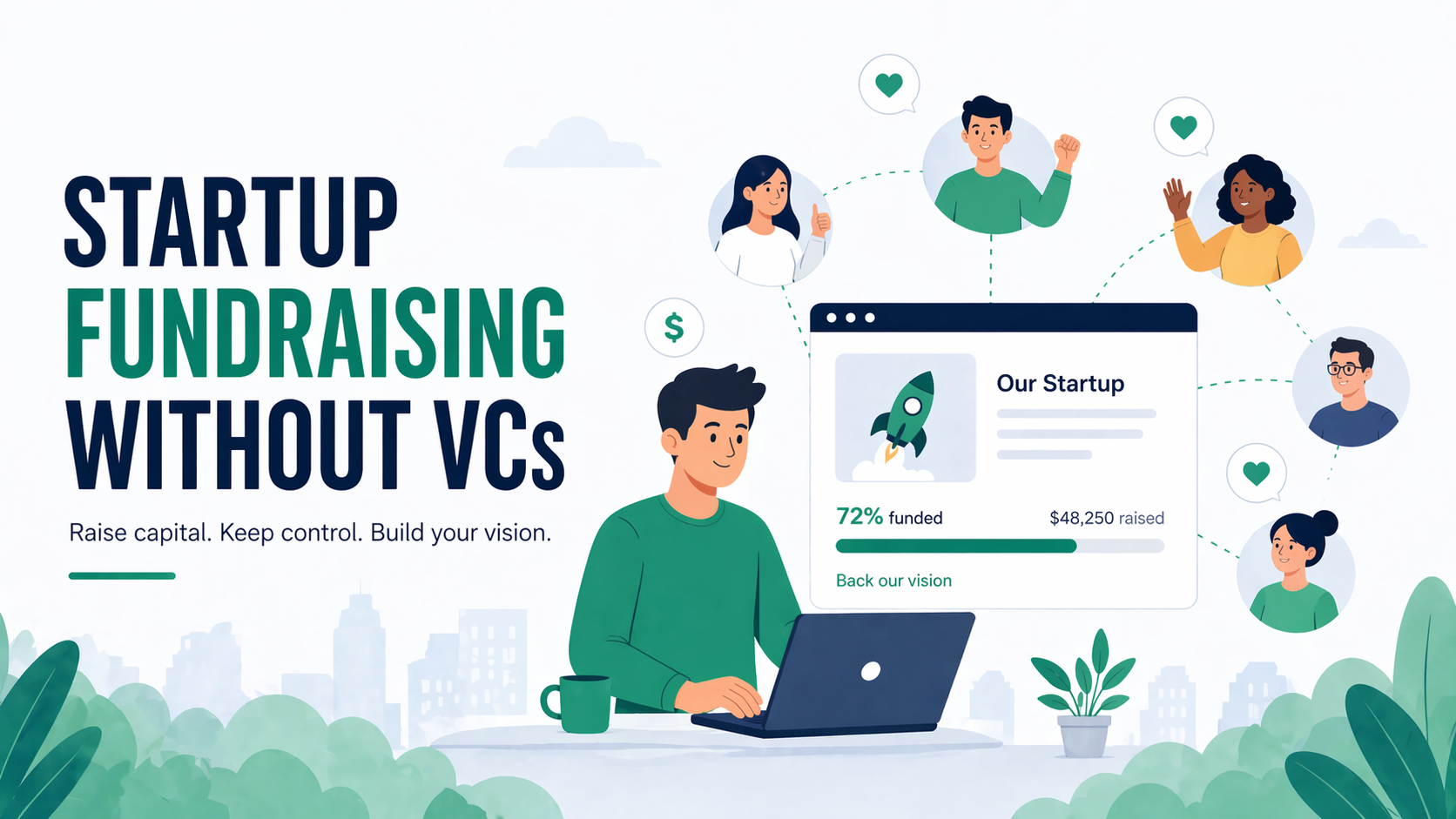
Most startups will never raise VC. Stripe-powered community crowdfunding gives indie founders a credible, equity-free alternative — with verified metrics that backers can actually trust. Here is how it works.
Startup Fundraising Without VCs: How Stripe-Powered Crowdfunding Works
Less than 1% of startups ever raise venture capital. The other 99% either self-fund, take on debt, or never build at all. That math is not a bug in the system — it reflects the fundamental structure of VC: funds need to target 100x returns on a small number of bets. Most products, no matter how useful, do not fit that profile.
The question for the other 99% is not "how do I become the kind of company VCs fund?" It is "what are the actual alternatives?"
Community crowdfunding is one of the most underused. When it is powered by reliable payments infrastructure and backed by real, verifiable business data, it becomes a serious fundraising path — not a fallback. This guide explains how Stripe-powered crowdfunding works, who it is suited for, and how platforms like Fundl are making it easier for founders to raise from the people who actually care about what they are building.
Table of Contents
- TLDR
- The VC Problem for Most Founders
- Why Crowdfunding Is a Serious Alternative
- Why Stripe Makes Crowdfunding Better
- How Stripe-Powered Crowdfunding Works on Fundl
- The Fee Model: What Fundl Takes
- Fundraising Options for Startups: A Comparison
- What Makes a Strong Fundl Campaign
- Frequently Asked Questions
- The Bottom Line
TLDR
- Fewer than 1% of startups raise VC. Community crowdfunding is one of the most viable equity-free alternatives for the rest.
- Stripe-powered crowdfunding means all payments run through the world's most trusted payment infrastructure — fast, global, and secure.
- On Fundl, backers see live GitHub and Stripe data before pledging, so funding decisions rest on real evidence, not pitch decks.
- Funds go directly to the creator when received. Fundl takes a transparent platform fee.
- Best suited to software startups, SaaS products, and indie developers with an active codebase and early revenue.
The VC Problem for Most Founders
Venture capital is optimized for a very specific type of company: one that can plausibly return 100x in 7-10 years. That means large addressable markets, scalable software economics, and a team capable of building a billion-dollar business. Most software products — even good ones — do not fit this profile.
Qubit Capital reports that VC firms receive thousands of pitches per year and fund fewer than 1% of them. The selection criteria are not purely about product quality. They also include network proximity, geographic location (most VC dollars go to San Francisco, New York, and Boston), and whether the company fits the portfolio thesis of a specific fund.
For an indie developer building a niche SaaS tool, a bootstrapper who does not want to give up equity, or a founder outside a major tech hub, VC is not a realistic path. The question is what comes next.
Why Crowdfunding Is a Serious Alternative
The global crowdfunding market hit $7.09 billion in 2025 and is projected to grow to $11.58 billion by 2032 at a 7.3% CAGR, according to industry research. More importantly, the profile of what gets funded is broadening — from hardware gadgets and creative projects toward software, SaaS, and community-driven developer tools.
Community crowdfunding offers several advantages over VC that are particularly relevant for indie founders:
No equity required. Backers receive rewards, early access, or simply the satisfaction of supporting a product they believe in. The founder retains full ownership.
Your community makes the decision. The people who back your project are often your target users. Their vote is a signal the market wants what you are building — and they become invested advocates.
Speed. A campaign can be live within days. Compare that to a VC fundraise that typically takes 3-9 months from first pitch to term sheet.
Size-appropriate capital. Not every startup needs $2 million in Series A funding. If you need $30,000 to hire a contractor and extend your runway by six months, crowdfunding is a proportionate tool. VC is not.
The traditional critique of crowdfunding is accountability: what stops a founder from taking the money and disappearing? Platforms that surface live, verifiable metrics directly address this. Backers can see whether you are actively building before they commit.
Why Stripe Makes Crowdfunding Better
Payment infrastructure is not glamorous, but it matters enormously for crowdfunding credibility.
Traditional crowdfunding platforms run their own proprietary payment systems. Backers have no choice but to trust the platform to handle their card data, process refunds, and disburse funds correctly. These platforms have had documented issues with payment processing failures, delayed disbursements, and limited geographic support.
Stripe is a different category of payment infrastructure. It processes hundreds of billions of dollars annually, operates in 135+ countries, and carries PCI DSS Level 1 certification — the highest available standard for payment security.
For a crowdfunding campaign, running on Stripe means:
Global reach. Backers from almost anywhere in the world can fund a campaign with their local payment method. No currency conversion friction. No geographic restrictions that cut off international supporters.
Trusted checkout. Backers recognize Stripe's checkout interface. The trust signal is immediate. Unfamiliar proprietary payment pages create drop-off.
Fast disbursement. Stripe payouts move quickly — typically 2-7 days to a bank account depending on location. Funds do not sit in a platform escrow for weeks after a campaign closes.
Transparent transaction history. Every payment through Stripe generates a clean, auditable record that both the creator and the platform can verify.
Fundl uses Stripe as its payment layer. When a backer pledges, the transaction runs through Stripe's infrastructure. When the campaign receives funds, they go directly to the creator's account. Fundl takes its platform fee at the point of transaction — no complex reconciliation later.
How Stripe-Powered Crowdfunding Works on Fundl
Here is the end-to-end flow for a Fundl campaign:
1. Creator sets up a campaign. The creator connects their GitHub repository and Stripe account, writes a project description, and sets a funding goal. Live metrics from GitHub (commit activity) and Stripe (revenue data) appear automatically on the campaign page.
2. Campaign goes live. The campaign page is publicly accessible at a Fundl URL. Backers can view the pitch alongside the live verified metrics — active GitHub commits, real Stripe revenue — before deciding to back.
3. Backer pledges. The backer clicks "Back This Project" and completes payment through Stripe. The transaction is secure, fast, and familiar.
4. Funds go directly to the creator. Stripe routes the pledged funds directly to the creator's account. Fundl collects its platform fee at the time of transaction. The creator does not wait for a campaign to "close" to receive funds.
5. Campaign continues. The campaign remains live with live metrics updating in real time. New backers can evaluate current GitHub and Stripe data throughout the campaign period.
No escrow. No fund streaming. No complex mechanics. The simplicity is intentional: Fundl's value is in the verification layer before the pledge, not in managing what happens to funds afterward.
The Fee Model: What Fundl Takes
Fundl charges a transparent platform fee on each transaction. The fee structure is visible before a creator launches their campaign.
Key points:
- All payments process through Stripe. Stripe's standard processing fees apply.
- Fundl's platform fee is deducted at the point of transaction.
- Funds go directly to the creator — there is no pooled escrow or delayed disbursement.
Compared to traditional platforms (Kickstarter charges 5% plus payment processing; Indiegogo charges the same), Fundl's direct-to-creator model means founders receive capital without waiting for a campaign period to end. For a creator who needs runway now, immediate disbursement is a practical advantage.
Fundraising Options for Startups: A Comparison
| Model | Equity required | Access | Speed | Verification | Best for |
|---|---|---|---|---|---|
| Venture capital | Yes (10-30%+) | Networked, selective | Months | Investor due diligence | High-growth, large TAM |
| Angel investment | Yes (5-15%) | Networked | Weeks to months | Ad hoc | Pre-seed product |
| Revenue-based financing | No (revenue share) | Application-based | Weeks | Bank statements | Post-revenue companies |
| Traditional crowdfunding | No | Open | Days to weeks | None | Hardware, creative |
| Verified crowdfunding (Fundl) | No | Open | Days to weeks | Live GitHub + Stripe | Software, SaaS, indie dev |
| Bootstrapping | No | Always | Immediate | N/A | Founders with savings |
Verified crowdfunding sits in an interesting position: as accessible as traditional crowdfunding, but with a credibility layer that bridges the gap toward the diligence standards of angel/VC investment. For a software founder with real traction, it is the most friction-efficient path to capital without giving up equity.
What Makes a Strong Fundl Campaign
The campaigns that perform well on Fundl share common characteristics. Before you launch, check against this list:
Active GitHub repository. Recent, consistent commits signal that the product is under active development. Campaigns launched from a dormant repo undermine credibility with the very metrics meant to build it.
Real Stripe revenue. You do not need a large number. Even $500-$1,000 MRR connected to your Fundl page demonstrates that someone, somewhere is willing to pay for this. That is a powerful signal.
A specific ask. Campaigns with a clear explanation of how the capital will be used — "this gets us to 1,000 users" or "this funds three months of server costs while we build the next feature" — convert better than vague goals.
An existing audience. Campaigns do not grow themselves. A newsletter list, a GitHub followers count, a Discord community, or a Twitter audience gives you a launch base. The strongest campaigns reach 30% of their goal within the first 48 hours from warm audiences.
Consistent activity during the campaign. Backers can see your live metrics updating throughout the campaign. Keep shipping. Keep committing. The live data is a continuous signal to prospective backers.
Frequently Asked Questions
Do I need to be incorporated to run a Fundl campaign? You need a valid Stripe account to receive funds. Stripe's requirements for business accounts vary by country — consult Stripe's documentation for your jurisdiction.
Can non-technical founders use Fundl? The GitHub verification layer is most meaningful for software and developer-focused projects. Non-technical founders without a GitHub repository can still run a campaign, though the Stripe revenue data carries the most weight in those cases.
Is there a minimum funding goal? Fundl does not impose a minimum, but campaigns with targets below $5,000 may see lower engagement. Set a target that is genuinely meaningful to your project.
What happens if I do not hit my goal? Unlike all-or-nothing crowdfunding platforms, Fundl disburses funds as they are received. There is no minimum threshold to unlock capital. Each pledge goes directly to your account as it arrives.
The Bottom Line
The venture capital system produces remarkable companies. It also excludes the vast majority of founders who are building real, valuable products that simply do not fit the 100x return profile.
Stripe-powered community crowdfunding is not a consolation prize. For the right type of product — software, SaaS, developer tools, open-source — it is a structurally better fit. No equity dilution. No investor board. No gatekeeping. Capital from the community that will actually use what you build.
The difference with verified crowdfunding is that backers do not have to take your word for it. Your GitHub commits and your Stripe revenue make the case.