
TLDR
- Milestone-based funding releases capital in stages tied to specific, verifiable goals rather than in a single lump sum.
- Smart contracts on blockchain networks enforce these disbursements automatically, with no intermediary required.
- On-chain metric verification, live revenue data, and GitHub activity can serve as objective proof of progress.
- Backers gain real protection through democratic refund voting when founders miss milestones.
- Fund streaming, a newer model, takes this further by releasing capital continuously as a real-time flow proportional to verified progress.
- The global crowdfunding market is projected to reach $18.5 billion in 2026, with Web3 platforms capturing a growing slice of that growth.
The Problem with Writing a Blank Check
Every year, thousands of backers send money to crowdfunding campaigns and hear nothing back. About 9% of funded Kickstarter campaigns fail to deliver on their promises, according to research from DTU Science Park — resulting in an estimated $26 million in losses from hardware projects alone. The root problem is structural: traditional crowdfunding hands over all the money upfront, then trusts the creator to follow through.
Milestone-based funding fixes that. By tying capital release to measurable outcomes, it aligns incentives, reduces backer risk, and gives founders a structured accountability framework. When smart contracts enforce those milestones on-chain, the entire mechanism becomes trustless, transparent, and automatic.
This article explains how milestone-based funding works for startups, how blockchain technology makes it enforceable, and why this model is quickly replacing lump-sum disbursement as the preferred structure for modern fundraising.
What Is Milestone-Based Funding?
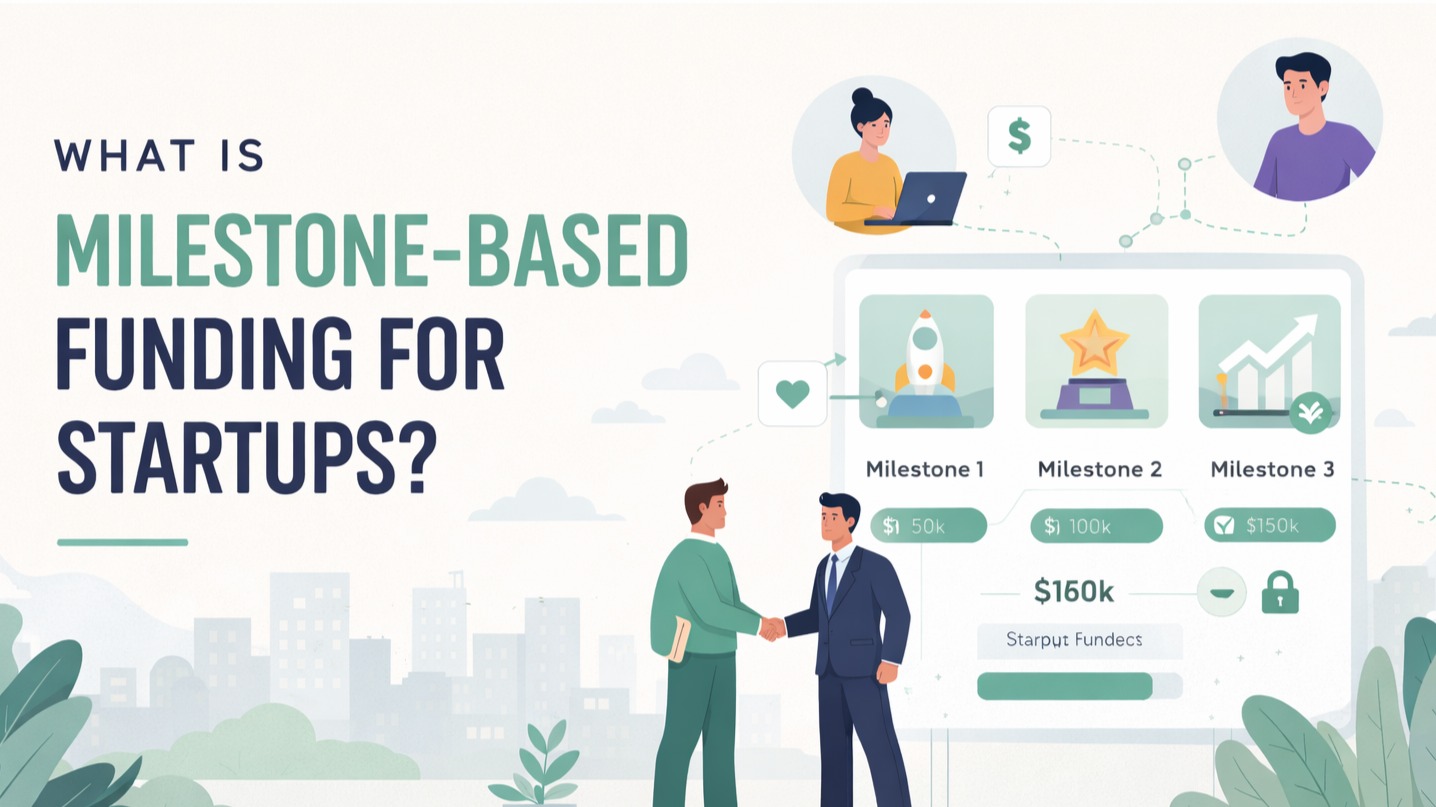
Milestone-based funding is a capital deployment structure where investment is released in tranches tied to the achievement of specific, pre-agreed goals rather than handed over in full at the outset.
In practice, a startup and its backers agree on a set of milestones before the campaign closes. These might include:
- Shipping an MVP within 90 days
- Reaching 100 paying customers
- Hitting $10,000 in monthly recurring revenue
- Publishing a public GitHub repository with a defined commit threshold
- Completing a security audit
When a milestone is achieved, a portion of the raised capital unlocks. If the founder misses a milestone, the remaining funds stay locked until the issue is resolved, or backers can vote to reclaim their contributions.
Allied Venture Partners describes the framework clearly: "Milestone-based financing links capital deployment to achievement — VC investors disburse funds in stages tied to specific, measurable goals rather than providing a single lump sum, creating accountability and reducing financial risk for both parties."
For early-stage startups, the SMART framework applies directly to milestone design:
- Specific: "Ship a public beta" beats "make progress on the product."
- Measurable: Revenue figures, user counts, commit activity — all quantifiable.
- Achievable: Milestones should be ambitious but realistic within the funding runway.
- Relevant: Each milestone should de-risk the biggest open question at that stage.
- Time-bound: A deadline converts a goal into an enforceable commitment.
How Smart Contracts Enforce Milestones Automatically
The key innovation that turns milestone-based funding from a negotiated clause into a self-executing system is the smart contract.
IBM defines smart contracts as "digital contracts stored on a blockchain that are automatically executed when predetermined terms and conditions are met." They work on simple if/when-then logic: if a verified condition is true, then release the funds. No lawyer, escrow agent, or platform moderator needs to intervene.
In a blockchain crowdfunding context, the flow looks like this:
- Campaign launch: The founder deploys a smart contract specifying raise target, milestones, and disbursement schedule.
- Backer contributions: Backers send USDC (or another stablecoin) directly to the smart contract address. Funds sit in escrow on-chain.
- Milestone verification: When a milestone is reached, proof is submitted on-chain (or via an oracle that reads external data like Stripe revenue or GitHub commits).
- Automatic disbursement: The contract releases the corresponding tranche to the founder's wallet.
- Default handling: If a milestone is missed, the contract either pauses disbursement or triggers the refund voting mechanism.
The entire history is public, immutable, and auditable. Any backer can verify that funds moved exactly as agreed, and no platform can unilaterally redirect the money.
According to Fortune Business Insights via ilink.dev, the global smart contracts market was valued at USD 2.14 billion in 2024 and is projected to grow to USD 12.07 billion by 2032 — a clear signal that automated, trustless payment logic is moving from niche to mainstream.
Milestone-Based vs. Lump-Sum Funding: A Comparison Table
| Factor | Lump-Sum Crowdfunding | Milestone-Based Funding |
|---|---|---|
| Capital release | All at once after campaign closes | In tranches tied to verified goals |
| Backer protection | Minimal (trust-based) | Strong (contract-enforced) |
| Founder accountability | Optional updates | Built into disbursement logic |
| Fraud risk | High — no mechanism to reclaim | Low — funds locked until progress |
| Transparency | Platform-dependent | On-chain, fully auditable |
| Admin overhead | High (manual escrow, legal docs) | Low (automated by smart contract) |
| Refund mechanism | Creator discretion | Democratic backer vote |
| Best for | Hardware pre-orders, creative projects | Software startups, open-source, Web3 projects |
How On-Chain Metric Verification Works
The weakest link in any milestone system is verification: how do you prove a milestone is genuinely met without introducing a human judge who can be pressured or corrupted?
Two approaches are leading the space:
Oracle-Based Verification
Blockchain oracles are services that read external data and write it on-chain. A smart contract can be configured to read a startup's Stripe MRR or GitHub commit count through a trusted oracle feed. When the feed confirms a threshold is crossed, the contract fires automatically. Stripe itself has documented on-chain crypto integrations, noting that "on-chain technologies make crypto more secure" through shared, tamper-resistant records.
Platform-Native API Verification
Some platforms pull metrics directly through authenticated API connections. Stripe's webhook infrastructure can confirm real payment volumes; GitHub's API exposes repository commit history, contributor counts, and code frequency data. These are live, independently verifiable signals that can't be faked without breaching Stripe or GitHub's own terms of service.
Fundl takes exactly this approach: its smart contract system on Base (Coinbase's L2 network) connects directly to live Stripe revenue and GitHub activity data, creating a fully verifiable, real-time picture of founder progress that backers can inspect at any time — no quarterly reports, no founder self-attestation.
How Backers Stay Protected in Milestone-Based Crowdfunding
Backer protection in traditional crowdfunding is largely aspirational. Kickstarter's own support documentation acknowledges it cannot guarantee projects will deliver. Crowd Supply is candid that "backing a product before it goes to market does entail some inherent risk."
Milestone-based smart contracts change this calculus in three concrete ways:
1. Locked Escrow
Funds never sit in a creator's bank account from day one. They stay in the smart contract until conditions are met. Even if a founder disappears, the capital is recoverable through the contract's logic.
2. Democratic Refund Voting
Rather than leaving refund decisions to the platform or the founder, milestone-based platforms can implement on-chain governance. If a milestone is missed or the project stalls, backers vote — and if a majority votes to reclaim funds, the contract executes the refund automatically. No customer support ticket. No waiting for a policy exception.
3. Incremental Risk Exposure
Because funds release in stages, backers are never fully committed. If a project shows early warning signs — missed first milestone, silence from the team, suspicious activity — the remaining capital sits untouched until the situation is resolved.
What Is Fund Streaming? The Linear Disbursement Model
Fund streaming is an evolution of milestone-based disbursement that treats capital release not as discrete events but as a continuous, real-time flow.
Rather than releasing $25,000 when Milestone A is hit and another $25,000 when Milestone B is hit, a fund streaming contract releases, say, $275 per day to the founder's wallet as long as verified conditions remain satisfied. The moment a condition is no longer met (the GitHub commit rate drops below a threshold, the MRR metric stalls, the backer vote triggers a pause), the stream stops.
This model creates tighter alignment between progress and resources. Founders have a constant incentive to maintain verified performance. Backers see a live feed of fund movement and can correlate it directly with publicly visible project metrics.
The model is borrowed from concepts pioneered in Web3 payroll and DeFi, where protocols like Sablier and Superfluid established real-time payment streams as a primitive on Ethereum. Applied to crowdfunding, it replaces the "raise-and-hope" cycle with a continuous, evidence-based funding relationship.
Fundl implements linear fund streaming natively on Base. Every campaign on the platform uses this model by default, giving both founders and backers a real-time, transparent view of capital movement tied to verified on-chain and off-chain metrics.
Traditional vs. Blockchain-Based Fundraising: Structural Differences
Understanding why blockchain matters here requires looking at what traditional fundraising actually involves.
Blockpass's comparison of fundraising models notes that traditional options — bootstrapping, angel investment, bank loans, and platform crowdfunding — all share a reliance on centralized trust: trust in the bank, the platform, the investor, or the creator. Blockchain-based fundraising replaces that trust with cryptographic proof and self-executing code.
Key structural differences:
- Settlement speed: On-chain transactions on Base settle in seconds at near-zero fees. Traditional disbursements can take days.
- Auditability: Every transaction in a blockchain crowdfunding campaign is permanently recorded on a public ledger. Traditional platforms offer backend dashboards that only the platform controls.
- Global access: Any wallet, anywhere in the world, can back a campaign. Traditional platforms are gated by geography, currency, and payment processor access.
- Fee structure: Smart contracts eliminate platform intermediary fees. Base (Coinbase's L2) keeps gas costs under a cent per transaction.
Qubit Capital reports that the global crowdfunding market is set to reach $16.6 billion in 2025 and rise to $18.5 billion in 2026 at an 11.6% CAGR. Investment crowdfunding alone raised $447.4 million in H1 2025, up 60% year-over-year. The structural shift toward verifiable, accountable fundraising is accelerating.
What to Look for in a Milestone-Based Fundraising Platform
If you're a founder or backer evaluating platforms, these are the criteria that separate genuine accountability infrastructure from marketing copy:
For Founders
- Automated disbursement: Funds should release via smart contract, not manual platform review.
- Metric integrations: Look for live Stripe and GitHub connections, not just self-reported updates.
- Low onboarding friction: Web2-friendly login (email or social wallet) is essential for reaching non-crypto-native backers.
- Stablecoin-denominated: USDC avoids the volatility risk that makes crypto fundraising unappealing for real operational budgets.
For Backers
- On-chain escrow: Confirm funds don't transfer to the founder until milestones are verified.
- Refund governance: Check whether the platform gives backers a democratic vote, or leaves refunds to founder discretion.
- Transparent activity feed: You should be able to see fund release events, metric snapshots, and any pauses in real time.
Platforms like Fundl combine all of these in a single interface — smart contract escrow on Base, live Stripe and GitHub verification, USDC denomination, democratic backer refund voting, and Privy-powered Web2 onboarding that lets backers sign up with just an email address.
Challenges and Honest Trade-Offs
Milestone-based funding is not a perfect system. Founders and backers should understand the real constraints:
- Oracle risk: Any system that reads off-chain data introduces a trust layer. Oracle manipulation, API outages, or data source changes can affect disbursement.
- Metric gaming: Founders with access to Stripe or GitHub could artificially inflate metrics. Platforms need anti-gaming logic and anomaly detection.
- Milestone design risk: Poorly written milestones create disputes. Specific, quantified, and time-bound criteria are essential.
- Regulatory uncertainty: Web3 crowdfunding operates in an evolving compliance environment. USDC-denominated fundraising may have different regulatory implications depending on jurisdiction.
- User education: Crypto-naive backers still need onboarding. Platforms must bridge the UX gap between Web2 familiarity and Web3 security guarantees.
These trade-offs are real, but they are engineering and design problems — not fundamental flaws in the model. The lump-sum alternative simply offers no accountability at all.
Conclusion: Progress Should Precede Payment
The core insight behind milestone-based funding is straightforward: capital should follow evidence, not promises.
Traditional crowdfunding was a breakthrough when it launched, but it encoded a fundamental design flaw — it trusted creators to self-govern with other people's money, and offered backers nothing but hope. Smart contracts, on-chain metric verification, and real-time fund streaming turn that trust relationship into a verifiable, enforceable system.
For startup founders, milestone-based funding is not just a fundraising model. It is a discipline framework that forces clear thinking about deliverables, timelines, and what "success" actually means at each stage of building.
For backers, it converts a speculative bet into a monitored position with exit options.
If you're building something worth funding, the accountability should be easy to embrace.
Ready to raise on your own terms? Explore active projects and launch your milestone-based campaign at fundl.us/projects.
Sources
- DTU Science Park — $26 Million Lost: Why Crowdfunded Hardware Projects Fail
- Allied Venture Partners — Milestone-Based VC Funding Explained
- IBM — What Are Smart Contracts on Blockchain?
- ilink.dev — Smart Contract Payments: Automating Payouts with Blockchain
- Stripe — On-Chain Crypto for Modern Payments
- Kickstarter — Does Kickstarter Issue Refunds?
- Crowd Supply — How Are Backers Protected?
- Blockpass — Traditional Fundraising vs. Blockchain-Based Fundraising
- Qubit Capital — Crowdfunding vs. Traditional Funding
- Qubit Capital — Best Crowdfunding Sites for Startups
- Deal Structuring — What Are Milestone-Based Investments?
- WeWillCure — Pros and Cons of Milestone-Based Financing for Biotech Startups