
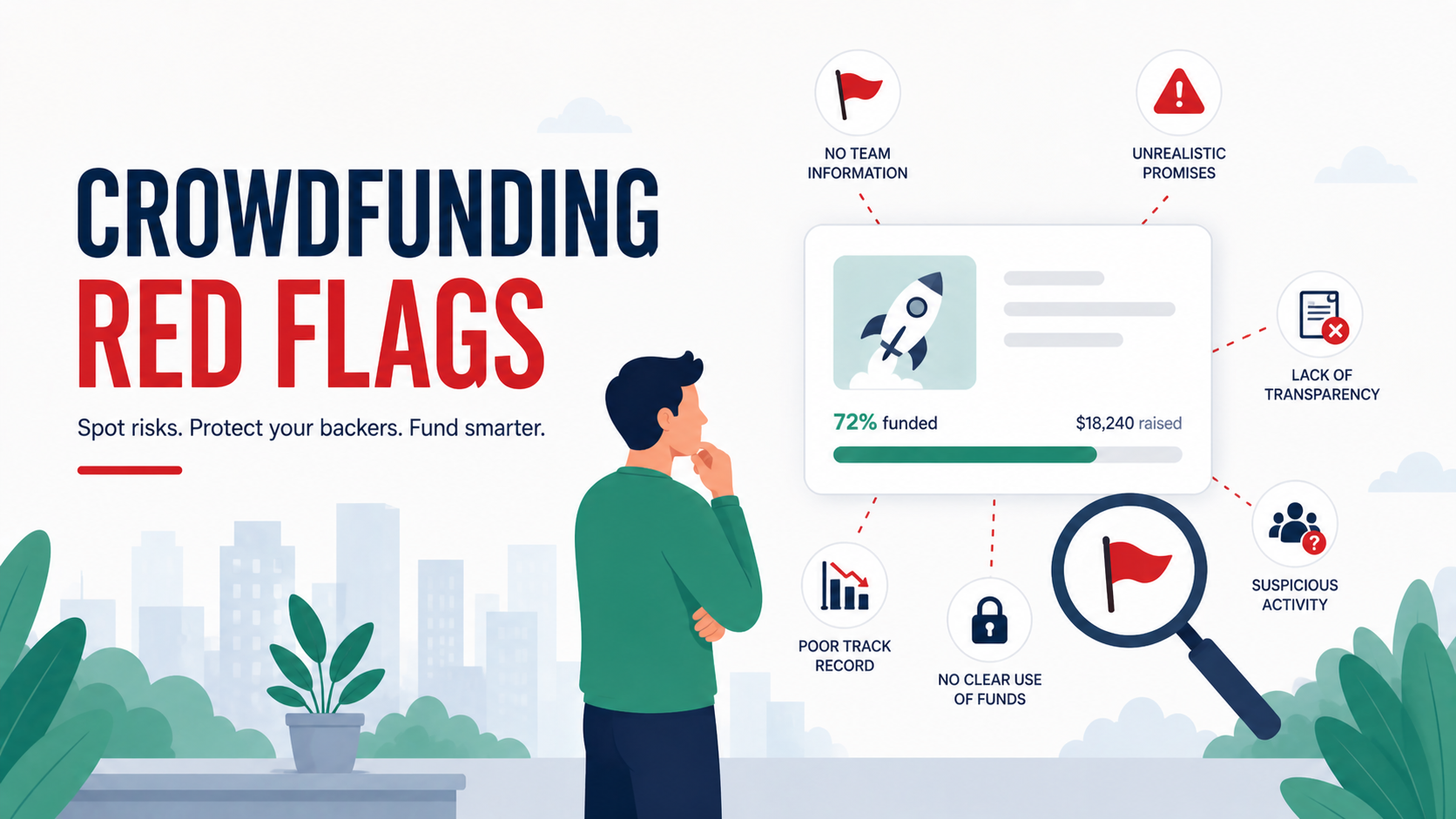
5 Crowdfunding Red Flags Every Backer Should Know Before Pledging
Crowdfunding has a trust problem.
Not with the platforms. Not with payment processing. With the fundamental information gap between the person asking for money and the person deciding whether to give it. A campaign page can be beautifully designed, compellingly written, and completely hollow. The pitch might be genuine, or it might be a polished fiction. Most of the time, backers have no reliable way to tell the difference before they pledge.
The result is a pattern that plays out constantly: a project raises funding, goes quiet after the campaign closes, and delivers months or years late — if at all. Backers lose money. Creators lose credibility. And the crowdfunding space develops a reputation for being a gamble rather than a way to support real work.
The good news: there are concrete signals you can look for before backing anything. Here are five of the most reliable crowdfunding red flags, and what the alternative actually looks like.
Table of Contents
- 1. The campaign is heavy on vision, light on evidence
- 2. No verifiable product history
- 3. The team has no public track record
- 4. Financials are vague or absent
- 5. The creator goes silent between updates
- What accountability actually looks like
1. The Campaign Is Heavy on Vision, Light on Evidence
Every crowdfunding campaign tells a story. The best ones also show proof.
The distinction matters. A campaign page full of concept renders, bold market size claims, and enthusiastic language tells you what a creator wants to build. What it rarely tells you is whether they have already started, how far along they are, or whether anyone has paid for anything yet.
Look for campaigns that anchor their pitch in something real: a working prototype, existing paying customers, a codebase with a commit history, user testing results. Any of these signals that the creator has already put in work and has something concrete to show for it.
If the only evidence on the page is a well-produced video and a funding goal, treat that as a yellow flag. The more polished the presentation and the thinner the underlying proof, the more cautious you should be.
2. No Verifiable Product History
For software and indie dev projects specifically, a public code repository is one of the clearest indicators of genuine work.
A GitHub profile with consistent commit activity over several months tells you the creator shows up. It tells you the project is alive between major announcements. It tells you they are doing the actual work, not just managing a campaign. A creator who has made 300 commits over six months has left an evidence trail that is difficult to fake and easy to check.
Absence of this is a red flag. If a software project has no public repository, no technical changelog, and no documentation of how the product actually works, you are backing a pitch — not a project.
The same logic applies to physical products: look for manufacturing documentation, supplier conversations, or unit economics that show the creator has thought through production at scale. Renders are not evidence. A Bill of Materials is.
3. The Team Has No Public Track Record
Before you back a project, spend five minutes researching the people behind it.
What have they shipped before? Do they have a history of completing projects? Are their professional profiles consistent with the claims on the campaign page? Have they run a crowdfunding campaign before, and if so, what happened to it?
A creator with a completed prior project — even a small one — is meaningfully lower risk than a first-time creator with no public track record. That is not a disqualifier on its own, but it should shift your expectation of risk accordingly.
The bigger red flag is active inconsistency: credentials that do not hold up to a quick search, previous campaigns with unresolved complaints from backers, or team members who are listed but cannot be found anywhere online.
4. Financials Are Vague or Absent
Crowdfunding platforms typically show you a funding goal and a percentage raised. They rarely show you how that number was calculated, where the money will go, or whether the creator already has revenue from other sources.
A creator who is willing to be specific about financials — who breaks down what the funding covers, explains their cost structure, and distinguishes between what they need to ship versus what would accelerate the timeline — is demonstrating a level of seriousness that a vague "we need $50,000 to bring this to life" simply does not.
For software and startup projects, existing revenue is one of the most useful signals available. A project that is already generating income through early access, subscriptions, or direct sales has demonstrated that real people will pay for what is being built. This is fundamentally different from a project that has only ever received funding from backers.
Platforms that surface live revenue data — not just what backers have pledged, but what the creator earns independently — give backers a much clearer picture of the project's actual traction. Fundl does exactly this: creators connect their Stripe account and GitHub repository, and that data appears directly on their campaign page in real time. Backers can see actual revenue alongside development activity, not just the numbers the creator chose to include in their pitch.
5. The Creator Goes Silent Between Updates
Consistency of communication is one of the most underrated signals in crowdfunding.
Pay attention to how a creator behaves before you back them, not just during the campaign. Do they post regular updates? Do they respond to questions from potential backers? Are their updates substantive — showing real progress — or are they brief posts designed to maintain the appearance of activity?
A creator who communicates openly and regularly during the campaign period is demonstrating the behavior you will need from them if something goes wrong after the campaign closes. A creator who is hard to reach before you pledge will almost certainly be harder to reach after.
Look at the comment section and update history carefully. The ratio of questions asked to questions answered tells you a lot about how a creator handles accountability under pressure.
What Accountability Actually Looks Like
The pattern across all five of these red flags is the same: the difference between a credible campaign and a risky one is almost always the difference between claims and evidence.
Good campaigns do not just tell you they are making progress. They show you the commits. They show you the revenue. They show you the cost breakdown. They answer hard questions in public. They treat backers as stakeholders rather than ATMs.
This is not an impossibly high bar. Creators who are genuinely doing the work have the receipts. The commits exist. The revenue data exists. The problem has historically been that crowdfunding platforms were not built to surface this kind of information — they were built to surface stories.
That gap is what platforms like Fundl are designed to close. By requiring creators to connect live data sources — GitHub commit history and Stripe revenue — before their campaign goes live, the platform makes the difference between a serious project and a pitch much harder to obscure. Backers see what is actually happening, not just what the creator wants them to believe.
That is not a guarantee. No platform can make every project succeed. But it puts backers in a substantially better position than a beautifully designed campaign page with nothing behind it.
Conclusion
Backing a crowdfunding campaign is always a judgment call under uncertainty. The goal is not to eliminate risk — it is to make that judgment with better information.
The five red flags above are not a definitive checklist, but they are a useful starting point. Vision without evidence, no verifiable product history, an unverifiable team, vague financials, and irregular communication are all signals worth taking seriously before you pledge.
The most important question to ask about any campaign is simple: what would I need to see to believe this is real? Then check whether the creator has actually shown it.
If you want to explore campaigns that lead with verified data rather than polished pitches, Fundl is built around that principle.