
Description
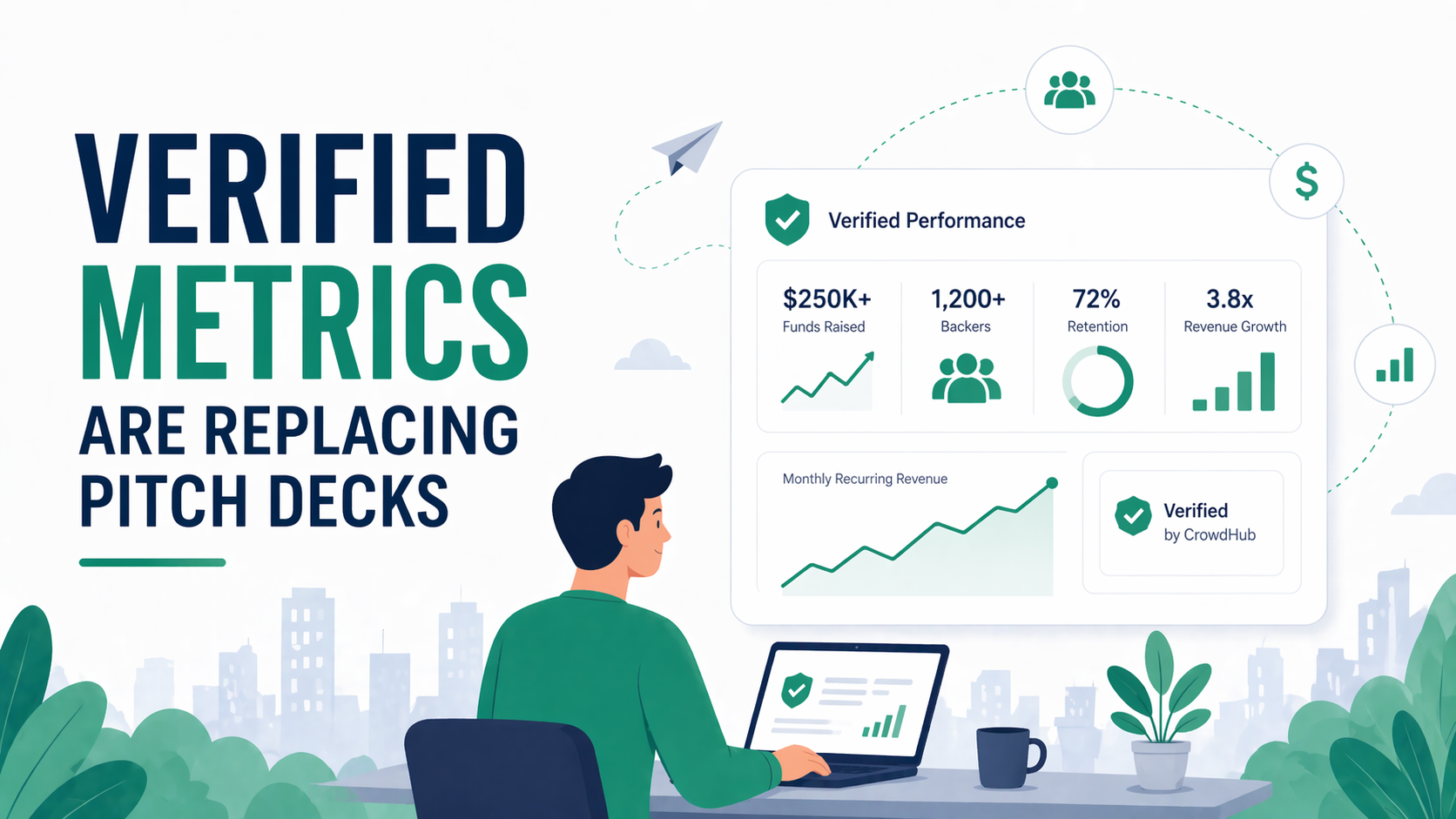
Traditional crowdfunding asks backers to trust a pitch. Verified crowdfunding shows them live data. This guide breaks down how startup crowdfunding works in 2026, why verified metrics are the new standard, and how founders can raise credibly without a VC.
Crowdfunding for Startups in 2026: How Verified Metrics Are Replacing Pitch Decks
The crowdfunding playbook has not changed much since Kickstarter launched in 2009: a founder writes a compelling pitch, backers send money, and everyone hopes for the best. That model produced a lot of funded projects — and a lot of ghost campaigns. Nearly 1 in 10 Kickstarter projects fails to deliver rewards to backers, according to research cited by Entrepreneur, resulting in tens of millions of dollars in backer losses.
The root cause is structural: traditional crowdfunding is built on unverifiable claims. A founder can say they have 200 paying customers and a working prototype. Backers have no way to confirm it.
Verified crowdfunding fixes that. By connecting live data sources — real Stripe revenue, real GitHub commit history — to a campaign page, platforms like Fundl let backers evaluate actual traction before they pledge a dollar. This guide explains how it works, who it is for, and why it is becoming the standard for serious startup fundraising.
Table of Contents
- Description
- Crowdfunding for Startups in 2026: How Verified Metrics Are Replacing Pitch Decks
- Table of Contents
- TLDR
- Why Traditional Crowdfunding Fails Backers
- What Is Verified Crowdfunding?
- How Verified Metrics Work
- Crowdfunding vs. VC: Which Is Right for Your Startup?
- Crowdfunding for Startups: Platform Comparison
- Who Should Use Verified Crowdfunding?
- How to Run a Verified Crowdfunding Campaign on Fundl
- Common Mistakes Founders Make in Crowdfunding
- The Bottom Line
TLDR
- Nearly 1 in 10 Kickstarter campaigns fails to deliver. The problem is unverifiable promises and lump-sum payouts.
- Verified crowdfunding connects live business data (Stripe revenue, GitHub commits) directly to a campaign so backers see real traction — not just a pitch.
- Fundl processes all payments through Stripe and sends donated funds directly to creators, taking a platform fee.
- The global crowdfunding market is on track to reach $11.58 billion by 2032, growing at 7.3% CAGR. Accountability is the gap that still needs closing.
- Verified crowdfunding is best suited to software startups, indie developers, open-source projects, and early-stage SaaS products with real (or early) traction.
Why Traditional Crowdfunding Fails Backers
Kickstarter, Indiegogo, and GoFundMe follow the same basic structure: a creator makes a pitch, backers contribute, and the platform releases the funds in full once the campaign closes. That structure creates a single, critical vulnerability: once the money moves, backers lose all leverage.
The accountability mechanisms are weak by design. Creators can post vague updates, miss deadlines by months, or go silent entirely. DTU Science Park estimates that hardware projects alone have cost backers $26 million in failed deliveries.
Three structural flaws drive these failures:
1. No verification. There is no requirement for a creator to prove their claims. A pitch deck can be aspirational, exaggerated, or outright fictional. Backers fund the story, not the evidence.
2. Lump-sum payouts. Once a campaign closes, the full amount goes to the creator immediately. There is no mechanism to link capital to progress.
3. No recourse. Kickstarter's own documentation acknowledges it cannot guarantee project delivery. Backers filing complaints typically receive nothing back.
These are not edge cases. They are the default outcome for a meaningful percentage of campaigns. Verified crowdfunding was built to address all three.
What Is Verified Crowdfunding?
Verified crowdfunding is a model where creators connect live business metrics to their campaign page before asking anyone for money. Backers see real data — active GitHub commits, Stripe revenue figures — alongside the pitch. The decision to back is based on evidence, not storytelling.
This is how Fundl works. Every creator on the platform connects their GitHub repository and Stripe account during campaign setup. Those live metrics display directly on the project page. A backer can see whether the codebase is actively maintained and whether the product is already generating revenue before they commit a single dollar.
The funds themselves are simple: backers donate via Stripe, the money goes directly to the creator, and Fundl takes a platform fee. No escrow delays, no fund streaming, no complex mechanics. The differentiation is in what backers can see before they decide.
How Verified Metrics Work
Two data sources power Fundl's verification layer.
GitHub Commits
GitHub is the standard repository platform for software projects. Fundl connects directly to a creator's GitHub repository via the GitHub API and pulls live commit data. The campaign page displays recent commit activity — giving backers a real-time view of whether the product is under active development.
What this tells backers:
- Is the team actually building, or just pitching?
- Is there consistent activity over time, or a burst of commits right before a campaign launch?
- Are there multiple contributors, or is this a solo project?
Stripe Revenue
Stripe is the most widely used payment infrastructure for software and SaaS businesses. Fundl connects to a creator's Stripe account (with their permission) and surfaces live revenue data on the campaign page. Backers can see real MRR or total revenue figures — not self-reported numbers, but numbers pulled directly from the payment processor.
What this tells backers:
- Does this product already have paying customers?
- Is revenue growing, flat, or declining?
- Is this a real business or a pre-revenue concept?
Together, these two signals give backers a factual basis for a funding decision that simply does not exist on any traditional crowdfunding platform.
Crowdfunding vs. VC: Which Is Right for Your Startup?
Venture capital and crowdfunding serve different founders at different stages, and the trade-offs are significant.
| Factor | Venture Capital | Verified Crowdfunding (Fundl) |
|---|---|---|
| Who decides | A small group of investors | Your target community |
| Equity required | Yes — typically 10-30% per round | No |
| Access | Invitation-based; heavily networked | Open to any founder |
| Speed | 3-9 months from pitch to close | Weeks |
| Accountability to backers | Quarterly reports, board oversight | Live public metrics |
| Best for | Companies targeting $100M+ exits | Products with a real community or user base |
| Minimum viable traction | Varies; often pre-product for top VCs | GitHub activity + early Stripe revenue strengthens the pitch |
The VC path concentrates power with a small number of decision-makers and requires giving up equity. Crowdfunding distributes the decision to the people who will actually use the product. For indie developers, niche SaaS tools, and community-first products, the crowdfunding path often aligns better with the actual business model.
Crowdfunding for Startups: Platform Comparison
| Feature | Kickstarter | Indiegogo | Fundl |
|---|---|---|---|
| Verified metrics | No | No | Yes (Stripe + GitHub) |
| Payment processor | Proprietary | Proprietary | Stripe |
| Funds to creator | After campaign ends | After campaign ends or via InDemand | Direct |
| Platform fee | 5% + payment processing | 5% + payment processing | Platform fee (transparent) |
| Focus | Creative projects, hardware | General | Startups and indie devs |
| Refund mechanism | Creator discretion | Platform discretion | No refunds |
| Best for | Hardware, games, creative | General campaigns | Software, SaaS, open-source |
The core distinction: Fundl's value is in the metrics layer before the pledge, not in complex fund management mechanics after it.
Who Should Use Verified Crowdfunding?
Verified crowdfunding on Fundl is a strong fit for:
Software founders and indie developers who have an active GitHub repository. Live commit data is your social proof. Show backers the product exists and is being built actively.
Early-stage SaaS products with at least some Stripe revenue. Even $500 MRR displayed on your campaign page signals that real people are paying for your product — a qualifier no pitch deck can replicate.
Open-source projects seeking community backing. GitHub activity is especially meaningful for open-source, where commit history and contributor count tell the whole story.
Founders who want to avoid equity dilution. If you are building a product with a clear path to revenue but do not want to give up ownership at this stage, community crowdfunding with verified metrics gives you a credible alternative.
Verified crowdfunding is a weaker fit for:
- Hardware or physical products (no Stripe revenue until post-production)
- Pre-product ideas with no GitHub activity
- Campaigns that require equity structure (use SEC Reg CF platforms instead)
How to Run a Verified Crowdfunding Campaign on Fundl
1. Connect your metrics first. Before you write a word of your pitch, connect your GitHub repository and Stripe account in your Fundl creator dashboard. These metrics appear live on your campaign page. The stronger your traction, the stronger your campaign.
2. Write a pitch that references the data. Your campaign description should point backers directly to your metrics. If you have 500 commits over six months and $2,000 MRR, say so — and let the live feed confirm it. Data-backed claims are far more persuasive than feature lists.
3. Set a realistic funding target. Set a goal you can explain specifically: what will this capital fund, over what timeline, and what does success look like? Backers with access to your live metrics will hold you to it, so make the case credibly.
4. Promote to your existing community first. Campaigns that reach 30% of their goal in the first 48 hours perform significantly better. Send your campaign to your email list, Discord, GitHub followers, and Twitter before launching publicly. Warm audiences convert better than cold traffic.
5. Keep metrics live. Backers can see your GitHub and Stripe data throughout the campaign and after. Keep building. Keep shipping. The live data is your most compelling ongoing argument.
Common Mistakes Founders Make in Crowdfunding
Launching before there is anything to show. A campaign with zero commits and zero Stripe revenue tells backers you are asking them to fund an idea, not a product. Build first; then raise.
Setting an arbitrary funding target. "$50,000" with no explanation of how it will be used signals poor planning. Break the target into specific, credible line items.
Going dark after the campaign opens. Backers who can see your metrics will notice if your commit rate drops during the campaign period. Stay active.
Treating crowdfunding as marketing. A campaign is a fundraising event, not a product launch. Run your launch as a separate initiative.
Ignoring the community. Respond to backer questions on your campaign page. Backers who feel heard become advocates.
The Bottom Line
Traditional crowdfunding is built on trust: trust that the creator is telling the truth, trust that the platform will enforce its terms, trust that the money will produce something real. That trust is routinely broken.
Verified crowdfunding replaces trust with evidence. When backers can see your Stripe revenue and your GitHub commit history directly on your campaign page, the question shifts from "should I believe this person?" to "does this data support backing this project?"
For startups and indie developers with real traction, that shift is a competitive advantage. Your metrics are your pitch.